|
I will here try to show the story of Earth with
background in Steiner's texts and my own research, where I will try to fill the
gaps. Its a work in progress!
|
|
I will here try to show the story of Earth with
background in Steiner's texts and my own research, where I will try to fill the
gaps. Its a work in progress!
|
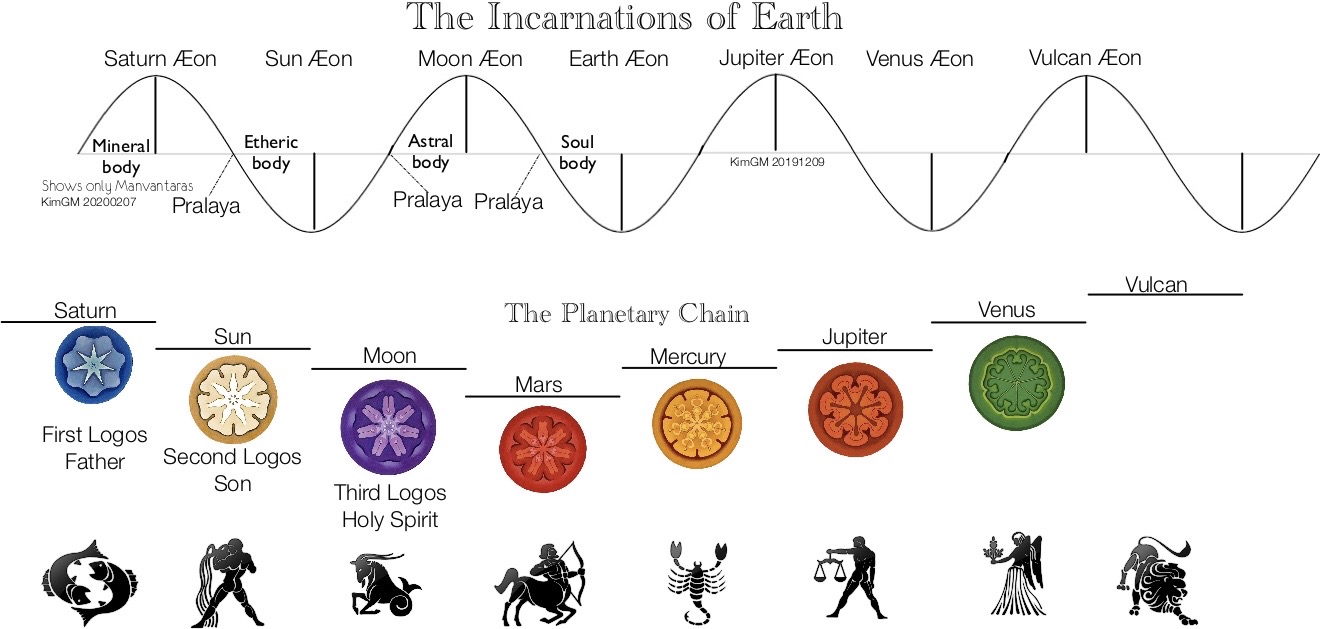
There are three godly creative powers in the universe, the Three Logoi: The First Logos, the Father, was created on the Old Saturn as Atma and the physical matter. The Second Logos, the Son, was created on the Old Sun as Buddhi and the etheric matter. The Third Logos, Sophia, was created on the Old Moon as Manas and astral matter.
The First Logos creates out of nothing, creates Consciousness. The Second Logos creates new Life out of the existing and guides the living. The Third Logos combines the created, the building blocks, the clockwork of microcosm.
Rudolf Steiner have written this text on the three Logoi, but I must admit I didn’t understand the text before I had found out on my own. Its very short, he don’t give any details or examples, and I think it’s one of the deep secrets he have hidden here for us to find, but I think it’s about time it becomes known.
This is the foundation for the true history of God.
From Steiner’s Foundations of Esotericism, lecture 27:
Here we have three definitions of Beings who bring about, who underlie a planetary chain. They are called the three Logoi.
1. The Third Logos produces by means of
combining. [Abel/Seth, the Feminine.]
2. When out of one substance something
else having new life comes into being, this is brought forth by the Second
Logos. [Cain, the Masculine.]
3. Everywhere, however, where we have to
do with a coming forth out of nothing, we have the First Logos. [Adam,
the Father.]
This is why the First Logos is also often called the One who is immanent in things, the Second Logos the One who in the quiescent substance in things creates life out of the living, the Third Logos the One who combines everything existing, who puts the world together out of things.

Drawing by Steiner
These three Logoi always manifest in the
world in and through one another.
…
In contemplating the world one continually sees the interaction of the three Logoi.
When a new creation start, a new Æon, the First Logos sacrifices himself by falling down to a lower level, like an archangel who becomes an angel by adding an etheric body as lower body.
The first logos is related to the second, as when, standing in front of the mirror image, we undertake to give our own life to the mirror image. The surrender of life is the original sacrifice in free action. That is the act of the first logo.
The second logos is exactly the same as the first logos, except that it was given its existence by a sacrifice. If one now studies the effect of the second logos, one finds that the essence of the second logos is that it radiates the essence of the first logos back to the first logos.
Thus, the second logos is a reflection of the first logos from which he received his own life, the life that emanated from the first logos.
The lecture series Foundations
of Esotericism contains gold nuggets not found otherwhere. Not
all
versions of this text is good and contain all the pictures. This I think
contains everything.
The First Logos encircles the creation, the Second Logos enters the reality. The Second Logos splits in two, a female part like Sophia/Eve and a masculine part like Anthropos/Adam, and like a potter the one hand forms the pot from outside and the other from inside the creation.
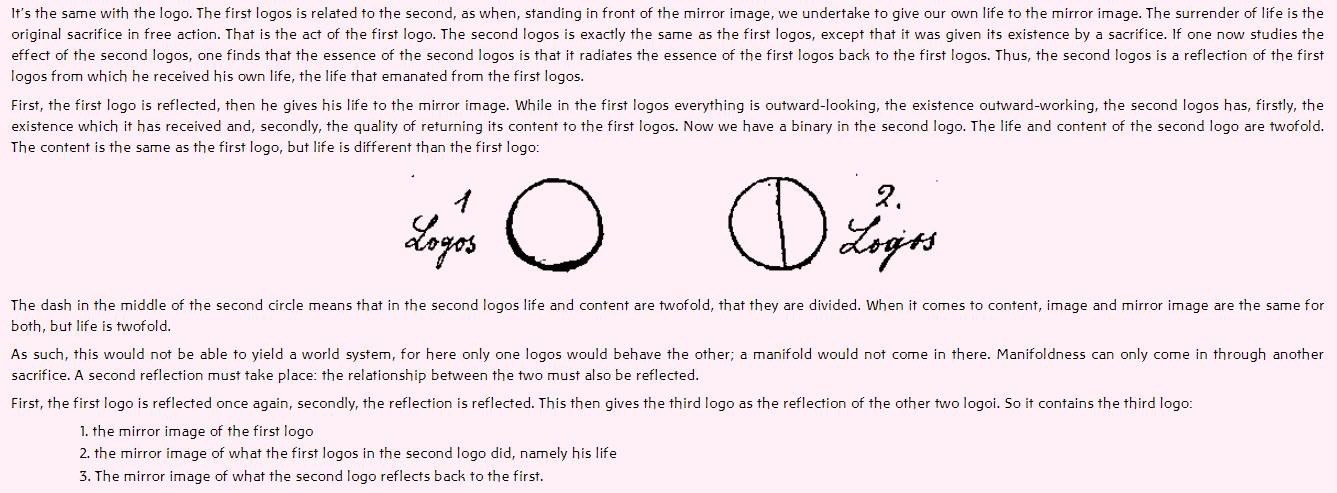
Now we have a binary in the Second Logos. The life and content of the Second Logos are twofold. The content is the same as the First Logos, but life is different than the First Logos.
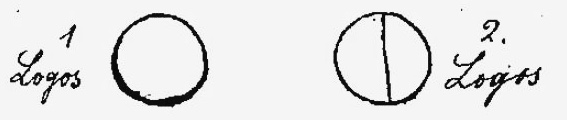
The dash in the middle of the second circle means that in the Second Logos life and content are twofold, that they are divided. When it comes to content, image and mirror image are the same for both, but life is twofold. ~Steiner.
The Third Logos is even more complex to understand. The Third Logos is the physical reality we live in, it’s the physical Earth we see and the reality behind it, the Holy Grail or the Holy Spirit.
First, the First Logos is reflected once again, secondly, the reflection is reflected. This then gives the Third Logos as the reflection of the other two logoi. So it contains the Third logos:
• the mirror image of the First Logos [physical body]
• the mirror image of what the First Logos in the Second Logos did, namely his
life [etheric body]
• the mirror image of what the Second
Logos reflects back to the First Logos. [astral body]
Let us now imagine: The First Logos is mirrored in a. If the First Logos is the creative activity that strives outward, then its reflection in the Third Logos is just the reverse activity of the First Logos. In the First Logos, a is the highest spiritual world light: in the Third Logos, a is the ultimate spiritual darkness.
In the Second Logos, b is the life that the Second Logos received from the First Logos. It is not the life that sacrifices itself, but the one that has been accepted. The life that sacrifices itself in the First Logos is love. The opposite of this in the Third Logos is the absolute desire, longing, striving for logos, b is therefore the absolute desire in the Third Logos.
In the Second Logos c is the mirror image of the First Logos, which reflects the Second Logos.

In our own reflection we distinguish:
• The emitted image coming back, from the darkness.
• What we have surrendered comes back as desire.
• The image itself, which we ourselves are.
This corresponds in the Third Logos to the three parts:
a spiritual darkness= Tamas
b the absolute desire = Rajas
c the simple reflection of the first logo = Sattva
Tamas, Rajas, Sattva are the three gunas, the three parts of the Third Logos. ~Steiner
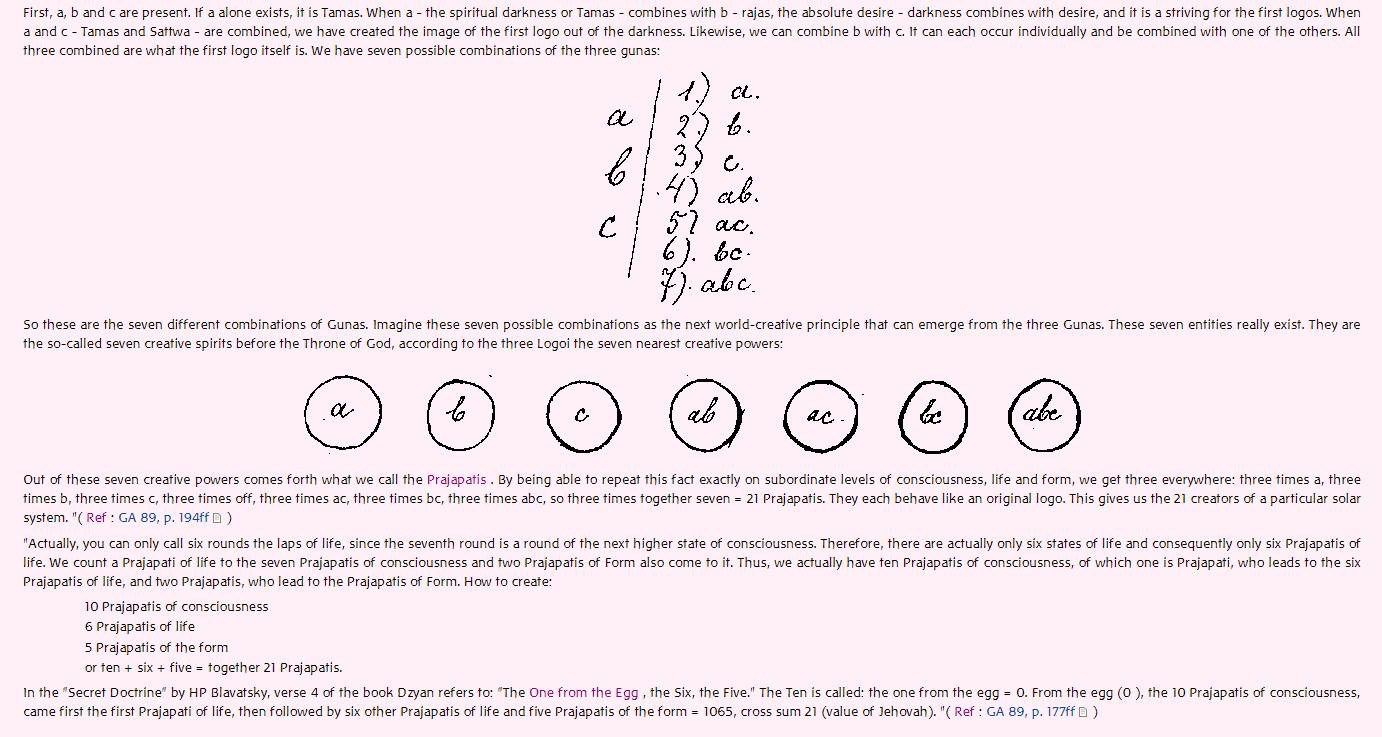
First, a, b and c are present. If a alone exists, it is Tamas. When a – the spiritual darkness or Tamas – combines with b – rajas, the absolute desire – darkness combines with desire, and it is a striving for the first logos. When a and c – Tamas and Sattva – are combined, we have created the image of the first logo out of the darkness. Likewise, we can combine b with c. It can each occur individually and be combined with one of the others. All three combined are what the first logo itself is.
We have seven possible combinations of the three gunas:
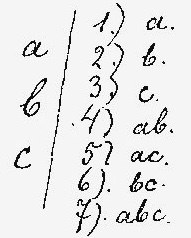
So these are the seven different combinations of Gunas. Imagine these seven possible combinations as the next world-creative principle that can emerge from the three Gunas. These seven entities really exist. They are the so-called seven creative spirits before the Throne of God, according to the three Logoi the seven nearest creative powers:

Seven creative spirits, which Jacob Boehme calls the seven spring spirits in his aurora, spring from the third logos, for all three activities of the third logos can work together, or in pairs two or each: there are seven combinations that appear essential, and of which the one that encompasses all three activities is the third logo itself. Thus, the next level is reached world-creative beings.
This can also be shown as the Alchemist Mountain:
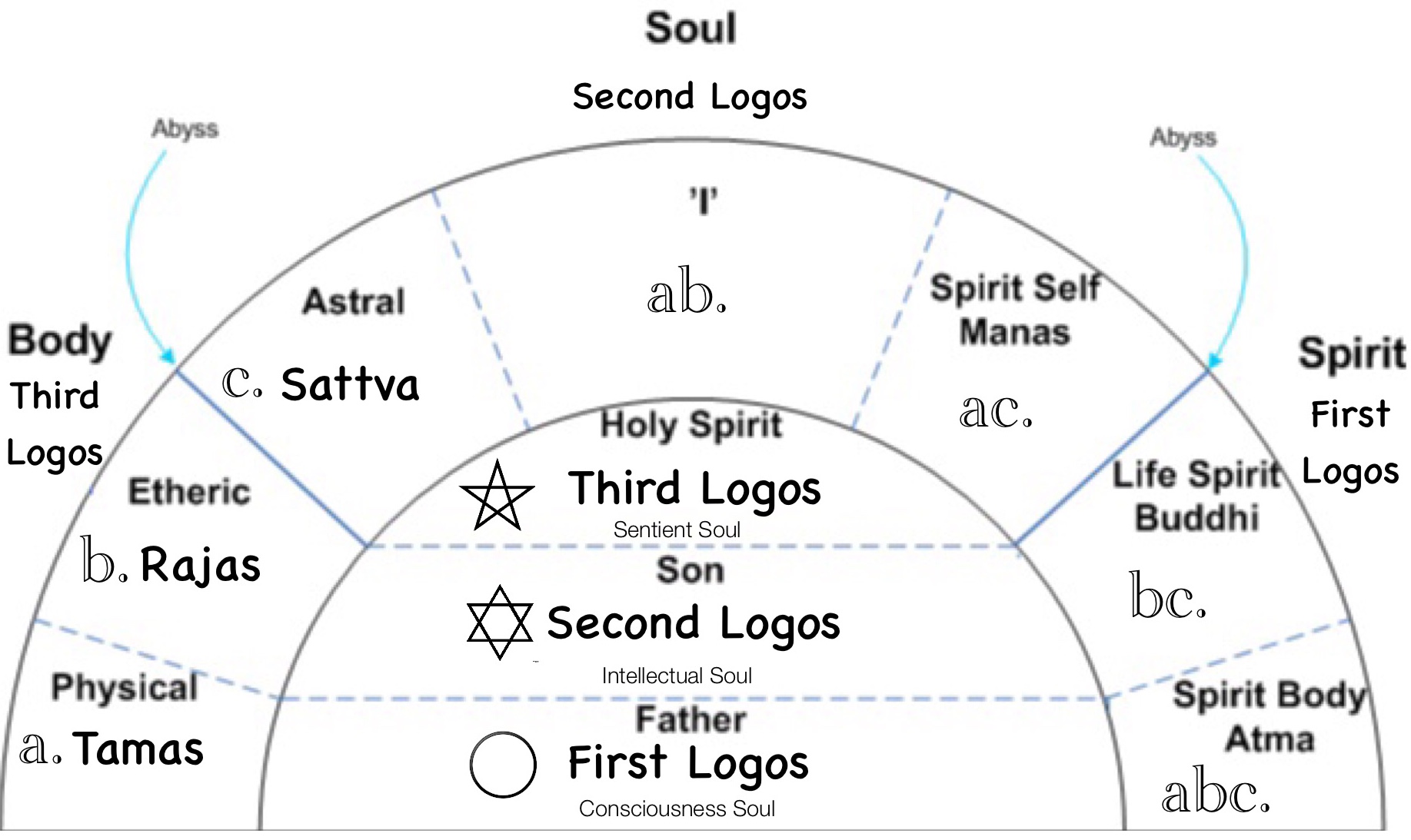
I have used a drawing of Steiner to show this information. It’s a versatile diagram that can be used to show many aspects of man, gods and the universe. It corresponds to the seven lowest sephira in the Kabbalah Tree of Life.
In the old Saturn æon the seed of the physical body and Atma was created. This is the Father. In the old Sun æon the seed of the etheric body and Buddhi was added too. This is the Son. On the old Moon the seed of the astral body and Manas was added too. This is the Holy Spirit.
The astral is the most flexible layer, most conscious, and therefore easier to transform. The etheric layers consciousness is not as flexible so it’s less easy to transform. And the physical layer is the least flexible and therefore most difficult to transform. Atma need all three layers (abc) to develop before it can be developed, and the consciousness soul is the channel developed.
Development of the spiritual bodies:
ab • The soul is the result of the work between the physical (a)
and etheric body (b).
ac • The Spirit Self or Manas is the result of the experiences of the physical body (a)
transforming the karma of the astral (c).
bc • Life Spirit or Buddhi is our wisdom, the result of the transformation of our etheric body (b)
our opinions by the speculative thinking of the astral body (c).
abc • Spirit Body or Atma is the result of the transformation of the physical (a)
by the work of the Etheric (b)
and the astral (c).
The astral is the most flexible layer, most conscious, and therefore easier to transform. The etheric layers consciousness is not as flexible so it’s less easy to transform. And the physical layer is the least flexible and therefore most difficult to transform.
Through the work in the physical and the etheric we create the soul. Through the work in the physical and astral we create Manas, develop the higher I. Through the work in the Etheric and Astral we create Buddhi, wisdom. Through the work in a, b and c we create Atma, the resurrection body.
Adam is created in the Beginning by the Word. He is the mineral being and the transformed mineral, Atma. This is the First Logos. Out of Adam comes Eve, the Second Logos, a projection of Sophia, Buddhi or wisdom.
Eve's masculine side is Cain, the Etheric, who are the Son of God, the archetypal human, in whose footsteps humanity walks. He enters the physical world, are the active creator, the Word, who we also know as Yahve, Yaldebaroth, Vishnu, and many more, who develop life on Earth from the smallest cells to the human body used by Jesus.
Abel is the Son of Man, the Third Logos we know as Jesus, he is a reflection of Adam and Eve, the Second Logos. Krishna is his first apperance on Earth, but in the etheric 'blue' form, his first physical incarnation is as Jesus, the Son of Man.
Abel is the Descending Force and Cain the Ascending Force. From The Cosmic Christ and the Zodiac - Viśvákarma:
At the entry of the ‘I’ [I AM], the ascending [Anthropos] and the descending [Sophia] forces were in balance [Anthroposophia] and it rests with man to turn the scales in the right direction.
Seth is the Abel being, not as part of God, as in Krishna, but as an individual, who give the astral body to humankind and helps humankind develop the astral body. The incarnation of Lucifer.

What do we know about these three, what does the tradition tell about them? Cain is the Son of God, where Abel is the Son of Man. Cain is cast down onto the Earth. The name Cain, means smith or metal smith, but resembles the verb translated as 'gotten' or 'to make'. Abel stays back, just as Rudolf Steiner says about the Nathan Jesus. The name of Abel in Hebrew is composed of the same three consonants as a root meaning "breath". Breath meaning spirit, the breath of God.
Cain is of the masculine line ascending from the physical, Anthropos, where Abel is of the feminine line descending from the spiritual, Sophia. Cain tended vegetables, the etheric principle and Abel tended sheep, animals, the astral principle.
From Steiner: The Temple Legend, Lecture 2, the Contrast Between Cain and Abel.
Abel is the same as ‘pneuma’ in Greek, which means ‘spirit’, and if we look at that from the point of view of sexuality, it denotes a decidedly female character. Cain, on the other hand, means almost literally ‘the masculine,’ so that in Cain and Abel the masculine and feminine principles confront one another. Not yet on an organic level: they tend to differentiate on a spiritual level.
Now I would ask you to hold that fast in your minds. Originally mankind was male-female. Later on it was divided into a male and a female gender [the differentiation first came about in the Seth period]. The male, the more material race, was represented in Cain, the female, the more spiritual, in Abel-Seth. A differentiation has occurred. That is symbolised in the words: ‘Abel was a keeper of sheep, but Cain was a tiller of the ground.’ (Genesis 4, 2)
Abel have two sisters. This is an interesting information as it is a pattern that we will find again, as family, lovers or friends.
From Sacred Texts
Cain was a twin, for with him was born a girl
 ; and Abel was one of three, for with him came two girls
 .--Gen. Rabba 22.
From Wikipedia
Various early commentators have said that Cain and Abel have sisters, usually twin sisters. According to Rabbi Joshua ben Karha as quoted in Genesis Rabbah, "Only two entered the bed, and seven left it: Cain and his twin sister, Abel and his two twin sisters."
A prominent Mesopotamian parallel to Cain and Abel is the Sumerian myth of the Courtship of Inanna and Dumuzid, in which the shepherd Dumuzid and the farmer Enkimdu compete for the affection of the goddess Inanna, with Dumuzid (the shepherd) winning out. Another parallel is Enlil Chooses the Farmer-God, in which the farmer-god Emesh and the shepherd-god Enten bring their dispute over which of them is better to the chief god Enlil, who rules in favor of Enten (the shepherd).
According to Midrashic tradition, Cain and Abel each had twin sisters; each was to marry the other's. The Midrash states that Abel's promised wife, Aclima, was more beautiful. Since Cain would not consent to this arrangement, Adam suggested seeking God's blessing by means of a sacrifice. Whoever God blessed would marry Aclima. When God openly rejected Cain's sacrifice, Cain slew his brother in a fit of jealousy and anger.
Seth is who Steiner calls the Luciferic incarnation, now the astral entered the Earth. He brought the wisdom of the God, he should help humankind, the Cain line, up again.
From Wikipedia
In gnosticism, Seth is seen as a replacement given by God for Abel, whom Cain had slain. It is said that late in life, Adam gave Seth secret teachings that would become the kabbalah. The Zohar refers to Seth as "ancestor of all the generations of the tzaddikim" (Hebrew: righteous ones).
In the Antiquities of the Jews, Josephus refers to Seth as virtuous and of excellent character, and reports that his descendants invented the wisdom of the heavenly bodies, and built the "pillars of the sons of Seth", two pillars inscribed with many scientific discoveries and inventions, notably in astronomy.
Some sources say that Seth was the receiver of scriptures. These scriptures are said to be the "first scriptures" mentioned in Q 87:18. Medieval historian and exegete al-Tabari and other scholars say that Seth buried Adam and the secret texts in the tomb of Adam, i.e., the "Cave of Treasures".
Within Islamic tradition Seth holds wisdom of several kinds; knowledge of time, prophecy of the future Great Flood, and inspiration on the methods of night prayer.
What is the main characteristics of Seth? He incarnated when man had worked himself deeply into the physical world, as a connection between God and man. Cain had developed his physical and etherical body, he should now develop his astral body, raise up to God again. Seth had the astral body with him, the last third element of the human body. The astral functions as a connection betwenn the gods (soul) and the etheric body. The astral body is the gift of Lucifer.
Seth is the exoteric teacher of man, the Light
Bringer, who should Help man up from
the physical again.
Incarnated much later than Cain.
Clairvoyant and magician.
Is an emanation of Abel on Earth.
This puzzle piece is not so clear as the previous two, but it shouldn't be impossible to find a number of candidates, a perfect example would be Enkidu/Eabani, but also King Solomon, the wisest man in the old Testament. Gilgamesh, who had worked himself up from the physical depth to become the most developed being, could be Cain, just as the temple-builder Hiram Abiff could. There is both cooperation between these two but there is also chivalry.
Seth and Cain streams gives names to two streams between which humanity develops, what’s after the crucifixion is known as the Aristotelian and Platonic streams. Seth is the exoteric teacher who keeps mankind in connection with the outer gods. Cain leads mankind down into the physical world until Golgotha, from there he becomes the esoteric teacher of mankind, helping man to raise in their inner.

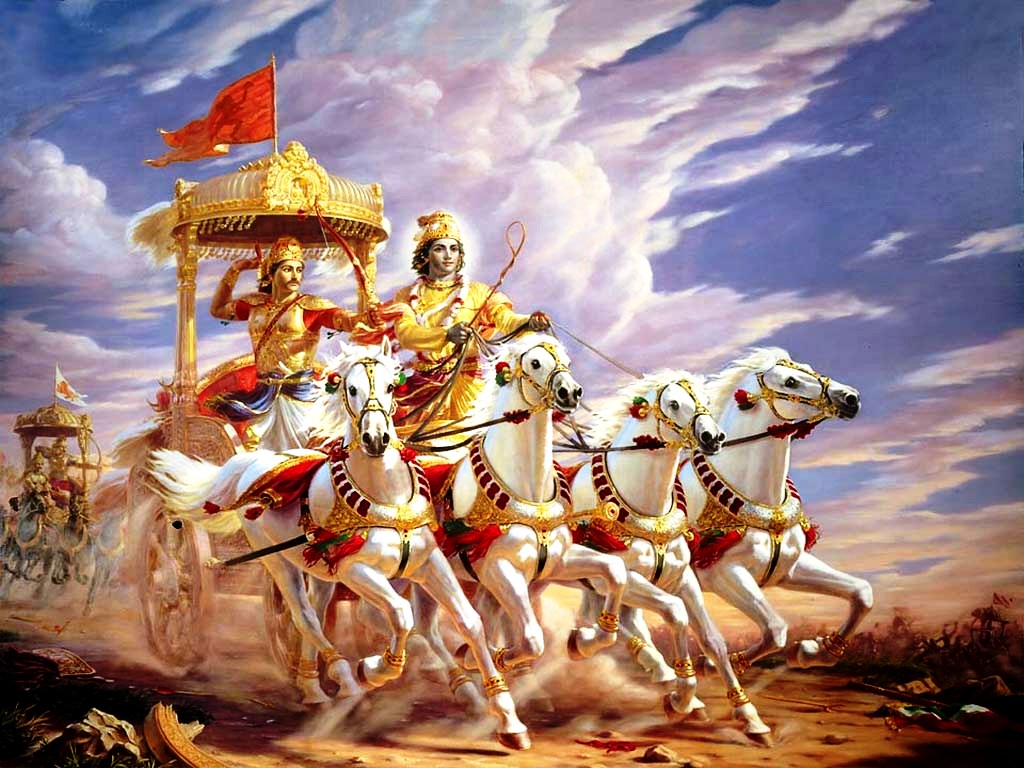 Krishna tells Arjuna that he should be his tool on Earth, that Krishna wouldn't take
active part
in the physical world, but will work through Arjuna. Through inspiration and the wheel of fate
he will lead Arjuna, make his endeavors successful.
Krishna tells Arjuna that he should be his tool on Earth, that Krishna wouldn't take
active part
in the physical world, but will work through Arjuna. Through inspiration and the wheel of fate
he will lead Arjuna, make his endeavors successful.
In the vision of Krishna, Arjuna sees himself as a mighty being. He is the Son of God. Cain.
Arjuna is the Son of God,
the right hand of God,
the archetypal Hero.
It should be possible to find good candidates. Alexander the Great is the mightiest and most influential hero the Earth have seen, working together with fate he wins all his wars without loss. His campaign changes the face of Earth forever, he creates culturel streams between East and West, and he creates an incarnational stream from East to West through the wars. No other person fits the description of Arjuna as good. Socrates is a good candidate too, although not as spectacular, he changed the western world, he was the first I conscious being, a true personality.
In the Old Testament Jacob have a dream that reminds very much about the Vision of Arjuna, so a hypothesis that Jacob is the same as Arjuna is near. He is helped by his mother/Sophia to take the leading part from his brother, Esau, who are an Enkidu/Seth incarnation. Jacob who are the new I-being should replace the old clairvoyance of Esau/Enkidu/Seth being.
From https://wn.rsarchive.org/GA/GA0233/19231226d01.html
Gilgamesh and Eabani confront the the Goddess Ishttar and take control of the city. She sends down the Bull of Heaven which Gilgamesh overcomes. But Eabani dies in the conflict.
Then Steiner shares out of the Akasha that Eabani stays united with Gilgamesh and Inspires him from the Spiritual world. Eabani henceforth lives in his will.
Gilgamesh travels to a colony of The Atlantean(Hibernian) Sun Mysteries and there they Initiate Gilgamesh and he ingests Planetary Medals and is kept awake for 7 days and nights, Steiner is sharing this so that it lands in the room that Ita Wegman is the re-incarnated Gilgamesh and he (Steiner) is the re -incarnated Eabani.
He is laying the foundation for an understanding that from this point on, that the two will incarnate together in each subsequent incarnation. He is revealing his and Her Karma openly to these members. He will go on an share other incarnations of the 2 of them. Those that are relevant to World History an Anthroposophy...
True Occult research of The Akasha reveals the story of Gilgamesh and Eabani. They set the foundation for the coming 3rd Post Atlantean Epoch, The Egyptian(2909 BC-747BC).
Something New was born into Earth evolution through Eabani and Gilgamesh. Friendship(Agape).
Gilgamesh was a Conquerer while Eabani still possessed the old Clairvoyance. He was a young Soul having recently come down into Earth life after journeying long in The Planetary spheres.
Gilgamesh had many incarnations and Eabani few. The old natural Clairvoyance was fading and Gilgamesh was one of the first to start having individual thoughts.
He came into conflict with the Priests and Priestess' of The Ishtar Mysteries in Erech but not before a Temple Priestess lured Eabani to the Temple and Initiated him into The Mysteries of The Feminine!
The Temple brought down The Bull of Heaven and Eabani died in the conflict. But something strange occured. Eabani stayed united with Gilgamesh.
He it was who inspired him to go on a journey in search of Immortality. Gilgamesh travels far to the West, right into Europe and finds a colony of the Hibernian Mysteries in the Burgenland .
There He is Initiated and Planetary Metals given to Him to keep him awake for 7 days and 7 nights. Gilgamesh see's into the Spiritual World the workings of the 7 Planetary Archangels and comes to Knowledge of the Path between Death and Rebirth all the while united in Spirit with Eabani.
This Wisdom was brought back to Ur in Chaldea and developed into the Great Pyramid building Culture of Egypt in it's search for Knowledge of where the Dead go?
See more on Gilgamesh, Enkidu and the vastly underrated Shamhat: Enki, Enkidu and Gilgamesh.


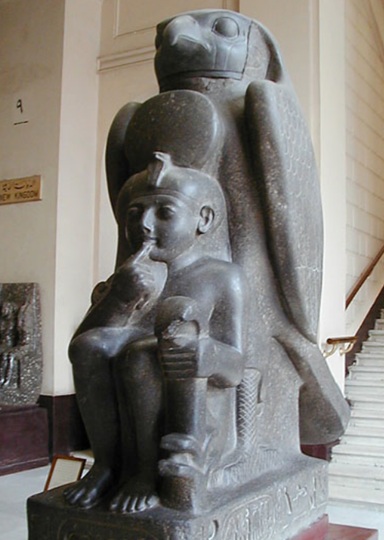 The picture I want to call up in your minds is that behind the whole evolutionary and historical process, through the millennia up to our own times, spiritual Beings, spiritual
Individualities, stand as guides and leaders behind all human evolution and human happenings, and that in the greatest, most significant events in history, this or that human being appears with his whole soul, his whole being, as an instrument of spiritual
Individualities standing and working with set purpose behind him. But we must familiarise ourselves with many a concept unknown in ordinary life if we are to gain insight into the strange and mysterious connections between earlier and later happenings in the course of history.
The picture I want to call up in your minds is that behind the whole evolutionary and historical process, through the millennia up to our own times, spiritual Beings, spiritual
Individualities, stand as guides and leaders behind all human evolution and human happenings, and that in the greatest, most significant events in history, this or that human being appears with his whole soul, his whole being, as an instrument of spiritual
Individualities standing and working with set purpose behind him. But we must familiarise ourselves with many a concept unknown in ordinary life if we are to gain insight into the strange and mysterious connections between earlier and later happenings in the course of history.

When we go back before the thousand. years preceding the Christian era we must reckon with the fact that wherever we have to do with historical personalities, higher Individualities, higher Hierarchies stand behind and take possession of these personalities — in the best sense of the word, of course.
When we go back from the Greco-Latin to the Egyptian epoch we must change our whole way of studying history: instead of looking at the purely human aspect — which it is still possible to do in connection with the figures of the Greek world as far back as the age of the Heroes — we must now apply a different criterion by looking behind the single personalities for the spiritual Powers which represent the super-personal and work through the personalities as their instruments. We must have These spiritual Individualities always in mind, so that working behind some human being an the physical plane we can discern discern a Being of the higher Hierarchies who, as it were, takes hold of him from behind and sets him at the appropriate place in evolution.
From this point of view it is highly interesting to perceive the connections between the really significant happenings — those which were determinative factors in the course of history — in the Egypto-Chaldean epoch and in the Greco-Latin epoch. These two culture-epochs follow one another, and to begin with we go back, let us say to the years from 2800 to 3200–3500 B.C. — which comparatively speaking is not so very far. Nevertheless we shall not understand happenings then — of which ancient history is already able to tell something to-day — unless behind the historical personalities we discern the higher Individualities.
There was once a great king, by name Gilgamish. From the name itself, one who understands such matters will recognise that here we have to do not merely with a physical king, but with a divinity standing behind him, a spiritual Individuality by whom the king of Erech is inspired, who works and acts through him. Thus we have to do with one who in the real sense must be called a god-man ["Two-thirds of him (Gilgamish) are divine, and one-third of him human. ... " meaning that he had sentient and intellectual soul, but not consciousness soul.]
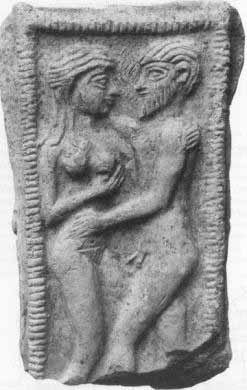 The Goddess of the City produces Eabani out of the earth.
Eabani is a kind of human being who, in comparison with Gilgamish, seems to be of an inferior nature, for we are told that he was clothed in the skins of animals, was covered with hair, was like a wild man. Nevertheless in his wild nature there was divine Inspiration, ancient clairvoyance, clairvoyant knowledge, clairvoyant perception.
The Goddess of the City produces Eabani out of the earth.
Eabani is a kind of human being who, in comparison with Gilgamish, seems to be of an inferior nature, for we are told that he was clothed in the skins of animals, was covered with hair, was like a wild man. Nevertheless in his wild nature there was divine Inspiration, ancient clairvoyance, clairvoyant knowledge, clairvoyant perception.
Under the impression of what he has experienced, he becomes conscious for the first time of the thought that man is mortal; a thought to which he had previously paid no heed comes before his soul in all its terror. And then he hears of the only man of earth who has remained immortal, whereas all other human beings in the Post-Atlantean epoch have become conscious of mortality: he hears of the immortal Xisuthros ["The exceedingly wise," Uta-Napishtim, Noah, Adam] far away in the West. And because he is resolved to fathom the riddle of life and death, he sets out on the perilous journey to the West.
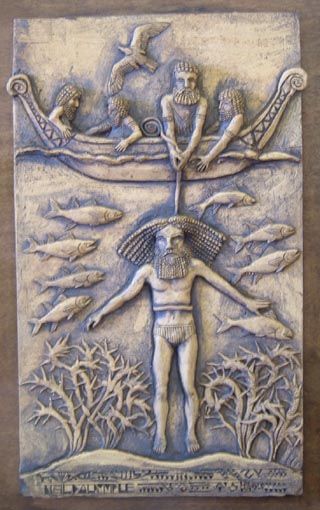 Gilgamish now asks Xisuthros whence he has knowledge of his eternal being; how comes it that he is conscious of immortality? Thereupon
Xisuthros says to him: “You too can have this consciousness, but you must undergo all that I had to experience in overcoming the terror, anxiety and loneliness through which it was my lot to pass. When the god Ea had resolved to let perish” (in what we call the Atlantean catastrophe) “that part of humanity which was to live no longer, he bade me to withdraw into a kind of ship. I was to take with me the animals that were to remain, and those
Individualities who are truly to be called the Masters. By means of this ship I outlived the great catastrophe.”
Xisuthros then tells Gilgamish: “What was there undergone, you can experience only in your innermost being; but you can attain the consciousness of immortality if for seven nights and six days you refrain from sleep.”
Gilgamish wishes to submit to the test but soon falls asleep.
Gilgamish now asks Xisuthros whence he has knowledge of his eternal being; how comes it that he is conscious of immortality? Thereupon
Xisuthros says to him: “You too can have this consciousness, but you must undergo all that I had to experience in overcoming the terror, anxiety and loneliness through which it was my lot to pass. When the god Ea had resolved to let perish” (in what we call the Atlantean catastrophe) “that part of humanity which was to live no longer, he bade me to withdraw into a kind of ship. I was to take with me the animals that were to remain, and those
Individualities who are truly to be called the Masters. By means of this ship I outlived the great catastrophe.”
Xisuthros then tells Gilgamish: “What was there undergone, you can experience only in your innermost being; but you can attain the consciousness of immortality if for seven nights and six days you refrain from sleep.”
Gilgamish wishes to submit to the test but soon falls asleep.
Then the wife of Xisuthros baked seven mystic loaves which by being eaten are to be a substitute for what would have been attained in the seven nights and six days without sleep. With this “life-elixir” Gilgamish continues his journeying, bathes as it were in a fountain of youth, and again reaches the borders of his own country in the region of the Euphrates and the Tigris.
A serpent deprives him of the power of the life-elixir and so he reaches his country without it, but all the same with the consciousness that there is indeed immortality, and filled with longing to see the spirit at least, of Eabani. The spirit of Eabani appears to him, and from the discourse which then takes place we can glean how, for the culture of the Egypto-Chaldean epoch, a consciousness of the link with the spiritual world could arise. — This relationship between Gilgamish and Eabani is very significant.
I have now outlined pictures from the significant myth of Gilgamish which, as we shall see, will lead us into the spiritual depths lying behind the Chaldean-Babylonian culture-epoch. These pictures show that two individualities stand there: the individuality of one — Gilgamish — into whom a divine-spiritual being has penetrated; and an individuality who is more of a human being, but of such a nature that he may be called a young soul, who has had few incarnations and for that reason has carried over ancient clairvoyance into later times — Eabani.
Eabani is depicted as being clothed in skins of animals. This is an indication of his wild nature; but because of this very wildness he is still endowed with ancient clairvoyance an the one hand, and an the other hand he is a young soul who has lived through far, far fewer incarnations than other souls who have reached a high level of development.
Thus Gilgamish represents a being who was ready for initiation but was not able to attain it, for the journey to the West is the journey to an initiation that was not carried through to the end. On the one side we see in Gilgamish the actual inaugurator of the Chaldean-Babylonian culture, and working behind him a divine-spiritual Being, a kind of Fire-Spirit [Archangeloi, Gilgamish is said to mean: " The Fire-god is a commander."]
And beside Gilgamish there is another individuality — Eabani — a young soul who descended late to earthly incarnation. If you read the book Occult Science, you will find that the individualities returned only gradually from the planets. — The exchange of the knowledge possessed by these two is the root of the Babylonian-Chaldean culture, and we shall see that the whole of this culture is an outcome of what proceeds from Gilgamish and Eabani.
Clairvoyance from the divine man [old soul,] Gilgamish, and clairvoyance from the young soul, Eabani, penetrate into the Chaldean-Babylonian culture. This process, enacted by two beings working side by side, each of whom is necessary to the other, is then reflected in the later, fourth culture-epoch, the Greco-Latin, and in fact reflected on the physical plane.
In "Christ and the Spiritual World: The Search for the Holy Grail" Lecture 3 Steiner wrote:
"Let us recall what is described in Occult Science — how from the Lemurian Age onwards souls gradually came down from the other planets (with the exception of one principal human pair who had stayed on earth) and were incarnated in human bodies throughout Atlantean times." See Old Souls in the History of Earth.
A later incarnation of Gilgamesh is as Alexander the Great, born in Pella 356 BC a few years after Socrates is dead, about 399 BC. Cratylos
Gautama Buddha was the teacher of mankind that incarnated again and again all over the world, like the bodhisattva Sig, representing Odin, but in many many others too. Buddha represented the Angelic hierarchy that didn't raise when they moved from the old Moon to Earth and Krishna represented the Angelic beings that raised at the end of the old Moon, who were without 'I'. Krishna worked through Buddha and others on Earth.
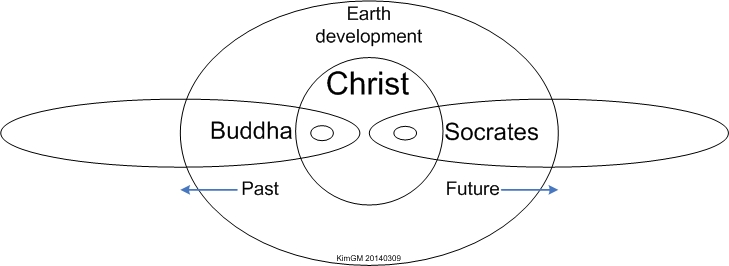
Now Socrates took over as teacher of mankind, incarnating again and again as the former teacher had. He was the teacher of the new development period. Steiner calls Socrates a personality, meaning that he had a perfect 'I', and his teaching was about using the thinking of the 'I'. The rest of mankind had only a rudimentary 'I', was about to start the development of the 'I'.
This is a very interesting drawing, not often mentioned in Anthroposophic circles, but it is a key for much knowledge. Buddha's ellipse goes back to the middle of the old Moon period and Socrates ellipse goes forward to the middle of the new Jupiter period:
"Thus there is one stream of human development that goes as far as the Buddha and ends with him; and there is another stream that begins with Socrates and goes on into the distant future. Socrates and the Buddha stand next to one another like the nuclei of two comets, if I may be allowed such an image. In the case of the Buddha, the light-filled comet's tail encircles the nucleus and points far back into the indeterminate perspectives of the past; in the case of Socrates the comet's tail of light encircles the nucleus in the same way but points far, afar into the indeterminate distances of the future. Two diverging comets going in succession in opposite directions whose nuclei shine at the same time . . . Half a millennium passes, and something like a uniting of these two streams comes into being through Christ Jesus."
Steiner in Gospel of Mark: Lecture 4
Cratylos, the friend of Socrates, incarnates shortly after his death as Aristotle, and Socrates may incarnate shortly after his death as Alexander.

The above picture is related to the infinity symbol:
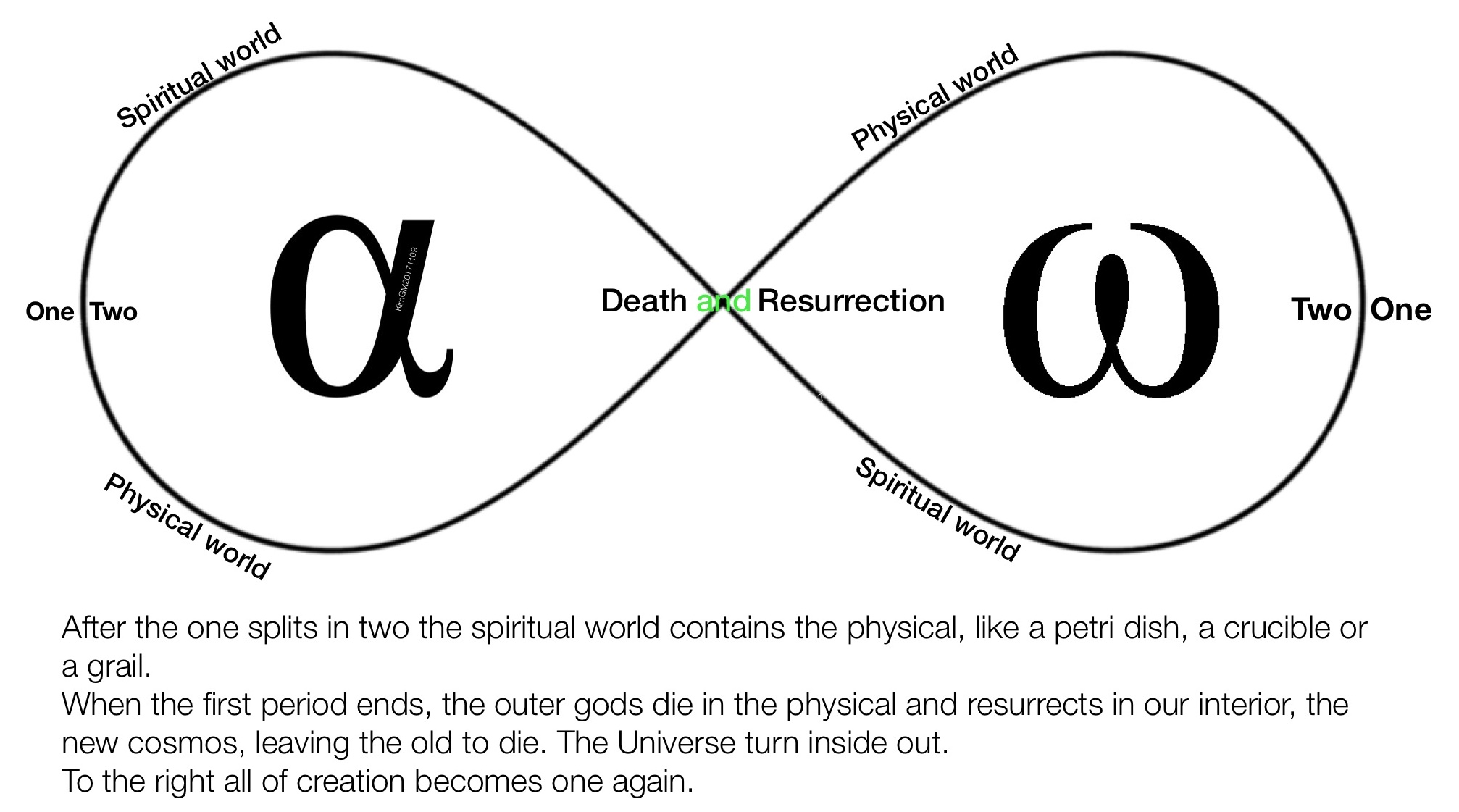
Infinity Symbol - Lemniscate
Repeating again and again through the æons like:

The Platonic stream should have been named after Socrates, just as the Aristotelian stream should have been named after Alexander, as it really was Alexander that changed the world, but the spiritual world always hides it's traces.
Gilgamish, then, was a personality who, owing to his particular condition of soul, participated in the most progressive spiritual elements and spiritual factors of the age — in everything that threw light far into the future and at that time could be attained only if such a personality went through a kind of initiation. Through the imparting of something that can be received only through a certain initiation, Gilgamish was to be enabled to provide a kind of leaven for the Babylonian culture. He had to experience an initiation up to a certain degree.
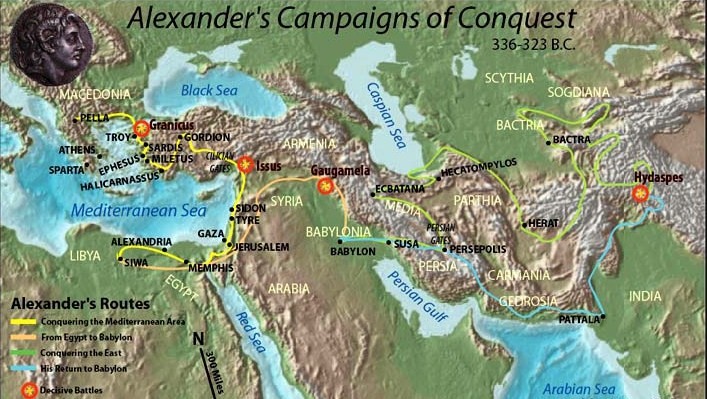
Alexander was anointed as pharaoh in Memphis on 14 November 332 BC, they named him the 'son of the gods' according to traditions dating back almost 3,000 years, interestingly enough the Olympias' called him the son of Zeus. It was not symbolic, it was a grand son of God that was on Earth.
His campaigns of conquest started the karmic movements, until then karma was within tribes, now karma was between countries, from Pakistan to Mideteranian Sea. He created Alexandria, that colledted people and knowledge from everywhere, and saved it against total destruction by the first barbarian Christianity.
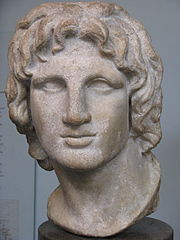 |
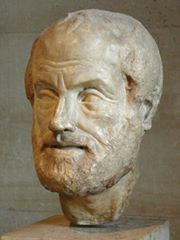 |
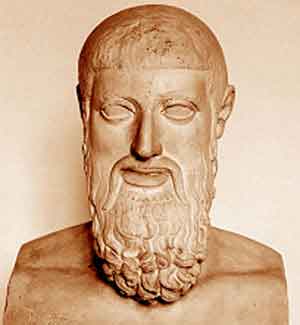
| Alexander the Great | Aristotle |
And on the very same day when a man, merely in order that his name might go down to posterity, throws the burning brand into the sanctuary of Ephesus, there is born the man who has achieved more than all others for the culture of personality — and on the very soil where the culture of mere personality was meant to be overcome.
Herostratus flings the burning torch on the day when Alexander the Great is born — the man who is all personality! Alexander the Great stands there as the shadow-image of Gilgamish. A profound truth lies behind this. In the Greco-Latin epoch, Alexander the Great stands there as the shadow image of Gilgamish, as a projection of the spiritual on to the physical plane. And Eabani, projected on to the physical plane, is Aristotle, the teacher of Alexander the Great.
Here indeed is a strange circumstance: Alexander and Aristotle standing, like Gilgamish and Eabani, side by side. And we see how in the first third of the fourth Post-Atlantean epoch there is carried over, as it were, by Alexander the Great but transformed into the laws of the physical plane — that which had been imparted to the Babylonian-Chaldean culture by Gilgamish.
This comes to wonderful expression in the fact that, as a result of the deeds of Alexander, there was established at the scene of Egypto-Chaldean culture Alexandria itself, the city founded by Alexander in 332 B.C. in order that the great achievements of the Egypto-Babylonian-Chaldean culture-epoch might be brought together in one centre. And gradually all the streams of Post-Atlantean culture that were intended to come together did indeed converge on Alexandria, the city established an the scene of the third culture-epoch but with the character of the fourth.
And it is impossible to conceive that the culture of Alexandria which was built entirely on the foundation of personality — could have been inaugurated in any other way than through the being who was inspired by personality — Alexander the Great. For now, through the very existence of this centre of culture, everything that formerly was super-personal, extending from the human personality upwards into the spiritual world, assumed a personal character.
The personalities we find in Alexandria; have, as it were, everything within themselves; the Powers from higher Hierarchies who guide the personalities and set them in their allotted places, are very little in evidence. All the sages and philosophers working in Alexandria seem to be embodiments of ancient wisdom transformed into human personality; it is the personal element that speaks out of them.
The singular fact is that everything in ancient Paganism that could be explained only by the teaching of how gods came down and united with daughters of men in order to bring forth heroes — all this is transformed into personal forcefulness in the men in Alexandria.
And it is there that to begin with, Christianity appears, shall we say, in a distorted, debased state of infancy. Christianity, whose real function is to lead the personal element in man upwards into the impersonal, made its appearance in Alexandria in a very ruthless form.
But in Alexandria a sign and token was to stand before the whole evolution of humanity. There again we have a projection on the physical plane of earlier, more spiritual conditions.
In the Orphic Mysteries of ancient Greece there was a wonderful personality, one who was initiated in the Mystery-secrets and was among the most loveable, most interesting pupils of these Mysteries, well prepared by a certain Celtic occult training undergone in earlier incarnations. This individuality sought with deepest fervour for the secrets of the Orphic Mysteries.
The pupils of these Mysteries had to live through in their own soul what is described in the myth of Dionysos Zagreus, who was dismembered by the Titans but whose body was carried away by Zeus into a higher life. How, as the result of a certain path taken in the Mysteries, man's life is surrendered to the outer world, how his whole being is torn in pieces so that he can no longer find his bearings within himself — this was to become an actual, individual experience in the pupils of the Orphic Mysteries.
 Among the pupils of the Orphic Mysteries was the loveable
personality of whom I am speaking, whose earthly name has not come down to posterity, but who stands out clearly as a pupil of these Mysteries. Already in youth and then for many years, this person was closely connected with all the Greek Orphics during the period preceding that of Greek philosophy — a period of which no account is given in books and the history of philosophy. For what is recorded of
Thales and Heraclitus is an echo of what the Mystery-pupils had accomplished in their way at an earlier period. And one of the pupils of the Orphic Mysteries was the individual of whom I have just spoken, whose pupil in turn was
Pherecydes of Syros, referred to in the lecture-course given at Munich last year:
The East in the light of the West. [Chapter IV]
Among the pupils of the Orphic Mysteries was the loveable
personality of whom I am speaking, whose earthly name has not come down to posterity, but who stands out clearly as a pupil of these Mysteries. Already in youth and then for many years, this person was closely connected with all the Greek Orphics during the period preceding that of Greek philosophy — a period of which no account is given in books and the history of philosophy. For what is recorded of
Thales and Heraclitus is an echo of what the Mystery-pupils had accomplished in their way at an earlier period. And one of the pupils of the Orphic Mysteries was the individual of whom I have just spoken, whose pupil in turn was
Pherecydes of Syros, referred to in the lecture-course given at Munich last year:
The East in the light of the West. [Chapter IV]
Investigation of the Akasha Chronicle reveals that the individuality of that pupil of the Orphic Mysteries was reincarnated in the 4th century A.D. We find this individuality amid the activity and life of those gathered together in Alexandria, the Orphic secrets now transformed into personal experiences of the loftiest kind. It is very remarkable how all the Orphic secrets were transformed into personal experiences in this new incarnation.
 |
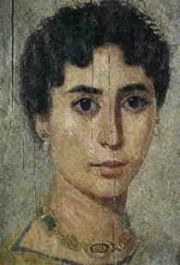 |
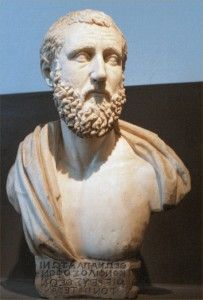
| Theon of Alexandria | Woman from the time of Hypatia |
At the end of the 4th century, A.D., we find this individuality reborn as the daughter of a great mathematician, Theon. We see how there flashes up in her soul all that could be experienced of the Orphic Mysteries through vision of the great mathematical, light-woven texture of the universe. All this was now personal talent, personal genius. These faculties had now to be of so personal a character that it was necessary even for this individuality to have a mathematician as father in order that something might be received from heredity.
Theophilus and Cyril were both filled with the deepest hatred of everything that was not Christian in the narrow ecclesiastical sense in which these two bishops, in particular, understood it. Christianity had assumed in them such an entirely personal character that these two patriarchs levied hirelings in their service; men were collected from far and near to form bodyguards for them. Their aim was power in its most personal sense. They were utterly obsessed by hatred of what originated in ancient times and yet was so much greater than the new that was appearing in caricatured shape. The deepest hatred was directed by the dignitaries of Christianity in Alexandria against the individuality of the reborn Orphic pupil. The fact that she was branded as a black magician will not therefore surprise us. But that was enough to incite the whole mob of hirelings against the noble, unique figure of the reborn pupil of the Orphic Mysteries.
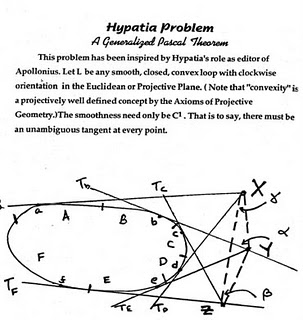 She was still young, but in spite of her youth, in spite of the fact that
she was obliged to undergo much that in those days, too, imposed great hardships
on a woman during a long period of study, she found her way upwards to the light that outshone all the wisdom, all the knowledge existing in those days. And it was wonderful how in the lecture halls of
Hypatia — for such was the name of this reincarnated Orphic pupil — the purest, most luminous wisdom in Alexandria was presented to the enraptured listeners.
She was still young, but in spite of her youth, in spite of the fact that
she was obliged to undergo much that in those days, too, imposed great hardships
on a woman during a long period of study, she found her way upwards to the light that outshone all the wisdom, all the knowledge existing in those days. And it was wonderful how in the lecture halls of
Hypatia — for such was the name of this reincarnated Orphic pupil — the purest, most luminous wisdom in Alexandria was presented to the enraptured listeners.
She drew to her feet not only the Pagans, bat also Christians of deep and penetrating insight, such as Synesius. She was an influence of outstanding significance, and the revival of the old Pagan wisdom of Orpheus transformed into personality could be experienced in Alexandria in the figure of Hypatia.
World-karma was working in the truest sense symbolically. What had constituted the secret of her Initiation was now projected, mirrored, on the physical plane. And here we come to an event that is symbolically significant in the case of many things that have taken place in historical times. We come to one of those events that is seemingly only a martyrdom, but is in reality a symbol in which spiritual forces, spiritual intimations are coming to expression.
On a day in March in the year 415 A.D., Hypatia fell victim to the fury of these who formed the entourage of the patriarch of Alexandria. They resolved to rid themselves of her power, of her spiritual power. The utterly uncivilised, wild hordes were rushed in from the environs of Alexandria as well, and the chaste young sage was fetched away under false pretences. She mounted the chariot, and at a given sign the enflamed rabble fell upon her, tore off her clothing, dragged her into a church, and literally tore the flesh from her bones. The fragments of her body were then scattered around the city by these hordes, completely dehumanised by their rapacious passions. Such was the fate of the great woman philosopher, Hypatia.
Symbolically, so to say, there is indicated here something that is deeply connected with the founding of Alexandria by Alexander the Great — although it happened a long time after the actual founding of the city. In this event, important secrets of the 4th Post-Atlantean epoch are reflected. This epoch, destined as it was to represent the dissolution, the sweeping-away, of the old, contained so much that was great and significant, and with paradoxical grandeur placed before the world a most pregnant symbol in the slaughter — one can call it nothing else — of Hypatia, the outstanding woman at the turn of the 4th-5th centuries of our era.
In the introductory lecture yesterday our attention was drawn to the fact that certain events in the more ancient history of mankind can be rightly understood only when we not merely observe the forces and faculties of the personalities themselves, but when we realise at the outset that through the personalities in question, as through instruments, Beings are working who allow their deeds to stream down from higher worlds into our world.
We must realise that these Beings cannot take direct hold of the physical facts of our existence because, on account of the present stage of their development, they cannot incarnate in a physical Body which draws its constituents from the physical world.
If, therefore, they desire to work within our physical world, they must make use of the physical human being — of his deeds, but also of his intellect, his powers of understanding. We find the influence and penetration of such Beings of the higher world the more clearly in evidence the farther back we go in the ages of the evolution of humanity.
But it must not be imagined that this downpouring of forces and activities from the higher worlds into the physical world through human beings has ever ceased; it continues even into our own time.
In the last sentences of The Education of the Human Race, Lessing has actually expressed what is described by Anthroposophy on the basis of occult facts — namely, that souls who lived in ancient epochs and then absorbed active, living forces, carry over these forces into their new incarnations, so that behind physical happenings there is not an abstract onflow of ideas but an actual and real onflow of the spirit.
The conception of the historical evolution of humanity has lost much of the earlier, spiritual insight, and Spiritual Science will really have to guard against the onslaught of materialistic thinking which comes from all sides and regards communications which are based on the spiritual facts as so much lunacy.
One would like to remind students of Spiritual Science particularly, that it is possible to prove on purely external grounds that spiritual powers, spiritual forces have worked through human beings right up to our own century — and this quite apart from the purely occult, esoteric research with which we shall be mainly concerned here.
Anyone who gains a little insight into the development of modern humanity, let us say in the 14th and 15th centuries and on until the 16th, will realise how infinitely significant in this outer development was the intervention of a certain personality, one in respect of whom it can be proved from completely external evidence that spiritual, super-sensible powers worked through her.
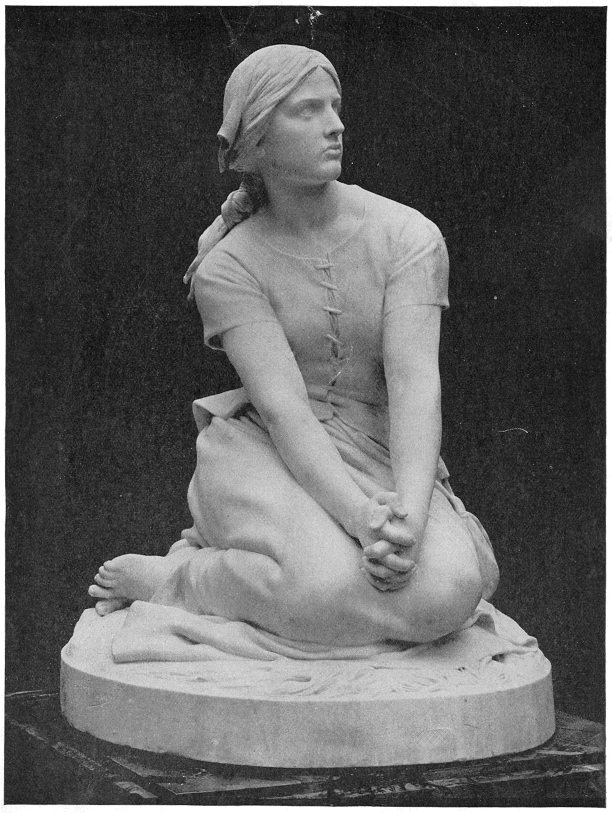
In order to throw a little light on the occult understanding of history, we may ask the question: What would the development of modern Europe have been if at the beginning of the 15th century the Maid of Orleans had not entered the arena of events?
Anyone who thinks, even from an entirely external point of view, of the development that took place during this period, must say to himself: Suppose the deeds of the Maid of Orleans were erased from history ... then, according to the knowledge obtainable from purely external historical research, one cannot but realise that without the working of higher, super-sensible Powers through the Maid of Orleans, the whole of France, indeed the whole of Europe in the 15th century, would have taken on an altogether different form.
Everything in the impulses of will, in the physical brains of those times, was directed towards flooding all Europe with a general conception of the State which would have extinguished the folk-individualities and under this influence a very great deal of what has developed in Europe during the last centuries through the interplay of these folk-individualities would quite certainly have been impossible.
Imagine the deed of the Maid of Orleans blotted out from history, France abandoned to her fate without this intervention, and then ask: Without this deed, what would have become of France? And then think of the role played by France in the whole cultural life of humanity during the centuries following! Add to this the facts which cannot be refuted and are confirmed by actual documents concerning the mission of the Maid of Orleans.
This young girl, certainly not highly educated even by the standards of her time, suddenly, before she is twenty years old, feels in the autumn of 1428 that spiritual Powers of the super-sensible worlds are speaking to her. True, she clothes these Powers in forms that are familiar to her, so that she is seeing them through the medium of her own mental images; but that does not do away with the reality of these Powers. Picture to yourselves that she knows that super-sensible Powers are guiding her will towards a definite point — I am speaking to begin with, not of what can be told about these facts from the Akasha Chronicle, but only of what is confirmed by documentary evidence.
Who intervened at that time in the course of history? — None other than Beings of higher Hierarchies! The Maid of Orleans was an outer Instrument of these Beings, and it was they who guided the deeds of history.
After the writer of this letter has set forth what the Maid of Orleans accomplished, he continues:
“This and much more has the Maid brought about, and with God's help she will accomplish still greater things. The girl is of appealing beauty and manly bearing; she speaks little and shows remarkable sagacity; when she speaks she has a pleasing, delicately feminine voice. She eats little and abstains from wine. She takes pleasure in fine horses and weapons and admires well-accoutred and noble men. To be obliged to meet and converse with large numbers of people is abhorrent to her; her tears often overflow; she loves a happy face, endures unheard of toil, and is so assiduous in the manipulation and bearing of weapons that she remains uninterruptedly for six days — day and night — in full armour. She says that the English have no right to France, and therefore — as she says — God has sent her to drive them out and conquer them, but only after previous warning. For the King she shows the deepest veneration; she says he is beloved by God, is under special protection, and will therefore be preserved. Of the Duke of Orleans, your nephew, she says that he will be delivered in a miraculous way, but only after a demand for his release has been made to the English who hold him prisoner.
“With that, revered Duke, I bring my report to a conclusion. Still more wonderful things are happening and have happened than I can write of or describe to you in words. While I write this, the afore mentioned Maid has already gone to the neighbourhood of the city of Rheims in Champagne, whither the King has hastily set off for his anointing and crowning under God's protection. Most respected and powerful Duke, and greatly venerated master! I commend myself to you in all humility, while praying the Almighty to protect you and fulfil your desires. Written at Biteromis, the 21st day of June in the year 1429.
Your humble servant
PERCEVAL
Lord of Bonlaninth.
Counsellor and
Chamberlain of the King of the French
and of the Duke of Orleans,
Seneschal of
Berry.”
This counsellor of the king with the interesting name Perceval, who stands by Jeanne Darc, who is he?
This letter was written by one who knew the Maid and was in close contact with the King. It is indeed amazing when one discovers all these things on purely occult grounds and with occult means of proof — for they are indeed to be found in the Akasha Chronicle — and then sees how, in cases like this, actual historical documents can also be produced. In short, it seems almost madness to doubt what was working through the Maid of Orleans.
And when we also take into consideration the fact that through her deeds the whole history of modern time assumed a different aspect, this gives us the right to say that here, verified by documentary evidence, we can see the direct intervention of the super-sensible worlds.
When the spiritual researcher goes further and seeks in his own way for the one who was the real Inspirer of the Maid of Orleans, he finds something very remarkable as he investigates the successive epochs of time. He finds that the same Spirit who worked through the Maid of Orleans as his instrument at that time had inspired — in a quite different form, a quite different way — another personality who was a philosopher at the Court of Charles the Bald. This was Scotus Erigena, through whose philosophical and theological ideas in an earlier period Europe had been so deeply influenced. And so we see that the same Powers work in different epochs in a different way through human beings who are their instruments; that there is continuity, an onflowing stream of happenings in what we call history.
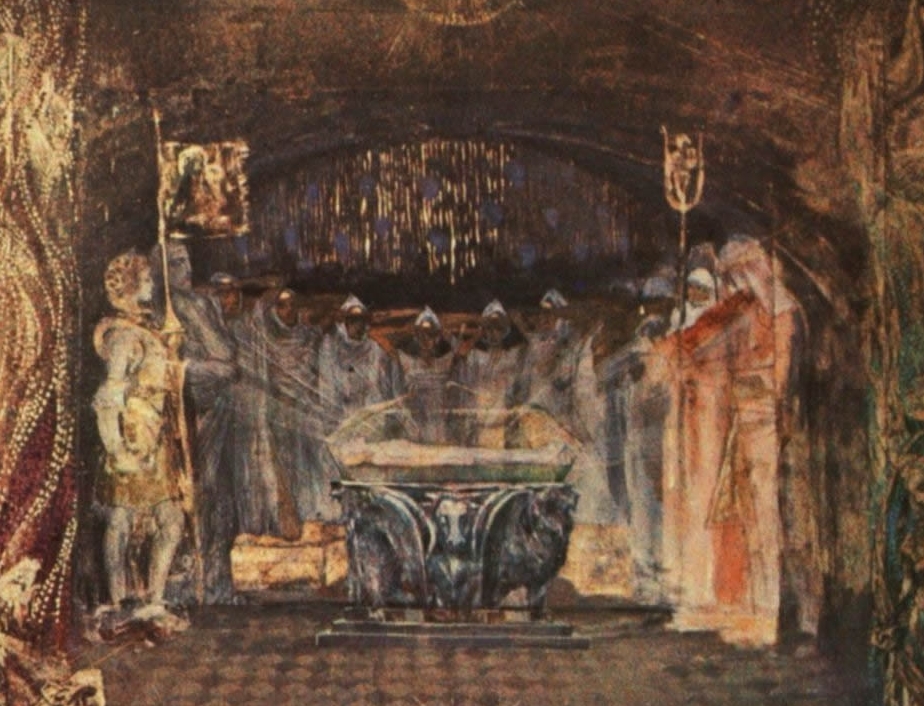
This shows the initiation of Christian Rosenkreutz.
To the left Jeanne Darc,
who lived after Christian Rosenkreutz.
So why have Rudolf Steiner put her
into the picture?
I showed you yesterday how a significant myth of Babylonian-Chaldean times points to the penetration of the spiritual worlds into men upon whom much depended for the third Post-Atlantean period, for the whole of historical development in ancient Chaldea, in ancient Babylonia.
But we must now also observe from the standpoint of occult science the two personalities hidden behind the legendary names of Gilgamish and Eabani. In the Sense of occult history we have to see in them personalities who stand at the starting-point of the Babylonian-Chaldean epoch of culture. The impulses proceeding from them are to be discerned again in the development of the really spiritual culture of ancient Babylonia and Chaldea. — Now Gilgamish was a personality who had many incarnations behind him and may therefore be called an “old” soul within the evolution of humanity.
You know from the book Occult Science that during the Lemurian epoch of earth-evolution only very few human beings had outlasted, on the earth itself, the happenings of this evolution, that only a few remained on the earth during the Lemurian epoch; that before the actual danger of the mummification of everything human began, the majority of souls withdrew from the earth to other planets, continuing their life on Mars, Saturn, Venus, Jupiter, arid so forth.
Then, from the end of the Lemurian epoch and during the Atlantean epoch, these souls gradually came down to the earth in order to incarnate in earthly bodies under the changed earthly conditions, and to appear in ever new incarnations.
Thus there are souls who came down comparatively early from the planetary worlds and others who came down late; indeed not until the later periods of Atlantean evolution.
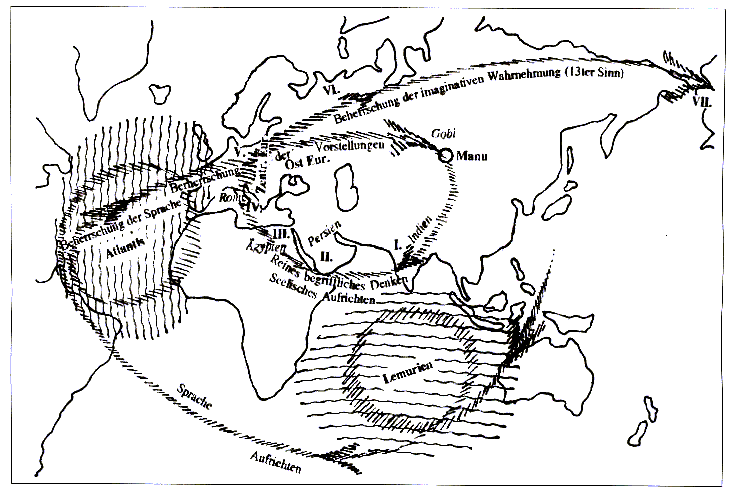

The souls who came down early have therefore more incarnations behind them in earth-evolution than those who came down later; hence we can call these latter, in contrast to the former, “younger” souls — souls who have taken less into themselves.
The individuality hidden behind the name Gilgamish was an old soul, and a younger soul was incarnated in Eabani, at the starting-point of the Babylonian civilisation. Indeed, in connection with human souls being younger or older in this sense, something very remarkable discloses itself — something that might almost be said to cause astonishment even to the occultist.
If someone has reached the point to-day of giving a little credence to the truths of Spiritual Science, but otherwise still clings to the prejudices and criteria of the external world, it will seem plausible to him that modern philosophers or scholars, for example, should be accounted among the older souls. But, strangely enough, occult research finds just the opposite; and for the occultist himself it is surprising to find that in Kant, for example, there lived a young soul.
In this sense, in Eabani we have to do with a young soul and in Gilgamish with an old soul in ancient Babylonia. The whole nature of an old soul will enable it early in life to grasp not only the essential element, the essential factor, in the existing culture, but also that which strikes into it as a new impulse, opening up a wide vista into the future.
Gilgamish, then, was a personality who, owing to his particular condition of soul, participated in the most progressive spiritual elements and spiritual factors of the age — in everything that threw light far into the future and at that time could be attained only if such a personality went through a kind of initiation. Through the imparting of something that can be received only through a certain initiation, Gilgamish was to be enabled to provide a kind of leaven for the Babylonian culture. He had to experience an initiation up to a certain degree.
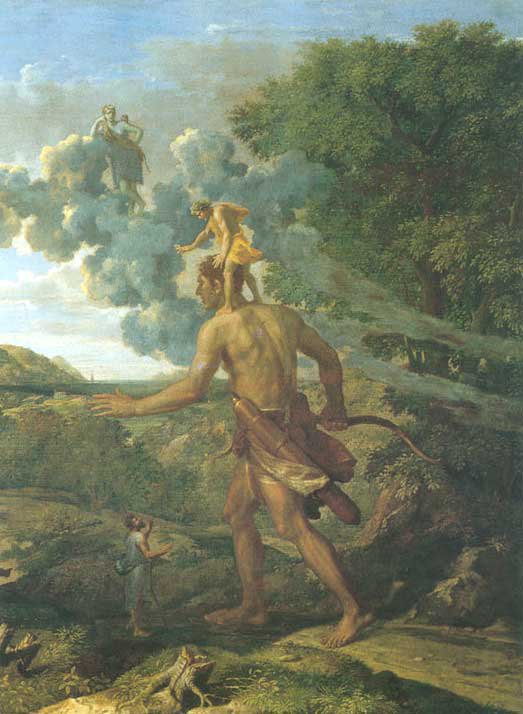 Let us think of this Gilgamish at the point where he stood in the evolution of humanity before this initiation. He was a man of the third Post-Atlantean epoch. But in this epoch twilight had already fallen over the natural human clairvoyance, over what men were able to achieve through forces that were innate in them. These forces were no longer present to the degree that could enable any great number of men to look back into their earlier incarnations. If we were to go farther back, into the second or into the first Post-Atlantean epoch, we should find that the majority of human beings then on the earth could look back into their earlier incarnations, into the course of their soul-life before their present birth. But that faculty had been lost.
In the case of Gilgamish, the Being who was to reveal himself through him, and who could do so only by leading him presently to a kind of initiation, kept a guiding hand upon him from the outset and set him at the place where he came to recognise his own position in the history of the world.
As it were through super-sensible events, presented to us in the pictures of the myth I outlined to you yesterday, a friend was placed at the side of Gilgamish, a friend whose barbarity and uncivilised nature are indicated by the statement that his outer form was half animal. It is said that this friend had skins of animals on his body, which means that he was still covered with hair like the men of primeval times, that his soul was so young that it built for itself a body which showed the human being still in a savage state. Thus the more advanced Gilgamish had in Eabani a man at his side who, because of his young soul and the bodily Organisation conditioned by it, still possessed ancient clairvoyance.
This friend was given to Gilgamish in order that he might find his own bearings in life. With the help of this friend he was then able to achieve certain things, such as the retrieval of that spiritual Power presented to us in the myth in the picture of Ishtar, the Goddess of the city of Erech. I told you how this Goddess had been stolen by the neighbouring City and that for this reason Gilgamish and Eabani together waged war against this city, vanquished its king and brought the Goddess back.
Gilgamish now realised that in human life, especially in times of transition, there is such a thing as is described in the legend of the blind man and the cripple: each is helpless alone, but together they can make progress inasmuch as the blind man carries the cripple on his shoulders and the cripple lends the blind man his power of sight. In Gilgamish and Eabani, whose respective gifts differed so greatly, we see the same kind of co-operation transformed into the spiritual.
He found, for example, that in these incarnations his soul had had unusual friendships, human connection, of a kind which in his present life he would have regarded as shameful. Thus, in face of what the City Goddess had revealed to him indirectly, through Eabani, he began in a certain way — as the myth indicates — to upbraid, to reproach his own soul.
In the myth it is said that he reproaches the Goddess about her lovers, for he is jealous of them. He is looking as it were across the horizon of his own soul and the visions are living realities before him, as real as human beings who stand around someone in the physical world, eliciting feelings of sympathy or antipathy towards them. In the reproaches leveled by Gilgamish against the Goddess we perceive that he is really speaking in terms of what is happening in his own soul.
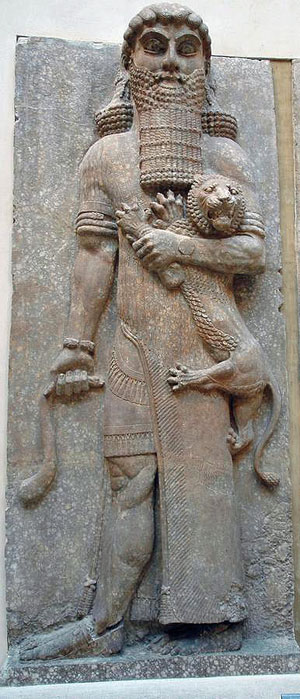 The myth tells that and this, his spiritual journeying,
Gilgamish was brought to the great Atlantean Being, Xisuthros, This was a Being who belonged to certain higher Hierarchies and who during the Atlantean time lived in the sphere of humanity but was afterwards transported from the world of men to dwell in higher regions.
The myth tells that and this, his spiritual journeying,
Gilgamish was brought to the great Atlantean Being, Xisuthros, This was a Being who belonged to certain higher Hierarchies and who during the Atlantean time lived in the sphere of humanity but was afterwards transported from the world of men to dwell in higher regions.
Gilgamish was to meet this personality in order that through beholding him he might come to know the condition of souls when they are able to look into the spiritual worlds. Thus he was to be led upwards again into the spiritual spheres by being transported in his life of soul into Atlantean times.
And when he is bidden not to sleep for seven nights and six days, this signifies nothing else than an exercise which was to make the soul capable of penetrating fully into the corresponding spiritual regions. When we are now told that he was not able to endure the test, Isis again signifies something of great importance, namely that Gilgamish is represented as a personality who was brought to the very brink of Initiation — who was destined, as it were, to look through the portal of Initiation into the mysteries of the spirit but owing to the conditions of the times was not able to penetrate fully into their depths. In short, this is intended to indicate that the inaugurator of the Babylonian civilisation had remained at the portal of Initiation, that he could not look with full clarity into the higher worlds, with the result that he gave Babylonian culture the stamp that is a sign of no more than a glimpse into the secrets of Initiation.
We shall now see that the nature of external Babylonian culture was indeed such that it confirms what has just been said. Whereas, for example, everything points to the fact that Hermes was a personality who gazed into the very depths of the holiest secrets of Initiation and could therefore become the great inaugurator of ancient Egyptian culture, it must be said that the Babylonian culture was prepared in the way I have just described: through a leading personality who had in his soul all those qualities which develop when penetration into the innermost essence of Initiation has not been fully achieved.
This external culture proceeded from the impulse given by Gilgamish. Everything that has been said points to the fact that Gilgamish, as a personality, had not actually reached the point where he could have experienced complete Initiation. But just because at the time in which he was working he did not give effect to his own, personal impulses, did not impart his own personal forces to the world, he was very specially able to let one of the spiritual Beings we place in the rank of the Fire-Spirits, the Archangeloi, work through him. Such a Being did indeed work through Gilgamish, and it is in a Fire-Spirit that we must see the source of the ordering of Babylonian life and its impelling forces, for which Gilgamish was the instrument.
So we shall rightly conceive of this Gilgamish in a picture that suggests the symbol of the ancient centaur. Such ancient symbols correspond more closely to reality than is generally supposed. A centaur — half man, half animal — was always intended to represent how in the more mighty of men of old the highest spiritual manhood and that which united the single personality with the animal organisation in a certain sense actually fell apart. Gilgamish gave the impression of a centaur to those who were capable of judging what he was, and it is the same to this day.
Remarkably enough, this picture of the centaur is cropping up again in the field of modern scientific thought. There has recently been published a book which sets out to base itself entirely on scientific facts, and yet goes to work with a certain absence of prejudice, hence it does not produce such an amateurish, senseless hotch-potch as do those who call themselves Monists.
The author makes a genuine effort to understand man, and how, as an independent being of soul-and-spirit, he is related to the physical organism. And then this author, who bases himself on natural science, comes out with a remarkable picture. Quite certainly he was not thinking of the centaur when he conceived this picture, but referring to what results from natural-scientific ideas about the relation of the soul to the body, he says: This may be likened to a horseman riding upon his horse.
The facts of natural science, when rightly understood, compel one to say: The soul is independent and uses the body as its instrument, as a rider uses his horse. — Yes, the centaur is here again; things will develop rapidly, and before people are aware of it, spiritual-scientific ideas will take root in our contemporaries under the compulsion of the facts of natural science itself.
But if, in line with our studies, we want to focus our occult observation upon a figure such as Gilgamish — who has already become an object of interest to external research — we must realise that there we have to do with penetration by a Being of the spiritual Hierarchies. So that while we must in truth see every human being, in respect of his spirituality, in the picture of the centaur, in the case of one who works as Gilgamish worked, we must recognise, in addition, that the spiritual part of the centaur is directed by higher Powers who are sending down their forces to further the progress of humanity.
And we shall find an going farther back into history that this is revealed even more clearly. We shall also see how modification takes place in the course of the ages up to our own time and how spiritual forces, when they work through human beings, assume constantly different forms the nearer we come to the immediate present.
The course of human evolution would have been quite different if nothing except the causal connections between one incarnation and the next, or between the earlier and the later incarnations of the human being came into consideration.
Other forces of great significance intervene perpetually in human life, in every incarnation, to a greater or less extent, and use the human being as an instrument. This applies particularly in the case of leading personalities in history. Hence it follows that purely individual karma is modified through the successive incarnations, and this is what actually happens.
We are now living in the middle of the Post-Atlantean epoch — in fact somewhat beyond the actual middle. lt is only necessary here to recapitulate very briefly what has been said on other occasions: that the Greco-Latin culture-epoch was the period of development paramountly of the intellectual or mind-soul, and that our present period is that of the development of the spiritual soul, the consciousness soul.
The Babylonian-Egyptian culture-epoch brought the sentient soul especially to development; the preceding Persian epoch, the sentient body or astral body; and the far-off Indian epoch, the etheric body. The adaptation of the physical body to Post-Atlantean conditions of earthly existence had already been achieved during the last epochs preceding the great Atlantean catastrophe.
So that when we now add to the diagram the other members of man's being we can say: in the Post-Atlantean epoch development proceeds during the ancient Indian period paramountly in the etheric body, during the ancient Persian period in the astral body, during the Egypto-Chaldean period in the sentient soul, during the Greco-Latin period in the intellectual soul, and during our own period in the consciousness-soul — that is to say, in the fifth member of man's being if we count each of the soul-members separately. In a sixth culture-epoch man will develop still further and his soul-nature will grow in a certain way into Manas, the Spirit-Self; in a seventh period — the last Post-Atlantean culture-epoch — man will grow into Life-Spirit or Buddhi; and what has been able to grow into Atma will actually unfold only after the great catastrophe by which the whole Post-Atlantean epoch will be brought to an end.
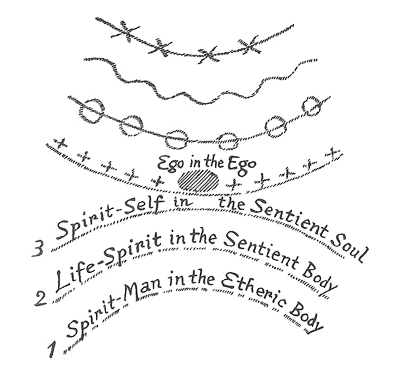
These things we know from the Lecture-Course on the apocalypse. But we must now take account of the fact that during the first, the ancient Indian epoch, man's development proceeded at a level below the realm of the 'I' itself. The ancient Indian, pre-Vedic culture was essentially an inspired culture, a culture which streamed as it were into the human soul without that activity of the 'I' which we know to-day as our life of thought and ideation.
Since the Egyptian period, man has had to be active in his 'I', to turn his 'I', via the senses, to the surrounding world in order to receive its impressions; he has had himself to participate actively in this further development. The ancient Indian culture was acquired more passively, through surrender to what streamed into men like inspiration.
It will therefore be understandable that this ancient Indian culture must be attributed to a kind of activity different from that carried out by the human 'I' to-day; what is now the activity of the 'I' had, so to speak, to be substituted in the ancient Indian soul by higher Beings who came down into human beings and inspired the human soul.
To describe what took place in the etheric bodies of ancient Indian souls, we can say: it was a dim, half-slumbering 'I'-consciousness that was working there; Atma was working in the etheric body. It may rightly be said that the soul of the ancient Indian was an arena where superhuman work was performed; higher Beings were working in the etheric body of the ancient Indian. And what was then woven into the etheric body was an activity such as man himself will later an come to achieve in the way indicated, when Atma works in the etheric body.
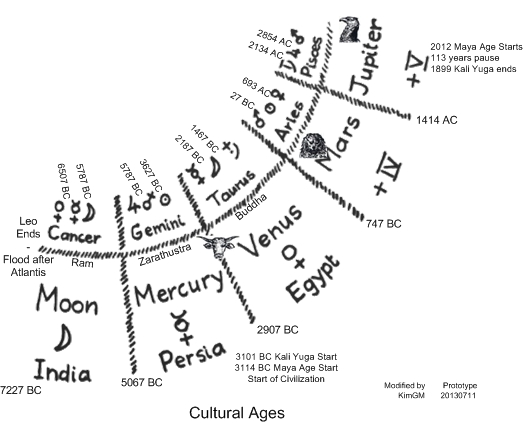
In ancient Persian culture, Buddhi or Life-Spirit worked in the astral body, in the sentient body; and in Babylonian-Chaldean? Egyptian culture, Manas or Spirit-Self worked in the sentient soul. This latter culture, therefore, does not yet bear the stamp of the 'I' working with full activity within the soul itself. Although to a less extent than before, man was still a passive arena for the working of Manas in the sentient soul. It was in the Greco-Latin epoch that for the first time man entered into his own life of soul with full activity. It is in the intellectual soul that the 'I' first makes itself felt as an independent, inner member of man's being, and we can therefore say: In Greek culture the 'I' actually works in the 'I', man as such works in man. In the course of these lectures we shall see that the essential and unique character of Greek culture is due to the fact that the 'I' is working in the 'I'.
In this respect we are in truth living in a period of transition, and if you recall what was said yesterday about the spiritual Power working in the Maid of Orleans, you will see that there was already in Operation in her something that takes the opposite direction to that of the influences of higher Powers in the pre-Grecian epoch. When, let us say, a man belonging to the ancient Persian culture received the influence of a super-sensible Power which used him as its instrument, this Power worked into and took effect in the very kernel of his being, and the man beheld and experienced what this spiritual Being inspired into him. When the man of our time enters into relation with such spiritual Powers, he can carry upwards what he experiences in the physical world through the work of his 'I' and the impressions it receives; he can give it all an upward orientation.
The Maid of Orleans is therefore a personality already working entirely in the spirit of our own epoch, when everything that we can produce on the foundation of our outer impressions must be directed upward to the spiritual.
With this picture of human history, of occult history, before us we shall understand that a soul incarnated in the ancient Indian and then in the Persian epoch could be inspired by an individual Being of the higher Hierarchies, but that on passing into the Greco-Latin epoch this soul was alone with itself, inasmuch as the 'I' was then working in the 'I'.
Everything that in the pre-Grecian age, in all the early cycles of Post-Atlantean civilisation, appears as divine inspiration, as a revelation from above — and this still holds good at the beginning of the Grecian epoch itself, in the 9th, 10th and 11th centuries, B.C. — everything that presents itself to us as inspired culture into which the spiritual content flows from outside, begins to be expressed more and more in the form of the purely human and personal.
And this comes to its strongest expression in Greek culture. No previous age had seen — nor will any subsequent age see again — such an expression of the outer man living in the physical world as a self-based 'I'-being.
The purely human and personal, entirely self-contained, comes to light as historical reality in the mode of life of the ancient Greek and in his creations.
See how the Greek sculptor has woven the element of the human and personal into his figures of the gods! We can truly say that in a masterpiece of Greek sculpture man stands before us wholly as personality — in so far as it can be made recognisable in physical media.
And if at the sight of a Greek work of art we were not able to efface the thought that the particular incarnation there expressed was preceded and will be followed by others — if we were to imagine for a single moment that in the form of an Apollo or a Zeus only one out of many incarnations is represented — then we should not have the true feeling for these masterpieces. In looking at them we must be able to forget that the human being is incarnated in successive earthly lives.
In Greek works of art the whole personality has poured into the form of the single personality. This was the hallmark of the life of the Greeks.
On the other hand, when we go further back into the past, the forms become symbolic; they indicate something that is not purely human, something that man does not yet feel within his own self. In those times he could only express in symbols what was coming in from divine-spiritual worlds. Hence, in the archaic period, art was symbolic.
And now it will no longer be incomprehensible to you that in the first of there lectures I said: what was incarnated at an earlier time appears in the physical world later on like a shadow-image. Beings of the higher Hierarchies streamed into the individuality of a man belonging, let us say, to the early Greek world, so that when we say “he was incarnated” we must not see this self-contained being only, but standing behind him an individuality of a higher Hierarchy.
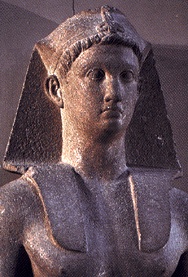
That is the picture we must have of Alexander, and of Aristotle, in the Greco-Latin epoch. We follow their individualities back into the past. From Alexander we must go back to Gilgamish and say: in Gilgamish is the individuality who then, projected as it were on the physical plane, appears as Alexander; behind this individuality is a Fire-Spirit who uses him as an instrument. And if we go back from Aristotle, we see the powers of the old clairvoyance working in Eabani, the friend of Gilgamish.
Thus we see how both old souls and young souls, with the old clairvoyance behind them, are placed right out on the physical plane in the Greek epoch. This confronts us vividly in the great woman mathematician Hypatia, in whom all the mathematical and philosophical wisdom of her time lived as personal ability, as personal erudition and wisdom. This was all embraced in the personality of Hypatia. And we shall understand that this individuality had to be born as a woman in order to bring together in a delicately concise form all that she had earlier received from the Orphic Mysteries — in order to impart to everything she had learnt from the Inspirers of those Mysteries the stamp of a personal style.
We see, therefore, how in the successive incarnations of human beings influences from the spiritual world bring about modifications. I can do not more than intimate that the individuality who incarnated as Hypatia, who brought with her the wisdom of the Orphic Mysteries and gave personal expression to it, was called upon in a subsequent incarnation to take the opposite path: to bear all personal wisdom upwards again to the divine-spiritual. Hypatia appeared at the turn of the 12th and 13th century as a significant, universal spirit of later history, one who had a great influence upon the knowledge that brings together science and philosophy. — Thus we see how the Powers operating in the course of history penetrate into the successive incarnations of particular individualities.
Observing the course of history in this way we actually see a kind of descent from spiritual heights until the Greco-Latin epoch, and then again an ascent. During the Greek epoch — and it has continued, naturally, into our own time — there is a gathering together of material to be acquired purely from the physical plane and then a carrying up of it again into the spiritual world. For this, Spiritual Science should provide an impulse — an impulse that was already alive instinctively in a personality such as Hypatia, when she was incarnated again in the 13th century.
The following passage [from H. P. Blavatsky] will show you that what is said about contradiction is really sheer invention — there is no other way of putting it.
"... Those great characters who tower like giants in the history of mankind, like Siddhartha Buddha and Jesus in the realm of the spiritual, and Alexander the Macedonian and Napoleon the Great in the realm of physical conquest are but the reflected images of human types which had existed — not ten thousand years before, as cautiously put forward in Isis Unveiled, but for millions of consecutive years from the beginning of the Manvantara. ..."
These authors had no inkling that Aristotle was communicating an ancient secret of the Mysteries when he said:
"A tragedy is a weaving together round a hero of successive actions, which are able to arouse in the spectator the emotions of fear and compassion in order that a catharsis may take place in his soul".
In studying the occult aspect of history it is borne in upon us more and more that with their activities and cultural achievements the several peoples by no means stand isolated in world-evolution, in the general progress of humanity. Each people has its spiritual task, a special contribution to make to human progress. Our civilisation to-day is extremely complex, for many single streams of culture have converged in it. In our present spiritual life and in external life, too, there is a confluence of the most varied folk cultures which were developed more or less one-sidedly by the several peoples in accordance with their own missions, and then flowed into the general stream.
It is deeply interesting here to think of the task and mission of the Babylonian people. The Babylonian people presented a great riddle to historical research in the 19th century as a result of the decipherment of the cuneiform writing. And even the superficial information which it has been possible to acquire is in the highest degree noteworthy .... There, above all in the earliest times, lived a most remarkable people, known in history as the Sumerians. They lived in the regions around the Euphrates and the Tigris, mainly in the upper districts but also towards the lower.
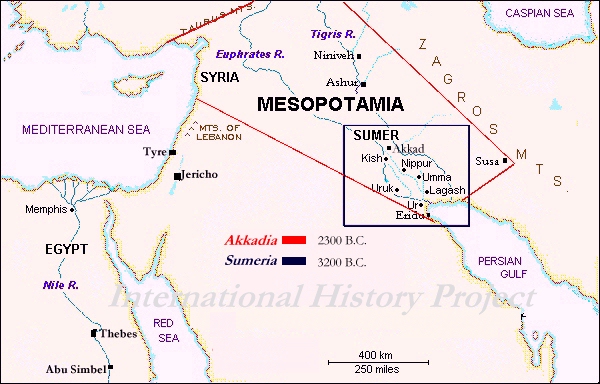
In their thought and spiritual achievements, and also in their outer accomplishments, this people belonged to a comparatively very early stage of Post-Atlantean civilisation. And the farther we go back in the history of the Sumerians, who may be called the predecessors of the Babylonians, the more evident it becomes that spiritual traditions of the highest significance were alive in this people, that there was present among them a spiritual wisdom which may be described by saying that in them the whole mode of life, the way of living not in thought alone, but in the very soul and spirit, was entirely different from anything that developed in later periods of world-history.

In the men of later times there is evidence, for example, of a certain hiatus between the thought and the spoken word. How can anyone fail to realise to-day that thinking and speaking are two quite different matters, that in a certain respect speech consists of conventional means of expression for what is being thought. This is evident from the very fact that through our many different languages we express a great many common ideas. Thus there is a certain hiatus between thinking and speaking.
It was not so among the Sumerians, this ancient people whose language was related to the soul quite differently from what came to be the rule in all later languages. Especially when we go back into times of the greatest antiquity we find something like a primal human language [In dream time, before the Tower of Babel or death of Krishna, before Kali Yuga] — although no longer preserved, even then, in complete purity.
True, we already find differentiation in the languages of the various tribes and races in widespread areas of Europe, Asia and Africa, but there existed among the Sumerians a kind of common speech-element which was intelligible through the whole of the then known earth, especially to more deeply spiritual men. How was this possible? It was because a tone or a sound evoked a definite feeling and the soul was bound to express unequivocally what was felt in association with a particular thought and at the same time with a particular sound.
But it was the task of the Babylonian people to lead this living connection of man with the spiritual world down into the personal, to the realm where the personality is based entirely upon itself in its separateness, in its singularity. It was the mission of the Babylonians to lead the spiritual world down to the physical plane. And with this is connected the fact that the living, spiritual feeling for language ceases and language adjusts itself according to such factors as climate, geographical position, race, and the like. The Bible ... describes this significant truth in the story of the Babylonian Tower of Babel, whereby men who speak a common language are scattered over the earth.... Therefore the measures to be found in buildings such as the pyramids are taken from the heavens and from the human body.
What, then, was bound to happen when human knowledge was to be led down from the heavens to the earth, from the universal spiritual-human to the human-personal? The measures could then be taken only from man himself, from the human personality in so far as it is an expression of the single egohood.
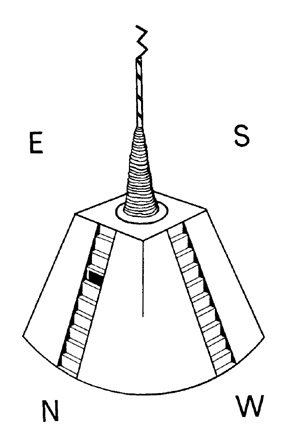
Thus the Tower of Babel was to be the cultic centre for men who were henceforward to derive the measures from the human personality. But at the same time it had to be shown that the personality must first mature to the stage of being able again to ascend to the spiritual worlds. The fourth and the fifth civilisation-epochs must be lived through before the reascent is possible — which it would not have been at that time. That the heavens were not yet within the reach of powers deriving from the human personality — this is indicated by the fact that the Tower of Babel was bound to be an unhappy affair.
Infinite depths are contained in this world-symbol of the Tower of Babel through which men were limited to the personality as such; to what the personality could achieve under the particular conditions prevailing among some race or people.
Thus the Babylonians were led downwards from the spiritual world to our earth; there lay their mission and their task. But, as I have already said, underlying the external Babylonian civilisation there was a Chaldean Mystery-culture which, while remaining esoteric, nevertheless flowed quite definitely into the outer civilisation. Hence we see the primeval wisdom still glimmering through in the ways and means available to the Babylonians.
We must learn to have respect for the profound knowledge of the heavens possessed by the Babylonians, and for their great mission, which lay in drawing forth from what was known to mankind through vision of the spiritual world, from the laws of measure prevailing in the heavens, everything that must be incorporated into civilisation for the needs of outer, practical life.
At the same time it was their mission to relate everything to man. And it is interesting that certain ideas have lived on into our own times, ideas that are like an echo of feelings that were still living experiences in the Babylonians — feelings of the inflow of the macrocosm into man, of a law which, holding sway in man as an earthly personality, mirrors the great law of the heavens.
[Meassures, mile, foot, and the systems based on 12 and 60 we got from the Babylonians.]
For it is obvious that measure to-day is abstract in comparison with the concrete measures directly connected with man and with the phenomena of the heavens — measures which are in truth all to be traced back to the mission of the Babylonian people.
In the case of other measures too, such as the “foot,” derived from a human limb, or the “ell,” derived from the human hand and arm, we could find underlying them something that had been discovered as law prevailing in man, the macrocosm, In point of fact the ancient Babylonian way of thinking still underlay our system of measure until a time not so very long ago.
The twelve zodiacal constellations and the five planets gave the Babylonians 5 times 12 = 60 — this they took as a basic number. They counted up to 60 and then began again.
Whenever they were counting things of everyday life they took the number 12 as the basis, because, since it derives from laws of the cosmos, it is related in a far more concrete way to all external conditions. The number 12 is capable of much division. Twelve — the dozen — is nothing else than a gift from the mission of the Babylonians.
We ourselves base everything an 10 — a number which causes great difficulty when it has to be divided into parts, whereas the dozen, both in its relation to 60 and in its various possibilities of division, is eminently suited to be the basis of a metrical and numerical system.
When it is said that humanity has sailed into abstraction even in respect of calculation and counting, this is not intended as a criticism of our time, for one epoch cannot do the same as the preceding epoch.
If we want to portray the course of civilisation from the Atlantean catastrophe to the Greek period and on through our own, we may say: The Indian, Persian and Egyptian epochs are periods of descent; in Greek civilisation the point is reached where the essentially human is unfolded on the physical plane; then the reascent begins. But this reascent is such that it represents one aspect only of the actual course of development, and on the other side there is a progressive descent into materialism.
Hence in our time, side by side with spiritual endeavour there is the crassest materialism which links deeply, deeply into matter. These things are natural parallels. This current of materialism is inevitably present as an obstacle which has to be overcome in order that a higher forte may be developed.
But it is the nature of this materialistic current to make everything abstract. The whole decimal system is an abstract system. This is not criticism but simply characterisation.
And in other directions, too, the whole tendency is to suppress the concrete reality. Just think of the proposals that have been put forward — for example to make the Easter Festival fall an a fixed day in April, in order that the inconveniences caused to commerce and industry may be avoided! No heed is given to the fact that there we still have something which, determined as it is by the heavens, reaches over to us from ancient times. Everything has to nun into abstraction, and concrete reality, which pressed on again to the spiritual, flows into our civilisation to begin with only as a tiny trickle.
It is extraordinarily interesting to see how not only in Spiritual Science, but outside it as well, humanity is instinctively impelled to take the upward path, to ascend again, let us say to a connection with measure, number and form similar to that which prevailed in the ancient Babylonians and Egyptians.
For in our time there is actually a kind of repetition of Babylonian and Egyptian culture; the civilisation-epochs preceding our era repeat themselves: the Egyptian in our own epoch, the Persian in the sixth, the Indian in the seventh. The first corresponds with the seventh, the second with the sixth, the third with the fifth, our own; the fourth Stands by itself, forming the middle. For this reason., so much that went to form the ancient Egyptian view of the world is being repeated instinctively.
There was a particularly characteristic personality who experienced as it were within his own breast this battle of the old with the new, this battle between treasures of primordial, spiritual wisdom and what was only at its very beginning — a feebly flowing stream. This personality of the Greco-Latin epoch in the 4th century, who experienced these things in the arena of his own soul, was Julian the Apostate.
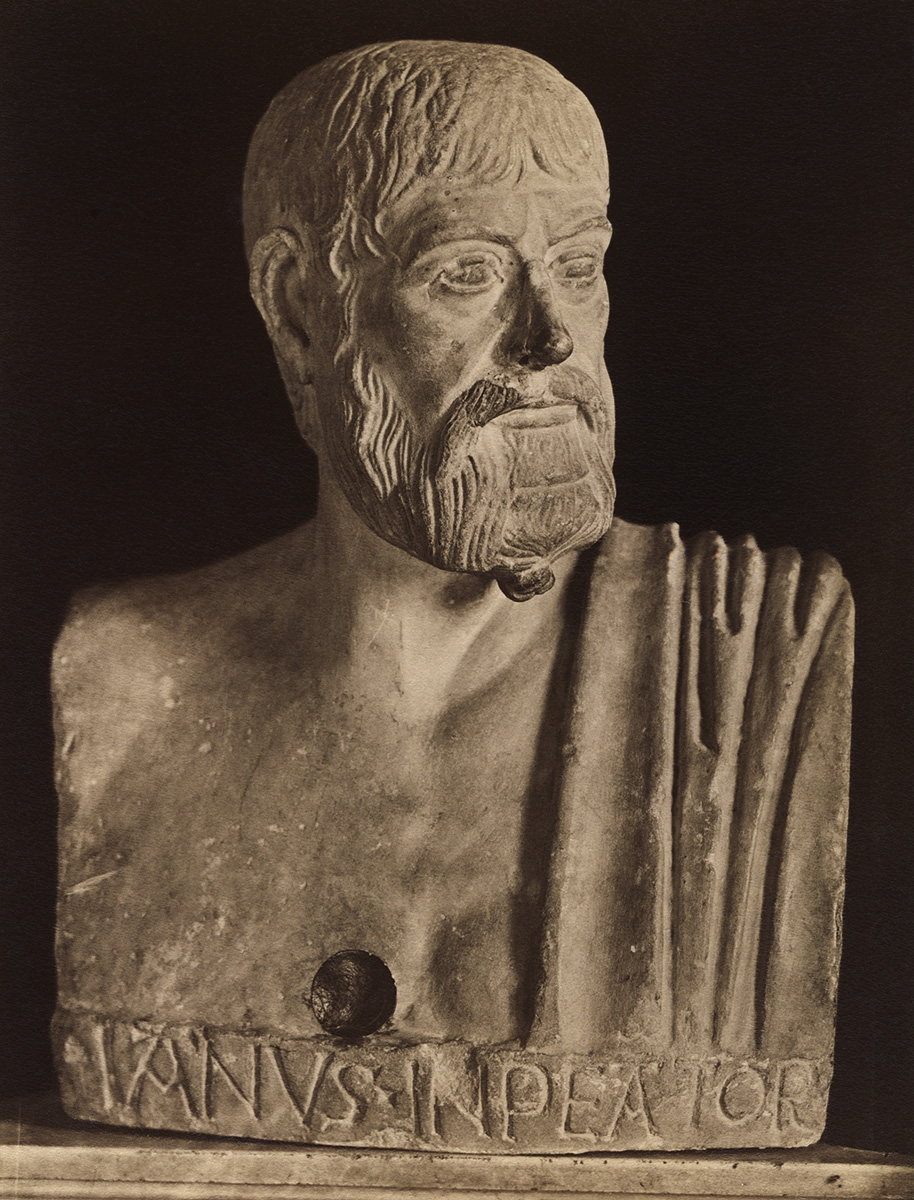 Wherever he found something of the old sacred traditions and institutions living an into the civilisation of the fourth epoch, he drank it in. And so it happened that on his many wanderings, to which he was driven by the persecutions meted out to him by his uncle the Emperor, he came into contact with teachers of the so-called Neo-Platonic School and with pupils of the men of Alexandria, who had received the old traditions handed down from there.
It was then that for the First time Julian's heart was nourished with that to which he was so deeply drawn. And then he came to know such treasures of ancient wisdom as still existed in Greece itself. And with all that Greece gave him, with all that the old world gave him in the way of wisdom, Julian could not bat unfold a living Feeling for the language of the heavens, for the secrets which in the starry script speak down to us from cosmic spare.
Then came the time when he was initiated into the Eleusinian Mysteries by one of the last hierophants; and in Julian we have the strange spectacle that one who is inspired by the ancient Mysteries, one who stands fully within what can be received when the spiritual life becomes a reality through the Mysteries—that such an initiate sits on the throne of the Cæsars. And although many misconceptions crept into Julian's writings against the Christians, we know what greatness there was in his conception of the world when he was speaking out of the majestic experiences of his Initiation.
And so we see him endeavouring by many ways and means to introduce the old Gods again into a civilisation already penetrated by Christianity. He went too far both in the matter of speaking openly of the Mystery-secrets and in his attitude towards Christianity. And so it came about that in the year 363, when he had to conduct a military campaign against the Persians, he was overtaken by his destiny. Just as destiny overtakes anyone who has unlawfully uttered those things which may not be uttered without authorisation, so it was in the case of Julian, and there is historical proof that on this expedition against the Persians, he fell by the hand of a Christian.
For the study of occult history, it is interesting to observe the laxer course taken by this particular life, this particular individuality. During the 16th century, in the year 1546, a remarkable man was born of a noble house of Northern Europe, and in his very cradle, so to speak, everything was laid — including family wealth — that could have led him to positions of great honour in the traditional life of that time. Because, in line with his family traditions, it was intended that he should occupy some eminent political or other high position, he was marked out for the legal profession and sent with a tutor to the University of Leipzig to study jurisprudence.
The tutor tormented the boy — for he was still a boy when he was forced to study law — all day long. But at night, while the tutor was sleeping the sleep of the just and dreaming of legal theories, the boy stole out of bed and observed the stars with the very simple instruments he had himself devised.
And very soon he knew not only more than any of the teachers about the secrets of the stars but more than was to he found at that time in any book. For example, he very soon noticed a definite position of Saturn and Jupiter in the constellation of Leo, turned to the books and found that they recorded it quite erroneously. The longing then arose in him to acquire as exact a knowledge as possible of this star-script, to record as accurately as possible the course of the stars.
No wonder that in spite of all his family's resistance he soon extracted the permission to become a natural philosopher and astronomer, instead of dreaming his life away over legal books and doctrines. And having considerable means at his disposal, he was able to set up a whole establishment.
This was arranged in a remarkable way. In the upper storeys were instruments designed for observing the secrets of the stars; in the cellars there was equipment for bringing about different combinations and dissolutions of substances. And there he worked, dividing his time between observations carried out on the upper floors of the building and the boiling, fermenting, mixing and weighing which went on in the cellars below. There he worked, in Order to show, little by little, how the laws that are written in the stars, the laws of the planets and fixed stars, the macrocosmic laws, are to be found again microcosmically in the mathematical numbers underlying the combinations and dissolutions of substances.
And what he discovered as a living connection between the heavenly and the earthly he applied to the art of medicine, producing medicaments which were the cause of bitter animosity around him because he gave them freely to those he wanted to help. The doctors at that time, intent upon extorting high fees, raged against this man who was accused of perpetrating all sorts of “horrors” with what he endeavoured to bring down from the heavens to the earth.
 Fortunately, as the result of a certain happening, he found favour with the
Danish King,
Frederick the Second, and as long as he retained
this favour, all went well: tremendous insight was gained into the spiritual
working of cosmic laws in the sense I have just described.
Fortunately, as the result of a certain happening, he found favour with the
Danish King,
Frederick the Second, and as long as he retained
this favour, all went well: tremendous insight was gained into the spiritual
working of cosmic laws in the sense I have just described.
This man did indeed know something about the spiritual course of cosmic laws. He dumbfounded the world with things which admittedly would no longer find the same credence to-day. On one Occasion, when he was at Rostock, he prophesied, from the constellation of the stars, the death of the Sultan Soliman, which came true within a few days of the date he had foretold. The news of this made the name of Tycho Brahe famous in Europe.
To-day the world at large knows hardly anything more of Tycho Brahe, whose life lies such a short time behind us, than that he was somewhat of a crank and never quite reached the lofty standpoint of modern materialism. He recorded a thousand stars for the first time in the maps of the heavens and also made the epoch-making discovery of a type of star, the “Nova,” which flares up and vanishes again, and described it. But these things are mostly passed over in silence. The world really knows nothing about him except that he was still “stupid” enough to devise a plan of the cosmos in which the earth stands still and the sun together with the planets revolve around it. That is what the world in general knows to-day.
The fact that we have to do here with a significant personality of the 16th century, with one who accomplished an infinite amount that even to-day is still useful to astronomy, that untold depths of wisdom are contained in what he gave — none of this is usually recorded, for the simple reason that in presenting the system in detail, out of his own deep knowledge, Tycho Brahe saw difficulties which Copernicus did not see. If such a thing dare be said — for it does indeed seem paradoxical — even with the Copernican cosmic system the last word has not yet been uttered. And the conflict between the two Systems will still occupy the minds of a later humanity. — That, however, only by the way; it is too paradoxical for the present age.
And now, placing both personal destinies side by side, think how endlessly instructive it is when we learn from the Akasha Chronicle that the individuality of Julian the Apostate appears again in Tycho Brahe, that Tycho Brahe is, so to say, a reincarnation of Julian the Apostate.
Thus strangely and paradoxically does the law of reincarnation take effect when the karmic connection of the single individual are modified by world-historic karma; when the cosmic Powers themselves use the human individuality as their instrument.
See also Rudolf Steiner on The individuality of Julian the Apostate — Herzeleide — Tycho Brahe
The question may arise: Which particular Spirits, from which Hierarchies, worked through the ancient Indians, the ancient Persians, the Babylonians, Chaldeans and Egyptians respectively It is the answer to this question that alone can give us deeper insight into the occult course of history [The Spiritual Guidance of Man and of Mankind. Lectures II and III.]

The Bull is the incarnation of Lucifer, Leo is the incarnation of Christ and the Eagle is the incarnation of Ahriman.
Into the ancient Indian soul, which created the civilisation immediately following the Atlantean catastrophe, the Beings we call the Angeloi, the Angels, poured their forces. And in a certain connection it is true to say that when a man of ancient India spoke, when he gave expression to what was active in his soul, it was not his own egohood speaking directly, but an Angelos, an Angel.
This direct expression was less possible for the Beings of the higher Hierarchies who spoke through the souls of the ancient Persian people, for they were Beings of the next higher rank — the Archangels. And because these Beings stand two stages higher than man, what they were able to express by means of human instruments was farther away from their own inherent nature than what the Angels could express through the ancient Indians.
Through the souls of the Babylonian, Chaldean, Egyptian peoples, the Spirits of Personality (the Archai) express themselves. Hence it is in this period that the emergence of personality is most prominent, and what man is still able to give out from the forces streaming down to him is therefore the farthest removed from its origin, bearing the essential stamp of the human-personal. And so, as evolution advances to the Egypto-Babylonian epoch, there is a continuing manifestation of the Angels, the Archangels and the Spirits of Personality.
In the ancient Persians, especially, we can see very exactly how they had an awareness that the Archangels — the Spirits of paramount importance in that epoch — were working into the human organism, the human organism in its totality.
We must not, to be sure, take an average Persian when considering the downflowing of forces from the Hierarchies. The forces streamed down, too, upon the average Persian, but only those who were the immediate pupils of the inspirer of the ancient Persian culture, of Zarathustra himself, were capable of knowing how this happened, of seeing through to the reality.
And they did indeed possess this knowledge. For you will remember from many descriptions I have given of the teachings of Zarathustra, or from exoteric traditions, that according to the view of the ancient Persians the primal Divinity, Zervana Akarana, reveals himself through the two opposing powers, Ormuzd and Ahriman.
The ancient Persians were clearly aware that whatever comes to manifestation in the human being derives from the macrocosm, and that the phenomena of the macrocosm — especially, therefore, the movements and positions of the stars — are mysteriously connected with the microcosm, with man. Hence the pupils of Zarathustra saw in the Zodiac the external expression, the image, of Zervana Akarana, of the primal reality of Being living and weaving through eternity. Even the very word “Zodiac” is reminiscent of the word Zervana Akarana.
From At the Gates: Lecture XI: The Post-Atlantean Culture-Epochs
The second sub-race, that of the ancient Persians, had a very different mission, although its culture originated from the clear purpose of Manu. Long before the time of Zarathustra, Persia had an ancient culture, of which only an oral tradition survives. People were now coming to the thought that external reality was an image of the Divine, which must not be turned away from but shaped anew. The Persian wished to transform nature by work; he became a husbandman. He moved out of the quiet realm of world-renouncing thoughts and learnt from the resistance he encountered that the outer world was not wholly Maya. Side by side with the world of Spirit he found a real world in which work had to be done. The conviction gradually grew within him that there are two worlds: the world of the good Spirit in which a man can immerse himself and the world which has to be worked upon. And then he said: In the world of the Spirit I shall find the ideas and concepts through which I may transform the world of external reality, so that it may itself become an image of the eternal Spirit.
Thus the Persian saw himself placed in a struggle between two worlds; and presently this took more and more the form of a conflict between two powers — Ormuzd, representing the world of the good Spirit, and Ahriman, representing the world which has to be transformed. But he found himself still at a loss in one respect: the outer world confronted him as something he could not understand; he could not discover any laws in it. He failed to see that the spiritual can be found in nature; he was aware only of nature's resistance to his work.
The pupils of Zarathustra saw twelve powers proceeding from the twelve directions of the Zodiac, six directed towards the light side of the Zodiac traversed by the sun by day; the other six towards the dark side — turned, as they said, towards Ahriman. Thus the Persian conceived of the macrocosmic forces coming from the twelve directions of the universe and penetrating into, working into humanity, so that they are immediately present in man.
Consequently, what unfolds through the working of the twelve forces must reveal itself also in its microcosmic form, in human intelligence; that is to say, it must come to expression in the microcosm, too, through the twelve Amshaspands [Turning-Points in Spiritual History. Lecture I.] (Archangels), and indeed as a final manifestation, so to say, of these twelve spiritual, macrocosmic Beings who had already worked in former ages, preparing that which merely reached a last stage of development during the epoch of Persian civilisation.
It should not be beyond the scope of modern physiology to know where the microcosmic counterparts of the twelve Amshaspands are to be found. They are the twelve main nerves proceeding from the head; these are nothing else than material densifications of what arose in the human belong through the instreaming of the twelve macrocosmic powers. The ancient Persians pictured the twelve Archangel-Beings working from the twelve directions of the Zodiac, working into the human head in twelve rays, in order gradually to produce what is now our intelligence.
The Persians called the Beings of the rank below the Amshaspands, “Izads,” and of these they enumerated 28 to 31. The Izads, therefore, are Beings who give rise to a less lofty activity; to soul-activity in man. They send in their rays, which correspond to the 28, 30 to 31 spinal nerves. And so in Zarathustrianism you have our modern physiology translated into terms of the spiritual, the macrocosmic, in the twelve Amshaspands and in the 28 to 31 Izads of the next lower Hierarchy.
The Spirits of Form manifest in a different way. They manifest from below upwards as far more powerful Spirits who are not dependent upon using man merely as an instrument; they manifest in the kingdoms of Nature around us, in the configuration of the beings of the mineral, plant and animal kingdoms.
And if man would recognise the Spirits of Form in their manifestation, he must direct his gaze outwards, he must observe Nature and investigate what has been woven into her by the Spirits of Form. Consequently in the Greek epoch, when the paramount manifestation is that of the Spirits of Form, man does not receive any direct influence as an inspiration.
The influence of the Spirits of Form works far rather in such a way that man is allured by the outer world of sense; his senses are directed with joy and delight towards everything spread out around him, and he tries to elaborate and perfect it. Thus the Spirits of Form attract him from without. And one of the chief Spirits of Form is the Being designated as Jahve or Jehovah. Although there are seven Spirits of Form and they work in the different kingdoms of Nature, men of the present age have a faculty of perception only for the one Spirit, Jehovah.
And here, because it is of essential significance in the whole historical development of earthly humanity, we may point particularly to the fact that in the seventh millennium before Christ there was a very specially important astronomical epoch — important because, on account of the constellation brought about by the relative position of the earth's axis to the neighbouring stars, the climatic conditions on earth culminated in the Atlantean cataclysm. This happened six to eight thousand years before our era, and the effects of it continued for long ages.
Here we can only emphasise what is correct, as opposed to the fantastic periods of time that are mentioned, for these happenings lie much less far behind us than is generally believed. During this period the macrocosmic conditions worked into the physical in such a way as to bring about the mighty physical upheavals of the Atlantean cataclysm, which completely changed the face of the earth.
This was the greatest physical transformation of all, the most drastic action of the macrocosm upon the physical earth. Hence the influence from the macrocosm upon the spirit of man at that time was at its lowest; this epoch therefore provided an opportunity for the less powerful Beings of the Hierarchies to begin to exercise on man a potent influence, which then ebbed gradually away.
When the Spirits of Form are exercising a powerful influence on the human personality and have only a little influence upon what is taking place in the external world, the impression will be less vivid. The point of time when this condition — in the nature of things, less perceptible to men — set in, was the year A.D. 1250 This year 1250 is of momentous importance in history. [The Spiritual Guidance of Man and of Mankind. Lecture II.] It fell in a period that can be characterised briefly as follows.
Hence we see that this year 1250 was the starting-point of great and detailed elaborations of what was formerly only believed, only divined: it was the starting-point of Scholasticism, which is greatly undervalued to-day. [The Redemption of Thinking: a Study in the Philosophy of Thomas Aquinas.] It was also the starting-point of revelations which found expression in spirits such as Agrippa of Nettesheim, and which took effect most deeply in Rosicrucianism.
If we want to understand there happenings fully, we must also take into consideration that such crucial points in evolution are always connected with certain positions of the stars, and that in the year 1250 the earth's axis lay in a definite position and was therefore related in a particular way to the so-called minor axis of the ecliptic.
So you see — and this is what I wanted to bring before you today — how the great macrocosmic penetration from the vast universe into the souls of men is connected with what may take place in a minute arena. But these things become especially interesting if we connect them with another law, with such points of intersection in evolution as was the year 1250. At that time there was the strongest possible penetration into the souls of men — and that is not so readily noticed as the upheavals of continents.
During the Atlantean catastrophe the Spirits of Form worked so little into the souls of men that the younger hierarchies held the field, as it were, at that time. Thus the activities of the different ranks of hierarchical Beings are distributed. And it is important to know that again in these cyclic movements certain laws of ascent and decline prevail. I indicated something of this when I said that in the year 1250 there was an impetus and then an ebbing away which manifested in the current of materialism. Such things are often to be perceived. And it is interesting to notice how cycles of ascent and of decline alternate in the history of mankind.
But in regard to this Greek civilisation, the following must also be said. It was preceded by the Third epoch, which then ebbed away, and during this period of decline Greek culture was being prepared. During the decline of the Babylonian culture, which streamed from the East towards the West, there was enshrined in the little peninsula of Southern Europe we know as Greece the seed of what was to sink into humanity as the impulse of a new life.
True though it is that this Greek life brought pre-eminently to expression the essentially human element, that which man can find entirely within himself, it must not be thought that such things need no preparation. What we call the essentially human element — that, too, had first to be taught to men in the Mysteries by super-sensible Powers, just as now the still higher freedom which must be prepared for the Sixth civilisation-epoch is sustained and taught in super-sensible worlds by the Beings who lead and guide human evolution.
If we picture Greek civilisation rising up from unknown depths even during the decline of Babylonian culture, then, in the age of the Persian Wars we can clearly perceive the effects of what the Greek character had received from the old temple-wisdom. For in these Persian Wars we see how the heroes of Greece, aflame with enthusiasm for the heritage received from their forefathers, fling themselves against the stream which, as an ebbing stream from the East, is surging towards them.
The significance of their violent resistance, when the treasures of the temple-wisdom, when the teachers of the ancient Greek Mysteries themselves were fighting in the souls of the Greek heroes in the battles against the Persians, against the waning culture of the East — the significance of all this can be grasped by the human soul if the question is asked: What must have become of Southern Europe, indeed of the whole of later Europe, if the onset of the massive hordes from the East had not been beaten back at that time by the little Greek people? What the Greeks then achieved contained the seed of all later developments in European civilisation up to our own times.
And even the outcome in the East of what Alexander subsequently carried back to it from the West — albeit in a way that from a certain point of view is not justifiable — even that could develop only after what was destined to decline in respect also of its physical power had first been thrust back by the burning enthusiasm in the souls of the Greeks for the temple-treasures. If we grasp this we shall see how not only the teaching concerning Fire given by Heraclitus, not only the all-embracing ideas of Anaxagoras and of Thales, work on, but also the actual teachings of the guardians of the temple-wisdom in prehistoric Greek civilisation. We shall feel all this as a legacy of spiritual Powers who imbued Greek culture with what it was destined to receive. We shall perceive it in the souls of the Greek heroes who defied the Persians in the various battles. This is how we must learn to feel history, for what is offered us in the ordinary way is, at its best, only an empty abstract of ideas.
Just as the pre-Grecian age had sons of the gods and the Greeks had sages, the peoples of the post-Grecian age have saints — human beings who lift themselves into the spiritual life through what they carry into effect on the physical plane. Something is alive there in the folk-instinct, enabling us to glimpse how behind maya itself there is a factor which impels humanity forward.
My dear friends, if the aphoristic and isolated thoughts that have been presented in connection with the historical development of humanity unite in your hearts to produce a feeling of how the spiritual Powers themselves work in history through their instruments, you will have assimilated there lectures in the right way. And then it could be said that the feeling which arises in our hearts from the study of occult history is the right feeling for the way in which development and progress occur in the stream of time.
To-day, at this minor turning-point of time, it may be fitting to direct our meditation to this feeling of the progress of men and of gods in the flow of history. If in the heart of each one of you this feeling for the science of occult progress in time were to become clear perception of the weaving, creative activity in the becoming of our own epoch, if this feeling could come alive within you, it might perhaps also live as a New Year's wish in your souls.
And at the close of this course of lectures, this is the New Year's wish that I would fair lay in your hearts: Regard what has been said as the starting-point of a true feeling for time. In a certain way it may be symbolical that we should have been able to use this minor transition from one period of time to another as an opportunity for allowing ideal which embrace such transitions in their sweep, to take effect in our souls.
Our souls have beheld the old cultural monuments that they see again today. The same souls that lived then have gone through later periods and have appeared again in our own time. We know that no life remains without fruit; we know that what the soul has gone through in the way of experiences remains within it and appears in later incarnations as powers, temperament, capacities, and dispositions. Thus the way we look on nature today, the way we take up what our times bring forth, the way we view the world, all this was prepared in ancient Egypt, in the land of the pyramids. We were then prepared in such a way that we now look at the physical world as we do. Just how these widely separated periods link themselves together is what we will now explore.
If we want to grasp the deeper meaning of these lectures, we must go a long way back in earthly evolution, We know that our earth has often changed. Before ancient Egypt there were still other cultures. By means of occult research we can see much further back into the gray primeval times of human evolution, and we come to times when the earth appeared quite other than it is today. Things were entirely different in ancient Asia and Africa. If we look back clairvoyantly into primeval times, we come to a point where a tremendous catastrophe, caused by water-forces, took place on our earth and fundamentally altered its face. If we go still further back, we reach a time when the earth had an entirely different physiognomy, when what now forms the floor of the Atlantic Ocean, between Europe and America, was above water, was land. We come to a time when our souls lived in entirely different bodies than today; we reach ancient Atlantis, of which our external science can as yet say little.
The regions of Atlantis were destroyed through colossal deluges. Human bodies had different forms at that time, but the souls that live in us today lived also in the ancient Atlanteans. Those were our souls. Then the water-catastrophe caused a movement of the Atlantean peoples, a great migration from west to east. We ourselves were these peoples. Toward the end of Atlantis all was in movement. We wandered from the west toward the east, through Ireland, Scotland, Holland, France, and Spain. Thus the peoples moved eastward and populated Europe, Asia, and the northern parts of Africa.
It must not be imagined that those who, in the last great migration, wandered out of the west into the regions that have gradually developed into Asia, Europe, and Africa, did not encounter other peoples.
Almost all of Europe, the northern parts of Africa, and large parts of Asia were already inhabited at that time. These areas were not peopled from the west only; they had already been settled earlier, so that this migration found a strange population already established. We may assume that when quieter times set in, special cultural relations arose.
There was, for instance, in the neighborhood of Ireland, a region where, before the catastrophe that now lies thousands of years behind us, there lived the most advanced portions of the entire population of the earth. These portions then migrated, under the special guidance of great individualities, through Europe to a region of central Asia, and from that point cultural colonies were sent out to the most diverse places.
One such colony of the post-Atlantean time was sent from this group of people into India, finding a population that had been seated there from primeval times and had its own culture. Paying due heed to what was already present, these colonists founded the first post-Atlantean culture. This was many thousand years ago, and external documents tell us scarcely anything about it. What appears in these documents is much later.
In those great compendiums of Wisdom called the Vedas, we have only the final echoes of a very early Indian culture that was directed by super-earthly beings and was founded by the Holy Rishis. It was a culture of a unique kind, and we today can form only a feeble idea of it because the Vedas are only a reflection of that primeval holy Indian culture.
After this culture there followed another, the second cultural epoch of the post-Atlantean time. Out of this the wisdom of Zarathustra flowed and the Persian culture arose. Long did the Indian culture endure, long also the Persian, reaching a culmination in Zarathustra.
Then arose, under the influence of colonists who were sent into the land of the Nile, the culture that is comprised under the four names, Chaldean-Egyptian-Assyrian-Babylonian. This third post-Atlantean culture arose in Asia Minor and northern Africa, and reached its summit, on the one side, in the wonderful Chaldean star-lore and, on the other, in the Egyptian culture.
Then comes a fourth age, developing in the south of Europe, the age of the Greco-Roman culture, which dawns with the songs of Homer and goes on to produce the Greek sculptures and the art of poetry that appears in the tragedies of Aeschylus and Sophocles. Rome also belonged to this period. The epoch begins in the eighth pre-Christian century, approximately in 747 B. C., and lasts until the fourteenth or fifteenth century A. D. After that we have the fifth period, in which we ourselves live, and this in turn will be followed by the sixth and seventh periods.
In the seventh period, ancient India will appear in a new form. We shall see that there is a remarkable law that enables us to understand the working of wonderful forces through the various epochs and the relationships of the epochs to each other. If we begin by looking at the first period, that of the Indian culture, we will find that this first culture later recrudesces in a new form in the seventh period. Ancient India will then appear in a new form. Mysterious forces are at work here.
And the second period, which we have called the Persian, will appear again in the sixth period. After our own culture perishes, we will see the Zarathustra religion revive in the culture of the sixth period.
And in the course of these lectures we will see how, in our own fifth period, there takes place a sort of reawakening of the third period, the Egyptian.
The fourth period stands in the middle; it is peculiar to itself, and neither earlier nor later does it have a parallel.
The Rise and Fall of Alexandria
Hypatia and Her Mathematics by Michael A. B. Deakin
Hypatia Taught Conic Sections and Diophantine Equations
Hypatia: Great Mathematician or Geometry Teacher?
Rudolf Steiner on Pherecydes of Syros in The East in the light of the West. [Chapter IV]
We will go back, not so very far, to a historical personage who lived in a comparatively ancient period of Greek culture, of whom history knows very little and the length of whose life even is veiled in much uncertainty. Pherecydes of Syros is in a certain respect the forerunner of the other Greek sages.
He lived at a time in Greek spiritual development called the epoch of the Seven Sages. — This period preceded that of all historical Greek philosophy. The little that external history tells us of Pherecydes of Syros is very interesting; he, among others, is spoken of as the teacher of Pythagoras; and many of the teachings of Herakleitos, of Plato and of later sages can be traced back to him.
It is said that he taught the existence of three principles fundamental to the whole of evolution, and called them Zeus, Kronos and Chthon. Now what precisely did he mean by these names?
It will at once be realised that Kronos is only another name for the Old Saturn evolution. In the teaching of Pherecydes, Kronos is the totality of spiritual beings belonging to the kingdom of Old Saturn, who during the course of the Earth evolution were able to bring about the separation of the Moon.
Now for Zeus! Zeus is a word of uncertain meaning when used in ancient times, for it was applied to spiritual individualities at very different stages of evolution. But men in ancient Greece who know something of initiation recognised in Zeus the ruler of the Sun spirits. Zeus lives in the influences which came to the Earth from the Sun.
Chthon is a designation of the somewhat chaotic condition of the earth after the withdrawal of the moon, at which time neither plant nor animal nor human forms were to be found. In most remarkable words, Pherecydes spoke of the holy primordial triad, of Zeus, Kronos and Chthon, principles fundamental to the earth, having come over from pre-terrestrial ages; he also speaks of a further evolution. But in ancient times men did not clothe matters of this kind in such dry, crude concepts as they do today, they drew vivid pictures of what they saw and recognised in spiritual realms.
Pherecydes said: ‘Chthon becomes Gea (today called earth), because of the gift of Zeus whereby she came to be covered as with a garment.’ This is a wonderful description of that evolution which I have just outlined in a few short words. The earth was alone; outside it were the sun and the moon, the spiritual kingdoms of Zeus and of Kronos. The sun from without began to work upon the earth and to fructify it in its then chaotic state; or, in the language of the old Greek sage, Zeus fructified Chthon.
The beneficent influences of the kingdom of Zeus were sent down to the physical earth in the warmth and light of the sun. This was the gift made by Zeus to the earth. The earth covered herself with the garment of plant and animal forms, and with the forms of physical men. Chthon becomes Gea; therefore, because of the gift of Zeus the earth covers herself with a garment.
Pherecydes of Syros by Giannis Stamatellos
Pherecydes flourished around the sixth century BC. He is the most important forerunner of the Presocratic thought. Pherecydes’ Heptamychia is the first prose style work in Greek literature and includes the first attempt in Greek thought to rationalize Greek mythology.
According to some ancient sources Pherecydes was the teacher of Pythagoras. As Diogenes Laertius testifies (Vitae Philosophorum I.119) Pherecydes died and was buried by Pythagoras in Delos. For Pherecydes, in the beginning of cosmos three primary and eternal principles existed: Zeus, Time and Earth.
Pherecydes is the first ancient author to introduce the everlastingness of time (chronos). Chronos is the everlasting procreative cosmogonical principle, personified as one of the three primal everlasting principles that initially began the generation of Cosmos: Zas/Zeus, Chronos/Time and Chthonie/Earth.
The self-creative nature of Pherecydes’ time eliminates ex nihilo creation. The universe cannot result from non-being, but only from some basic procreative and self-creative everlasting principles. The early Presocratics were influenced by his radical thought especially on the following fields:
Rudolf Steiner on The individuality of Julian the Apostate — Herzeleide — Tycho Brahe
If the time had been favourable, if the conditions had existed, he could have brought about out of the ancient Mysteries a straightforward continuation from the pre-Christian Christ, the true macrocosmic Logos, to the Christ who was to work on within mankind after the Mystery of Golgotha. He was indeed a vessel well prepared. Strange as it may sound, we find it so, if we enter into his true spirit. We find in the foundations of his soul the true impulse to take hold of Christianity. But he did not let it emerge, he suppressed it, misled by the stupidities which Celsus had written about Jesus. It does indeed happen now and then that men of real genius are led astray by the stupidest effusions of their fellow-men.
But when at length we do succeed in following it to the end, we land at a strange place, which though it be not historic in the proper sense, is in reality more than historic. We come at length to the figure of a woman, in whom we find again the soul of Julian the Apostate. It was a woman who accomplished an important deed in her life under the impression of an essentially painful event. For she beheld, not in herself, but in the person of another, an image of the fate of Julian the Apostate, inasmuch as Julian the Apostate went on a campaign to the East and there lost his life by treachery.
The woman whom I mean is Herzeleide, the mother of Parsifal, who was an historic character though history itself tells nothing of her. In Gamuret, whom she married and who lost his life through treachery upon an Eastern campaign, she was pointed to her own destiny in the former life as Julian the Apostate. This went deep into her soul, and under this impression she achieved what is told to us in a legendary way — yet it is historic in the truest sense — of the education of Parsifal by Herzeleide.
The soul of Julian the Apostate who had remained thus in the depths and of whom one would believe that it should have been his very mission to prepare the right way for Christianity — this soul is found again in the Middle Ages in the body of a woman who sent out Parsifal, to seek and to find the esoteric paths for Christianity.

Lohengrin and Elsa / Parzival and Condwiramurs / Gahmuret and Herzeloyde