By Kim Graae Munch.
When reading Steiner there is a tendency to ignore the people he mentions. When talking about Krishna and Arjuna we concentrate on Krishna, when talking about Yahve and Moses we forget Moses, and we don't do the needed research to learn about Radha and Zipporah.
In this paper, I will look at Arjuna and his relation to Krishna, from the beginning of time.
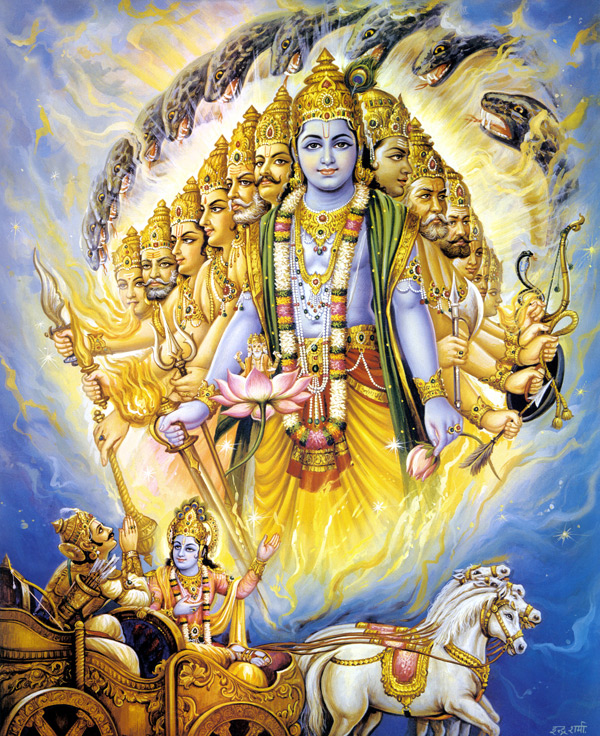
Krishna stands before the start of Kali Yuga and tells Arjuna what role he has to play under Kali Yuga. This drawing is the stage of the play Krishna prepares Arjuna and humankind for.

Steiner in the Teaching of Krishna, see The Word was a God - The Planet of Love
We not only admire the Bhagavad Gita for the reasons we have briefly given but because it strikes us as something so poetically great and powerful; because from every verse it radiates forth to us the great nobility of the human soul; because in everything spoken from the mouths of Krishna and his pupil, Arjuna, we feel something which lifts us above everyday human experiences, above all passions, above everything emotional which may disturb the soul.
We are transported into a sphere of soul-peace, of clearness, calm, dispassionateness, freedom from emotion, into an atmosphere of wisdom, if we allow even one part of the Gita to work upon us; and by reading the Gita we feel our whole humanity raised to a higher stage.…
When Krishna Himself caused to sound into the ears of Arjuna that which He then spoke, it sounded thus:
“I am Time, which destroys all worlds. I have appeared to carry men away, and even if thou shalt bring death to them in battle, yet all these warriors standing there in line would die even without thee.
Rise up, therefore, fearlessly. Thou shalt acquire fame and conquer the foe, Exult over the coming victory and mastery. Thou wilt not have killed them when they fall dead in the battle; by Me they are all killed already, before thou canst bring death to them.
Thou art only the instrument, thou fightest only with the hand The Dronas, the Jayadanas, the Bhishmas, the Karnas, and the other warrior heroes whom I have killed, who are already dead — now kill thou them, that my actions may appear externally when they fall dead in Maya; those whom I have already killed, kill thou them. That which I have done will appear to have been done by thee. Tremble not!
Thou art not able to do anything which I have not done already. Fight! Those whom I have already killed will fall by thy sword.”
…in everything spoken from the mouths of Krishna and his pupil, Arjuna, we feel something which lifts us above everyday human experiences, above all passions, above everything emotional which may disturb the soul.…
He is man as a whole; he is — one might almost say — humanity as such, thought of as a single being [Adam Kadmon.]

…Truly we are confronting a great cosmic mystery; for what says Arjuna when he sees his own self before him in bodily form? He addresses this own Being of his as though it appeared to him higher than Brahma Himself.…
And Arjuna said:
“Now I see Thee once more before me in Thy human shape, now knowledge and consciousness return to me and I am again myself, such as I was.”
And Krishna spoke:
“The shape which was so difficult for thee to behold, in which thou hast just seen Me, that is the form for the sight of which even Gods have endlessly longed. The Vedas do not indicate My shape, it will neither be attained by 'repentance, nor by charity, neither by sacrifice, nor by any ritual whatsoever. By none of these can I be seen in the form in which thou hast just seen Me.
Only one who knows how to go along the way in freedom, free from all the Vedas, free from all repentances, free from all charities and sacrifices, free from all ceremonials, keeping his eyes reverently fixed upon Me alone, only such an one can perceive Me in such a shape, he alone can recognise Me thus, and can also become entirely one with Me.”
This view is comparable with Jacob's view of the ladder or the Kaballah Tree of Life showing the angels ascending and descending, and Moses vision of God.
See more by Steiner on Krishna and Arjuna in Nathan Jesus.
I think Nara is the same as Narada Muni, the teacher Krishna sent to earth to help humanity come through the dreadful Kali Yuga, to spread Bhakti to humankind. Here a text on how he is assigned to educate mankind under Kali Yuga with Bhakti becoming part of him, Bhakti and Narada.
From Wikipedia: Nara-Narayana
Nara-Narayana (Sanskrit: नर-नारायण; Nara-nārāyaṇa) is a Hindu deity pair. Nara-Narayana is the twin-brother avatar of the God Vishnu on Earth, working for the preservation of Dharma or righteousness. Nara and Narayana are two bodies, one soul.
The Hindu epic Mahabharata identifies the Lord Krishna with Narayana and Arjuna - the chief hero of the epic - with Nara. The legend of Nara-Narayana is also told in the scripture Bhagavata Purana.
The name "Nara-Narayana" can be broken into two Sanskrit terms, Nara and Narayana. Nara means Human, and Narayana refers to the name of the deity.
Monier-Williams dictionary says Nara is "the primeval Man or eternal Spirit pervading the universe always associated with Narayana, "son of the primeval man"; both are considered either as gods or sages and accordingly called देवौ, ऋषी, तापसौ. In epic poetry, they are the sons of Dharma by Murti or Ahimsa and emanations of Vishnu, Arjuna being identified with Nara, and Krishna with Narayana.- Mahabharata, Harivamsa and Purana". Narayana and Nara both are forms of Vishnu.
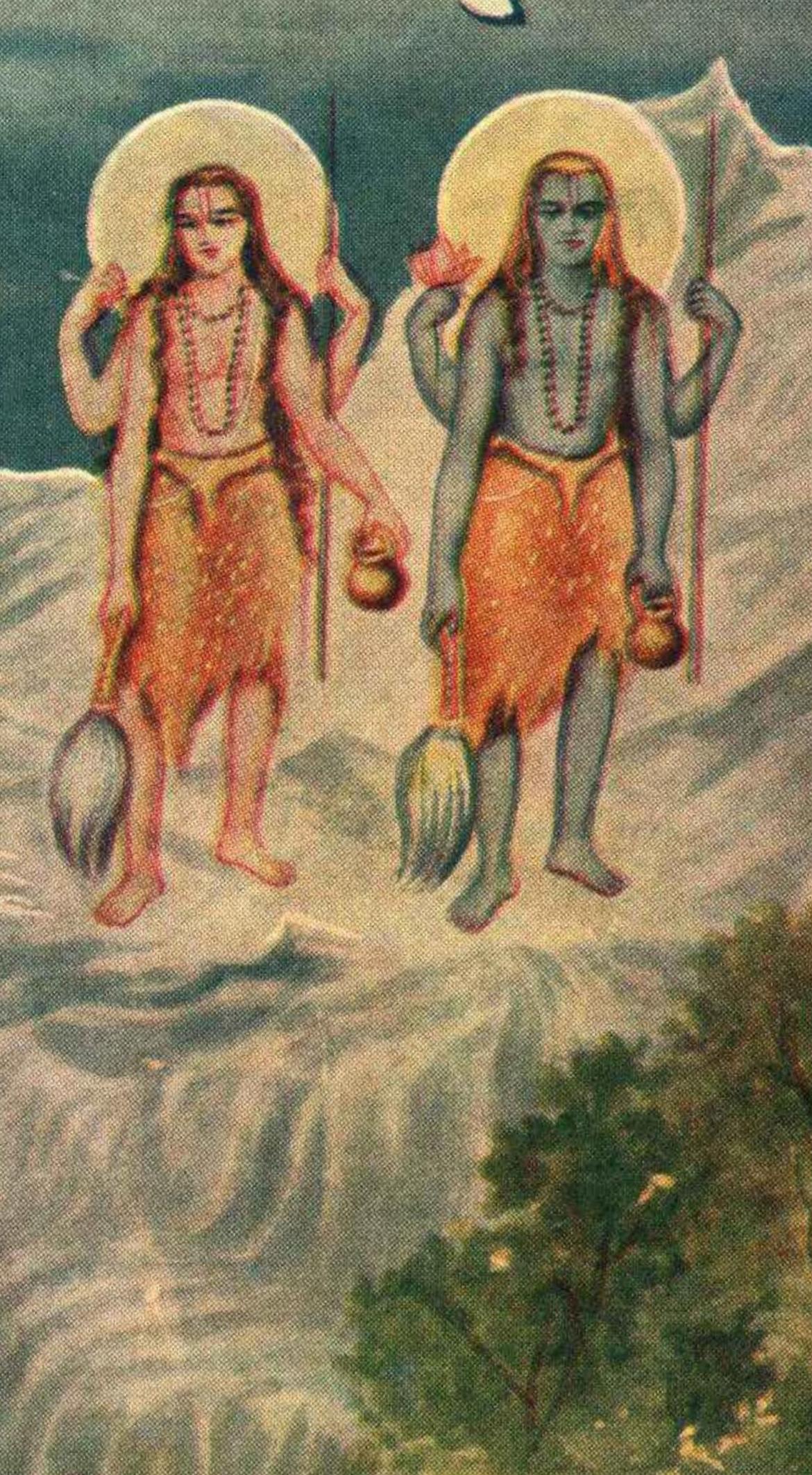
Nara-Narayana are depicted jointly or separately in images. When depicted separately, Nara is portrayed with two hands and wearing deer skin while Narayana is shown on the right in the usual form of Vishnu.
Sometimes, both of them are depicted identical to each other. They are depicted four-armed holding a mace, a discus, a conch and a lotus, resembling Vishnu. Nara and Narayana were the Fourth Avatar of Vishnu. The twins were sons of Dharma, the son of Brahma and his wife Murti (Daughter Of Daksha) or Ahimsa.
These two inseparable sages took avatars on earth for the welfare of mankind.
Legend has it that once Shiva tried to bring the fame of Nara and Narayana before the entire world. To do that, he hurled his own potent weapon Paashupathastra at the meditating rishis. The power of their meditation was so intense that the astra lost its power before them. In Vanaparvan (12. 46, 47), Krishna says to Arjuna,"O invincible one, you are Nara and I am Hari Narayana, and we, the sages Nara-Narayana, have come to this world at the proper time.." In the same Parva, chapter 40 (verse 1); Shiva says to Arjuna — "In former birth you were Nara and with Narayana as your companion, performed austerities for thousands of years at Badari".
Modified from Wikipedia: Arjuna
The word Arjuna refers to the character having white skin and clean hands. He is known by many other names, such as:
Arjuna is said to be born under the star Uttara Phalguni, also known as Denebola in the sign Leo. Krishna is the Lion and Arjuna his hand on earth.
From Wikipedia: Denebola
The traditional name Denebola is shortened from Deneb Alased, from the Arabic phrase ذنب الاسد ðanab al-asad 'tail of the lion', as it represents the lion's tail, the star's position in the Leo constellation.…
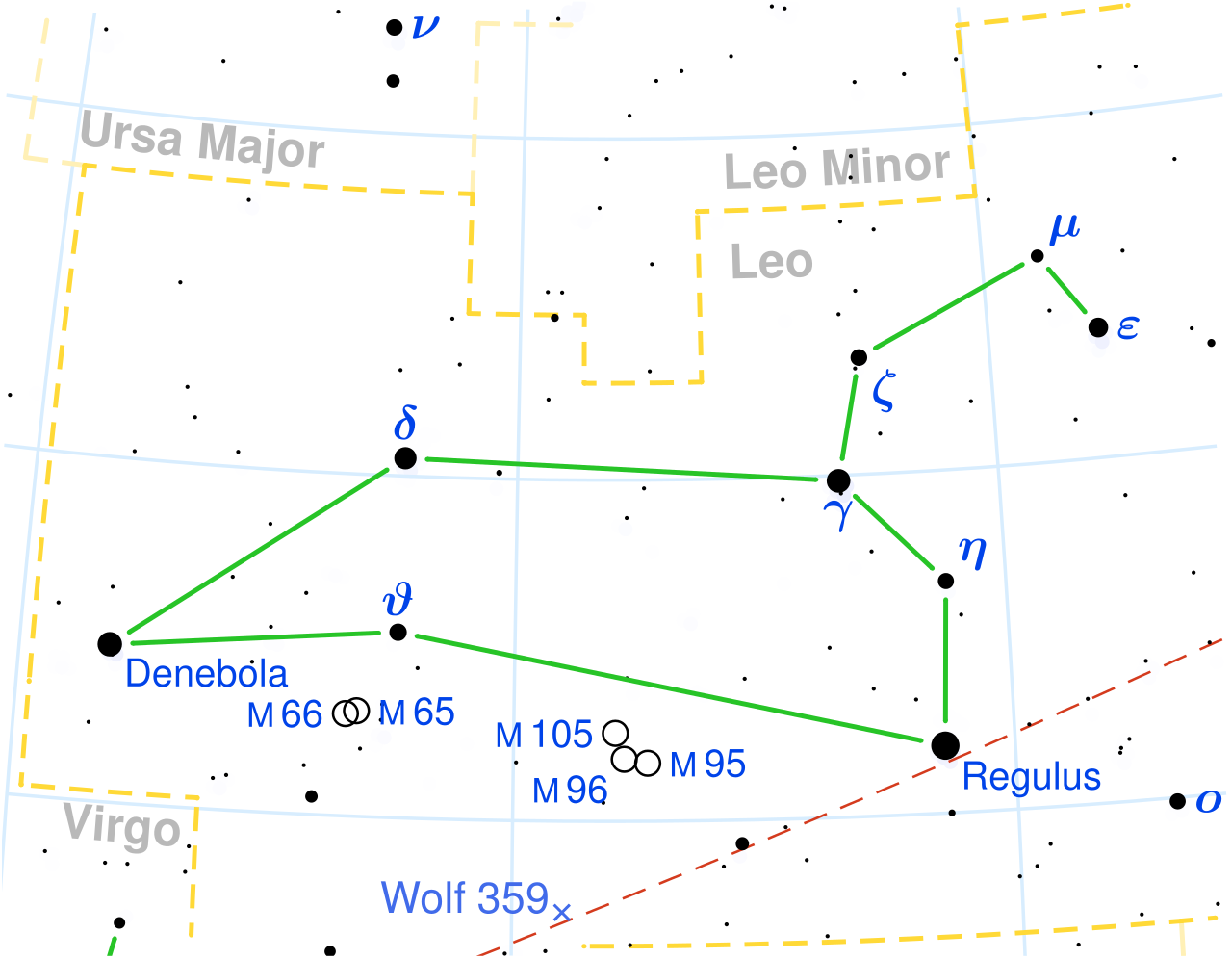
Ancient Chinese astronomers designated it the first star of the five-star asterism "Seat of the Five Emperors", hence its Chinese name 五帝座一 (Wǔdìzuò-yī).
Draupadi is the consort of Krishna, and her soul or I AM is Radha/Lakshmi. see Radha and Krishna.
From Wikipedia: Draupadi
The female protagonist of the Hindu epic Mahabharata. Draupadi (Sanskrit: द्रौपदी, romanized: draupadī, lit. 'Daughter of Drupada'), also referred as Krishna, Panchali and Yajnaseni, is the tragic heroine, one of the central characters and the common wife of the Pandavas in the Hindu epic, Mahabharata. She is described to be the most beautiful woman of her time and was prophesied to bring a major change in the future.
Draupadi emerged as a beautiful full grown young woman from the sacrificial fire after her sibling Dhrishtadyumna. When she emerged from the fire, a heavenly voice said that she would bring about a big change in the future of dharma of Bharat varsha. Draupadi is described to be the most beautiful woman of Dvapada Yuga with dark complexion, lotus eyes, beautiful convex nails, dark curly hair and an enchanting fragnance like that of a blue lotus.
In Sanskrit Mahābhārata, Draupadi is described as the incarnation of different goddesses. In Sambhava section of Adi Parva, she is said to be partial incarnation of Goddess Shachi or Indrani, wife of Indra.
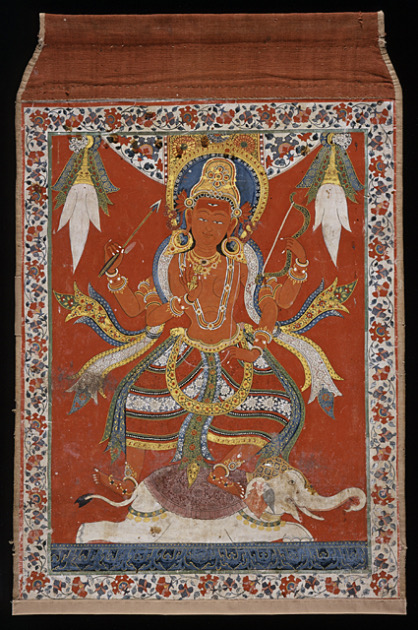
A painting of the Matrika Indrani, Nepal.
Shachi is described to be very beautiful and sensuous. She was the daughter of Puloman, an Asura son of the sage Kashyapa and his wife Danu. In a version, after Indra eloped with her, Puloman tried to curse Indra for taking his daughter but was killed by him.
However, in Vaivahika section of Adi Parva Vyasa describes Draupadi as the celestial Sri, Lakshmi and Radha. In Svargarohanika Parva, Yudhisthira goes to heaven and sees Draupadi seated as Goddess Sri (Or Sree).
In living traditions, however, Draupadi is seen more often as an incarnation of Adi Shakti and Goddess Kali. The Draupadi Amman sect (or Draupadi devotional sect) is a tradition that binds together a community of people in worshipping Draupadi Amman as a village goddess with unique rituals and mythologies. The sect believes that Draupadi is the incarnation of goddess Kali. Fire walking or Thimithi is a popular ritual enacted at Draupadi Amman temples. At the ancient religious festival of Bengaluru Pete named Bangalore Karaga, Draupadi is worshipped as an incarnation of Adishakti and Parvati in the nine-day event.