Kim Graae Munch
Kim Graae Munch
Rudolf Steiner on the Gospel of John
In the following "Spiritual Soul" is replaced by "Consciousness Soul" as
it is the term Steiner chose later.
In most english translations they have
translated "Ich" to ego, and it gives problems with other literature, New Age
and Jung, where they use ego as the sentience in the astral body, so I
have substituted "ego" with "I" that have the same meaning as "Ich".
From Gospel of John (Basle 1907): Lecture I
Now, the various religious records may be considered from four different points of view:
1. The point of view of the Simple Believer, who holds fast to the words that are giving him. Many people, however, cannot reconcile the standpoint with their modern thought and they then pass on to:
2. The point of view of the Critic, the Doubter, the one who denies. This is the point of view of the “clever, enlightened men”, who have “risen above” religious truths. But many of them search further and discover that a very great deal is nevertheless contained in these religious documents they wrestle through to:
3. The point of view of the Symbolists. These interpret the religious records in their own way and find in them much or little according to their knowledge or acuteness. In Germany many former Freethinkers have come to this point of view. Finally, it is possible through Spiritual Science to arrive at:
4. The point of view where one learns to take the religious documents literally once more. We find many remarkable examples of this in the study St. John's Gospel.
St. John's Gospel takes quite a special place among the four Gospels. The Gospel of Matthew, Mark and Luke give us an historical picture of Jesus, but St. John's Gospel is regarded as a kind of apotheosis, a wonderful poem. There are many contradictions when we compare it with the statements made in the other Gospels, but these contradictions are so apparent that it cannot be supposed that the old defenders of St. John's Gospel did not perceive them also.

It is repugnant to materialistic thinking to accept a Being who towers above all men; it is much more acceptable to them to see in Jesus a noble human being only, “the humble man of Nazareth.”
According to St. John's Gospel is quite inadmissible to see in Jesus only that which also lives in any other man. The Christ-soul in the Jesus-body is something quite different.
St. John's Gospel represents Christ to us not only as a very great man, but as a Being who embraces the whole earth.
If we translate St. John's Gospel according to the spirit and not only according to the words, the first 14 verses run approximately as follows: —
1. In the beginning was the Word, and the Word was with God, and the Word was a God
2. The same was in the very beginning with God
3. All things were made by Him, and without Him was not anything made that was made.
4. In Him was Life, and the Life was the Light of men.
5. And the Light shone in the darkness, but the darkness did not comprehend it.
6. There was a man sent from God whose name was John.
7. The same came for a witness, to bear witness of the Light, that through him all men might believe.
8. He was not that Light, that came to bear witness of the Light.
9. For the true Light, which enlighteneth all men, was to come into the world.
10. He was in the world, and the world was made by Him, but the world did not recognize Him.
11. It came into the several human beings, even into the I-men; but the individual human beings, the I-men, did not receive Him.
12. But those that did receive Him, to them gave He power to manifest that they were Sons of God.
13. Those who trusted in His Name were born, not of blood, nor of the will of the flesh, nor of the will of man, but of God.
14. And the Word was made flesh and dwelt among us, and we have heard His teaching, the teaching of the only begotten Son of the Father, full of devotion and truth. (in St. John's Gospel truth — aletheia — is Spirit Self, devotion — charis — is Life Spirit, and wisdom — sophia — is Spirit Man.)
Even the very first words are taken in an abstract sense by the modern man. The “Very Beginning” is thought of as an abstract beginning; but to grasp the true significance of this word we must recall what was taught on this point in the Christian Secret School of Dionysius the Areopagite.
Mineral, plant, animal, and man make up the series of being in evolution which require the physical body. Above them are beings who do not need the physical body, namely, the Angels, Archangels, Very Beginnings [Archai,] the Powers, Virtues, Dominions, the Thrones, Cherubim and Seraphim, and Beings still higher.
Thus the Very Beginnings are real Beings. They are those who, at the beginning of the evolution of our world, were already at the stage humanity will only reach at the end of its evolution (in the Vulcan Period.)
If in the light of this we study the first verse, “In the very beginning was the word,” we might represent the state of affairs pictorially by the following comparison.
Before we utter a word, this word lives in us as thought [The wordless or silent thoughts of our soul.] It lives within us [Christ.]
When the word is uttered the air around us is set in motion; vibrations are produced. If we imagine these vibrations condensed and hardened in some way, we should see the words fall to the ground as forms and figures; we should perceive the creative power of the word with our eyes. If the word is already creative now, it will be much more so in the future.
The Very Beginnings already possessed this creative power at the outset of the evolution of our world and can therefore be rightly looked upon as divine Beings [Christ.]
At the beginning of the evolution of the Earth a divine Word was uttered, and this has become mineral, plant, animal and man.

From Gospel of John (Basle): Lecture II
The fourth principle [the
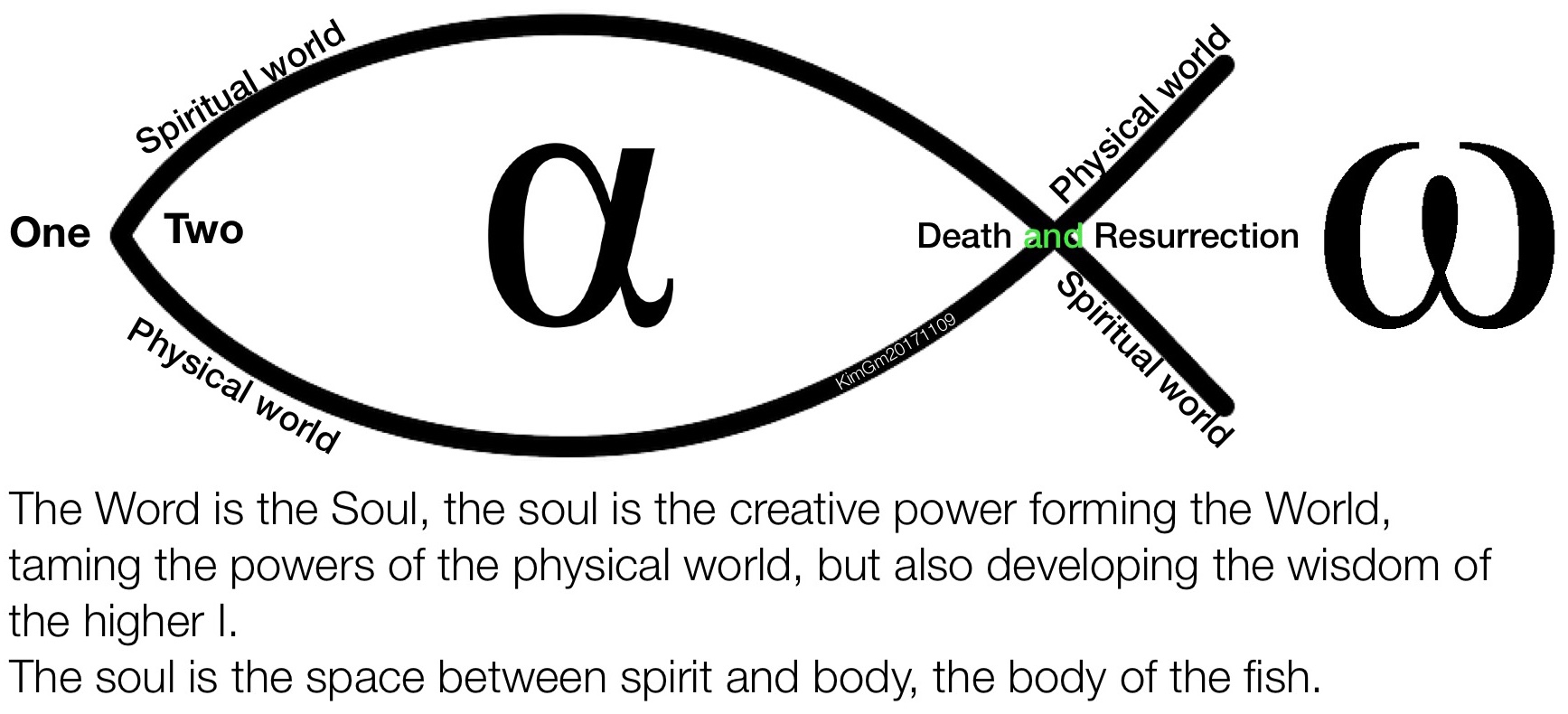
Soul] of man is the "I". The word “I” can only be uttered by a man with reference to himself; this word can never strike our ear from outside with reference to ourselves.
When this “I” sounds in a being, then God is expressing Himself in him.
In the Christian occult doctrine the world in which the I's of the animals are found — the astral world — is called the world of the Holy Spirit, and the world which contains the I's of the plants — the lower spiritual world [lower devachan, the world of the soul] — the world of the Son.
When the seer begins to have perceptions in this world, the “Word,” the “Logos” speaks to him. In the same occult teaching the world of the mineral I's — the higher spiritual world [higher devachan, the world of MANAS] — is called the world of the Father Spirit.
Man is involved in a process of continuous development. We have now become acquainted with all four principles of his nature; they are what Pythagoras referred to in his school as the lower quaternary. The savage, the civilised man, the idealist, the saint — all possess these four parts. But the savage is the slave of his passions; the civilized man no longer follows indiscriminately all his passions and desires; the idealist does this still less, and the saint has fully mastered them.
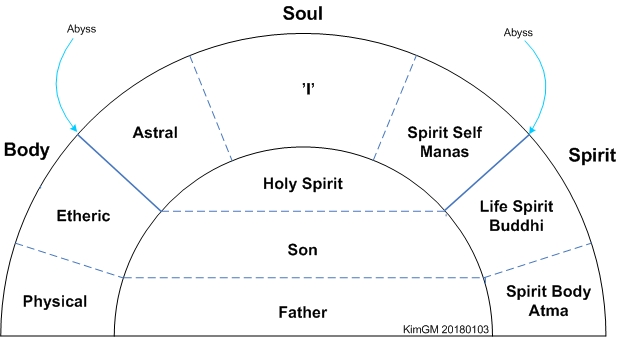
The I works upon the astral body and separates a portion from it. In the course of human evolution this part grows larger and larger, whereas the inherited portion becomes ever smaller. In Francis of Assisi almost the whole of the astral body was worked upon by the I and transformed. This transformed part forms the fifth principle of human nature: the Spirit Self.
But the I can also become master of the etheric or life-body. The part of the etheric body which has been transformed by the I is called Life Spirit. The etheric body is transformed under the influences of art and religion.
The influence of religion is especially strong because it is repeated day after day, and this repetition is the magic power which transforms the etheric body. But the conscious work in occult training acts most strongly upon the etheric body, and meditation and concentration are the means here used.
The relative speed in the transforming of the etheric body and the astral body may be compared to the movement of the hour and minute hands of a clock. If a man succeeds in changing his temperament ever so little, which depends on the conditions of his etheric body, this is of more value to him than the acquisition of many clever theories.
It requires the very greatest strength to change the physical body consciously. The means for this are only given in the occult school. We can only indicate here that the regulation of the breathing forms the beginning of this transformation. The physical body that has been consciously transformed by the I is called Spirit Man or Atma.
The force for the transformation of the astral body flows to us from the world of the Holy Spirit; the force for the transformation of the etheric body flows to us from the world of the Son or the Word; the force for the transformation of the physical body flows to us from the world of the Father Spirit or the Divine Father.
From Gospel of John (Basle): Lecture III
There is a remarkable agreement between the beginning of St. John's Gospel and the first words of the Bible. The first words of the book of Genesis are:
“In the very beginning God created the heavens and the earth;”
and in St. John's Gospel the first words are:
“In the very beginning was the word.”
These opening words give the fundamental tone to the whole of St. John's Gospel. The development of the earth can only be understood correctly when it is realised that in it the same laws are at work as in the evolution of the individual human being.
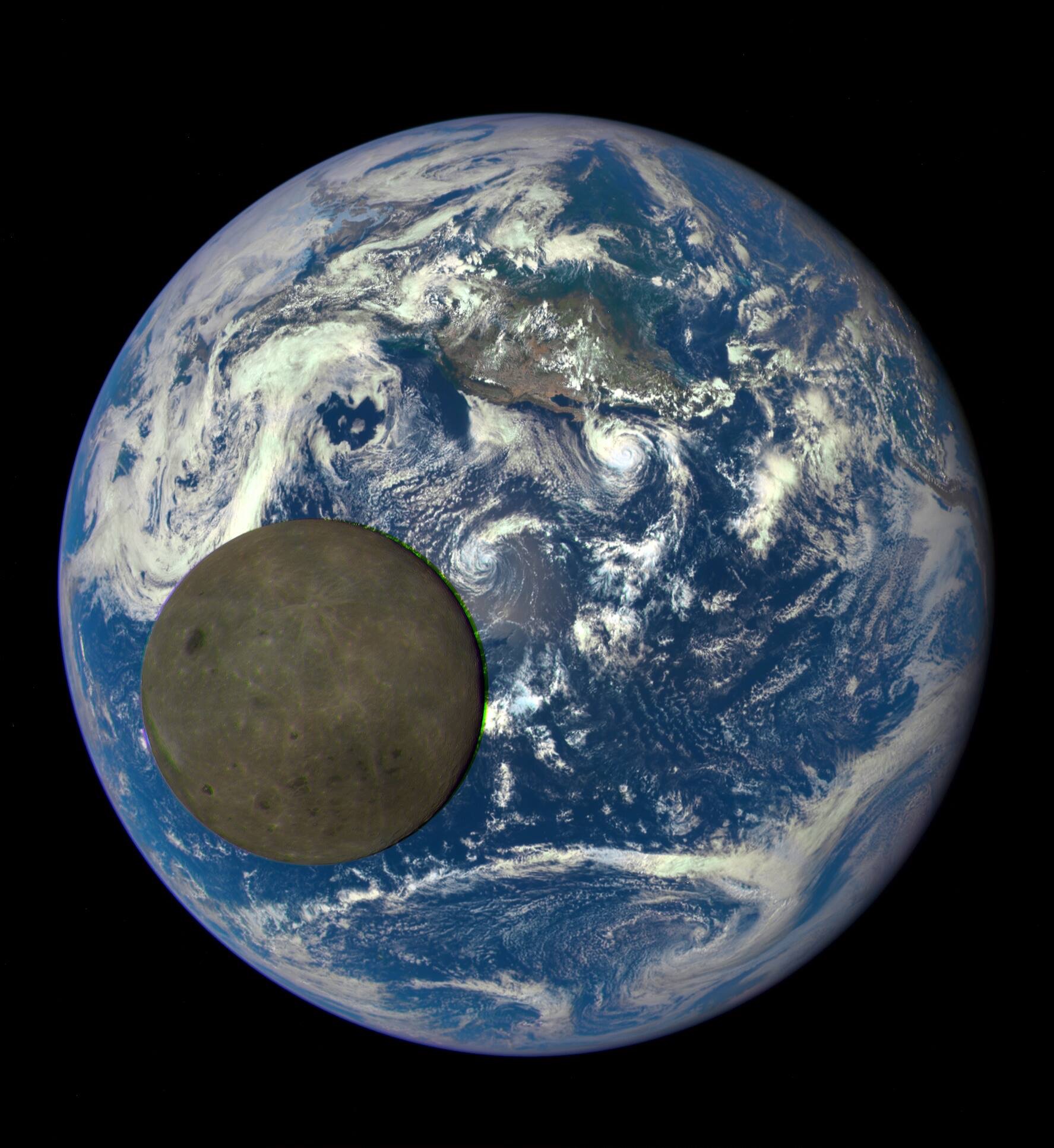 It was a sad time when the Sun was separated from the Earth and the Moon was still within it. There was a danger of man being immersed in mere form, of his spiritual part dying out and with it all possibility of development.
If the Sun had remained united with the Earth, this would have caused man to develop so rapidly in the direction of the spiritual that he would not have been able to develop himself corporeally. If, on the other hand, the Moon forces had remained united with the forces of the Earth [the Angels, Krishna/Abel] all life would have hardened in mere form, the human beings would have become statues and, as Goethe says in “Faust”, a “crystallised people” would have originated.
Through the separation of the forces of the Sun and Moon from the Earth there was brought about the balance between life and form [Christ principle, Center Pillar,] which was necessary for the evolution of humanity.
It was only because these forces could from this time forth work upon man from outside that he could continue to develop in the right way. The forces coming from the Sun create and fertilise life; the forces coming from the Moon pour this life into firm forms.
The form of the physical body we now possess we owe to the Moon; but the life which sinks into this body comes from the Sun.
It was through one of the Sun-Beings uniting himself with the Moon that these two streams from the Sun and Moon work in the right way. The Beings standing at the stage of the Gods separated with the Sun; that one of these Beings separated himself from the rest and made the present Moon his dwelling place [Krishna.]
This Spirit who is united with the Moon is known as Jehovah, the God of Form or the Moon-Deity. This God Jehovah or Jahve so moulded the three bodies of man that they became capable of receiving the drop of the I [This is the three deeds of Christ, of Krishna.] Jehovah formed the human body in his image, “in the Image of God created He him:” (Genesis 1:27.)
We have now arrived at the point touched upon by the Evangelist John in the first verse of his Gospel: “In the very beginning was the Word.” The highest Spirit united with the Sun, He who sent the I's to the Earth, is called in the occult teaching: “Christ.” But the I's, as parts of the Sun-Logos, only streamed gradually into the forms.
The “Light” streamed forth from the Sun-Logos, but few received it in those old times; those, however, who received it became different from their fellow-men. They were called children of God or Sons of God (St. John, 1:13). They possessed four principles, physical body, etheric body, astral body, and I, although the fourth, the youngest principle, was still weak and dim [pioneers, the old souls.]
The “light,” however, is to come to all men, but for this time is needed. This is indicated in verses eight to fourteen.
But there were a few men who had already received the light to a high degree so that they knew about it and could bear witness to it, and these taught others. Those who bore witness to the “light” from their own experience, those who were able to point out that One was coming Who for the first time would offer the light to all, were in the occult teaching called “John” (Chapter 1:6-7).
The writer to one of these “Johns.” In verse eighteen we read: “No man has ever seen God.” That is to say, no one before “Johns,” for He only became personified in Christ Jesus.
The Event of Golgotha is the greatest Event in the evolution of Man and the Cosmos.

From Steiner: Origin of Suffering, Origin of Evil, Illness and Death
Earth-existence signifies the Cosmos of Love; existence on the previous planet signifies the Cosmos of Wisdom.
We are to evolve love from its most elementary stage to its highest.
Wisdom rests hidden on the foundation of earth-existence. One should not speak therefore of the “lower” physical human nature, for it is really the most perfected form of man. One should look at the wisdom-filled structure of a bone, for instance the upper thigh bone. We see there solved in the most complete way the problem of how to carry the greatest possible mass of weight with the employment of the least material and force. One should look at the marvellous structure of the heart, of the brain, The astral body does not indeed stand higher. It is the “enjoyer” which makes continual attacks on the wisdom-filled heart.
It will still take a long time to become as perfect and wise as the physical body. But it must become so, for that is the course of evolution. The physical body had to evolve too; what is wise in it had to develop out of unwisdom and error.
Evolution of wisdom preceded the evolution of love; love is not yet perfected. It is to be found in the whole of nature, in plant, animal and man from the lowest sex-love to the highest spiritualised love.
Immense numbers of beings which the love-urge brought forth are destroyed in the battle for existence.
Conflict is active wherever love is, the entry of love brings conflict, necessary conflict. But love will also overcome it and change conflict into harmony.
From Gospel of John (Hamburg 1908), Lecture III: The Mission of the Earth
The human being, in fact, always follows along groping his way behind the cosmic wisdom. As a principle, all that men will discover in the course of the Earth's evolution is already present in nature.
But what the human being will really give to the Earth is love, a love which will evolve from the most sensuous to the most spiritualized form of love. This is the mission of the Earth-evolution. The Earth is the cosmos of love.
From Gospel of John (Basle): Lecture IV
In Christian occult science the Old Moon is called the Cosmos of Wisdom and the Earth the Cosmos of Love.
By “Moon” we here mean the Moon Period of the Earth. The reason why the Old Moon is called the Cosmos of Wisdom is because all that was then developed was filled with wisdom. [Only gradually throughout the whole of the Moon evolution was wisdom stamped upon the outer world.]
When the Earth Period succeeded the Moon Period the Cosmos of Wisdom was replaced by the Cosmos of Love. When the Earth came forth from the darkness of Pralaya, the rudiments of the human being which had been developed in former periods reappeared — the physical, etheric and astral bodies.
On the Old Moon Wisdom had been implanted in these bodies and their mutual relationships; we therefore find wisdom in the constitution of these three bodies. We find the greatest wisdom in the construction of the physical body, less in that of the etheric body, and still less in that of the astral body.
Wisdom lies at the foundation of the construction of the world, and it is for this reason that our intellect can now seek and find it there. But wisdom did not come suddenly into the world, it was only poured in slowly and gradually; and in the same way love will also permeate the Earth very gradually.
The purpose of the evolution of our Earth is to be permeated with love. Love has only begun to permeate the Earth to the smallest extent, but it will spread more and more, and at the end of the Earth Period everything will be saturated with love, just as it was saturated with wisdom at the end of the Moon Period.
It was the planet Mars which brought iron to the Earth, and from that time it was possible for Man to develop warm blood containing iron. Through Mars the astral also received a new principle, the sentient soul, the courageous soul.
When Mars entered, the aggressive element developed in the soul. We have now to distinguish in men the physical body, the etheric body, the astral body and the sentient soul. Red, warm blood was the result of the activity of the sentient soul on the physical body; then the fertilising I could gradually be membered into the human being. “Blood is a very special fluid.”
The God of Form, Jehovah [Krishna,] now played a specially important role. He took possession of the newly developed organ, the blood, permeated it with His forces, transformed the aggressive qualities of the
courageous soul into the forces of love and made the blood into the physical vehicle of the
I.
In the beginning each human individual did not possess his own
I. The same Jehovah-force, the I-force, the same I worked in all who were related by blood, who preserved the same blood through endogamy (near marriage). A small group of this kind had a common
I.
The individual was related to the whole family as a finger is related to the whole body. In the beginning there were group-souls; the individual felt himself to be part of the family or tribe; and the same I lived on through several generations, it was not confined to those who were living at the same time; the common I was felt as long as the blood remained unmixed, as long as those who belonged to the same tribe intermarried. Therefore the I was not felt as something personal, but as something common to all the members of the tribe.
On the Old Moon there was something else in place of the breathing of air. Whereas the man of the present day breathes air in and out and thereby has a source of warmth within himself, his ancestors on the Old Moon consisting of physical, etheric and astral bodies; breathed the substance of warmth or fire in and out. Man's predecessors on the old Moon were fire-breathers.
Occult Science looks upon all matter only as the expression of spirit. We breathe in and out not air alone, we breathe in the Spirit it contains.
Air is the body of Jehovah just as flesh is the body of man. The remembrance of this is expressed in the German legend of Wotan [Krishna] who rides in the Wind. What was breathed in and out on the Old Moon was also spirit.
Between Man and these highly developed Sun-Spirits there are the spiritual Beings, who, it is true, developed very much further than man upon the Moon, but not as fast as the Sun-Spirits and Jehovah. They were unable as yet to influence man through his breathing, nevertheless they endeavoured to influence him. They were the Fire-Spirits [Luciferic Spirits] who had not completed their task. They worked in the element of warmth and this existed in man his blood. They lived in this warmth.
Thus in the course of his evolution man was placed between the Air-spirits, who live in his breathing (the highest Spirits who permeate him with Spirit), and the fire-spirits who live in the warmth of his blood. They act in his blood as the opponents of the God Jehovah. [The opposing forces Shiva and Krishna.]
Jehovah sought to hold men together by love in small groups, He desired to fill them with the feeling of belonging together. But if love had only existed in this form men would never have become independent beings; they would have had to develop love involuntarily. The Fire-spirits directed their attacks against this, with the result that man gained his personal freedom. The small groups of people were broken up. Jehovah's only interest was to lead people together in love, He worked in the blood as the God of blood-love.
 The action of the Fire-spirits was different; it was they who brought art and science to men. These Spirits are also called
Luciferic Spirits [Shiva.] The further course of the evolution of humanity proceeded under the influence of Lucifer, who brings freedom and wisdom to man. Under the guidance of the God
Jehovah [Krishna] men were to be led together through the principle of blood-brotherhood. The fact that man has become a free citizen of the Earth, — this he owes to Lucifer.
The action of the Fire-spirits was different; it was they who brought art and science to men. These Spirits are also called
Luciferic Spirits [Shiva.] The further course of the evolution of humanity proceeded under the influence of Lucifer, who brings freedom and wisdom to man. Under the guidance of the God
Jehovah [Krishna] men were to be led together through the principle of blood-brotherhood. The fact that man has become a free citizen of the Earth, — this he owes to Lucifer.
Jehovah placed men in the Paradise of Love; then there appeared the Fire-spirit, the Serpent, in the form which man once possessed when he still breathed fire, and opened men's eyes to what still remained from the Old Moon.
This Luciferic influence was perceived as a temptation. But those who were instructed in the occult schools did not look upon this enlightenment, as wrong; the great Initiates have not cast the Serpent down but, like Moses in the wilderness, they have raised it. (Numbers 21:8-9).
Love gradually spread from smaller to larger groups of human beings, from families to tribes and peoples. A characteristic example of this is the Hebrew people, which felt itself as a group which belonged together and called all others “Galileans,” i.e. those who did not belong to the blood.
But humanity was to receive not only blood-love but spiritual love, which will embrace the whole earth with a bond of brotherhood. The period during which humanity was held together by the love which existed between relations is only to be looked upon as a period of preparation for what was to come later.
The action of Lucifer, too, which consisted in splitting apart the bonds which confined human beings, is only the preparation for the activity of a higher Being who was to come. This higher Being was called in the Christian occult schools the true Light-bearer, the true Lucifer, the Christ.
From Gospel of John (Basle): Lecture V
The law was perceived as something coming from outside, and this Law which was given from outside holds good until the “grace and truth,” or devotion and truth, which comes through Jesus Christ, has developed in us from within, the understanding for the true knowledge.
Through the advent of Christ Jesus an entirely new kind of initiation came in. Imagine that a man has transformed the whole of his astral body into Spirit Self. This Spirit Self then impresses itself into the etheric body, as a seal impresses itself into sealing-wax, and gives it its imprint. The etheric body is thereby changed into Life Spirit. When this has come about completely, the Life Spirit then imprints itself in the physical body and makes it into Spirit Man.
Now it was only through the appearance of Christ Jesus that it became possible to imprint the Life Spirit directly into the life body [ether body]; and the experiences undergone in the higher worlds could henceforth be embodied in the physical brain without the necessity of a previous separation of the etheric body.
Thus all the pre-Christian initiates had undergone the experiences of initiation outside the physical body; they had then descended again into the physical body and could from that time forward, out of their own experience, announce what had taken place in the spiritual world. Buddha, Moses and others were initiates of this kind.
In Jesus there had come to the Earth for the first time a Being who, while still remaining in the physical body, could see the life of the higher worlds.
The teachings of Buddha, Moses, etc., were quite independent of the personality of their agent. Those who accept the teachings of
Buddha or Moses are Buddhists or followers of Moses, for these founders of religion only passed on what they had experienced in the higher worlds.
With Christ it is different. It is only through His personality that His teachings become Christianity, and in order to be a Christian it is not enough merely to follow the teachings of Christianity. Those alone are true Christians, who feel themselves united with the historical Christ. Certain sentences contained in Christian teaching, or something very similar to them, could also be found in that world before Christ appeared; but that is not the point. The essential thing is, that the Christian believes in Christ Jesus, that he considers Him to be the One Who, while walking in the flesh, represents the perfect man. [United with the 'I'.]
In Christ the Deity had for the first time come down visibly to the Earth.
This is told us in St. John's Gospel, (Chapter 1:14): “And the Word was made flesh, and dwelt among us (and we beheld His glory, the glory as of the only begotten of the Father), full of grace and truth.” It was also taught in the Dionysian School. Christ came to show men the way; they are to become His followers; they are to prepare to imprint what is in the etheric body into the physical body; that is to say, to develop within themselves the Christ principle.
The disciple “John” is never mentioned by name in this Gospel. We read of him as “the disciple whom the Lord loved,” for example in Chapter 19:26. This is a technical expression and signifies the one who was initiated by the Master Himself.
“John” describes his own initiation in the story of the “raising of Lazarus.” (Chapter 11).
It was only through the writer of St. John's Gospel being initiated by the Lord Himself that the most secret connections between Christ and the evolution of the world could be revealed.
As we have already said, the old initiations lasted for three and a half days; hence the raising of Lazarus on the fourth day. It is also said of Lazarus that the Lord loved him (John 3:35-36.)
While the body of Lazarus lay as if dead in the grave, his etheric body was lifted out in order to undergo the initiation, and to receive the same force that is in Christ.
Thus the one whom the Lord loved, the one to whom we owe St. John's Gospel, was raised, he was awakened. Not a line in St. John's Gospel, contradicts this fact; the process of initiation is represented in a veiled way.
Let us now consider another scene in this Gospel. In (John 19:25), we read:
“Now there stood by the cross of Jesus, His mother, and His mothers sister, Mary the wife of Cleophas, and Mary Magdalene.”
If we wish to understand this Gospel it is necessary to know who these three women are.
We do not usually give two sisters the same name; neither was it the custom in former times. The passage we have quoted proves that, according to St. John's Gospel, the mother of Jesus was not called Mary.
If we search through the whole of this Gospel we nowhere find it said that the mother of Jesus was called Mary. In the scene of the Marriage of Cana, for example, Chapter 2, we only read, “the mother of Jesus was there.”
In these words something important is indicated, something we only understand when we know how the writer of this Gospel uses his words. What does the expression “the mother of Jesus” mean? We have seen that man consists of physical, etheric and astral bodies. We must not consider the transition of the astral body to the Spirit Self so simply.
The I transforms the astral body very slowly and gradually into sentient soul, intellectual soul and Consciousness Soul. The I goes on working and only when it has developed the Consciousness Soul is it able so to purify it that Spirit Self can arise in it.
The following diagram represents the constitution of man.
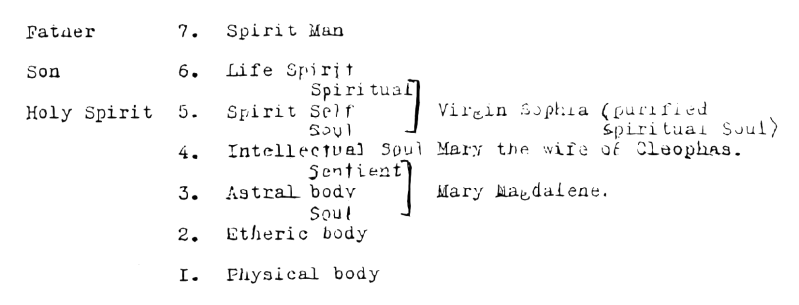
The Spirit Man will only be developed in the distant future, and Life Spirit is also only germinal in most people of the present day. The development of the Spirit Self has only just begun; it is closely united with the Consciousness Soul (somewhat like a sword in its sheath). The sentient soul is similarly united with the astral body.
The human being thus consists of nine parts or principles; but as the Spirit Self and the Consciousness Soul, and the sentient soul and the astral body are so closely united, we often speak of seven parts. Spirit-Self is the same as the “Holy Spirit,” who according to esoteric Christianity, is the guiding Being in the astral world. According to the same teaching, Life Spirit is called the Word or the Son; and Spirit Man is the “Father Spirit” or the “Father.”
Those human beings who had brought the Spirit Self to birth within them, were called Children of God; in such men “the light shone into the Darkness and they received the light.” Outwardly they were, men of flesh and blood, but they bore a higher man within them; the Spirit Self had been born within them out of the Consciousness Soul.
The “mother” of such a spiritualised man is not a bodily mother, she lies within him; she is the purified and spiritualised Consciousness Soul; she is the principle who gives birth to the higher man. This spiritual birth, a birth in the highest sense, is described in St. John's Gospel.
The Spirit Self or the Holy Spirit pours into the most highly purified Consciousness Soul. This is referred to in the words, “I saw the Spirit descending from heaven like a dove, and it abode upon him.” (John 1:32).

As the Consciousness Soul is the principle in which the Spirit Self develops, this principle is called the “mother of Christ,” or, in the occult schools, the “Virgin Sophia.” Through the fertilisation of the Virgin Sophia the Christ could be born in Jesus of Nazareth. In the occult school of Dionysius, the Intellectual Soul was called “Mary,” and the Sentient Soul “Mary Magdalene.”
As the Consciousness Soul is the principle in which the Spirit Self develops, this principle is called the “mother of Christ,” or, in the occult schools, the “Virgin Sophia.” Through the fertilisation of the Virgin Sophia the Christ could be born in Jesus of Nazareth.
In the occult school of Dionysius, the Intellectual Soul was called “Mary,” and the Sentient Soul “Mary Magdalene.” The Physical man is born of the union of two human beings; but the higher man can only be born of a Consciousness Soul which embraces a whole people [The First Logos, Elijah.]
Among all the peoples of olden times the method of initiation was essentially the same. Each initiation had seven stages or degrees. Among the Persians, for example, they were called as follows: —
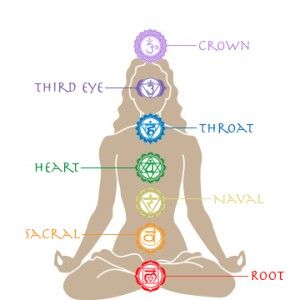 1.
The Raven. [Root
chakra.] One at this stage had to bring information from the outer world into the temple. The Raven has always been called the spiritual messenger, for instance in the legend of the Ravens of Barbarossa, and also in the German legends of Odin and his two ravens.
1.
The Raven. [Root
chakra.] One at this stage had to bring information from the outer world into the temple. The Raven has always been called the spiritual messenger, for instance in the legend of the Ravens of Barbarossa, and also in the German legends of Odin and his two ravens.
2. The Occult. [Sacral chakra.]
3. The Warrior. [Solar Plexus chakra.] In the occult school the warrior was allowed to go forth and announce the teachings.
4. The Lion. [Heart chakra.] The Lion was one who was firmly grounded in himself; he not only had the word, but he possessed also the magical forces; he had stood the test which guaranteed that he would not misuse the powers entrusted to him.
5. The Persian; [Throat chakra.]
6. The Sun Hero. [Third Eye chakra.]
7. The Father. [Crown chakra.]
Let us consider the title of the fifth degree,the “Persian”, a little more closely. In all the occult schools an initiate of the fifth degree was called by the name of the people to whom he belonged; for his consciousness had widened where it included the whole people. He felt all the sorrow of the people as his own; his consciousness had been purified and expanded to the consciousness of the whole people.
Among the Jews the initiate at this stage was called an “Israelite.” Only when we grasp this fact do we understand the conversation between Christ and Nathanael (John 1:46-49). Nathanael was an initiate of the fifth degree. The words of Christ Jesus to Nathanael, that he had seen him under the fig tree, refer to a special process in initiation, namely, the reception of the Consciousness Soul.
The following considerations will help towards the understanding of the inner process of initiation. The individual “I”-consciousness of man is in the physical world; men walk the Earth with their I. But the I's of the animals are on the astral plane; each group of animals there possesses an I-consciousness in common. There is, however, in the astral world, not only the I of the animal, but also the I of the body which man has in common with the animals, the I [the ego of New Age and Jung] of the human astral body. In the Lower Spirit World we find the I of the plants and also the I of the body man possesses in common with the plants, the I of the etheric body.
The I of the etheric body may be compared to the engineer who builds a motor-car; the I of the astral body may be compared to the one who drives it; and the I of the individual to the one who owns it.
From Gospel of John (Basle): Lecture VI
Over in the Far East the first post-Atlantean civilisation arose, a civilisation to which the ancient Vedas still bear witness. The first impulse for this civilisation was given towards the south in the old Indian Civilisation. The reports of this fact are preserved in the old Indian legends and in the religious records, and they can be read by one who is clairvoyant. Many statements that are apparently contradictory prove to contain the deepest truth.
The men of this civilisation had preserved clear remembrances of the former old clairvoyance, and they still longed for it, for they looked upon it as a valuable possession which they had lost. They were still so filled with the reality of the spiritual world that they looked upon the physical as maya, illusion. Hence they sought to regain this lost treasure by turning away their gaze from all that is earthly and continually directing it to the spiritual. This is the origin of the Yoga exercises, which seek to lead the pupil into the spiritual world by diminishing the consciousness. They desired to return to the old dreamy state; they sought the path which would lead them back into the Paradise they had lost.
Throughout the whole of the Atlantean Epoch man had only perceived the outer world in dim, unclear outlines; the Atlantean lived chiefly in the spiritual world. To the spiritual investigator the whole of the post-Atlantean Epoch signifies but a gradual conquest of the physical plane.

The men of the first post-Atlantean civilisation, the Indian had little feeling for what was outside in physical nature; for the Initiates it was an absolute illusion, and they strove to get away from it and reach the only reality, the spiritual world.
The second was the old Persian civilisation. The Persian was already closer to the outer world than was the Indian. He learned to distinguish especially between good and evil, represented by the Gods Ormuzd and Ahriman; he strove to unite himself with the former in order to combat the latter. The Earth was for him a place for work, in order to embody the Spirit in physical existence.
The third age of civilisation was the Egyptian-Assyrian-Chaldean-Babylonian, and here, again, man made a further step forward in the conquest of the physical plane. To the Persians the world was physically an undifferentiated field for work; in the Egyptian civilisation man began to apply his knowledge and make it useful. He applied his knowledge of Geometry and divided the land; he directed his gaze to the stars, and laid the foundations of Astronomy.
The fourth was the Graeco-Latin age of civilisation. Hitherto man had occupied himself in applying his science to the things of the outer world; he now began to embody his own inner being, his specifically human nature, in matter. His own form reappeared in his works of art, and in his epics and dramas he described his own psychic qualities. The Romans developed the idea of citizenship, and so the State and Jurisprudence arose.
In the fifth age of civilisation, in which we are now living, man has gone still further in the mastery of the outer world. In our age the Spirit has descended most deeply into matter. This descent had to come if humanity was to progress; only when the Spirit has descended fully into matter can its reascent begin.
In our age we have a great development of science, and with its aid we can control the various forces of nature. In ancient times, when men ground their corn in a most primitive way between two stones, they did not need to expend much mental power to satisfy their simple needs, but things are quite different now.
Think of the immense expenditure of mental effort necessary to satisfy the material needs of the modern man. We have locomotives, steamships, telephones, electric light. An immense amount of mental power has been embodied in matter in these things, but the spiritual interests of men here pass entirely into the background.
Thus we see that the whole development of humanity in the post-Atlantean Epoch has signified a descent of the human spirit into matter. But the purpose of this descent is the conquest of matter, this great opponent of the Spirit; for after the deepest descent, an ascent to conscious, spiritual life must now begin.
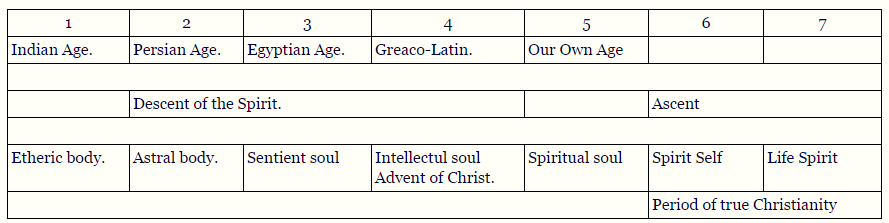
Christ Jesus appeared as the great Personality Who brought to humanity the power which would enable it later to rise to the Spirit. All the former ages of civilisation can also be looked upon as a preparation for Christianity.
In the fifth age of civilisation Christianity has to withstand the severest testing, for materialistic thought darkens and hides the spiritual truths of Christianity.
In the sixth age Christianity will unite humanity into a great bond of brotherhood, and Spiritual Science or Anthroposophy must be looked upon an the messenger of this coming age, for it is preparing the way for the spiritualising of humanity.
In the Indian Age the etheric body was especially developed [First Deed of Christ/Krishna.] In that first age of civilisation the Indians were very receptive to the spiritual life, and this was connected with a special development of the etheric body.
In the Persian civilisation the astral body was specially developed [Second Deed of Christ/Krishna.]
In the Egyptian-Assyrian-Chaldean-Babylonian civilisation the Sentient Soul was developed; [Third Deed of Christ/Krishna.]
In the Graeco-Latin civilisation the Intellectual Soul [Fourth Deed of Christ Jesus.],
And in our own age the Consciousness Soul [Fifth Deed of Christ/Holy Spirit/Christian Rosencreutz.]
In the sixth age the Spirit Self [Sixth Deed of Christ/Holy Spirit/Maitreya,] as yet is only in a germinal condition, will be developed.
We see how in the third age, a relatively small body of people, the Hebrews, prepared the conditions which made the appearance of Christ possible; how in the fourth age the power of Christ penetrated into the physical; how in the fifth age humanity sank most deeply into the physical world; now, after humanity has gained the mastery over this physical world, it will gain a still greater power and capacity in the sixth age to receive into itself the spiritual life which the Christ Spirit has brought.
Christ appears as the firstborn, the man who is far ahead of his time, who has already reached the stage which the rest of humanity will only reach in the sixth age. The fifth is the most material age in the evolution of humanity.
In the sixth and seventh ages of civilisation the Spirit Self and the Life Spirit will develop through the power of Christ in those who rely upon Him, and at the same time these will gain healthy thought and feeling. Christianity brings health and healing, for the life force of Christ conquers all disease and death.
The human body as a solid body has developed out of liquid substances. The five porches or halls which surround the pool of Bethesda signify the five ages which man has used to penetrate more and more deeply into the body, and in the end he has succumbed entirely to matter. Only after he has passed through these five ages can man be healed. One who has entered into these five halls cannot be healed unless the great Healer, the Christ, approaches him; but when this happens, there takes place what is described in the fifth chapter of St. John's Gospel. Thus the story of the man who had been ill for thirty-eight years is a prophetic announcement of what will take place in the sixth age, when man will no longer need any remedies, because he will be his own healer.
See Krishna and the Holy Spirit.
The explanations here given must not give rise to the idea that the descriptions in St. John's Gospel are to be looked upon as symbols only.
In ancient times names were not given arbitrarily, they were strictly adapted to the person's character.
It is true that the three women who stood by the cross of Jesus represented the three souls, the sentient soul the intellectual soul and the Consciousness Soul; but it is also true that these three persons stood there in the body at the foot of the cross.
When we read St. John's. Gospel we look at the symbolical pictures of what will be realised on this Earth in the next age of civilisation; but we also see what actually took place at the beginning of our era. All the historical facts are presented by the wise powers that are guiding humanity as symbols of the future evolution of humanity.
From Gospel of John (Basle): Lecture VII
The Beings who, at the very beginning of the evolution of the Earth, had already the state of perfection which humanity will only achieve at the end of earthly evolution, have their seat in the Sun. Christ belongs to these Beings as a cosmic- force.
What Steiner writes here has a specific meaning. All who have fulfilled their development have their seat in the Sun, are Sun Initiates, are part of the great being Adam Kadmon. Those who haven't fulfilled are not part of the Sun or Adam Kadmon, like the Luciferic beings.
His astral body, therefore, was united with the astral body of the Sun at the beginning of our present earthly evolution. He had His seat in the Sun.
When the personality of Christ came to the Earth, the astral body of this cosmic force of the Christ Spirit [Holy Spirit, Krishna] sank down to the Earth at the same time, and ever since the incarnation of Christ on the Earth His astral body has been continually united with the astral body of the Earth.
Through the appearance of Christ on Earth the astral body of the Earth has received from the Sun an entirely new substance. If at the time of Christ a Being had looked towards the Earth from another planet, he would have seen the addition of this new substance to the astral body of the Earth in the change of the colour radiating, from the astral body.
Through the union of His astral body with that of the Earth, the Sun Spirit Christ became the Spirit of the Earth as well. The Christ is therefore Sun Spirit and at the same time Earth Spirit.
From the time when Christ walked the earth He has remained continuously united with the earth; He has become the planetary Spirit of the Earth. The Earth is His body, and He guides the evolution of the Earth.
He accomplished this union upon Golgotha, and the Mystery of Golgotha is the symbol of what took place at that time for the evolution of the Earth.
From Gospel of John (Hamburg 1908), Lecture I: The Doctrine of the Logos
Thus, it is alleged, the very first words of the Gospel, “In the beginning was the Word, and the Word was with God and the Word was a God” show that the Logos-idea of Philo had entered into the spirit of the writer of this Gospel and had influenced his form of presentation.
What was said by those who were eye-witnesses and ministers of the Logos shows that in olden times the Logos was spoken of as something which the people knew about and with which they were familiar. And this we must particularly hold in mind in order that we may penetrate more deeply into the first paradigmatic verses of the Gospel of St. John. What was a writer speaking about, if at that time he used the word “Logos” or “Word” in our sense? What could he have meant?
The followers of St. John said further: What appears last in the human being existed in the world in the very earliest times. We fancy that the human being in his present form did not exist in the earlier conditions of the earth. But in an imperfect, mute form he was there and little by little he evolved into a being endowed with the Logos or the Word.
This became possible through the fact that what appears within him later as the creative principle was there from the very beginning, in a higher reality. What struggled forth out of the soul was in the beginning the divine creative principle.
The Word, which sounds forth from the soul, the Logos, was there in the beginning and so guided evolution that at last a being came into existence, in whom it also could manifest.
Guiding evolution means that all the spiritual books is about guiding the evolution, and they are containing the teachers and the coming Temple Builder and his helper as central figures in all these stories, Krishna and Arjuna is such two pairs, where Arjuna is the coming Temple Builder. Krishna is the Sun spirit, Buddha the sistersoul who stayed on Earth as the teacher of humanity, the channel for Krishna.
What finally appears in time and space was already there in spirit from the beginning.
They will ask where is the “Word” today? The Word is also here today and the Word is with men and the Word has become man! Thus the writer of the Gospel of St. John forges a link between man and God and indeed we find sounding forth in the beginning of this Gospel a doctrine easy for every human heart to understand.
The Word and the Temple Builder is one, to whom the rest of mankind connects with time.
And those who endeavored to perpetuate the wisdom of these Gospels — what did they say? How did the Johannine Christians put it? They said: In the individual human being a great and mighty event can take place that can be called the rebirth of the higher 'I'. As the child is born of the mother, so the divine 'I' is born of man. Initiation, awakening, is possible; and when once this has come to pass — so said those who were competent to speak — a new standard of values will arise.
Let us try to understand by a comparison what it is that henceforth becomes important.
Suppose we have before us a man seventy years old — an "awakened" man who has attained to his higher 'I' — and suppose he had been in his fortieth year when he experienced rebirth, the awakening of his higher 'I'.
Had someone approached him at that time with the intention of describing his life he could have reflected: I have before me a man who has just given birth to his higher 'I'. It is the same man I knew five years ago in certain circumstances, and ten years ago in others.
— And if he had wanted to portray the identity of this man — if he had wanted to show that this man had a quite special start, even at birth — he would trace back the forty years with his physical existence in mind and describe the latter as far as pertinent, in the spirit of one who sees matters from the spiritual-scientific viewpoint.
But in his fortieth year a higher 'I' was born in this man, and henceforth this higher 'I' irradiates all the circumstances of his life. He is a new man. That which existed previously is of no further importance.
What is now important is to understand, above all things, how the higher 'I' grows from year to year and develops further.
Now, when this man had arrived at the age of seventy, we would enquire into the path taken by the higher 'I' from the fortieth to the seventieth year; and if we believe in what was born in the soul of this man thirty years before, it would be of importance that it is the true spiritual 'I' he presents to us in his seventieth year.
That is the way the Evangelists went about it; and it was thus, and in connection with the Gospels, that the Johannine Christians of Rosicrucianism dealt with the Being we know as Christ Jesus.
The Gospel writers had set themselves the task of showing, first of all, that Christ Jesus had His origin in the primordial World Spirit, in the God Himself. The God that had dwelt unseen in all mankind is specifically manifested in Christ Jesus; and that is the same God of Whom the John Gospel tells us that He was in the beginning.
What the Evangelists set out to do was to show that it was precisely this God that dwelt in Jesus of Nazareth. But those whose task it was to perpetuate the eternal wisdom right into our own time had to emphasize the fact that man's higher 'I', the divine spirit of mankind — born in Jesus of Nazareth through the event in Palestine — had remained the same and had been preserved by all who approached it with true understanding.
Let us turn back for a moment to the first civilization that followed upon a great catastrophe, to the ancient Indian civilization. There we find seven great and holy teachers known as the Holy Rishis. They pointed upwards to a higher being of whom they said, Our wisdom can divine the existence of this being, but it suffices not to perceive it. — The vision of the Holy Rishis was great, but the exalted being they called Vishva Karman was beyond their sphere. Vishva Karman, though permeating the spiritual world, was a being beyond what the clairvoyant human eye of that time could reach. [First]
— Then followed the civilization called after its great leader, Zarathustra, and Zarathustra spoke as follows to those whom it was his mission to guide: When the clairvoyant eye contemplates the things of this world — minerals, plants, animals, men — it perceives behind these things all sorts of spiritual beings. The being, however, to whom man is indebted for his very existence, who in the future is destined to dwell in man's deepest self, remains hidden as yet even from the clairvoyant eye when it contemplates the things of this earth. But by raising the clairvoyant eye to the sun, said Zarathustra, more than the sun is seen: as an aura is perceived surrounding man, so, in contemplating the sun, the great sun aura is discerned — Ahura Mazdao. — And it was the great sun aura that once brought forth man, in a manner to be characterized later. Man is the image of the sun spirit, of Ahura Mazdao; but as yet Ahura Mazdao did not dwell on earth. [Second]
— Then came the time in which clairvoyant men began to see Ahura Mazdao in what surrounded them on earth. The great moment had arrived when something could take place that had not been possible in Zarathustra's time. When Zarathustra discerned clairvoyantly what was manifested in earthly lightning and thunder, it was not Ahura Mazdao, the great sun spirit who is the prototype of mankind, that he saw; but when he turned to the sun he saw Ahura Mazdao. When Zarathustra had found a successor in Moses, Moses' clairvoyant vision could see in the burning bush and in the fire on Sinai the spirit who proclaimed himself as ehjeh asher ehjeh, as the “I am,” as He Who was, as He Who is, as He Who shall be: Jahve, or Jehova [Krishna, Third.]
What had taken place? During that remote period between the appearance of Zarathustra and that of Moses upon earth, the Spirit Who previously had dwelt only on the sun had moved downward to earth. He flamed up in the burning bush and shone in the fire on Sinai: He was in the elements of the earth. And then another period passed; and the Spirit Whose presence the great holy Rishis felt, but of Whom they had to say: Our clairvoyance does not suffice to see Him — the Spirit Whom Zarathustra had to seek in the sun, Who revealed Himself to Moses in thunder and lightning — this Spirit appeared in a human being: in Jesus of Nazareth. That was the evolution: first a descent from the cosmos into the physical elements, then into a human body. Only then was reborn the divine 'I' from which man descended, and to which the writer of the Luke Gospel traces the genealogy of Jesus of Nazareth. This was the great event of the rebirth of the God in man. [Fourth]
That is a retrospect of the preparatory stages, and it shows us that mankind, too, passed through these. And those who had advanced with mankind as its early leaders were also destined to progress until one of them had achieved the capacity to become the bearer of the Christ. Such is the evolution of mankind as seen through spiritual eyes.
And there is another point. What the holy Rishis revered as Vishva Karman, what Zarathustra addressed as the Ahura Mazdao of the sun, and what Moses reverenced as ehjeh asher ehjeh — this had to appear in a single human being, in Jesus of Nazareth, in physically circumscribed humanness. This consummation was fore-ordained.
But to enable so exalted a being to dwell in such a man as Jesus of Nazareth, many circumstances had to contribute. For one thing, Jesus of Nazareth Himself had to have arrived at an exalted level. Not every man could be the vehicle of such a being that came into the world as described.
Now, we who have made contact with spiritual science know that there is reincarnation, so
we must realize that Jesus of Nazareth — not the Christ — had experienced many incarnations and that He had passed through the most manifold stages in His previous incarnations
before He could become Jesus of Nazareth [The
Zarathustra Soul.]
What this means is that Jesus of Nazareth
had Himself to become a high initiate before He could become the Christ bearer.
Now, when a lofty initiate is born, how do such a birth and the subsequent life differ from the birth and life of an ordinary man? In a general way it can be assumed that when a man is born he bears the characteristics, at least approximately, of what derives from a previous incarnation. But that is not the case with an initiate.
The initiate could not be a leader of mankind if he bore within him only what wholly corresponds with his outer self, for that he must build up according to the conditions of his external environment. When an initiate is born there must enter his body a lofty soul that in past times has had mighty experiences in the world. That is why legend so often tells of the strange births of initiates.
Whoever knows the mystery of the Holy Grail knows that from the wood of the Cross springs living, budding life, the immortal self symbolized by the roses on the dark wood of the Cross. Thus the mystery of the Rosy Cross may be regarded as a continuation of the Gospel of St. John and, in this respect, we may truly speak the following words:
‘In the beginning was the Word, and the Word was with God, and the Word was a God.
The same was in the beginning with God.
All things were made by Him and without Him was no thing made.
[this should be taken seriously in a degree that is
nearly unfathomable. How would that be possible if we don't count magic in as
possibility?]
In Him was the Life and the Life was the Light of men.
And the Light shone in the darkness and the darkness comprehended it not.
Only a few, in whom something lived that was not born of the flesh, comprehended the Light that shone in the Darkness.
Then the Light became flesh and dwelt among men in the likeness of Jesus of Nazareth.’
Now we might continue:
‘And in Christ who dwelt in Jesus of Nazareth we see none but the higher, divine self of all mankind, the God who came down to earth in Adam and was born again. This reborn human self was continued as a sacred mystery; it was preserved under the symbol of the Rosy Cross and is annunciated today as the mystery of the Holy Grail and the Rosy Cross.’
Thus we have the birth of the higher self in every individual man, and a similar birth for humanity as a whole — the rebirth of the divine 'I'. Then there are preparatory stages and others which succeed this event.
From the Christ-event we look back upon the preparatory stages. We behold other great beings and events in human evolution. We see how the Gospel of Christ gradually drew near.
As St. Luke said: In the beginning was a God; a spiritual Being in sublime spiritual regions. He descended into the material world and became Man, investing Himself with humanity. Man's divine origin could well be perceived, but God Himself could not be perceived when human evolution was regarded with mere physical eyes. God, so to speak, was behind the earthly, physical world. They alone perceived him who knew where He was and could perceive His kingdoms.

From Gospel of John (Kassel 1909), Lecture II: Living Spiritual History
But no opportunity will be missed to show that everything the spiritual scientist can fathom and observe is to be found in the Gospels, particularly in the Gospel of St. John.
We have a curious utterance by the great mystic Jacob Boehme which puzzles all who are not in touch with spiritual science. Jacob Boehme once drew attention to his way of discussing past epochs in human evolution — say, the figure of Adam — as though they had been within the scope of his own experiences, and he said:
“Many might ask, Were you then present when Adam walked the earth?” And Jacob Boehme answers unequivocally: “Yes, I was present.”
Suppose the spiritual scientist gazes back to Charlemagne, or to the time of Rome, or to Greek Antiquity: everything that took place there has been preserved in the spiritual world as imprints of its spiritual prototypes, and can be seen there. This seeing is called reading the akashic record. There exists this living script which the spiritual eye can see; and when the spiritual scientist describes the events of Palestine or the observation of Zarathustra he is not describing what is found in the Bible or in the Gathas, but what he himself is able to read in the akashic record. Only then does he investigate whether the disclosures of the akashic record are to be found in the documents as well — in our case, the Gospels.
Let us turn to the time in which Buddha appeared to the ancient Indian people. Conditions were very different at that time. Today the appearance of a Buddha, especially in Europe, would arouse no particular respect. But in those old days it was a different matter, for there were very many who could discern the true nature of the event, namely, that this Buddha birth meant a great deal more than does an ordinary birth.
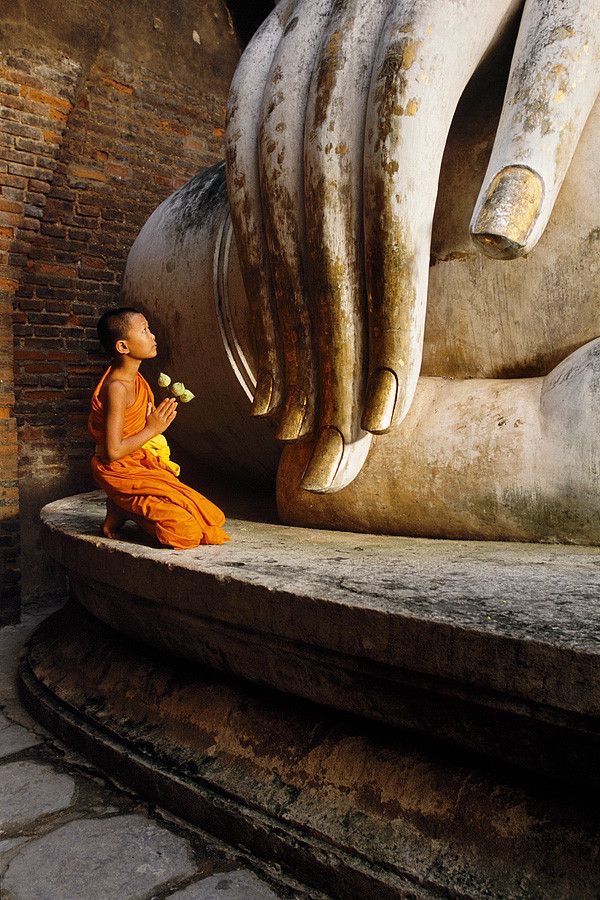
In oriental writings, especially in those treating the subject with the deepest understanding, the birth of Buddha is described in the grand manner, as one might put it.
It is related that Queen Maya was “the image of the Great Mother”, and that it was foretold she would bring a mighty being into the world.
This being was then born prematurely — a very common means of launching an outstanding being in the world, because thereby the human being in which the higher spiritual being is to incarnate is less closely amalgamated with matter than when the child is carried the full time of gestation.
It is then further related in the notable records of the Orient that at the moment of birth Buddha was enlightened, that he opened his eyes at once and directed his gaze to the four points of the compass, to the north, south, east, and west.
We are told that he then took seven steps, and that the marks of these steps are engraved in the ground he trod.
It is further recorded that he spoke at once, and the words he spoke were these: “This is the life in which I shall rise from Bodhisattva to Buddha, the last incarnation I shall have to pass through on this earth!”
Strange as such a communication may appear to the materialistic-minded man of today, and impossible as it is to interpret offhand from a materialistic viewpoint, it is nevertheless the truth for one who is able to see things with the eye of the spirit; and at that time there still existed men who, by means of natural clairvoyance, could discern spiritually what it was that was born with Buddha.
Today I shall merely point out that the author of the Luke Gospel told us in a single sentence that he who received the Christ into himself had indeed prepared himself in the previous years: that his astral body had achieved the virtue, nobility and wisdom indispensable for the birth of the Christ in him; and furthermore, that he had brought his etheric body to such a degree of maturity, and had developed such pliancy and beauty in his physical body, that the Christ could dwell in him. — One need only understand the Gospel aright. Take the second Chapter of Luke, verse 52. True, the wording of this verse in most of the Bible translations will not tell you what I just said. There it says:
And Jesus increased in wisdom and age, and in favor with God and man.
It would still make sense if such a man as the writer of the Luke Gospel had related of Jesus of Nazareth that he increased in wisdom; but when he reports as a solemn fact that he increased in age — well, that is not clear on its face, for it is a circumstance calling for no special emphasis. That it is nevertheless mentioned suggests that something more must be involved. Let us examine the verse in question in the original text:
Kai Jesous proekopten en to Sophia, kai helekia kai chariti Para theo kai anthropois.
As a matter of fact, here is what this means: “He increased in wisdom” signifies that he developed his astral body; and anyone who knows what the Greek mind associated with the word helekia can tell you that the term refers to the development of the etheric body, whereby wisdom gradually becomes skill.
As you know, the astral body develops the qualities called upon for individual occasions: we understand something once and for all.
The etheric body, on the other hand, shapes what it develops into habits, inclinations, and capabilities. This occurs by means of constant repetition. Wisdom becomes a habit: it is practised because it has become second nature.
So what this "increase in age" means is an increase in maturity: just as the astral body has grown in wisdom, so the etheric body has increased in pure habits in the realm of goodness, nobility, and beauty.
And the third quality that increased in Jesus of Nazareth, charis, really means that which manifests itself and becomes visible as beauty. No other translations are right. In translating this verse we must indicate that Jesus gained in gracious beauty; in other words, that his physical body, too, grew in beauty and nobility.
And Jesus increased in wisdom (in his astral body), in maturity of disposition (in his etheric body), and in gracious beauty (in his physical body), in a way manifest to God and man.
There you have the delineation given by St. Luke. Clearly, he knew that he who was to receive the Christ into himself had first to develop the threefold sheath — physical body, etheric body, and astral body — to its highest capacity.
From Gospel of John (Hamburg 1908), Lecture II: Esoteric Christianity
We need but briefly call to mind how the human being appears to us between the time of waking in the morning and the evening, when he again sinks into sleep. We know that he is composed of a physical body, an ether or life body, an astral body, and an I.

At the Abyss our bodies separate at sleep.
These four members of the human being, however, are in close relationship only during the waking state. It is quite necessary that we remember that during the night, while sleeping, the human creature is, in reality, entirely different from the same creature during the day, during waking day consciousness, for then his four members are assembled in a very different manner.
When he sleeps, the physical and ether bodies lie in bed. The astral body and I, in a certain sense, are loosened from their connections with the physical and ether bodies and are in fact outside of them — we must understand the word outside in a spiritual, not in a purely spatial sense.
Therefore during the night the human being is a creature consisting of two parts, one that remains lying in bed and another part which separates from the physical and ether bodies. Now we must first of all clearly understand that if, during the night, from the moment of going to sleep to the moment of waking again in the morning, the physical and ether bodies lying in bed were completely abandoned by what fills them throughout the day — that is, the astral body and I — they could not then exist at all by themselves.
The human physical body, on the contrary, cannot of itself retain its form. It has its form only because and as long as there are within it an ether body, an astral body, and an I. The moment the ether body, the astral body, and the I are separated from it, it becomes something quite different from what it is between birth and death; it follows the laws of the physical and chemical substances and forces and decays, while on the other hand the physical body of the mineral remains unchanged.
Something similar is the case with the ether body. Immediately after death the ether and astral bodies and the I separate from the physical body; then after a time the ether body also leaves this union of astral body and I and resolves itself into the cosmic ether, just as the physical body disintegrates and goes back into the earth kingdom.
There remains behind only that extract of the ether body of which we have often spoken. This remains united with the human being.
But now let us approach him in sleep and observe his physical nature. Here we have the physical body and the ether body lying in bed — the astral body and
I outside.
...
With the human being, on the contrary, the astral body and I depart each night and he does not concern himself about his physical and ether bodies, but leaves them to themselves. This fact is not always fully considered. Every night the human being, in his truly spiritual part, takes leave of his physical and ether bodies which he himself deserts.
However, these bodies would not be able to exist by themselves, because no physical body, and for that matter no ether body, can exist by itself.
... What occurs then during the night? Your own astral body and I are indeed
not within the physical and ether bodies, but present in their place there is
another I and another astral body ... During the night, while your own I and
astral body are outside your physical and ether bodies, the astral body and I
of higher, divine-spiritual powers are actually active within them.
[The original
human groupsouls still take care of the human body when we are asleep.]
...
In the first incarnation upon the earth the I, working from within outwardly, transformed certain thoughts, feelings, and passions which originally had been given to men [our animal heritage, the original sin or karma, so to speak,] and from incarnation to incarnation these were changed more and more through the activity of the I.
Thus it may be said that the human being has today not only the four members, physical, ether, and astral bodies, and I, but through the activity of the I within the astral body, he has now a member which is the actual creation of the I itself.
In each human being of today, the astral body is two-fold; it has one part that has been transformed by the
I [Manas or
Spirit-Self,] and another part not so transformed. This will continue and a time will come for every human being when his entire astral body will become a creation of his
I.
...
Thus we may say that in every human being the astral body contains within it Manas or Spirit-Self, the work of the
I, the product of the activity of the I.
The human astral body consists, as we have said, of two parts, one of which has been mastered by the human being and another which has not. What, then, is present there within that part which he cannot yet control?
It is the Spirit-Self, but a divine Spirit-Self [of the group souls of man.] The real spiritual life of mankind is only present in that part of the astral body in which the I has already been active since the first incarnation. Thus we have the human being before us.
Let us now look at him in his waking state. What shall we say? The physical body as it appears to us is only the exterior. Within, he is what may be called an atmic being. Interiorly, he is composed of and permeated by higher divine-spiritual beings.
The same is true of the ether body. Exteriorly, it is what holds the physical body together; interiorly it is the divine Life-Spirit.
And the astral body also is permeated by a divine being, the Spirit-Self. But out of this whole combination, the transformed portion of the astral body alone has been mastered by the I.
Now, look back to the beginning of our earthly evolution when nothing in the human being had yet been mastered by the I. Before his first incarnation the I was not yet united with the three other members, the physical, ether, and astral bodies. These last came over from the Moon, but the I did not enter them until the Earth period.
On the other hand, a divine I was present within them. They would not have been able to exist had not this divine I completely permeated them. The astral body was permeated by a divine Spirit-Self, the ether body by a divine Life-Spirit and the physical body by a divine Atman or Spirit-Man.
Now, let us proceed to the real Earth incarnation. Here, by experiencing a further transformation, the physical human body became still more perfected than previously.
What had it previously been unable to do? What was yet quite foreign to it? What had the divine Spirit kept within itself? What had it not yet entrusted to the human body? It was the power to express in sound the inner life of the soul. [Deeds of Christ.]
While on Saturn, the physical body was a kind of machine, a sort of automaton, wholly permeated and maintained, however, by the Logos.
To the physical body was added the life body, permeated by the Life-Spirit. The Logos became Life upon the Sun, while advancing the human creature to a higher stage.
...
Thus upon the Moon, the human astral body was united with the physical and ether bodies.
...
Upon the Moon, the light-body is added: Life becomes Light!
Here we have the story of the evolution of the human body. When the human being began life upon the Earth, he was a creation of the divine-spiritual powers.
At that time he existed because within his physical, ether, and astral bodies the Logos was living, the Logos which was Life and which became Light.
What now occurred upon the Earth? In the human being and for the human being the I now entered, and because of this, he was now able not only to live in Light and in Life, but also became capable of observing everything externally, capable of confronting the Logos, Life, and Light. Therefore everything became material to him and he acquired a physical material existence.
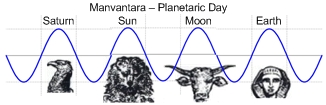
In the beginning was the Logos which was the archetype of the physical human body, the foundation of all things. All animals, plants and minerals appeared later, for the human creature alone was present upon Saturn.
In the Sun Period, the animal kingdom was added, in the Moon Period, the plant kingdom and upon the Earth the mineral kingdom appeared.
Upon the Sun, the Logos became Life and upon the Moon, it became Light; then when the human creature became endowed with an I, the Logos as Light confronted him. But he had to learn to know the nature of the Logos and learn in what form It eventually would make its appearance.
First there was the Logos which became Life, then Light, and this Light lives in the astral body. Into the human inner being, into the darkness, into the ignorance, the Light shone. And the meaning of life upon Earth is this: —
That men should overcome this darkness of the soul, in order that they may recognize the Light of the Logos.
From Gospel of John (Hamburg 1908), Lecture III: The Mission of the Earth
The night belongs to the moon and it belonged to the moon to a much greater degree in that ancient time when the human being was not yet able to receive the force of love in the direct rays of the sun. At that time he received the reflected force of ripened wisdom from the moonlight. This ripened wisdom streamed down upon him from the moonlight during the time of night-consciousness.
Therefore, Jahve [Krishna] is called the Ruler of the Night who prepared humanity for the love that was later to manifest during full waking-consciousness. See Krishna as Teacher of Love.
Thus we can look back to that ancient past in human evolution when spiritually that event occurred which is merely symbolized by the heavenly bodies, the sun on the one side, the moon on the other [Second Deed of Christ.]
During the night, at certain times, the moon [Krishna] sends down to us the reflected force of the sun [Christ,] but it is the same light which also shines upon us directly from the sun. Thus in ancient times, Jahve or Jehova reflected the force of matured wisdom, the force of the six Elohim, and sent this force down into human beings while they slept, preparing them to become capable later, by degrees, of receiving the power of love during waking-day consciousness.
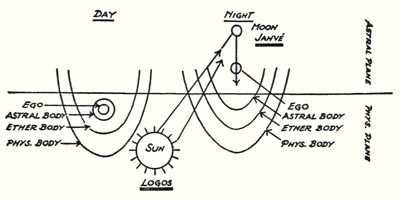
The above drawing attempts in a symbolic manner to show the waking-day human being when his physical and etheric bodies are dependent upon the Divine and his I and astral body are within the physical and ether bodies upon the physical plane.
Here the whole human organism is shone upon by the sun from without. We now know that for the humanity of primeval ages, night was much longer and much more filled with activity than it is at present.
The astral body and I were then outside of the physical and ether bodies, the I existing wholly within the astral world, and the astral body sinking into the physical body from without, having, however, its entire inner being still embedded in the divine-spiritual world.
Therefore, the sun could not shine directly upon the human astral body and enkindle in it the force of love. Hence, the moon, which reflects the sunlight, was active through Jahve or Jehova [Christ permeated the Nathan Jesus being, Krishna.]
The moon is the symbol of Jahve or Jehova [Krishna.] and the sun is none other than the symbol for the Logos [Christ,] which is the sum of the other six Elohim.
This drawing, which you should study, and upon which you should meditate, tries to indicate this in a symbolic way and if you reflect upon it, you will discern what deep, mystery-truths are presented in it, namely: that during long periods of time, in sleep-consciousness, the force of love was being implanted in human beings by Jehova, in a manner of which they were themselves unconscious.
In this way they were being made capable of experiencing the Logos, of feeling the force of Its love. One can ask: — How was this possible, how could that take place? We come now to the other side of the mystery.
...
But little by little something happened, something happened in full actuality which made it possible for him to see outwardly, physically, the Being of Love itself. But how could that occur? It could only take place, because the Being of Divine Love, the Being of the Logos, became a man of flesh, whom men by means of their physical senses could perceive upon the earth.
It was because mankind had developed to a condition of perceiving by means of outer senses that God, the Logos, had Himself to become a sense-being. He had to appear in a physical body. This was fulfilled in Christ-Jesus, and the historical appearance of Christ Jesus means that the forces of the six Elohim, or of the Logos, were incarnated in Jesus of Nazareth at the beginning of our Christian era and were actually present in Him in the visible world. That is the important thing.
The forces of the six Elohim, the Logos or the inner forces of the sun means Adam Kadmon, the perfect man, the perfect bodies from physical to Atma.
The inner force of the sun, the force of the Logos-Love assumed a physical human form in the body of Jesus of Nazareth. For, like an external object, like an outer being, God had to appear to the earthly, human sense-consciousness in a bodily form.
... ‘The Word became flesh and dwelt among us.’”...
...Mankind had its beginning in the group-soul and then advanced to a state of independent, personal existence, in which every individual experiences the “I AM,” and the Christ is the force that has brought it to this consciousness of the “I AM.”...
Therefore, they named Christ-Jesus the “I AM.” That was the name in which the closest initiates felt themselves united, the name which they understood, the name “I AM.” We must in this way delve deeply into the most significant chapters of the Gospel of St. John. If we take that chapter where we find the words: “I am the Light of the world,” we must interpret them literally, quite literally.
Now, what was this “I AM” which for the first time appeared in carnate form? It was the force of the Logos that streamed to earth in the sunlight. All through the entire eighth chapter, beginning with the twelfth verse which is usually entitled “Jesus, the Light of the World,” we find a transcription of this profound truth concerning the meaning of the “I AM.”
When you read this chapter, emphasize the words “I” or “I AM” wherever they appear and realize that “I AM” was the name in which the initiates felt themselves united. Then you will understand it and it will seem to you that this chapter must then be read in somewhat the following manner:
Then Jesus spoke to His disciples and said: That which is able to say “I AM” to itself, is the Force of the Light of the World, and whoever follows after me will see in clear, waking consciousness what those who wander in darkness do not see.
But those who clung to the old belief that only by night can the Light of Love be implanted within the human being, those who were called the Pharisees, answered: Thou callest upon thy “I AM” but we call upon Father Abraham. In this way we feel the power which justifies us in acting as self-conscious beings. We feel ourselves strong when we immerse ourselves in the substance of a common I which reaches to Father Abraham.
Jesus said: — If one speaks of the I, as I speak, then is the testimony a true one; for I know that this I comes from the Father, from the primeval foundation of the world and I know whither it tends.
Now, let us consider those important words of Chapter VIII, verse 15, which should be translated in the following manner:
Ye judge all things according to the flesh, but I judge not the perishable that is in the flesh. And if I judge, then is my judgment true. For the I does not exist for itself alone, but it is united with the Father from whom it has descended.
That is the meaning of this passage. Thus everywhere you find reference to a common Father. We are now able to bring the idea of the Father still more clearly before our souls. Then we see that the words, “Before Father Abraham was, was the I AM,” contain the living essence of the Christian doctrine.
From Gospel of John (Hamburg 1908), Lecture IV: The Raising of Lazarus
In the middle of the Gospel of St. John a fact is presented which, if not understood, would render this Gospel incomprehensible.
Directly following the passage in which these words are introduced as confirmation of the truth of the testimony of John the Baptist stands the chapter concerning the raising of Lazarus.
With this chapter the whole Gospel falls into two parts. At the end of the first part it is pointed out that the testimony of John the Baptist should be accepted for everything that is maintained and affirmed concerning Christ Jesus and at the very end of the Gospel it is pointed out that all that follows the chapter on the raising of Lazarus should be accepted on the testimony of the Disciple whom we have often heard designated as “the Disciple whom the Lord loved.”
The human being at one time did not have eyes and ears in his physical body as he has today, but undeveloped organs instead — just as animals who have never been exposed to the light have no eyes. The light forms the eye, sound fashions the ear.
What the neophyte practiced through meditation and concentration and what he experienced inwardly through them, acted like light upon the eye and sound upon the ear. In this way the astral body was transformed and organs of perception for seeing in the astral or higher world were evolved.
But these organs are not yet firmly enough fixed in the ether body. They will become so when what has been formed in the astral body will have been stamped upon the ether body.
However, as long as the ether body remains bound to the physical, it is not possible for all that has been accomplished by means of spiritual exercises to be really impressed upon it. Before this can happen, the ether body must be drawn out of the physical. Therefore when the ether body was drawn out of the physical body during the three and a half days deathlike sleep, all that had been prepared in the astral body was stamped upon the ether body.
The mark of the Rosicrucian gives man such a chock that the etheric body become loosened from the physical body.
This three and a half day death-like sleep can now be replaced by the force proceeding from the Christ.
For we shall soon see that in the Gospel of St. John strong forces are present which render it possible for the present astral body, even though the ether body is still within the physical, to have the power to stamp upon the etheric what had previously been prepared within it. But for this to take place, Christ-Jesus must first be present.
The individuality Lazarus had to be initiated in such a way that he could be a witness of the spiritual worlds.
An expression is used, a very significant expression in the language of the Mysteries, “that the Lord loved Lazarus.” What does “to love” mean in the language of the Mysteries? It expresses the relationship of the pupil to the teacher. “He whom the Lord loved” is the most intimate, the most deeply initiated pupil.
He whom the Lord loved, is not something new, who have the Lord loved also in earlier incarnations? This is worth contemplating!
The Lord Himself had initiated Lazarus and as an initiate Lazarus arose from the grave, which means from his place of initiation. This same expression “Whom the Lord loved” is always used later in connection with John, or perhaps we should say in connection with the writer of the Gospel of St. John, for the name “John” is not used. He is the “Beloved Disciple” to whom the Gospel refers.
He is the risen Lazarus himself and the writer of the Gospel wished to say: — “What I have to offer, I say by virtue of the initiation which has been conferred upon me by the Lord Himself.” Therefore the writer of the Gospel distinguishes between what occurred before and what occurred after the raising of Lazarus.
Before the raising, an initiate of the old order is quoted, one who has attained a knowledge of the Spirit, one whose testimony is repeatedly announced to be true. “However, what is to be said concerning the most profound of matters, concerning the Mystery of Golgotha, I myself say, I the Risen One; but only after I have been raised, can I speak concerning it!”
And so we have in the first part of the Gospel, the testimony of the old John — in the second half, the testimony of the new John whom the Lord Himself had initiated, for this is the risen Lazarus.
John the Baptist called himself — literally interpreted — the forerunner, the precursor, the one who goes before as herald of the I. He designated himself as one who knew that this I must become an independent entity in each individual soul, but he also had to bear witness of Him who was to come, in order that this be brought about.
John the Baptist is the Elijah being, although not technically the same, the transformed Adam soul.
He said very clearly, “That which is to come is the ‘I AM,’ which is eternal, which can say of Itself, “Before Abraham was, was the I AM.” John could say, “The I which is spoken of here existed before me. Although I am Its forerunner, yet It is at the same time my Forerunner. I bear witness of what was previously present in every human being. After me will come One Who was before me.”
From Gospel of John (Hamburg 1908), Lecture VI: The "I AM"
We shall now learn how the Egyptians, who were the third sub-race of the post-Atlantean root-race, developed by degrees the complete impulse of the “I AM,” and how they furnished, like the mother's womb, the outer structure for this “I AM,” but did not go far enough to give birth to the Christ Principle. Then we shall learn how at last the ancient Hebrew peoples separated from them. [Third deed.]
Moses is represented to us as one chosen from among the people of Egypt to become the prophet of God, of the incarnated “I AM.” He prophesied the coming of the “I AM” to those who could understand something of It. He announced that for the words, “I and Father Abraham are one,” will be substituted these other words, “I and the Father are one,” which means, I and the spiritual foundation of the World are directly one.
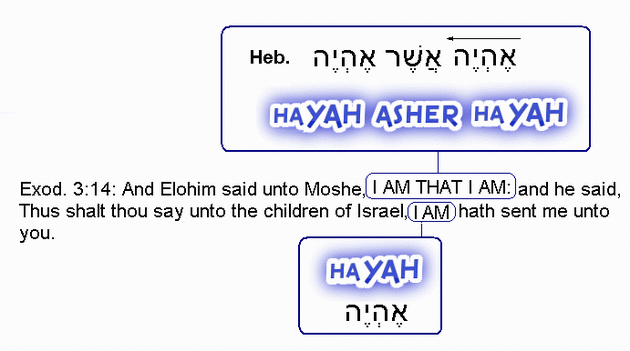
He had to announce prophetically a more exalted God, Who exists within the God of Father Abraham, but Who is at the same time a higher Principle. What is His name?
And God said unto Moses, I am the “I AM!”
Here is foretold the profound truth about the Word which later appeared incarnate in Christ-Jesus.
And he said: Thus shalt thou say unto the children of Israel: the “I AM” hath taught it to me.
This is the literal wording. In other words, this means that the “name,” that name which is the basis of the blood-name, is the “I AM” — and this “I AM” appears incarnate in the Christ of the Gospel of St. John.
What has been seen only externally streaming through the blood, is in its deeper meaning, the “I AM.”
Thus was proclaimed what was later to enter the world through Christ-Jesus. We hear the name of the Logos, we hear Him at that time calling to Moses, “I am the I AM!” The Logos proclaims His name, that part of Himself which can be comprehended through the understanding, through the intellect. What is here proclaimed appears in the flesh as the Logos, is incarnated in Christ-Jesus.
Now let us consider the external sign of the flowing down of the Logos into the Israelitish people, as far as this can be grasped abstractly in thought. This outer sign is the “Manna” of the Wilderness. The word “Manna” is, in fact, (those who understand Spiritual Science know this) the same as “Manas”, the “Spirit-Self.”
Thus there streams into that people which has by degrees acquired an I-consciousness, the first trace of the Spirit-Self. However that which lives and appears in Manas itself must be called by another name. It is not something that can be simply known, but it is a force which can be taken into oneself.
When the Logos simply proclaimed His name, it could be understood and grasped with the intellect. But when the Logos became flesh and appeared among men, then it became a Force-Impulse which is not only a teaching and a concept, but exists in the world as a Force-Impulse in which humanity can participate. He then calls Himself no longer “Manna,” but the “Bread of Life,” which is the technical expression for Budhi or Life-Spirit.
The water transformed by the spirit, which was offered in symbolic form to the Samaritan woman, and the “Bread of Life” are the first heraldings of the influx of Budhi or Life-Spirit into mankind.
From The Bible and Wisdom (1908)
When God appeared to Moses in the Burning Bush, Moses asked: ‘Who shall I say to the people hath sent me?’ God said: ‘Tell them that One Who can say “I am” hath sent thee.’
From I am the Way, the Truth, and the Life (1911)
You know well that the child's consciousness is different from that of a mature human being, The difference comes to expression in the fact that the child does not, to begin. with, say “I” of itself. The word that is so important for us is voiced only later, when the consciousness of “I” awakens in the child.
It is through speaking that the human being learns to think. The child's consciousness is quite different. The child would not designate itself by saying, as we do in late years: “I feel, I wish this or that.” Between the ages of 2½ and 3½ (varying with the individual) something happens in the child which we can easily confirm by looking back into our own childhood. We find that we can remember back to a certain point and then the thread of memory whereby the consciousness of our own deeds is retained, breaks. We know that the “I” existed before this break in memory, but it was not within the sphere of consciousness.
Thus there is the life of the “I” between birth and about the third year, during which the relation of the “I” to the physical, etheric and astral bodies is not at all the same as it is later on. Occult science reveals that in these first years of childhood, the “I” hovers around the body like an aura, and only afterwards penetrates into the human being. In the same measure as the “I” enters, the human being begins to say “I” of himself, to relate thing to himself. Before this happens the “I” works from outside and when we study the child's organism realise how much there is to be done. The delicate structure of the brain, for example, has to be built up, and the “I” does this and can only do it as long as it is not inwardly bound up with the organism.
Now it might be contended that the human “I” is not clever enough to build its own brain, to give it the infinitely delicate furrows and convolutions which enable it to be an instrument for thinking. But this work is not performed by the human alone; in its work on the body the “I” is accompanied and directed by the wisdom of quite other forces. Why can the child-“I” work with such wisdom and yet know nothing of it later on? The reason is that as long as the “I” is outside, is the aura, it is connected with the spiritual world. While the child-“I” is working on the body in this way, the seer can observe that the streams which proceed from it on the one side enter the body and on the other flow upwards to the Hierarchies, to the Angeloi, Archangeloi, Archai, and so on. It can therefore truly be said that child-“I” Is anchored in the spiritual world.
This is really a repetition of what happened in early periods of mans development where the soul also hovered above the body, wasn't incarnated.
The truths of Spiritual Science are not meant to be easily comprehensible. They are far, far deeper. — I have often said that the wisest man can learn much from a child. The child-“I” which hovers like an aura around the head and upper part of the child's body is like a telephone connection with the spiritual world and in this aura the seer can perceive the weaving deeds of higher Hierarchies. To spiritual vision this aura continues up into the realms of the Hierarchies. And in the same measure in which the “I” penetrates into the body and man begins to say “I” of himself, yielding as he says it to the illusion that his “I” is enclosed within the limits of his body, in that measure the thread of connection with spiritual worlds is, in a certain respect, severed.
Thus the link between the “I” and the other bodily members is not the same in early childhood as it is in later life and it may be said that there is also a difference between this “I” while it is working in earliest childhood outside the body, and the “I” of later life. For in early childhood the “I” is creative productive, whereas later on it loses these creative forces.
As the human body is today, we are composed in later life of physical, etheric and astral bodies and the “I” which feels itself within these bodies; the spiritual, life-giving forces which were active in early childhood are suppressed. In fact we kill them and our whole life is a process of killing, of deadening the living forces which were at work in early childhood. The spiritual forces of the Cosmos live and weave during this period of life and later on our sheaths have a deadening, destructive effect upon these forces.
When we handle our karma, we find the way back to the soul, and the "I" becomes conscious in the soul, until then it believes that it is the body, that it is defined through the habits, temperament, opinions, desires of the three lower bodies.
We have the creative life-forces of the “I” in early childhood but lose them in later life.
The path of human evolution is that the physical body develops in the first seven years, the etheric body up to the age of 14, the astral body to the age of 21, then the sentient soul to the age of 28, the intellectual of mind-soul from the age of 28 to that of 35, and the consciousness soul from the 35th year onwards. It is the intellectual soul which, from the 28th year of life, permeates us fully with the “I”-consciousness, but the “I” has for long been deadened through our bodily forces, so that the strongest life-giving forces of the “I” and the “I”-consciousness itself, do not coincide.
Man would evolve quite differently if his bodily constitution before the 28th year did not develop in such a way as to work with a deadening effect upon the “I,” but if the “I” and the “I”-consciousness were completely in unison and could work in full strength upon each other between the 28th and the 35th years.
Only so could this sublime Ideal be embodied. A man would have to be there on earth with a physical body, etheric body, astral body and an “I,” and this “I” would have to depart from the sheaths at about the 30th year and a child-“I” would have to descend, in full consciousness, into these sheaths with forces reaching up to the Hierarchies.
The embodied Ideal was Christ Jesus. And as the members of man's being gradually develop, we so learn to understand the Christ that we say: In Him were working, in full consciousness, those divine forces which work unconsciously in the human being to the third year of life.
This Christ-“I,” filled with the full forces of childhood, came down at the Baptism in the Jordan into the body of Jesus of Nazareth and worked for three years in a human body. Such was the working of World-Karma. This Christ-“I” dwelt in a human body for three years, after which the Mystery of Golgotha was accomplished.
The power proceeding from the Mystery of Golgotha is able to make men realise that this Christ-“I” is the wellspring and source of those forces which kindle to life the power to create ideals. When the power to create ideals is filled with new life by looking to the highest of them all, when the forces of human feeling and intellect are utterly permeated with this ideal, then it will be as if the Christ Himself were to fill the human soul, and then, in such a soul, the words of St. Paul would find fulfillment: “Not I, but Christ in me.”
Human beings are distinguishable from the higher animals in that the latter find their equilibrium from the outset. The animal, as climbing, jumping, running animal, acquires the equilibrium its life demands.
Man, however, has to learn to find his poise as an upright being. This, too, is work of the “I.” The “I” brings about our state of poise, of equilibrium, whereas the animal acquires its equilibrium through implanted instincts.
In man, the “I” creates the equilibrium and points the way to be taken in life.
The “I” points the way to man and also gives him his ideas, his thoughts, his knowledge. The animal has instincts; man acquires wisdom and attains to truth through knowledge.
Thus we can say: through the work of the “I,” man receives, in early childhood, those forces which give him Life. Through the “I,” man acquires knowledge, which leads him to Truth.
Through the “I,” man raises himself into the upright posture and finds the Way. That is what is proceeding unconsciously, while the human body is developing in early childhood.
The same thing, raised to a higher level and striven for in a spiritual way, happens to man when he permeates his being with the power of Christ. When this Christ Power has become reality in the soul, when the Christ has become a living experience in the soul, when the soul has thereby found the direction of its path, when it knows the Truth of the higher worlds, then this “I” in man can affirm: I am the Way, the Truth and the Life — while realising that it is not his personal, earthly “I” which speaks, but the Christ in him.
The Christ in man is the child-“I,” working in later life as a spiritual power. Therefore the words: “Except ye become as little children ye cannot enter the kingdom of heaven” contain the exhortations: Become like little children, become strong, stand upright, learn to find your Way through the Christ within you, become seekers after the Truth and then, in full consciousness, you will also find in yourselves the Life-kindling forces which streamed into your organism in childhood unconsciously.
Think of this child-“I” spiritualised and enhanced — that is what must work in us through all following incarnations. We must live with this spiritualised child-“I” as we now live with our earthly “I.” It is with the Christ-“I” that we shall then be living. In order that this should be possible, the events in Palestine took place.
Thus we see how through what once took place, when the highest human Ideal was given an actual basis in life, the way was laid down for man for all subsequent evolution. The Mystery of Golgotha stands at the pivotal point of all existence, and must be regarded as the one and only true guide for all following incarnations. This is the Truth that must become the deepest of all human experiences.
What happens to the forces of the child-“I”? These forces of the first three years are deadened by the egoistic impulses and passions of men. If man had not received at the beginning of earth-evolution a sufficient fund of wisdom and life-force to enable him to hold firmly to his existence in face of these destructive forces, no development would have been possible for him.
Through the influences of Lucifer and Ahriman, man gradually deadened these original life-forces and they could only be re-kindled through that unique Individuality Who did not take the ordinary path of human evolution, Who did not succumb to the working of Lucifer and Ahriman, Who entered once and only once into a human body, Who shared all human experiences during the time He was on earth, and Who stands before all human souls as the sublime Ideal.
The Abel being didn't incarnate, Krishna didn't incarnate.
The Christ had resolved to descend to the earth, to live for three years in a human body and then to offer Himself in sacrifice on Golgotha.
See Adam Cadmon for a deeper analysis of the seven I AM's.
From Gospel of John (Basle): Lecture VIII
By “Adam” we have to understand not a single human being, but an I-consciousness that embraced several generations. The one who begins such a generation is the “Father.”
The Hebrews of the Old Testament actually felt Abraham to be their father, and the single personalities in the Hebrew people said to themselves: I am not an independent I; there is one that flows down from Abraham and branches out into all who belong to my people, and also into me.” Just as in a large tree the saps flow from the root into all the branches, in the same way the sap of Abraham, the common I of the Hebrew people, flows through the whole tribe.
This is a Group Soul, it's an I, as these people didn't have an I yet. Remember this definition when Jesus talk about his Father!
When a Hebrew in Old Testament times uttered the name “father” he referred to the whole line of his ancestry, and this I consciousness which embraced all the generations he called the divine consciousness.
When he called upon the I as God, he called it Jahve or Jehovah. When the name “Jahve” rang out, the people were reminded that a common I which began with the ancestor of their race flowed down through the whole people.
Through the intermingling of blood this condition became different in course of time; the consciousness of the “I am” became individualised, and Christ is the power which was to bring the consciousness of this change to humanity.
When the man of ancient times said “I am,” he meant something that flowed down through generations; the man of more recent times meant by it something that flows through his own inner being. The first meant the God who flows through the whole community as the divine I-consciousness; the other feels in himself a spark or a drop of the divine substance.
Now let us imagine that there is transposed to the Earth a Power which makes men clearly conscious that this “I am” can live in each individual human being, a Power which enables one to realise that God has sunk a drop of His own substance into each human being.
This Power would say: — “This ‘I am’ is something that is in each one of you, it is a part of the one divine force. What you perceive as your individual ‘I am’ is one with the ‘I am’ of the Father.
Whichever of you has developed within him the consciousness of this fact, can say: ‘I and the Father are one.’ If you look back as far as to Adam, you see the I-consciousness flow through generations for hundreds and thousands of years.
But there is a still higher human consciousness, which was given to man in his primal quality as Man. This is the consciousness of humanity, the consciousness which embraces not only a few generations, but the whole of humanity.” [The Soul.]
Then came the consciousness which belongs to generations, lasts for generations, and was finally individualised by man to his “I am”. Man, therefore, already possessed the foundations for the “I am” earlier, and for this reason Christ could say: “Before Abraham, was the ‘I am.’ ” That is the correct teaching of the occult school; it ought to read: “Before Abraham was the ‘I am.’ ”
In the “I am” lies the way to the truth and to the truth life, because the “I Am” works upon the lower bodies and enables the true life to arise in them. We may represent this in the following way: —

In most of the translations of the Bible, Christ's answer to the question: “Who did sin, this man or his parents, that he was born blind?” we read: “Neither hath this man sinned, nor his parents; but that the works of God should be made manifest in him.”
But is this a view worthy of a Christian, that God makes a man be born blind, in order that God may make His Glory manifest in him? What an incredible conception of God, that can arrive at such a conclusion:
This passage is much more simple and clear when we view it with the knowledge of Spiritual Science. Christ replied:
“Neither has this man sinned, nor his parents; he is fulfilling his karma, in order that the divine spark in him shall become visible, in order that the works of “The God in him” shall be made manifest.
That is the way in which Christ's answer should be translated: “He was born blind in order that the works of the God in him may be made manifest.”
Each human being through repeated incarnations on Earth. It is not necessary that he should have sinned in this life; it is possible that he has brought from a former life the guilt which has led to this fate in this life.
Here we have the teaching of karma, quite in the anthroposophical sense, karma which works over from one incarnation to another.
The fact that Christ's teaching was opposed to the general views of the Jews is apparent, and this also explains the discord into which He comes with them (John 9:22).
This pupil is to bring to men the knowledge of the significance of Christ, therefore Christ Jesus points to the mother Sophia with the words: “This is thy mother, whom thou art to love!” The spiritualised Mother of Jesus is the Gospel itself; it is the wisdom that leads men up to the highest knowledge. [This wisdom of the Gospel also points to Krishna, and to Sophia.]
This disciple has given us the mother Sophia; that is to say, he wrote for us the Gospel which enables those who search into it to know Christianity, and to comprehend the origin and goal of this great movement.
The Gospel of John contains the wisdom of “the God in man,” Theosophia, and the more that men devote themselves to the study of this document, the more will they receive wisdom and enlightenment from it.
See Adam Cadmon for a deeper analysis of the seven I AM's.
From The Alphabet, An Expression of the Mystery of Man (1921)
It may be said that if a Man could look through himself inwardly he would have to admit: I am an etheric body, in other words, I am the echo of cosmic vowels; I am a physical body, in other words, the echo of cosmic consonants. Because I stand here on the earth, there sounds through my being an echo of all that is said by the signs of the Zodiac; and the life of this echo is my physical body. An echo is formed of all that is said by the planetary spheres and this echo is my etheric body.
1. Physical body = Echo of the Zodiac
2. Etheric body = Echo of the planetary movements
3. Astral body = Experience of the planetary movements
4. 'I' = perception of the echo of the Zodiac
Nothing is said, my dear friends, by repeating that Man consists of physical body and etheric body. Those are no more than vague, indefinite words.
If we want to speak in a real language, which can be learned from the mysteries of the cosmos, we would have to say: Man is constituted out of the echo of the heavens, of the fixed stars, of the echo of the planetary movements, of what is experienced of the echo of the planetary movements, and of what knowingly experiences the echo of the fixed star heavens.
Then we would have expressed in real cosmic speech what is abstractly expressed by the words: Man is made up of physical body, etheric body, astral body and 'I'. We remain entirely in the abstract by saying: Man is composed first of physical body, secondly of etheric body, thirdly of astral body, fourthly of 'I'.
But we pass into concrete cosmic speech if we say: Man consists of the echo of the Zodiac, of the echo of the planetary movements, of the experience of the impression of the planetary movements in thinking, feeling and willing, and in the perception of the echo of the Zodiac. The first is abstraction, the second reality.
When you say ‘I’, what is that exactly? Now just imagine someone had planted trees in a beautifully artistic order. Each individual tree can be seen. However at a distance all the trees resolve into a single point. Take all the individual things — all that resounds from the Zodiac in the way of world consonants, then go far enough away: Everything that is formed as inward sound, in the most manifold way, is compressed within you to the single point ‘I’.
It is an actual fact that this name which Man gives himself is really only an expression for what we perceive in the measureless spaces of the universe. Everywhere it is necessary to go back to what, as reflection, as echo, appears here upon earth. Thus, when the matter is seen in its reality, before Man's higher and inward experience, everything out of which Man builds himself up as a phenomenon, as pure experience, melts away. If we look upon Man and gradually learn to know his true nature, then his physical body actually ceases to be in the way it normally confronts us and otherwise stands before us, our vision widens and Man grows into the heavens of the fixed stars. The etheric body, too, ceases to be before us. Vision is extended, experience is extended, and we arrive at a perception of planetary life, for this human etheric body is a mere reflection of planetary life.
From Gospel of John (Hamburg 1908), Lecture VII: The Mystery of Golgotha
In order to understand this quite clearly, we must once more bring before our souls the way in which human evolution actually takes place.
The human being consists of physical, ether and astral bodies and an I. How does this evolution occur? By the I gradually working through the other three members, purifying and strengthening them.
The I is called upon gradually to purify the astral body, to cleanse it and to raise it to a higher level. When the entire astral body has been purified and strengthened by the special forces of the I, it becomes Manas or Spirit-Self.
When the ether or life-body has been thoroughly worked over and strengthened by the force of the I, it becomes Budhi, or Life-Spirit.
When the physical body has been fully overcome and conquered by the I, it becomes Atman or Spirit-Man. Then will the human being have reached the goal which above all lies in store for him. That, however, will be attained only in the far distant future.
Moreover, we wish it to be quite clear that the I acts in full consciousness in what has just been described; namely, that the human being consisting of the four members — physical, ether and astral bodies and I — works by means of the I upon the other three members, transforming them into Spirit-Self, Life-Spirit and Spirit-Man.
For the most part this is not yet the case with present humanity which, as a matter of fact, is just beginning, fully conscious, to work a little of Manas into its astral body. The human being is doing this now.
Through the help of higher beings he has already, although unconsciously, worked upon his three lower members during this Earth evolution.
In ancient times he unconsciously worked over the astral body, and this then became permeated by the Sentient Soul. The I unconsciously worked into the ether body and this unconsciously re-formed ether body is what you will find described in regular sequence in my book Theosophy as the Intellectual Soul, and that part of the physical body, unconsciously worked upon by the I, you will find described there as the Consciousness Soul.
The Consciousness Soul only came into being toward the end of the Atlantean period when the ether body — previously outside the physical body in the head region — gradually drew wholly within it. Through this the human being learned to utter the word “I.” Thus variously-membered, he gradually passed over into the postAtlantean period.
It is the task of our age to work Manas or Spirit-Self by degrees into what had previously been received unconsciously. The human being must, as it were, develop Manas within himself by means of all the forces he has acquired by virtue of possessing a physical, an ether and an astral body, a sentient, an intellectual and a consciousness soul; by means of all the forces which these various members can give him, he must develop Manas and also, although in a very small degree, the germ of a Life-Spirit or Budhi.
Therefore our post-Atlantean age has the important task of helping the human being to develop consciously these higher members of his being (Manas or Spirit-Self, Budhi or Life-Spirit and Atman or Spirit-Man) in the distant future when he will at last have reached his goal. He must from now on, by degrees, develop within himself the force to evolve his higher members out of his lower.
Since humanity of the present has not yet perfected this metamorphosis, what is the result? Spiritual Science makes this very clear.
Because this katharsis of the astral body has not yet been accomplished, that is, the astral body has not yet transformed itself into Spirit-Self, selfishness or egotism is possible.
Because the ether body has not yet been strengthened by the I, lying and error are possible; and
because the physical body has not yet been fortified by the I, sickness and death are possible.
In a once fully developed Spirit-Self, there will be no more selfishness; no sickness and death, but just health and salvation in the fully developed Spirit-Man, that is, in the fully evolved physical body.
Besides what has been said today, let us take what the Christ Himself said: “The most profound mystery of My being is the I AM, and the true and eternal might of the I AM or of the 'I' which has the force to permeate other bodies must flow into human beings. It dwells within the Earth Spirit.”
Let us hold this clearly in mind and take very earnestly, quite seriously, the fact that, because the Christ wishes to bestow the true 'I' upon every human soul, He will awaken the God in it and gradually enkindle the Spirit of the Lord and King in everyone. What does this signify? We have here nothing more nor less than the fact that the Christ brings to expression, in the highest sense, the idea of Karma, the karmic law.
For when anyone fully understands the idea of Karma, he will understand it in this Christian sense. It means that no man should set himself up as a judge of the inner soul of another human being. Unless the idea of Karma has been understood in this way, it has not been grasped in its deepest significance.
When one man judges another, the one is always placing the other under the compulsion of his own 'I'. However, if a person really believes in the “I AM” in the Christian sense, he will not judge. He will say: “I know that Karma is the great adjuster. Whatever you may have done, I do not judge it!”
Then Moses asks: “How will the people believe me, how can I convince them? What shall I say when they ask who has sent me?”
And he was commanded: “Say the ‘I-am’ has sent thee.”
Read it again and compare as exactly as you can with the original text and you will see its significance.
The “I-Am,” what does that mean? The “I-Am” is the name for the divine Being, the Christ-principle of man — the Being of whom man feels like a drop, a spark, when he can say “I am.” The stone, the plant, the animal cannot say “I am.” Man is the crown of creation inasmuch as he can say “I am” to himself, he can utter a name which does not hold good for anyone but the one who utters it.
You alone can call yourself “I”; no one else can call you “I.” Here the soul speaks within itself in a word to which none other has entrance except a Being which comes to the soul through no external sense, on no outer path.
Here Divinity speaks. Hence the name “I-Am” was given to the Godhead whose being fills the world. “Say that the ‘I-am’ has told thee !” Thus was Moses to speak to his people.
And who was the Being born in Jesus of Nazareth? We indicated this yesterday: the God who was there from the beginning, who had remained in the spiritual world, leaving mankind to its development. He it was who descended and incarnated in the body of Jesus of Nazareth.
Does the writer of the Gospel of St. John give us to understand this? To answer this question we need only read attentively the words of the Gospel; but first let us read the beginning of the Old Testament:
‘In the beginning God created the Heaven and the Earth. And the Earth was waste and void; and darkness was upon the face of the deep. And the Spirit of God moved upon the face of the waters.’
Let us call up this picture before us: ‘The Spirit of God moved upon the waters.’ Below is the Earth with its kingdoms, which issued from the divine Spirit.
Among the descendants of the divine Spirit there is an individual so highly advanced that he can receive into himself this Spirit that moved upon the waters.
What does the writer of St. John's Gospel say? He tells us that John the Baptist recognized that the Being foretold in the Old Testament was there. He says: ‘I saw the Spirit descending from Heaven like a dove, and it rested upon him.’
John knew that he upon whom the Spirit descended was He who was to come: The Christ. Thus, the Spirit moving upon the waters is the beginning of earthly evolution; then, as John baptized with water, the Spirit who in the beginning moved upon the waters, descended into the body of Jesus of Nazareth.
It would be impossible to express in words sublimer than St. John's, the connection between the events in Palestine and that other event related at the beginning of the same tradition of which his Gospel is a continuation. St. John also has words to express the fact that with Jesus of Nazareth that Spirit was united to whom the whole earth owes its creation and evolution. We know the first words of St. John's Gospel: ‘In the beginning was the Word (or Logos), and the Word (or Logos) was with God, and the Word (or Logos) was a God.’
We must be clear on the point that, up to the Baptism by John, the life of Jesus of Nazareth, as related to us in the Gospels, presents nothing but a sum of experiences demonstrating his ascent to higher worlds in former incarnations, and showing how he prepared his entire being — his astral, etheric, and physical bodies — for the final reception of the Christ.
The meaning of this verse is as follows: He increased in wisdom, that is, he developed his astral body. Again, anyone who knows what is suggested to the Greek mind by the word age, stature, can tell you that the development of the etheric body is meant, whereby wisdom gradually becomes an accomplishment.
We know that in the astral body qualities are developed which are called upon on single occasions; that is, we understand a thing once and then know it for ever.
The etheric body brings to perfection the habits, inclinations, and accomplishments which it has acquired in the course of prolonged and continual repetition. Wisdom becomes a habit; it is put into practice, having passed into flesh and blood. That is the meaning of this increase in maturity (age).
Even as the astral body increased in wisdom, the etheric body grew mature in noble habits of goodness and virtue. The third quality in which Jesus of Nazareth increased means in reality physical beauty as outwardly revealed. All other renderings are incorrect. We must render: He increased in grace and beauty, that is, he rendered also his physical body beautiful and noble.
‘And Jesus increased in wisdom (in his astral body), in maturity of disposition (in his etheric body), and in grace and beauty (in his physical body), so that it was visible to God and to man.’
The manner of speaking of the “Mother of Jesus” in the Gospel, is usually overlooked. If the ordinary, average Christian were asked: who was the Mother of Jesus? he would reply: “The Mother of Jesus was Mary?” And many indeed will believe that there is something in the Gospel of St. John to the effect that the Mother of Jesus was called Mary.
But nowhere in this Gospel is there anything to indicate that the Mother of Jesus was called Mary. Wherever reference is made to her, she is quite intentionally called just the Mother of Jesus. The meaning of this we shall learn later.
In the chapter on the Marriage in Cana, we read: “and the Mother of Jesus was there;” and further on, it says: “His Mother saith unto the servants.” Nowhere do we find the name “Mary.” And when we meet her again in the Gospel of St. John, when we see the Saviour upon the Cross, we read: “There stood by the Cross of Jesus, His Mother, and His Mother's sister Mary, the wife of Cleophas, and Mary Magdalene.” It is clearly and definitely stated who stood by the Cross. The Mother was there, then her sister who was the wife of Cleophas and who was called Mary, and Mary Magdalene. Whoever thinks about it at all, must say to himself: It is extraordinary that the two sisters are both called Mary? That is not customary in our day. It was also not customary at that time. And since the writer of the Gospel calls the sister, Mary, it is clear that the Mother of Jesus was not called Mary. In the Greek text, it says clearly and distinctly: “Below stood the Mother of Jesus, and His Mother's sister Mary who was the wife of Cleophas, and Mary Magdalene.”
For a proper understanding the question arises: “Who was the Mother of Jesus?” Here we touch upon one of the most important questions in the Gospel of St. John: “Who was the real father of Jesus, and who was His mother?”
Who was the father? Can this question be asked at all? Not only can it be asked according to the Gospel of St. John, but also according to St. Luke. For it would show an extraordinary absence of thought not to see that at the Annunciation it was proclaimed: The Holy Ghost shall come upon thee, and the power of the Highest shall overshadow thee; therefore also, that holy thing which shall be born of thee shall be called the Son of God.
Even in the Gospel of St. Luke it is pointed out that the father of Jesus is the Holy Spirit. This must be taken literally and those theologians who do not recognize it cannot really read the Gospel.
Thus we must ask the great question: — How does all this harmonize with what we have heard in the words, “I and the Father are one,” “I and Father Abraham are one,” “Before Abraham was, was the I AM?”
How can we bring into harmony with all this, the undeniable fact that the Evangelist sees the Father-Principle in the Holy Spirit?
And what must we think about the Mother-Principle, according to the Gospel of St. John?
In order that you may come tomorrow properly prepared in spirit to formulate these questions, your attention should also be called to the fact that a sort of series of generations is presented in the Gospel of St. Luke; that we are told that Jesus was baptized by John the Baptist; that He began to teach in His thirtieth year and that He was the son of “Mary and Joseph, who was the son of Eli,” etc., and there follows the whole line of generations. If we trace this succession, we see that it goes back to Adam. Then follows something extraordinary; here we find the words: “who was the son of God.” Just as the generations are traced back from son to father in the Gospel of St. Luke, so is the succession traced back from Adam to God. Such a passage must be taken very seriously! Now we have gathered together the questions which should lead us tomorrow directly into the very center of the Gospel of St. John.
From Gospel of John (Hamburg 1908), Lecture X: The Effect of the Christ Impulse Within Mankind
In the first cultural epoch of the post-Atlantean period, the human being for the first time made his ether body into a bearer of the I, just as he had previously done with his physical body. This was the ancient Indian civilization. In this epoch, the human being acquired the ability to develop not only a physical instrument for the I, but also a fitting ether body. Therefore in the following table, the first epoch, the ancient Indian civilization is indicated as having an ether body. [First.]
...What was evolved during the ancient Persian period is the actual Astral or Soul Body. It is the bearer of the actual human active forces, therefore the transition from the Indian to the Persian periods consisted in passing over from a state of inactivity to one of activity in the material world. [Second.]
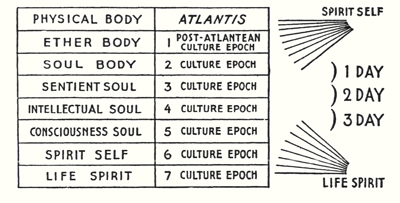
The Deeds of Christ!
From Gospel of John (Hamburg 1908), Lecture XI: Christian Initiation
We shall consider the specifically Christian initiation and explain its basis. You must think of this form of initiation as one which a person belonging to the present social order could hardly undergo. It demands a temporary isolation. The Rosicrucian method, however, is the method by which we can work ourselves into the higher worlds without interfering with our duties.
What, however, is applicable in principle, we can also fully explain by means of Christian initiation. This method of initiation has to do exclusively with the feelings, and I shall now have to enumerate seven experiences of the feeling-life; seven stages of feeling, through the experiencing of which the astral body is actually so affected that it develops its organs during the night.
Let us describe how the Christian neophyte must live in order that he may pass through these stages.
The first stage is what is called “Washing the Feet.” Here the teacher says to the pupil: “Observe the plants. They have their roots in the ground; the mineral earth is a lower being than the plant. If the plant were able to contemplate its own nature, it would have to say to the earth; it is true I am a higher being, but if thou wert not there, I could not exist; for from thee, O earth, I draw most of my sustenance.
If the plant were able to translate this into feeling, it would then bow itself down to the stone and say: — I bow myself before thee, O stone, thou humbler being, for I am indebted to thee for my very existence!
Then if we ascend to the animal, it would have to behave in a similar manner toward the plant and say: Indeed it is true, I am higher than the plant, but to the lower kingdoms I owe my existence!
If in this manner we mount higher and reach the human being, then each individual who stands somewhat higher in the social scale must incline himself to the lower and say: To those on the lower social level I owe my existence!
This continues on up to Christ-Jesus. The Twelve who are about Him are at a level lower than Christ-Jesus; but as the plant develops out of the stone, so does the Christ grow out of the Twelve. He bows down to the Twelve and says: I owe you My existence.”
When the teacher had explained this to the pupil, he then said to him: "For weeks must thou surrender thyself to this cosmic feeling of how the superior should incline to the inferior and when thou hast thoroughly developed this feeling within thee, then wilt thou experience an inner and an outer symptom!"
These are not the essential things, they only indicate that the pupil has practiced sufficiently. When the physical body was sufficiently influenced by the soul, this was indicated to him by an external symptom in which he feels as though water were lapping over his feet. That is a very real feeling!
And he has another very real feeling in which the “Washing of the Feet” appears to him as in a mighty vision in the astral, the inclining of the Higher Self to the lower.
Thus the occult student experiences in the astral world what is found depicted in the Gospel of St. John as an historical fact.
At the second stage, the pupil is told: "Thou must develop within thyself yet another feeling. Thou must picture how it would be were all the suffering and sorrow possible in the world to come upon thee; thou must feel how it would be wert thou exposed to the piling up of all possible hindrances, and thou must enter into the feeling that thou must stand erect even though all the adversity of the world were to bear down upon thee!"
Then when the pupil has practised this exercise for a sufficient length of time, there are again two symptoms; in the first he has the feeling of being beaten from all sides, and in the second he has an astral vision of the “Scourging.” I am relating what hundreds of people have experienced whereby they have acquired the ability to mount into the higher worlds.
In the third exercise, the pupil had to imagine that the holiest thing that he possesses, which he defends with his whole I-being, is subjected to jeers and gibes. He must say to himself: — “Come what may, I must hold myself erect and defend what is holy to me.”
When he had accustomed himself to this, he felt something like pricking upon his head, and he experienced the “Crown of Thorns” as an astral vision. Again it must be said that the important thing is not the symptoms; they appear as a result of the exercises. Care was also taken that there was no question of suggestion and auto-suggestion.
In the fourth exercise, the pupil's body must become as foreign to his feelings as any external object — a stick of wood for example — and he must not say “I” to his body. This experience must become so much a part of his feelings that he says: “I carry my body about with me as I do my coat.” He connects his I no longer with his body. Then something occurs which is called the Stigmata. What in many cases might be a condition of sickness is in this case a result of Meditation, because all sickness must be eliminated. On the feet and hands and on the right side of the breast appear the so-called Stigmata; and as an inner symptom, he beholds the “Crucifixion” in an astral vision.
The fifth, sixth and seventh grades of feeling, we can only briefly describe.
The fifth grade consists of what is called “The Mystical Death.” Through feelings which the pupil is permitted to experience at this stage, he feels as though, in an instant, a black curtain were drawn before the whole physical, visible world and as though everything had disappeared. This moment is important because of something else that must be experienced, if one wishes to push on into Christian initiation, in the true sense of the word. The pupil then feels that he can plunge into the primal causes of evil, pain, affliction and sorrow. And he can suffer all the evil that exists in the depths of the human soul, when he descends into Hell. That is the “Descent into Hell.” When this has been experienced, it is as though the black curtain had been rent asunder and he looks into the spiritual world.
The sixth step is what is called the “Interment and Resurrection.” This is the stage at which the pupil feels himself one with the entire earth-body. He feels as though he were laid within and belonged to the whole earth planet. His life has been extended into a planetary existence.
The seventh experience cannot be described in words; only one could describe it who is able to think without the physical brain instrument — and for that there is no language, because our language has only designations for the physical plane. Therefore, only a reference can be made to this stage. It surpasses anything that the human being can possibly conceive. This is called the “Ascension” or the complete absorption into the spiritual world.
This completes the gamut of feelings into which the pupil, during waking day-consciousness, must place himself with complete inner equanimity.
When the pupil has surrendered himself to these experiences, they act so strongly upon the astral body that, in the night, inner sense-organs are developed, are plastically formed.
These seven steps of feeling are not practiced in the Rosicrucian initiation, but the result is the same as that of which we have just spoken. Thus you see that the important thing in initiation is to influence the astral body in such a way by the indirect means of the day-experiences, that it may, when it is wholly free during the night, take on a new plastic form.
When the human being in this manner, as an astral being, has given himself a plastic form, the astral body has become actually a new member of the human organism. He is then wholly permeated by Manas or Spirit-Self.
When the astral body is thus divided, that part which has in this way been plastically formed is brought over into the ether body. And just as you press the seal upon the sealing-wax, and the name on the seal appears not only on the seal, but on the wax as well, so too must the astral body dip down into the ether body and impress upon it whatever it may now possess.
The inner process, the working over of the astral body, is the same in all methods of initiation. Only in the method of transmission into the ether body do the individual methods differ.
From Gospel of John (Hamburg 1908), Lecture XII: The Nature of the Virgin Sophia and of the Holy Spirit
The re-fashioning of the astral body indirectly through Meditation and Concentration, is called by an ancient name, “katharsis,” or purification. Katharsis or purification has as its purpose the discarding from the astral body all that hinders it from becoming harmoniously and regularly organized, thus enabling it to acquire higher organs. It is endowed with the germ of these higher organs; it is only necessary to bring forth the forces which are present in it. We have said that the most varied methods can be employed for bringing about this katharsis.
Something else must now be considered and that is that when this katharsis has taken place, when the astral organs have been formed in the astral body, it must all be imprinted upon the ether body.
In the pre-Christian initiation, it was done in the following manner. After the pupil had undergone the suitable preparatory training, which often lasted for years, he was told: The time has now come when the astral body has developed far enough to have astral organs of perception, now these can become aware of their counterpart in the ether body.
Then the pupil was subjected to a procedure which today — at least for our cultural epoch — is not only unnecessary, but is not in all seriousness feasible. He was put into a lethargic condition for three and a half days, and was treated during this time in such a way that not only the astral body left the physical and ether bodies — a thing that occurs every night in sleep — but to a certain degree the ether body also was lifted out; but care was taken that the physical body remained intact and that the pupil did not die in the meantime.
The ether body was then liberated from the forces of the physical body which act upon it. It had become, as it were, elastic and plastic and when the sensitory organs that had been formed in the astral body sank down into it, the ether body received an imprint from the whole astral body.
When the pupil was brought again into a normal condition by the Hierophant, when the astral body and I were again united with the physical and ether bodies — a procedure which the Hierophant well understood — then not only did he experience katharsis, but also what is called “Illumination” or “Photismos.”
The pupil could then not only perceive in the world around him all those things that were physically perceptible, but he could employ the spiritual organs of perception, which means, he could see and perceive the spiritual. Initiation consisted essentially of these two processes, Purification or Purging, and Illumination.
By continually meditating upon passages of the Gospel of St. John, the Christian pupil is actually in a condition to reach initiation without the three and a half day continued lethargic sleep. If each day he allows the first verses of the Gospel of St. John, from “In the beginning was the Word” to the passage “full of devotion and truth,” to work upon him, they become an exceedingly significant meditation.
They have this force within them, for this Gospel is not there simply to be read and understood in its entirety with the intellect, but it must be inwardly fully experienced and felt. It is a force which comes to the help of initiation and works for it. Then will the “Washing of the Feet,” the “Scourging” and other inner processes be experienced as astral visions, wholly corresponding to the description in the Gospel itself, beginning with the 13th Chapter.
The Rosicrucian initiation, although resting upon a Christian foundation works more with other symbolic ideas which produce katharsis, chiefly with imaginative pictures. That is another modification which had to be used, because mankind had progressed a step further in its evolution and the methods of initiation must conform to what has gradually been evolved.
We must understand that when a person has attained this initiation, he is fundamentally quite different from the person he was before it. While formerly he was only associated with the things of the physical world, he now acquires the possibility likewise of association with the events and beings of the spiritual world. This pre-supposes that the human being acquires knowledge in a much more real sense than in that abstract, dry, prosaic sense in which we usually speak of knowledge.
For a person who acquires spiritual knowledge, finds the process to be something quite different. It is a complete realization of that beautiful expression, “Know thyself.” But the most dangerous thing in the realm of knowledge is to grasp these words erroneously and today this occurs only too frequently.
Many people construe these words to mean that they should no longer look about the physical world, but should gaze into their own inner being and seek there for everything spiritual. This is a very mistaken understanding of the saying, for that is not at all what it means.
We must clearly understand that true higher knowledge is also an evolution from one standpoint, which the human being has attained, to another which he had not reached previously. If a person practices self-knowledge only by brooding upon himself, he sees only what he already possesses. He thereby acquires nothing new, but only knowledge of his own lower self in the present meaning of the word.
This inner nature is only one part that is necessary for knowledge. The other part that is necessary must be added. Without the two parts, there is no real knowledge. By means of his inner nature, he can develop organs through which he can gain knowledge. But just as the eye, as an external sense organ, would not perceive the sun by gazing into itself, but only by looking outward at the sun, so must the inner perceptive organs gaze outwardly, in other words, gaze into an external spiritual in order actually to perceive.
The concept “Knowledge” had a much deeper, a more real meaning in those ages when spiritual things were better understood than at present. Read in the Bible the words, “Abraham knew his wife!” or this or that Patriarch “knew his wife.” One does not need to seek very far in order to understand that by this expression fructification is meant. When one considers the words, “Know thyself,” in the Greek, they do not mean that you stare into your own inner being, but that you fructify yourself with what streams into you from the spiritual world. “Know thyself” means: Fructify thyself with the content of the spiritual world!
They must permit this I to work upon their previously prepared inner natures. This means that the human inner nature, in other words, the astral body has to be cleansed, purified and ennobled and subjected to katharsis, then a person may expect that the external spirit will stream into him for his illumination. That will occur when the human being has been so well prepared that he has subjected his astral body to katharsis, thereby developing his inner organs of perception. The astral body, in any case, has progressed so far that now when it dips down into the ether and physical bodies, illumination or photismos results.
What actually occurs is that the astral body imprints its organs upon the ether body, making it possible for the human being to perceive a spiritual world about him; making it possible for his inner being, the astral body, to receive what the ether body is able to offer to it, what the ether body draws out of the entire cosmos, out of the Cosmic I.
This cleansed, purified astral body, which bears within it at the moment of illumination none of the impure impressions of the physical world, but only the organs of perception of the spiritual world is called in esoteric Christianity the “pure, chaste, wise Virgin Sophia.” By means of all that he receives during katharsis, the pupil cleanses and purifies his astral body so that it is transformed into the Virgin Sophia. And when the Virgin Sophia encounters the Cosmic I, the Universal I which causes illumination, the pupil is surrounded by light, spiritual light.
This second power that approaches the Virgin Sophia, is called in esoteric Christianity — is also so called today — the “Holy Spirit.” Therefore according to esoteric Christianity, it is correct to say that through his processes of initiation the Christian esotericist attains the purification and cleansing of his astral body; he makes his astral body into the Virgin Sophia and is illuminated from above — if you wish, you may call it overshadowed — by the “Holy Spirit,” by the Cosmic, Universal I.
And a person thus illuminated, who, in other words, according to esoteric Christianity has received the “Holy Spirit” into himself, speaks forthwith in a different manner. How does he speak? When he speaks about Saturn, Sun and Moon, about the different members of the human being, about the processes of cosmic evolution, he is not expressing his own opinion. His views do not at all come into consideration.
When such a person speaks about Saturn, it is Saturn itself that is speaking through him. When he speaks about the Sun, the Spiritual Being of the Sun speaks through him. He is the instrument. His personal I has been eclipsed, which means that at such moments it has become impersonal and it is the Cosmic Universal I that is using his I as its instrument through which to speak.
Therefore, in true esoteric teaching which proceeds from esoteric Christianity, one should not speak of views or opinions, for in the highest sense of the word this is incorrect; there are no such things. According to esoteric Christianity, whoever speaks with the right attitude of mind toward the world will say to himself, for instance: If I tell people that there were two horses outside, the important thing is not that one of them pleases me less than the other and that I think one is a worthless horse. The important point is that I describe the horses to the others and give the facts. In like manner, what has been observed in the spiritual worlds must be described irrespective of all personal opinions. In every spiritual- scientific system of teaching, only the series of facts must be related and this must have nothing to do with the opinions of the one who relates them.
Thus we have acquired two concepts in their spiritual significance. We have learned to know the nature of the Virgin Sophia, which is the purified astral body, and the nature of the “Holy Spirit,” the Cosmic Universal I, which is received by the Virgin Sophia and which can then speak out of this purified astral body.
There is something else to be attained, a still higher stage, that is the ability to help someone else, the ability to give him the impulse to accomplish both of these. Men of our evolutionary epoch can receive the Virgin Sophia (the purified astral body) and the Holy Spirit (illumination) in the manner described, but only Christ Jesus could give to the earth what was necessary to accomplish this. He has implanted in the spiritual part of the earth those forces which make it possible for that to happen at all which has been described in the Christian initiation.
... He does this by indicating that she cannot be
called Mary and what is more, he places by her side her sister Mary, wife of
Cleophas and calls her simply the “Mother of Jesus.” He shows thereby that he
does not wish to mention her name, that it cannot be publicly revealed. In
esoteric circles, she is always called the “Virgin Sophia.” It was she who
represented the “Virgin Sophia” as an external historical personality.
...
The fact is that the corporality of Jesus of Nazareth which he had left behind was so mature, so perfect, that the Sun Logos, the Being of the six Elohim, which we have described as the spiritual Being of the Sun, was able to penetrate into it. It could incarnate for three years in this corporality, could become flesh.
The Sun Logos Who can shine into human beings through illumination, the Sun Logos Himself, the Holy Spirit, entered. The Universal-I, the Cosmic I entered and from then on during three years, the Sun Logos spoke through the body of Jesus. [Adam Kadmon.]
The Christ speaks through the body of Jesus during these three years. This event is indicated in the Gospel of St. John and also in the other Gospels as the descent of the dove, of the Holy Spirit, upon Jesus of Nazareth.
In esoteric Christianity it is said, that at that moment the I of Jesus of Nazareth left his body, and that from then on the Christ is in him, speaking through him in order to teach and work.
The Mother of Jesus — the Virgin Sophia in the esoteric meaning of Christianity — stands at the foot of the Cross, and from the Cross the Christ says to the Disciple whom He loved: “Henceforth, this is thy Mother” and from this hour the Disciple took her unto himself.
This means: “That force which was in My astral body and made it capable of becoming bearer of the Holy Spirit, I now give over to thee; thou shalt write down what this astral body has been able to acquire through its development.” “And the Disciple took her unto himself,” that means he wrote the Gospel of St. John. And this Gospel of St. John is the Gospel in which the writer has concealed powers which develop the Virgin Sophia.
At the Cross, the mission was entrusted to him of receiving that force as his mother and of being the true, genuine interpreter of the Messiah. [And it didn't start here and it didn't stop here, from the start of Earth it has been his destiny.]
The woman who anointed the feet of Christ Jesus in Bethany had received through the Event of Palestine the powerful force needed for spiritual perception, and she is, for example, one of those who first understood that what had lived in Jesus was present after His death, that is, had been resurrected. She possessed this faculty. It may be asked: Whence came this possibility? It came through the development of her inner sense-organs. [Magdalene, an Initiate.]
If we understand that we must call the father of Christ Jesus the Holy Spirit who begot the Christ in the bodies of Jesus, then if we are able to comprehend a thing from all sides, we shall find it easy to understand that those disciples who were less highly initiated could not give us so profound a picture of the Events of Palestine as the Disciple whom the Lord loved.
From Theosophy and Rosicrucianism (Kassel 1907), Lecture XII: The Stages of Christian Initiation
...when the earth separated from the present Moon, it was enclosed by a kind of primordial ocean, ... the human being then united himself with his soul-spiritual part ...
...the division into two sexes took place in ancient Lemuria. The lower beings upon the Moon were already divided into two sexes, but the human being who lives in each one of you was only at that time divided into two sexes upon entering his bodily form. We must think of these antediluvian times of human evolution; before the separation of mankind into two sexes, male and female, in such a way that what we designate as sex did not exist as yet, or at least, it existed in quite a different form.
...If this division into two sexes had not occurred, if humanity were not to complete its course of development through this cooperation of the male and female principle, the human being would have an entirely different form.
The individual element in man comes from the influence of the male principle. Yesterday I explained to you the difference between a group soul and an individual soul. This is quite different among animals. The animal has two sexes even on the astral plane.
But the human beings did not have these two sexes on the astral plane before descending like drops into the individualised human bodies, or they had not yet passed, as one might. say, through “the fall into sex”. Had the sexlessness of man continued in the physical world, replacing the two sexes, man could not have become an individual being. The true meaning of human development is that man should become more and more individualised.
If we once more survey the epochs which I described to you yesterday you would see how greatly the human beings resembled one another in regard to their external form. The cooperation of the two sexes gave rise to individual differentiations; these became more and more pronounced the further man advanced into the future.
Without the division into sexes the generations would always look alike. We must really say that the fact that man becomes an independent being depends upon the division into two sexes.
[In the start the difference in gender were only the result of the physical of hormones, with time we developed the gender in the spiritual.]
In that remote time, and far back in the Atlantean epoch, but even in the post-Atlantean epoch, you find that the law of “marriage among close relatives” prevails, and: that this is only gradually replaced by the law of “marriage among non-relatives” In remote epochs people married within closely related groups, within small tribes. In every nation you will find that it was once considered unusual and wrong to marry someone who belonged to another tribe one's own, and this was everywhere considered an exceptional event.
Rosegger and Anzengruber one day went for a walk together and Rosegger said: “I know you really never look at farmers; perhaps you could describe them better if you went to see them in the village.” Anzengruber replied: “If I did this, I would probably be quite at a loss. I never learned to know peasants more closely, but I can describe them because my father, my grandfather and all my ancestors were farmers, and I still have this farmer's blood in my veins. I form my characters through the farmer's blood in me, and I do not bother about the rest!”
This is an interesting fact and it indicates what we should bear in mind. Where blood does not mix, as in the case of old tribal communities, or in the case of the Anzengruber family, we find such a marked character as the writer Anzengruber, in his last incarnation. He had inherited the plastic force and he knew how to appreciate it; this plastic force ran through the blood of the generations. This really occurs where the blood only mixes with the blood of relatives. If the blood mixed with alien blood it quenched the soul's plastic forces.
The Christians of St. John, whose symbol was the Rosy Cross, said: Precisely that which was reborn as the mystery of humanity's higher self, this same has been preserved intact. It was preserved by that exclusive community which took its rise in Rosicrucianism.
This continuity is indicated symbolically in the legend of the sacred vessel called the ‘Holy Grail’, from which Christ Jesus ate and drank and in which the blood which flowed from His wounds was gathered by Joseph of Arimathea.
This vessel, they say, was brought to Europe by angels. A temple was built for it and the Rosicrucians became the guardians of its content, that is, of that which constituted the very essence of the reborn God.
The mystery of the reborn God prevailed among men — the mystery of the Holy Grail. It is presented to us as a new Gospel, and we are told the writer of the Gospel of St. John, whom we venerate, could say in his wisdom: ‘In the beginning was the Word, and the Word was with God, and the Word was a God.’
The same that was in the beginning with God has been born again in Him whom we saw suffer and die upon Golgotha and who is risen again. The continuity of the divine principle through all ages and the resurrection of the same is described by the writer of the Gospel of St. John.
But the narrators of such things knew that that which was from the beginning has been preserved unchanged. IN THE BEGINNING WAS THE MYSTERY OF THE HIGHER HUMAN I; THE SAME WAS PRESERVED IN THE GRAIL AND REMAINED UNITED THEREWITH. IN THE GRAIL LIVES THE I WHICH IS UNITED WITH THE ETERNAL AND THE IMMORTAL, EVEN AS THE LOWER I IS UNITED WITH THE TRANSITORY AND THE MORTAL.
Whoever knows the mystery of the Holy Grail knows that from the wood of the Cross springs living, budding life, the immortal self symbolized by the roses on the dark wood of the Cross. Thus the mystery of the Rosy Cross may be regarded as a continuation of the Gospel of St. John and, in this respect, we may truly speak the following words:
‘In the beginning was the Word, and the Word was with God, and the Word was a God. The same was in the beginning with God. All things were made by Him and without Him was no thing made. In Him was the Life and the Life was the Light of men. And the Light shone in the darkness and the darkness comprehended it not. Only a few, in whom something lived that was not born of the flesh, comprehended the Light that shone in the Darkness. Then the Light became flesh and dwelt among men in the likeness of Jesus of Nazareth.’
Now we might continue:
‘And in Christ who dwelt in Jesus of Nazareth we see none but the higher, divine self of all mankind, the God who came down to earth in Adam and was born again.
This reborn human self was continued as a sacred mystery; it was preserved under the symbol of the Rosy Cross and is annunciated today as the mystery of the Holy Grail and the Rosy Cross.’
In "Christ and the Spiritual World: The Search for the Holy Grail" Lecture 5 Steiner wrote:
Where, then, is the Grail, which today must be found in such a way that the name of Parsifal stands upon it? Where can it be found?
...
For one day, while I was following with inner sight the gold-gleaming sickle of the moon, as it appeared in the heavens, with the dark moon like a great disc dimly visible within it ... so that with physical sight one saw the gold-gleaming moon — ganganda greida, the journeying viaticum — and within it the large Host, the dark disc.
This is not to be seen if one merely glances superficially at the moon, but it is evident if one looks closely — and there, in wonderful letters of the occult script, was the name Parsifal!
So the grail is the hierarchy of the Angels, who we also know as Krishna or the Nathan Jesus.
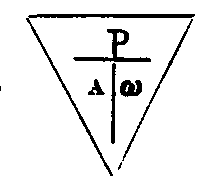
From "Pre-Earthly Deeds of Christ (Pforzheim 1914)"
In a certain sense as preparation this Mystery [Golgotha,] as I have already pointed out, had already been accomplished three times before for the salvation of mankind: once in the old Lemurian epoch, then in the Atlantean, and once again at the end of Atlantean times. That is, three times and then a fourth time in the post-Atlantean epoch at the beginning of our own era.
That which we know as the Mystery of Golgotha, however, was the only one enacted on the physical plane. The other events, which were preparatory, took place wholly in the spiritual world; but the forces which were thus developed flowed down into the earthly souls and bodies for the salvation of mankind.
In all three of these preparatory events that same Being [known as Krishna in the Indian pantheon] was present who was born later as the Nathan-Jesus and who was permeated by the Christ-Being. This is the essential fact in the Mystery of Golgotha that the Jesus-Being who grew up as the Nathan boy was permeated by the Christ-Being.
He who was later the Nathan-Jesus had been present in the three earlier events, but not incarnated as physical man; he lived in the spiritual worlds as a spiritual Being of the nature of the Archangels [Krishna]; and in the spiritual worlds, in the preparatory stages of the Mystery of Golgotha, in the Lemurian age and twice in Atlantis, he was permeated by the Christ-Being.
It may be said, therefore, that there were three Archangel-lives in the spiritual world, and that the Being who lived those lives was the same as he who was later incarnated as man and is described in the Gospel of St. Luke as the Jesus-child [Krishna.]
Three times had this Angelic being, who later sacrificed himself as Man, offered himself for permeation by the Christ-Impulse. As in Christ Jesus we have a Man [Krishna] permeated with the Christ-Impulse, so it may be said that three times previously we have an Angel permeated with that Impulse.
And as that which was accomplished by the Mystery of Golgotha streamed forth into the spiritual atmosphere of the Earth, so did that which was brought about by the first three events pour into the Earth from out the Cosmos.
Looking at the course of our human evolution we note that the Mystery of Golgotha stands in its very center. Everything that went before was in preparation for and pointed to this Event, which was the center-point of human development, and everything that has since happened is a gradual advance in the streaming of the forces of the Mystery into the hearts and souls of men.
The child learns to walk; that is to say, he learns to raise himself from the position in which he was incapable of lifting his body from the earth level towards the heavenly heights of the Cosmos. He is now in that position which, above all, distinguishes man from the animals.
Having learnt by his own inner forces to assume it, he turns his gaze away from the earth at which the animal is compelled to look by reason of its nature and form.
In our present post-Atlantean life we recapitulate those things which, as man, we have acquired only in the course of the ages. This power to stand and to walk in an upright position was acquired by slow stages in the old Lemurian epoch, and we now recapitulate it in infancy before our 'I' awakens to consciousness.
During the old Lemurian time he [man] learnt to alter the Moon direction to that of the Earth. This came about because, during the Earth development, the Spirits of Form poured the 'I' into man out of their own substance. [At this time Christ was a Spirit of Time and Personality, but he became a Spirit of Form when he gave his lowest body to man, the soul with the 'I'. The soul is the bridge between the spirit and the body and is called Christ esoterically. Christ is the Sun spirit, the prime Spirit of Forms.]
And the first manifestation of this in-flowing of the “I” was that inner force by means of which man raised himself into an upright position. Thus, through this position, he is wrested from the Earth. The Earth contains within itself spiritual forces capable of streaming through the spine as in the case of the animal body where in its natural growth it remains horizontal.
In the super-earthly region Jesus of Nazareth [Krishna] is to be found as an etheric angel-form. Through permeation with the Christ he then assumed etheric human form.
Thereby something new entered the Cosmos and rayed down upon Earth and made it possible for man, the physical earthly human form, into whom streamed the force of the etheric super-earthly Christ-Being, to protect himself from that destruction which must have overtaken him had not the
Formative Force, which enabled him to become an upright harmonious being, permeated and lived on in him.
...
We take the right view of a growing child when we see him emerging from the crawling, wriggling, helpless state and managing for the first time to stand upright or walk, when we realize that his being able to do so has only become possible because the
first Christ-Event took place in the old Lemurian time for the help and salvation or mankind; because he who, as the Nathan-Jesus
[Krishna,] was permeated by Christ, took on as a spiritual etheric being the human etheric form as the result of that permeation.
You will have seen from my descriptions of Atlantean times taken from the Akashic Records that our Atlantean forefathers were dumb. The Atlantean man was actually the first to learn to speak, and the Akashic Records show how that came about.
Learning to speak is the second capacity which a child acquires before the actual 'I'-consciousness awakens, the awakening coming after he has learnt to speak. Learning to speak depends altogether on a kind of imitation, the aptitude for which, however, is deeply embedded in human nature. Speech came to man as a consequence of progressive development.
The Spirits of Form poured themselves into man and permeated him, and thereby he became able to speak a language, to live his earth life on the physical plane. [Deed of Christ.]
Thus, by means of two principles, viz., the upright position and speech, he wrests himself free from those spiritual forces that are active upon the Earth.
If nothing had been brought about by Christ, man in the Atlantean epoch would so have developed his whole life-culture — all his bodily organs: larynx, tongue, throat, etc., and indeed even the organs lower down such as the heart in so far as they are connected with the former — that he would only have been capable of expressing his own selfish joy or pain, desire or bliss, in poor babbling sounds somewhat like the utterances of Sibyls or mediums.
Certainly he would have been able to utter much more artistic or intelligent sounds than an animal can produce, but these sounds would only have been expressive of that which lived within him, of the bodily processes taking place in his organism. He would have found expressive interjections for these only; his speech would have consisted entirely of interjections. Whereas we now limit our interjections to a few words, the human art of speech with all its subtleties would have developed at that time only as far as a language of such interjections. This disorder in the power of speech in so far as it would have affected man's inner being was averted; the second Christ-Event prevented it from entering human evolution.
Through the fact that for the second time the Being in the etheric heights [Krishna,] who later became the Nathan-Jesus child, received into himself the Christ-Being who henceforward permeated the bodily organs of man, man became capable of uttering more than interjections. The power of grasping the objective was brought about through the second Christ-Event.
But the power of so describing outer things in words, in order that the words should rightly indicate them, was still in danger from the Luciferic and Ahrimanic influences right into the Atlantean epoch.
Then came the third Christ-Event. For the third time that Being in the spiritual heights [Krishna,] later to be born as the Nathan-Jesus, united himself with the Christ-Being and again poured the forces so received into the human power of speech. The force of this Christ-Jesus Being [Krishna] now permeated once more the organs of the human body in so far as those organs come to expression in the power of speech.
In this way it was made possible for the power of speech to create, by means of words, actual signs representative of the external environment, thus enabling mankind to create language as a means of communication between the different inhabited regions.
A child learns to speak, but he could never do so if these two Christ-Events had not taken place during the Atlantean epoch. Through Spiritual Science we can enrich anew our inner feelings if we remember, when we see a child beginning to speak and gradually improving his power of expression, that the Christ-Impulses rule within the unconscious nature and that the Christ-Force lives in the child's power of speech, guarding and stimulating it.
Quite unconsciously man learnt to stand upright in the Lemurian epoch, and to become a speaking being in the Atlantean epoch. Quite unconsciously he took in the Christ-Impulse at that time because his power of thought had not been awakened.
In the post-Atlantean times he has had to be led slowly to understand what it was that he had thus taken in unconsciously in prehistoric ages. It was the Christ-Impulse which enabled him to stand upright and look up into the cosmic heights.
The Initiates, whose mission it was to influence the culture of Egypt, taught the people to revere that power by causing them to build the
Pyramids which reach up from the earth towards the Cosmos.
...
The wonderful hieroglyphics in the Pyramids and on the Obelisks, which were intended to point to the Christ, awakened to consciousness the super-earthly forces of the
Lemurian epoch.
In the contemplation of the silent Sphinx, from which sound only proceeded at sunrise under certain cosmic conditions and in certain relations, there came to man that deep reverence by which the soul was prepared to understand the language which must be spoken when it would be brought to higher consciousness how the Christ-Impulse gradually enters into the evolution of earthly humanity. That which the Sphinxes themselves could not yet say, although they prepared the way for it, had to be said to mankind. In the forming of the word-movement lies the Christ-Impulse.
A third thing which the child has to learn before he actually awakens to the 'I'-consciousness is to form ideas, to think.
This power of thinking was reserved for the humanity of the post-Atlantean epoch; and, indeed, for the humanity of the fourth age in that epoch. Before that men thought in pictures.
...
The child, too, thinks in pictures. It was only gradually given to humanity to think in thoughts, this faculty not being aroused in man until the sixth and seventh centuries before Christ. From that time onwards the thinking of thoughts has developed more and more; we now stand in the middle point.
It is through the development of this power that the 'I' can be grasped. In order that thinking, too, might be united with the Christ-Impulse, that thinking as such might not come into disorder in its activity on the 'I', there came the fourth Christ-Event, the Mystery of Golgotha.
The fourth danger was to man's thinking, the inner representation of his ideas.
From this danger man is saved by permeation with thoughts on such forms as live within him — forms such as that which flowed out into the spiritual sphere of the Earth through the Mystery of Golgotha.
This can be the case even now if man will prepare himself for it through Spiritual Science. My dear friends, we have progressed so far in the evolution of humanity that the first words of the Gospel of St. John may be set forth in another form, in the following form: —
In the Primal Beginning is the Thought,
And the Thought is with God,
And a God-like being is the Thought.
In it is Life,
And the Life shall become the Light of my 'I'.
And may the Divine Thought shine into my 'I'
That the darkness of my 'I' may grasp the Thought Divine.
...
The fourth post-Atlantean civilization began in the eighth century before Christ.
About three and a-half centuries later thought had ripened sufficiently to be expressed by the Greek philosophers with such clarity that it led to the Platonic Philosophy [with Socrates.]
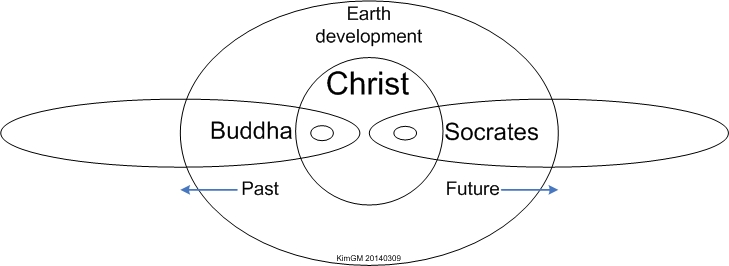
Then the life of man was permeated with the Christ-Impulse.
With the dawn of the fifteenth century after Christ the fifth post-Atlantean age began. There was exactly the same length of time between the beginning of the fourth post-Atlantean age and the understanding of thought as there was between the beginning of the fifth post-Atlantean age and the conscious utterance of the nature of thought, that is to say, until Hegel.
Human thought attained its highest point with Hegel: “The living and weaving of thought in truth is the causative Spirit.” What Hegel says, in a form so apparently quite incomprehensible, can really be expressed as follows: —
In the Primal Beginning is the Thought,
And Infinite is the Thought.
And the Life of the Thought is the Light of the 'I'.
May light-giving Thought fill the Darkness of my 'I',
That the Darkness of my 'I' may grasp the Living Thought
And live and weave in its Divine Primal Beginning.
Thus with rhythmical steps the evolution of humanity goes forward. Humanity has not yet advanced very far; even Hegel was much maligned.
It may well be said that “The Light-giving Thought did indeed shine into the Darkness, but the Darkness wished to know nothing of it.”
When man learns to understand the Life of Thought he will understand what devolves upon humanity in its further existence.
We have now to prepare for the introduction of the Christ-Impulse into a fourth element, a fourth human capacity, if we truly stand on the foundation of Spiritual Science. We must consider this, too!
The soul-capacity into which the Christ-Impulse cannot yet be directed, but into which we must prepare to direct it, is the human memory. For in addition to the walking and standing upright, the speaking and thinking, the Christ-Force is now entering the memory.
We can understand the Christ when He speaks to us through the Gospels. But we are only now being prepared as human beings for His entrance also into the thoughts which live in us and which then, as remembered thoughts and ideas, live on further in us.
And a time will come for humanity which is now being prepared but which will only be fulfilled in the Sixth Great Period of humanity when men will look back upon that which they have lived through and experienced, upon that which lives on within them as memory.
They will be able to realize that Christ Himself is present in the power of Memory. He will be able to speak through every idea. And if we make concepts and ideas alive within us Christ will be united with our memories, with that which as our memory is so closely and intimately bound up with us.
Man, looking back at his life, will realize that just as he can remember, just as the power of recollection lives within him, so in this recollection there also lives the Christ-Impulse which has streamed into it.
The path which is shown to man is to make the words, “Not I, but Christ in me,” more and more true. And the way will be made smooth through the Christ-Impulse gradually drawing into man's power of memory.
The Christ-Impulse is not yet within the memory. When it actually comes, when it lives not only in the understanding of man but is poured out over the whole length and breadth of his memories, he will not have to turn to external documents to learn history, for then his whole power of memory will be extended. Christ will live in this memory.
And when Christ has entered into the power of Memory, when Christ lives in that power, man will know that until the Mystery of Golgotha Christ worked outside the Earth; that He prepared for and went through that Mystery, and that He works on further as an Impulse in history.
Man will be able to survey this in the same way as he now perceives facts which live in his ordinary life as Memory. He will not be able inwardly to survey the earthly evolution of humanity otherwise than by seeing the Christ-Impulse as the central point. The whole power of Memory will be penetrated, and at the same time strengthened, by the entrance into it of the Christ-Impulse.
In time to come, if we grasp Christianity in a living way, the following words will also hold good for us: —
In the Primal Beginning is Memory,
And the Memory lives on further,
And Divine is the Memory.
And the Memory is Life.
And this Life is the 'I' of Man
Which streams into Man himself,
Not he alone, the Christ in him.
When he remembers the Divine Life
In his Memory is the Christ.
And as the radiant Life of Memory
Christ will pour Light
Into every Darkness of the immediate present.
We shall be able to say that Christ is in our inner soul-life. Many of us will feel it to be so if we learn to unite ourselves with the Christ-Impulse, even as the human child learns to stand upright and to speak because he has united himself with the Christ-Impulse.
Looking upon our present faculty of memory as a preparatory stage, many of us also realize that it must fall into disorder in the future unless it has the will to allow itself to be permeated with the Christ-Impulse.
Should there be upon the Earth a state of materialism in which the Christ is denied, the power of Memory would fall into disorder. More and more people would appear whose memory was chaotic; who would become duller and duller in their dark 'I'-consciousness if memory were not to shine into this darkness of the 'I'.
Our life of feeling and perception can be enriched if, through Spiritual Science, we penetrate in the right way into the nature of the Christ-Impulse and its sovereignty in man, in the spiritual being of man. It is well for us to think often on the following: —
In the Primal Beginning was the power of
Memory.
The power of Memory shall become Divine;
And a Divinity shall the power of Memory become.
All that arises within the 'I' shall become
Something which has arisen
Out of the Christ-permeated, God-permeated Memory.
In it shall be the Life;
In it shall be the radiant Light
Which, out of the Thinking which remembers,
Shines into the Darkness of the present time.
May that Darkness as it is to-day
Comprehend the Light of the Memory which has become Divine!
When we take into our hearts the meaning of such words as these, we take in something which is right for us human beings to receive.
Just as the plant forms the seed for the next plant life, so do we learn to perceive and feel within ourselves not only the fruits that come to us from former incarnations, but also how to pass over into our future incarnations.
It would go ill with our power of Memory in future incarnations if we were not permeated with the Christ-Impulse.
Our Thinking is as yet permeated with the Christ-Impulse in the barest measure, and already this Impulse is approaching our Memory.
May we learn, through Spiritual Science, to live not only for the transitory man who exists between birth and death but for that man who passes through ever-recurring incarnations.
Let us learn, through Spiritual Science, what it means for the full development of the individual soul to have the right understanding, the right feeling and perception for the most powerful Impulse in the whole evolution of humanity — the Christ-Impulse.
On Krishna, see Krishna as Teacher of Love and Krishna and the Holy Spirit.
On Lucifer and Krishna, see The Origin of Lucifer – Shiva and Shiva – Creator and Destroyer.
From From Jesus to Christ (Karlsruhe 1911), Lecture VIII
Today the most important thing for us is to establish that in the astral body [Virgin Sophia] of the Jesus-child described by Luke we have the Buddha forces at work.
And when this Nathan Jesus-child was twelve years old, the Zarathustra individuality passed over into his three-fold being.
Why is it, then, that this Jesus-child had the remarkable qualities we have just characterised? It was because he was not a human individuality like every other, but in a certain respect quite different, and in order to understand him we must go back to the ancient Lemurian time in which, strictly speaking, the Earth-evolution of man took its start.
We must clearly understand that everything before the Lemurian time was really only a repetition of the Saturn, Sun, and Moon periods. Only in the Lemurian time was the first germ-condition laid down in man as a potentiality, so that during the Earth-evolution he could receive the fourth member of his being, the 'I'. We can say the ex-tension of mankind over the Earth — a subject dealt with more precisely in the Outline of Occult Science — is to be traced to certain human ancestors in the Lemurian period, the period with which our present Earth took its start.
It is only after a certain point of time in this Lemurian period that we can speak correctly, in a modern sense, of the human race. Before this, those 'I's who have since continued to incarnate were not present in men on Earth.
They were not yet separate from the substance of that Hierarchy which had first brought the human 'I' into being: the Hierarchy of the Spirits of Form.
We can now picture to ourselves — occult research shows this — that part of the substance of the Spirits of Form entered into the incarnations of men for the building up of the human 'I'. [They sacrificed the soul-layer, raised from Archai consciousness.]
But when in due time man was given over to his physical incarnations on the Earth, something was held back. A certain 'I' substance was not brought into the stream of physical incarnations. If we were to represent the stream of physical human incarnations, beginning with him whom the Bible calls ‘Adam’, the progenitor of the human race, we should have to draw a genealogical tree with wide-spreading branches. Instead, let us simply imagine that the substance poured down from the Spirits of Form now flows onward, but that something was held back: an 'I' that was now protected from entering into physical incarnations.
Instead, this 'I' preserved the form, the substantiality, which man had had before proceeding to his first earthly incarnation. This 'I' lived on collaterally with the rest of humanity, and at the time of which we are now speaking, when the Event of Palestine was to take place, it was still in the same condition, if we wish to speak according to the Bible, as was the 'I' of Adam before his first embodiment in flesh.
In examining what occult science knows about this 'I' — which naturally for modern man is something extremely foolish — we see that this 'I', which was, as it were, held back ‘in reserve’, was given into the care of the Holy Mysteries through Atlantean and post-Atlantean times. It was preserved in an important Mystery centre, as in a tabernacle, and because of this it had quite special characteristics; it was untouched by everything that a human 'I' could have learnt on Earth. It was therefore untouched by any Luciferic and Ahrimanic influences; it was indeed something we can think of, in contrast to other human 'I's, as an empty sphere, still completely virginal with regard to all earth experiences — a nothing, a negative, in this respect. Hence it seemed as though the Nathan-child, described in the Luke Gospel, really had no 'I'; as though he consisted only of physical, etheric and astral body. And it is quite adequate if at first we say that an 'I', developed as 'I's had developed in Atlantean and post-Atlantean times, was not there at all in the Luke Jesus-child. [Krishna as the raised Angelic hierarchy had an 'I' untouched of Lucifer.]
We speak in the true sense of the words when we say that in the Matthew Jesus-child we have to do with a completely human being; whereas in the Nathan Jesus-child of the Luke Gospel we have to do with a physical, an etheric and an astral body which are interrelated in the harmonious unity that belonged to man when he emerged from the Saturn, Sun and Moon evolutions. Hence this Jesus-child, as the Akashic Record tells us, was untalented for all that human culture had developed. He could not receive it because he had never been among it. External abilities and adaptations to existence are the outcome of certain experiences in earlier incarnations. Anyone who had never shared in such experiences would show himself without talent for all that men have accomplished during the earth-evolution. If the Nathan Jesus-child had been born in our time, he would have been totally ungifted for learning to write, since in Adamic times writing was unknown. By contrast, the Luke Jesus-child revealed in a high degree the qualities he had brought with him — qualities that had not fallen into decadence through the Luciferic influence. Even more interesting is the remarkable language he spoke.
Here we must bring to mind something I mentioned in The Spiritual Guidance of Mankind: that the languages which are now spread over the earth took their rise comparatively late in evolution: they were preceded by what can truly be called a primal human language. It is the disuniting spirits of the Luciferic and Ahrimanic world who have made many languages out of the primal language.
The primal language is lost, and can be spoken today by nobody with an 'I' which in the course of earth-evolution has passed from incarnation to incarnation. This Jesus-child, who had not gone through human incarnations, acquired from the starting-point of human evolution the faculty of speaking, not this or that language, but a language of which we can rightly say that it was not comprehensible to those around him. But, because of the inner qualities of heart that lived in it, it was understood by his Mother's heart. This points to a phenomenon of immense significance in the case of the Luke Jesus-child. [The Dream Language spoken back in dreamtime, lost after Kali Yuga started, after the so-called death of Krishna.]
I have already said that the human element which had remained behind, and up to this time had developed in the Mysteries by the side of the rest of humanity, was born for the first time in the Palestine period as the Nathan Jesus-child. There was a transference from a Mystery centre in Western Asia, where this human kernel had been preserved, into the body of the Nathan Jesus-child.
This child grew on, and in his twelfth year the individuality of Zarathustra passed into him. We know also that this passing over is intimated in the scene of the twelve-year-old Jesus in the Temple. It was quite natural that the parents of the Nathan Jesus-child, who were accustomed to regard him in the light we have described, should find a remarkable change when they discovered him in the Temple after he had been lost. For that was the moment when Zarathustra passed over into this twelve-year-old child. From the twelfth to the thirtieth year, therefore, we have to do with the individuality of Zarathustra in the Luke Jesus-child.
Now in the Luke Gospel we have a remarkable expression which indicates something that can be made clear only by occult investigation. You know that in the Luke Gospel, after the description of the scene with the twelve-year-old Jesus in the Temple, there is a passage: ‘And Jesus increased in wisdom and stature, and in favour with God and man’. (Luke II:52).
In truth this passage stands as follows when we restore the text of the Gospels from the Akashic record: The twelve-year-old child increased in everything wherein an astral body can increase, i.e., in wisdom; in everything wherein an etheric body can increase, i.e. in all the qualities of kindliness, goodness, etc; and in everything wherein a physical body can increase, i.e., in all that pours itself into external beauty of form.
In this passage, therefore, a special indication is given that the Jesus-child, not having gone from incarnation to incarnation, had up to his twelfth year remained untouched, and could not be touched in his individuality, by the Luciferic and Ahrimanic forces. The Luke Gospel intimates this again by tracing the sequence of generations back through Adam to God, thus indicating that the substance in question was uninfluenced by all that had taken place in human evolution.
So this Jesus-child lived on, increasing in all that was possible for a three-fold organism not touched by the contamination which has affected the three-fold bodies of other men.
And this enabled the individuality of Zarathustra, from the twelfth to the thirtieth year of life, to pour into this three-fold human being all that could come from the heights to which he himself had previously attained. Hence we form a correct idea of Jesus of Nazareth, up to the thirtieth year of his life, when we think of him as a lofty human individuality, for whose coming into existence the greatest possible preparations had been made. [Zarathustra was also Arjuna]
But we must now be clear about one thing if we want to understand how the fruits of a development we go through in our bodies are of benefit to the individuality. Our bodies enable our individuality to absorb the fruits of our life for its future evolution. When in death we forsake our bodies, we do not usually leave in them what we have achieved and gained for ourselves as individuals. Later on we shall see under what special conditions something may remain in the bodies; but it is not the rule that the individuality should leave behind in his bodies whatever he has won for himself.
When Zarathustra forsook the threefold bodily being of Jesus of Nazareth in the thirtieth year, he left behind the three bodies, physical, etheric, and astral. But all that he had been able to gain through these instruments went into the individuality of Zarathustra and lived on further with him, to his benefit.
Something however, was gained by the three-fold bodily organism of Jesus of Nazareth. His human nature, still free, as it always had been, from Luciferic and Ahrimanic influences, was conjoined for a period with the individuality who had unequalled insight into the spirituality of the cosmos.
Think what this Zarathustra had experienced! While he was founding the ancient Persian civilisation and looking up to the great Sun Spirit, he was even then gazing out into the cosmic realms of the spiritual.
Through successive incarnations his development went on.
When the innermost part of human nature, together with the most intensive powers of sympathy and love, had become manifest through the unsullied human substance which had been preserved until the birth of the
Nathan Jesus, and when the astral body [Virgin Sophia] had permeated itself with the forces of
Gautama Buddha, there was present in this child what we may call the most intimate inwardness of man.
And then into this bodily nature there entered the individuality who above all others had seen most clearly and deeply into the spirituality of the Macrocosm [Zarathustra, Arjuna]. By this means the bodily instrument, the entire organism, of the Nathan Jesus was so transformed that it could be the vehicle capable of receiving into itself the Christ-extract of the Macrocosm.
If this bodily nature had not been permeated by the Zarathustra-individuality up to the thirtieth year, the eyes would not have been able to endure the substance of the Christ from the thirtieth year up to the Mystery of Golgotha; the hands would not have been capable of being permeated with the substance of the Christ in the thirtieth year. To be able to receive the Christ, this bodily nature had to be prepared, expanded, through the individuality of Zarathustra.
Thus in Jesus of Nazareth, as he was at the moment when Zarathustra took leave of him and the Christ-Individuality entered into him, we have to do neither with an adept, nor with anything like a higher human being. For an adept is an adept because he has a highly developed individuality, and it was just this that had passed out of the threefold bodily nature of Jesus of Nazareth.
We have simply the bodily nature so prepared through the indwelling of Zarathustra that it could take into itself the Christ-Individuality. But now, through the union of the Christ-Individuality with this bodily nature, by necessity the following consequence came about.
This is alluded to in the passage where Christ Jesus wishes to explain to his first-chosen disciples: ‘Through the way in which you feel yourselves united with the Christ Being, a certain possibility for the future evolution of humanity will come about. It will be possible for the one body risen from the grave — the spiritual body — to pass over into men’. That is what Christ wished to say when he used the phrase, ‘You are the salt of the earth’.
When the body was taken down from the Cross, the parts were still coherent, but they had no connection with the Phantom; the Phantom was completely free of them. When the body became permeated with certain substances, which in this case worked quite differently from the way in which they affect any other body that is embalmed, it came to pass that after the burial the material parts quickly volatilised and passed over into the elements. Hence the disciples who looked into the grave found the linen cloths in which the body had been wrapped, but the Phantom, on which the evolution of the 'I' depends, had risen from the grave.
It is not surprising that Mary of Magdala, who had known only the earlier Phantom when it was permeated by earthly elements, did not recognise the same form in the Phantom, now freed from terrestrial gravity, when she saw it clairvoyantly. It seemed to her different.
What Paul experienced on the road to Damascus could not have been that. He had experienced something which he knew could be experienced only when the Scriptures were fulfilled; when a perfect human Phantom, a human body risen from the grave in a super-sensible form, would appear in the spiritual atmosphere of the earth. And that is what he saw!
That is what appeared to him on the road to Damascus and left him with the conviction: ‘He was there — He is risen! For what is there could come only from Him: it is the Phantom which can be seen by all human individualities who seek to relate themselves to the Christ.’ This is what convinced him that Christ was already there; that he would not come first in the future, but was actually present there in a physical body, and that this physical body had rescued the primal form of the human physical body for the salvation of all men.
From Newborn Might and Strength Everlasting (Berlin, December 23, 1913)
In the Nathan Jesus boy we see the Child of Humanity, the Being of mankind who was left behind when humanity descended into earthly incarnations before the approach of the Tempter or luciferic principle. He was the Child who was left behind in the spiritual world, remaining, as it were, in the childhood stage of mankind until the time had come for his birth as that exceptional human being, the Nathan Jesus. He appeared then for the first time as a human being in an earthly body, and soon after birth addressed his mother in a language that could be understood only by her. Considering the different way things are understood today, it will be gradually realized how necessary it is to look up to the Heavenly Child who is worshiped in the Nathan Jesus boy. It was he who had remained behind with all the primal qualities man possessed before the Temptation, and it was he who entered the world endowed with all these qualities. In him, we can see mankind as a whole as it was in its childhood. We must bear this in mind if we wish to understand what simple folk felt when they saw the Heavenly Child glorified in such a play.
From The Driving Force of Spiritual Powers in World History (Dornach 1923), Lecture V
It is the event of which I said that it belongs essentially to the 4th century A.D. and it consists in the transference of rulership of the cosmic thoughts from the Spirits of Form to the Spirits of Personality, the Archai or Primal Powers. If we are mindful of the whole import, the cosmic import of this significant event, we may say: it consists in giving men in the course of their evolution what should rightly become theirs in our present Fifth post-Atlantean epoch, the epoch of the evolution of the Consciousness Soul, namely, inner freedom, the possibility for the individual to act from his own inner self. We know, of course, that human evolution on Earth was in essentials a kind of preparation for this very epoch, that the natural foundation had first to be laid down in man, so that within the sphere of what this foundation has enabled him to become, his soul might progress towards freedom. How is this connected with the super-sensible event previously characterized?
If we picture this event in broad outline we can say: on the one side, from our survey of the super-sensible world, we realize that the outstanding spiritual leaders of mankind are the Beings whom we must call Spirits of Personality, Archai, but those Archai who have been vested with rulership of the cosmic thoughts by the Exousiai, the Spirits of Form.
These Archai to whom man in his evolution owes the possibility of formulating thoughts through the inner efforts of his own soul, are hampered in their activity by those Beings who, as Exousiai, as Spirits of Form, have remained behind at an earlier stage of evolution; they are Beings who, as Spirits of Form, have not ceded rulership of the cosmic thoughts.
And now, in this epoch of the Consciousness Soul in which we have been living since the 15th century A.D., man is confronted with the great choice in some one of his incarnations definitely to decide for freedom or, which is the same thing, to have the possibility of this freedom through turning to the legitimate Archai.
We must be quite clear that many people — in greater and greater numbers — simply cannot come to terms with life. Some admit this to themselves — they are possibly the best. Others do not admit it, and the world-chaos into which we have fallen is due to their actions.
All the chaos, the disorder that exists today, is the direct consequence of this inner cleavage, this ignorance of the extent to which the moral world has reality. Men prefer to blunt their understanding of the great world-problems since they are unwilling to force themselves to admit where the cleavage actually lies. They prefer to ignore it.
Now the cleavage cannot be healed by what is today called civilization. It can be healed only on the basis of a spiritual world-outlook sought by way of Anthroposophy. Man comes to realize the existence of Archai who have now received the task in the cosmos of linking the thoughts of man — which now arise in isolation in the soul — to the world-processes in due arrangement.
In a grand and impressive way man again finds the foundation for the moral world-order. How does he find it? He could not become free if he were incapable of feeling: You unfold your thoughts out of your own individuality; you are yourself the elaborator of your thoughts.
But this at once implies that we have wrested our thoughts away from the cosmos. In ancient times it was like this:

If I draw the ocean of cosmic thoughts (yellow) and man diagrammatically (red), then I must indicate what passed into each man as his share of the world of cosmic thoughts. He clung to the world of cosmic thoughts — it came down into him. That this could take place was due to the action of the Spirits of Form.
In the course of evolution this has changed. We have here the ocean of cosmic thoughts (yellow) but the rulership of it has passed to the Archai. If I indicate individual men (below, red), their thoughts are detached; they are no longer connected with the cosmic thoughts. This is inevitable, for man could never be a free being if he did not wrest his world of thoughts away from the cosmos. He must wrest his thoughts away in order to become a free being but then they must be linked again with the cosmos. What is necessary, then, is that the rulership of these thoughts — which is not a direct concern of human life (green) but of the cosmos — should be exercised by the Archai, the Spirits of Personality.
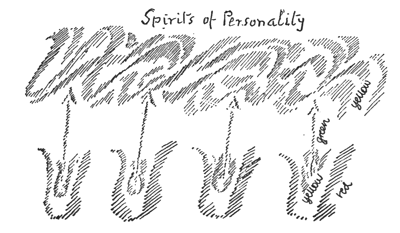
But now, if we turn to the moral aspect of these thoughts we shall say to ourselves:
When we enter the spiritual world — either through the gate of death or in the Earth's future or whenever it may be — when we enter the spiritual world we shall meet the Spirits of Personality, the Archai. We shall then be able to perceive what it has been possible for them to do with our thoughts which, to begin with, for the sake of our freedom were isolated within ourselves. We shall then recognize our worth and dignity as men from what the Spirits of Personality have been able to do with our thoughts. And cosmic thought turns directly into moral sensibility, moral impulsion.
Moral impulsion can arise anywhere today from Anthroposophy if rightly grasped — only it must be grasped by the whole being of man.
If we grasp this thought, the thought of responsibility to the normally evolving Archai, if we truly grasp our spiritual function in the cosmos, then we shall also find the place that rightly belongs to us in our epoch; we shall be true men of our time. And then we shall look in the right way at what, indeed, is forever around us: not a world of sense alone but also a spiritual world.
We shall regard the Archai as the spiritual Beings to whom man must be responsible if, as a member of humanity, he is to undergo his evolution rightly in the course of earthly time. We shall realize that in the present age what was once the necessary world-order is still opposed by all that has remained from those Spirits of Form who are still intent upon ruling over the cosmic thoughts in the old way. And this is the most important concern of civilization in our time.
The deeper talks of man today consist in this: through a right attitude to the Archai, the Spirits of Personality, to become truly free so that he may also adopt the right attitude to the Spirits of Form who today are not within their rights when they strive to exercise rulership over the cosmic thoughts as formerly, but were once the legitimate rulers. [Right attitude to the soul so we may adapt the right attitude to our higher I.]
On the one hand we shall find what makes life in the world difficult, but we shall also find everywhere ways out of these difficulties. Only we must seek for these ways as free individuals. For if we have no will to achieve a free development of thoughts, what could the Archai possibly make of us?
What is important in our age is that man should have the resolute will to be a free being. In most cases he still does not will it and so has to accommodate himself to the idea. It is still difficult today for a man to wish to be a free being. What would please him most would be to wish what he likes and that the right Spirits would be there to carry out his wishes in an invisible, super-sensible way. Then he would perhaps feel free, feel his dignity as man! We need only wait for one or two incarnations — not such a very long time, until about the year 2800 or 3000 — and then in our next incarnation, when looking back on the earlier one, we should never be able to excuse ourselves if we had confused human freedom with the furtherance of human comfort by indulgent Gods !
Today man does exactly this — he confuses freedom and indulgence of benevolent Gods with his love of ease and his wishes for comfort. There are still many people today who wish that there were benevolent Gods to carry out their wishes without much assistance from themselves. But as I said, we need only wait for the year 2800 or 3000 and in a subsequent incarnation we shall thoroughly despise such an attitude. Today, if we develop a truly moral attitude of mind this must be allied with a certain moral strength, with a genuine desire for freedom — inner freedom in the first place; outer freedom will soon follow in the right form if the will for inner freedom is present. But to this end it is essential to perceive exactly where the unauthorized Spirits of Form are active.
Well, they are active everywhere. I could imagine — the human intellect has such a strongly Luciferic tendency — that there may be people who say: Yes, it would certainly be much more sensible for the divine ordering of the world if these backward Spirits of Form were not causing havoc, indeed if they were not there at all ! I advise individuals who think like this also to consider as sensible people whether they could nourish themselves without at the same time filling their intestines with unpleasant substances. The one process is simply not possible without the other. Similarly it is not possible in the world for the things upon which the greatness and dignity of man depend to exist without their correlates.
Where, then, do we see backward Spirits of Form in action? Today in particular we see them active in the national chauvinisms which have spread over the whole world wherever the thoughts of men arise, not directly from the innermost core of human nature but out of the blood, out of what comes from the instincts.
National Chauvinism is connected with the development of the throat chakra, so all kinds of opinions and illusions comes under their influence. The Throatchakra relates to the lowest body of the Spirits of Form and the heartchakra relates to the lowest body of the Archai. The Backward Spirits of Form haven't raised from Archai to Spirit of Form, haven't released or sacrificed their soul layer.
In this connection there are two attitudes to nationality One is this: a man scorns the normal Archai and simply lends himself to what the backward Spirits of Form achieve through the nationalities. He then grows up simply as a national, boasting in chauvinistic style of what he has become through having been born with national blood in his veins. His speech is a product of his nationality, his thoughts come to him in the language of his nationality, the very form of his thoughts too comes from the particular form of this language. He grows from the soil which the Spirits of Form have made out of the nationalities.
Now suppose there is someone who is willing to fall in with the backward Spirits of Form and is at the same time an extremely ambitious individual, placed by destiny in a special position, then — with an eye to the national chauvinisms — he may compose ‘Fourteen Points‘. He then finds followers who regard Woodrow Wilson's Fourteen Points as a splendid gift to the world!
Seen truly, what were these Fourteen Points? They were something flung to the world as an inducement to pander to what the backward Spirits of Form were intent upon inculcating into the different nations. The Fourteen Points were directly inspired from that source.
One can speak of all these things on very different levels. Exactly what I am saying today on one level in characterizing the Archai and the Exousiai, I said years ago in order to underline the significance of Woodrow Wilson's Fourteen Points, because they have lulled the world in a cradle of illusions, have caused untold disaster and chaos.
The five sub-races that we know are: first, the sub-race of Spirituality; this is the sub-race from which the Indian cultural community arose.
Then we have the sub-race of the Flame, that is the Persian cultural community.
Then we have what we call the ancient Chaldean sub-race, the sub-race of the Stars, of which the Israelite people forms a branch, indeed the most important branch.
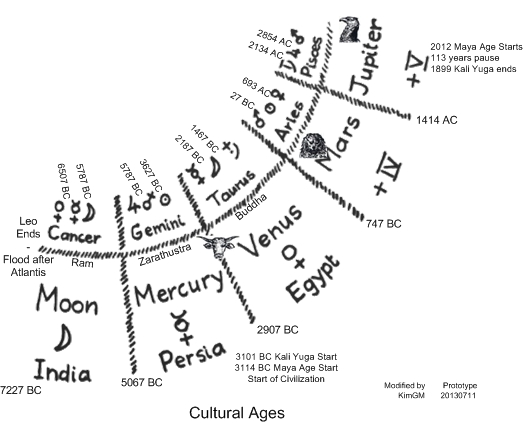
The fourth cultural community is the one which produced Greece and Rome, the sub-race of Personality. The fifth sub-race is that of the World, the culture within which we ourselves live, the culture of the present stage of evolution, which will be replaced by a cultural community coming from Asia. Rudolf Steiner
From Christianity As Mystical Fact (1902)
In Lazarus Jesus accomplished the great miracle of the transformation of life in the sense of ancient traditions. Through this event Christianity is linked with the Mysteries. Lazarus had become an initiate through Christ Jesus himself. Thereby Lazarus had become able to rise into the higher worlds. He was at the same time both the first Christian initiate and the first to be initiated by Christ Jesus himself.
Through his initiation he had become capable of perceiving that the “Word” which had come to life within him had become a person in Christ Jesus, and thus there stood before him in the personality of his “awakener” the same which had been revealed within him spiritually. [Christ was in Lazarus, was his I.]
From The Occult Significance of the Bhagavad Gita (Helsingfors 1913)
Krishna — that is, the spirit who worked through Krishna — appeared again in the Jesus child of the Nathan line of the House of David, described in St. Luke's Gospel.
Thus, fundamentally, this child embodied the impulse, all the forces that tend to make man independent and loosen him from external reality. What was the intention of this soul that did not enter human evolution but worked in Krishna and again in this Jesus child? [The Son of Man, Abel.]
At a far distant time this soul had had to go through the experience of remaining outside human evolution because the antagonist Lucifer had come; he who said, “Your eyes will be opened and you will distinguish good and evil, and be as God.” In the ancient Indian sense Lucifer said to man, “You will be as the Gods, and will have power to find the sattwa, rajas and tamas conditions in the world.”
Lucifer directed man's attention to the outer world. By his instigation man had to learn to know the external, and therefore had to go through the long course of evolution down to the time of Christ.
Then he came who was once withdrawn from Lucifer; came in Krishna and later in the Luke Jesus child. In two stages he gave that teaching that from another side was to be the antithesis of the teaching of Lucifer in Paradise. “He wanted to open your eyes to the conditions of sattwa, rajas, and tamas.
If the Krishna-Jesus influence alone had continued, one one-sidedness would have been added to another. Man would have taken leave of all that surrounds him, would have lost all interest in external evolution. Each person would only have sought his own perfection. Striving for perfection is right; but such striving bought at the price of a lack of interest in the whole of humanity is one-sided, even as the Luciferic influence was one-sided.
Hence the all-embracing Christ Impulse entered the higher synthesis of the two one-sided tendencies.
In the personality of the St. Luke Jesus child Himself the Christ Impulse lived for three years; the Christ who came to mankind to bring together these two extremes. Through each of them mankind would have fallen into weakness and sin.
Through Lucifer humanity would have been condemned to live one-sidedly in the external conditions of sattwa, rajas and tamas.
Through Krishna they were to be educated for the other extreme, to close their eyes and seek only their own perfection. Christ took the sin upon Himself. He gave to men what reconciles the two one-sided tendencies.
It was this that was brought home to the men who received the baptism of John in the Jordan, so that they understood the Baptist when he said to them, “Change your disposition; walk no longer in the path of Krishna” — though he did not use this word. The path on which mankind had then entered we may call the Jesus-path if we would speak in an occult sense.
In effect, the pursuit of this Jesus-path alone went on and on through the following centuries. In many respects human civilization in the centuries following the foundation of Christianity was only related to Jesus, not to the Christ Who lived in Jesus for the three years from the baptism by John until the Mystery of Golgotha.
Every line of evolution, however, works its way onward up to a certain tension. In the course of time this longing for individual perfection was driven to such a pitch that men were in a certain sense brought more and more into the tragedy of estrangement from the divine in nature, from the outer world.
Today we are experiencing this in many ways. Many people are going about among us who have little understanding left of our environment. Therefore, it is just in our time that an understanding of the Christ Impulse must break in upon us.
The Christ-path must be added to the Jesus-path. The path of one-sided striving for perfection has become too strong. It has gone so far that in many respects men are so remote from their surroundings that certain movements, when they arise, over-reach themselves immediately, and the longing for the opposite is awakened. Many human souls now feel how little they can escape from this enhanced self-consciousness, and this creates an impulse to know the divinity of the outer world.
It is such souls as these who in our time will seek the understanding of the Christ Impulse that is opened up by true anthroposophy; the force that does not merely strive for the one-sided perfection of the individual soul but belongs to the whole progress of humanity.
To understand the Christ means not merely to strive toward perfection, but to receive in oneself something expressed by St. Paul, “Not I, but Christ in me.” “I” is the Krishna word. “Not I, but Christ in me,” is the Christian word.
See The Origin of Lucifer – Shiva and Shiva – Creator and Destroyer.
From The Bhagavad Gita and the Epistles of St. Paul
What really was the reason that St. Paul could recognize Christ as he did when He appeared to him on the way to Damascus? Why did the certain conviction come to him that this was the risen Christ? This question leads us back to another one: What was necessary in order that the whole Christ Being should be able completely to enter into Jesus of Nazareth, at the baptism by John in the Jordan?
Now, we have just said what was necessary to prepare the body into which the Christ Being could descend. But what was necessary in order that the Arisen One could appear in such a densified soul form as he appeared in to St. Paul? What, then, so to speak, was that halo of light in which Christ appeared to St. Paul before Damascus? What was it? Whence was it taken?
If we wish to answer these questions, my dear friends, we must add a few finishing touches to what I have already said. I have told you that there was, as it were, a sister-soul to the Adam-soul, to that soul which entered into the sequence of human generations. This sister-soul remained in the soul world. It was this sister-soul that was incarnated in the Luke Jesus. [The sister-soul was Krishna, the hierarchy of the raisen Angels.]
But it was not then incarnated for the first time in a human body in the strictest sense of the words: it had already been once incarnated prophetically. This soul had already been made use of formerly as a messenger of the holy Mysteries; it was, so to say, cherished and cultivated in the Mysteries, and was sent whenever anything specially important to man was taking place; but it could only appear as a vision in the etheric body, and could only be perceived, strictly speaking, as long as the old clairvoyance remained. In earlier ages that still existed.
Therefore this old sister-soul of Adam had no need at that time to descend as far as the physical body in order to be seen. So it actually appeared on Earth repeatedly in human evolution: sent forth by the impulses of the Mysteries at all times when important things were to take place in the evolution of the Earth; but it did not require to incarnate in ancient times, because clairvoyance was there. [The deeds of Christ.]
The first time it needed to incarnate was when the old clairvoyance was to be overcome through the transition of human evolution from the third to the fourth post-Atlantean age, of which we spoke yesterday.
Then, by way of compensation, it took on an incarnation, in order to be able to express itself at the time when clairvoyance no longer existed.
The only time this sister-soul of Adam was compelled to appear and to become physically visible, it was incorporated, so to speak, in Krishna; and then it was incorporated again in the Luke Jesus.
So now we can understand how it was that Krishna spoke in such a superhuman manner, why he is the best teacher for the human ego, why he represents, so to speak, a victory over the ego, why he appears so psychically sublime. It is because he appears as human being at that sublime moment which we brought before our souls in the lecture before last, as Man not yet descended into human incarnations.
He then appears again, to be embodied in the Luke Jesus.
Hence that perfection that came about when the most significant world-conceptions of Asia, the
ego of Zarathustra and the
spirit of Krishna, were united in the twelve-year-old Jesus described by St. Luke.
He who spoke to the learned men in the Temple was therefore not only
Zarathustra speaking as an ego, but one who spoke from those sources from which Krishna at one time drew Yoga; he spoke of Yoga raised a stage higher; he united himself with the Krishna force, with Krishna himself, in order to continue to grow until his thirtieth year.
Then only have we that complete, perfected body which could be taken possession of by the Christ. Thus do the spiritual currents of humanity flow together. So that in what happened at the Mystery of Golgotha we really have a cooperation of the most important leaders of mankind, a synthesis of spirit-life.
When St. Paul had his vision before Damascus, He Who appeared to him then was the Christ.
The halo of light in which Christ was enveloped was Krishna. And because Christ has taken Krishna for His own soul-covering through which He then works on further, therefore in the light which shone there, in Christ Himself, there is all that was once upon a time contained in the sublime Gita.
We find much of that old Krishna-teaching, although scattered about, in the New Testament revelations.
This old Krishna-teaching has on that account become a personal matter to the whole of mankind, because Christ is not as such a human ego belonging to mankind, but to the Higher Hierarchies. Thus Christ belongs also to those times when man was not yet separated from that which now surrounds him as material existence, and which is veiled to him in maya through his own Luciferic temptation. If we glance back over the whole of evolution we shall find that in those olden times there was not yet that strict division between the spiritual and the material; material was then still spiritual, and the spiritual — if we may say so — still manifested itself externally. Thus because in the Christ Impulse something entered into mankind which completely prevented such a strict separation as we find in Sankhya philosophy between Purusha and Prakriti, Christ becomes the Leader of men out of themselves and toward the divine creation.
From The Bhagavad Gita and the Epistles of St. Paul Lecture IV
That which, after the Mystery of Golgotha, a man had to look for as the Christ-Impulse in himself, which he had to find in the Pauline sense: “Not I, but Christ in me,” that he had, before the Mystery of Golgotha, to look for outside, he had to look for it coming to him as a revelation from cosmic distances. [With Jesus died the outer gods and the resurrected in our inner.]
Who was the hero who crushed the head of the serpent, who struggled against that which was important in the third epoch? Who was he who guided mankind out of the old Sattva-time into the new Tamas-time?
That was Krishna — and how could this be more clearly shown than by the Eastern legend in which Krishna is represented as being a son of the Gods, a son of Mahadeva and Devaki, who entered the world surrounded by miracles (that betokens that he brings in something new), and who, if I may carry my example further, leads men to look for wisdom in their everyday body, and who crushes their Sunday body — the serpent; who has to defend himself against that which projects into the new age from his kindred. Such a one is something new, something miraculous.
If we observe this condition more clearly we come to a place in the Gita which, if we have already been amazed at the great and mighty contents of the Gita, must infinitely extend our admiration.
We come to a passage which, to the man of the present day, must certainly appear incomprehensible; wherein Krishna reveals to Arjuna the nature of the Avayata-tree, of the Fig-tree, by telling him that in this tree the roots grow upwards and the branches downwards; where Krishna further says that the single leaves of this tree are the leaves of the Veda book, which, put together, yield the Veda knowledge.
That is a singular passage in the Gita. What does it signify, this pointing to the great Tree of Life, whose roots have an upward direction, and the branches a downward direction, and whose leaves give the contents of the Veda?
 No man can see his own brain when he is observing; neither can any man see his own spine. This impossibility ceases as soon as one observes with the etheric body. A new object then appears which one does not otherwise see — one perceives one's own nervous system. Certainly it does not appear as the present-day anatomist sees it. It does not appear as it does to such a man; it appears in such a way that one feels: “Yes! There thou art, in thy etheric nature.”
One then looks upwards and sees how the nerves, which go through all the organs, are collected together up there in the brain. That produces the feeling:
“That is a tree of which the roots go upwards, and the branches stretch down into all the members.”
That in reality is not felt as being of the same small size as we are inside our skin: it is felt as being a mighty cosmic tree. The roots stretch far out into the distances of space and the branches extend downwards. One feels oneself to be a serpent, and one sees one's nervous system objectified, one feels that it is like a tree which sends its roots far out into the distance of space and the branches of which go downwards.
Remember what I have said in former lectures, that man is, in a sense, an inverted plant. All that you have learnt must be recalled and put together, in order to understand such a thing as this wonderful passage in the Bhagavad Gita.
Krishna had to give the finest spiritual blossoms to his own pupil, because he was to kill out the old knowledge of mankind, to crush the head of the serpent.
From Gospel of Mark: Lecture 5
How could the human soul itself feel in the course of subsequent centuries? It could perceive how these marvelous revelations of an older time spoke about the true, spiritual, celestial home of mankind. It could then look into all that surrounded it. It saw with eyes, heard with ears, grasped things with the sense of touch; it could think with the intellect about things, the intellect that never penetrates into the spiritual element proclaimed in the revelation of Krishna.
And the soul could say to itself, “There is an ancient holy teaching from times past which tells of a world, our spiritual home which lies all around us, around that world which is all that we now recognize. We no longer live in that spiritual home; we have been expelled from that world of which Krishna spoke so magnificently.”
Then comes the Buddha. How does he speak of the marvels of the world spoken of by Krishna to human souls which could perceive only what eyes can see and ears hear? He says, “Certainly you live in the world of the senses. The yearning that drives you from incarnation to incarnation has led you into this world. But I am telling you of that path which can lead you out of this world and into that world of which Krishna spoke. I am telling you about the path through which you will be redeemed from the world that is not the world of Krishna.” Buddha's teaching in these later centuries resounds like a kind of nostalgia for the world of Krishna.
In this respect the Buddha seems to us like the last successor of Krishna, as Krishna's successor who had to come. And if the Buddha himself had spoken of Krishna, how would he have been able to speak about him? He would have said something like this:
“I have come to proclaim to you again the greater one who was my predecessor. Turn your mind backward to the Krishna who was greater than I, and you will see what you can attain if you leave this world which is not your true spiritual home. I will show you the path by which you can redeem yourselves from the world of sense. I lead you back to Krishna.”
The Buddha could have spoken in this way, but he did not use these exact words. Nevertheless he did say them in a somewhat different form when he said, “In the world in which you live there is suffering, there is suffering, there is suffering. Birth is suffering. Age is suffering. Illness is suffering. Death is suffering. To be apart from that which one loves is suffering. To be bound to that which one does not love is suffering. The longing for that which one loves but may not attain is suffering.”
And so he gave his Eightfold Path. It was a teaching that did not go beyond that of Krishna because in fact it was the same teaching as the one given by Krishna.
“I have come after him who is greater than I, and I will show you the way back to him who is greater than I.”
These are the world-historical tones that ring forth to us from the land of the Ganges.
Now let us go a little further toward the West, and place once more before our souls the figure of the Baptist, and remember the words that the Buddha could have spoken: “I have come after Krishna who is greater than I; and I will show you the way back to him, away from the world bereft of the divine of which Krishna spoke. Turn your minds backward!”
Now consider the figure of the Baptist. How did he speak, how did he express his views? How did he express the facts he had received from the spiritual world? He too pointed to another, but he did not say, as the Buddha could have said, “I have come after him.” On the contrary he said, “After me there will come one greater than I.” (Mark 1:7.) This is what the Baptist said. Nor did he say, “Here in the world is suffering, and I wish to lead you to something that is not of this world.” No, he said, “Change your way of thinking. Do not continue to look backward, but look forward. When He comes who is greater than I the time will be fulfilled. Then the divine world will enter into the world of suffering. And what was lost of the revelations of past times will enter in a new way into human souls.
So the successor of Krishna is the Buddha, and John the
Baptist is the forerunner of Christ Jesus. Thus everything is reversed.
[Krishna
is Christ and Buddha is the Baptist, Adam.]
We are faced with the six hundred years that elapsed between these two events, and we have before us the two comets, with their nuclei: the one comet pointing backward with Krishna as nucleus together with the one who leads men backward, the Buddha. Then we have the other comet pointing forward, with Christ as its nucleus together with him who stands before us as the forerunner.
If, in the best sense, you recognize the Buddha as the successor of Krishna, and John the Baptist as the forerunner of Christ Jesus, then this formula expresses in the simplest way what took place in human evolution around the time of the Mystery of Golgotha. It is in this way that we should look at things, and then we can understand them.
Steiner have used the comet metaphor before, with Buddha as the past and Socrates as the future:

With Christ as Krishna raised in the inner.
Another context, but same story:
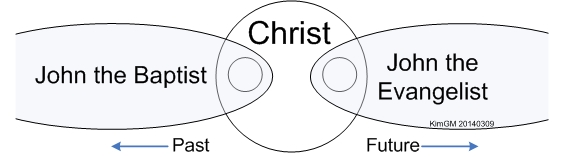
Gospel of John 1
29 The next day John saw Jesus coming toward him and said, “Look, the Lamb of God, who takes away the sin of the world.
30 This is He of whom I said, ‘A man who comes after me has surpassed me because He was before me.’
This saying is in many ways curious, why is the Baptist come after the Christ being? The Baptist is the astral principle while the Christ or the Evangelist is the Soul principle, and it's an æon older.
From German GA 146, p. 115ff (Google translation):
By those special circumstances in which the Arjuna soul perceived all that was around them, and exercised their feelings by feeling what was happening in Kurukshetra on the battlefield, where the Kurus and Pandus stood, That this particular peculiar soul spoke through the soul of the chariot of Arjuna. And the appearance of this soul, speaking through a human soul, is the Krishna .
What soul, then, was capable of sinking into the human soul, the impulse to self-consciousness? It was the soul which remained behind in the old Lemurian period when mankind entered the real earth evolution.
Earlier this soul was often seen in appearances, but in a much more spiritual way. In the time, however, of which the sublime singing, the divine Gita proclaims, is to be thought a sort of incarnation - but much Maya is there - a kind of incarnation of this soul of Krishna.
But then there is a definite incarnation in the history of mankind: this same soul is later embodied in a boy. Those of the revered friends, to whom I have often spoken, know that, at the time when Christianity was established, two boys were born in families in which the blood of the house of David flowed. The one boy is portrayed in the Gospel of Matthew, the other in Luke's Gospel. This is the true reason why the Gospel of Matthew, with the Gospel of Luke, is not correct for external observation.
The same Jesus, whom the Gospel of
Luke relates, Is the incarnation of this same soul which has never before lived
in a human body but is nevertheless a human soul because it was a human soul
during the ancient Lemurian period in which our actual evolution began.
It is the same soul that has revealed itself as Krishna. Thus we have what is the
Krishna impulse, the impulse to human self-consciousness, embodied in the body of
Luke-Jesus-Boy.
That which was embodied is related to the powers that are sleeping in the childhood in so innocent anger before they awaken as sexual forces. In the Luke-Jesus-boy, they can manifest themselves up to this age where man enters the sexual maturity.
It would have been the body of Jesus, who has been taken from the universal humanity which had descended into the incarnations, no longer fit the forces which are indeed related to the innocent, innocent generations of the child.
Therefore, the soul who is in the other Jesus-boy, and who, as most of our dear friends know, is the Zarathustra, is a soul that has passed from incarnation to incarnation, and which is reached by special work within many incarnations. Therefore, this Zarathustra is going into the body of the Luke-Jesus-boy, and from this point onwards-as you find it represented in my book, The Spiritual Leadership of Man and Humanity is connected with this body of Luke Jesus.
We touch a wonderful secret. Here we see, As in a human body, into the body of the Luke-Jesus-boy, the human soul is as it has been before man has descended into the earthly incarnation series. Then we understand that this soul in the human body could only rule until the twelfth year of this body, that then another soul, which has undergone all human transformations, like the Zarathustra, must take possession of this particular body. The miraculous is realized that what is the innermost of man is to see his own self, which we regard as Krishna, as impulses, flashing in the Krishna impulse, the Jesus, which is portrayed in Luke's Gospel.
From time to time Beings appear for the guidance of mankind such as we look up to in Krishna, the Great Teacher of Arjuna. Krishna teaches the highest human wisdom, the highest humanity, and he teaches it as being his own nature, and also in such a way that it is related to every human being, for all that is contained in the words of Krishna is to be found in germ in every human soul.
Thus when a man looks up to Krishna he is both looking up to his own highest self and also at another: who can appear before him as another man in whom he honours that which he himself has the predisposition to become, yet who is a separate being from himself and bears the same relationship to him as a God does to man.
In this way must we think of the relationship of Krishna to his pupil Arjuna, and then we obtain the keynote of that which sounds forth to us out of the Gita; that keynote which sounds as though it belonged to every soul and can resound in every soul, which is wholly human, so intimately human that each soul feels it would be ashamed if it did not feel within it the longing to listen to the great teachings of Krishna.
On the other hand, it all seems so calm, so passionless, so dispassionate, so sublime and wise, because the highest speaks; that which is the divine in every human nature and which yet once appears in the evolution of mankind, incorporated, as a divine human being. How sublime are these teachings! They are really so sublime that the Gita rightly bears the name of the “Sublime Song” or the “Bhagavad Gita.”
Only when we consider these life-connections do we realise how the laws of destiny work in the conceptions of the world. In the background of such great revelations, such great world-philosophies as the Gita and the Epistles of St. Paul, we are confronted by the ruling of these laws of destiny. We might say: if we look behind the Gita and the Epistles of St. Paul, we can see the direct ruling of destiny. [The Holy Spirit.]
We not only admire the Bhagavad Gita for the reasons we have briefly given, but because it strikes us as something so poetically great and powerful; because from every verse it radiates forth to us the great nobility of the human soul; because
in everything spoken from the mouths of Krishna and his pupil, Arjuna, we feel something which lifts us above everyday human experiences, above all passions, above everything emotional which may disturb the soul.
We are transported into a sphere of soul-peace, of clearness, calm, dispassionateness, freedom from emotion, into an atmosphere of wisdom, if we allow even one part of the Gita to work upon us; and by reading the Gita we feel our whole humanity raised to a higher stage.
In the case of the Pauline Epistles, all this is different. The sublimity of the poetical language is lacking, even the dispassionateness is lacking. We take up these Epistles and allow them to influence us, and we feel over and over again how what is wafted towards us from the mouth of St. Paul comes from a being, passionately indignant at what has happened. Sometimes the tone is scolding, or — one might say — condemnatory; in the Pauline Epistles this or that is often cursed; there is scolding.
The things that are stated as to the great concepts of Christianity, as to Grace, the Law, the difference between the law of Moses and Christianity, the Resurrection — all this is stated in a tone that is supposed to be philosophical, that is meant to be a philosophical definition but is not, because in every sentence one hears a Pauline note.
We cannot in any single sentence forget that it is spoken by a man who is either excited or expressing righteous indignation against others who have done this or that; or who so speaks about the highest concepts of Christianity that we feel he is personally interested; he gives the impression that he is the propagandist of these ideas. [The Holy Spirit talks through Paul - The Baptist and Krishna ?.]
We have already pointed out in yesterday's lecture, that in the Gita we find the significant instruction of Arjuna by Krishna.
Now who exactly is Krishna? This question must, above all, be of interest to us. One cannot understand who Krishna is if one does not make oneself acquainted with a point which I have already taken the opportunity of mentioning in various places; that is, that in earlier ages the whole system of giving names and descriptions was quite different from what it is now.
And one would not have been satisfied to designate him in the same way as other men, but would have called him after his prominent characteristic, a Manas-bearer; whereas another might only be called a senses-bearer. One would have said: That is a Manas-bearer, he is a Manu.
Suppose we were to meet two men; one of whom had been just an ordinary man, who allowed the world to act upon him through his senses and reflected upon it afterwards with the intellect attached to his brain; the other one into whom the word of divine wisdom had radiated.
According to the old ideas we should have said: This first one is a man, he is born of a father and mother, was begotten according to the flesh.
In the case of the other, who was a messenger of the Divine Substance, no consideration would be given to that which makes up an ordinary biography, as would be the case with the first who contemplated the world through his senses and by means of the reason belonging to his brain.
To write such a biography of the second man would have been folly. For the fact of his bearing a fleshly body was only accidental, and not the essential thing; that was, so to speak, only the means through which he expressed himself to other men.
Therefore we say: The Son of God is not born of flesh but of a Virgin, he is born straight from the Spirit; that is to say, what is essential in him, through which he is of value to humanity, descends from the Spirit, and in the olden times it was that alone which was honoured.
In certain schools of initiation it would have been considered a great sin to write an ordinary biography, which only alluded to everyday occurrences, of a person of whom it had been recognised that he was remarkable because of the higher principles of his human nature. Anyone who has preserved even a little of the sentiments of those old times cannot but consider biographies such as those written of Goethe as in the highest degree absurd.
Now let us remember that in those olden times mankind lived with ideas and feelings such as these, and then we can understand how this old humanity was permeated with the conviction that such a Manu, in whom Manas was the prevailing principle, appears but seldom, that he must wait long epochs before he can appear.
Now if you think of what may live in a man of our present cycle of humanity as the deepest part of his being, which every man can dimly sense as those secret forces within him which can raise him up to soul-heights; if we think of this, which in most men exists only in rudiment, becoming in a very rare case the essential principle of a human being-a being who only appears from time to time to become a leader of other men, who is higher than all the Manus, who dwells as an essence in every man, but who' as an actual external personality only appears once in a cosmic epoch [Christ Jesus]; if we can form such a conception as this, we are getting nearer to the being of Krishna.
He is man as a whole; he is — one might almost say — humanity as such, thought of as a single being [Adam Kadmon.]
Yet he is no abstract being. When people today speak of mankind in general, they speak of it in the abstract, because they themselves are abstract thinkers. The abstract being is we ourselves today, ensnared as we are in the sense-world, and this has become our common destiny. When one speaks of mankind in general, one has only an indistinct perception and not a living idea of it.
Those who speak of Krishna as of man in general, do not mean the abstract idea one has in one's mind today. “No,” they say, “true, this Being lives in germ in every man, but he only appears as an individual man, and speaks with the mouth of a man once in every cosmic age [The Jesus incarnation.]
“But with this Being it is not a question of the external fleshly body, or the more refined elemental body, or the forces of the sense-organs, or Ahamkara and Manas, but the chief thing is that which in Budhi and Manas is directly connected with the great universal cosmic substance, with the divine which lives and weaves through the world.
Arjuna is Gods hand on Earth, he manifest Gods will in the physical, he is not the reason himself. Krishna is the charioteer!
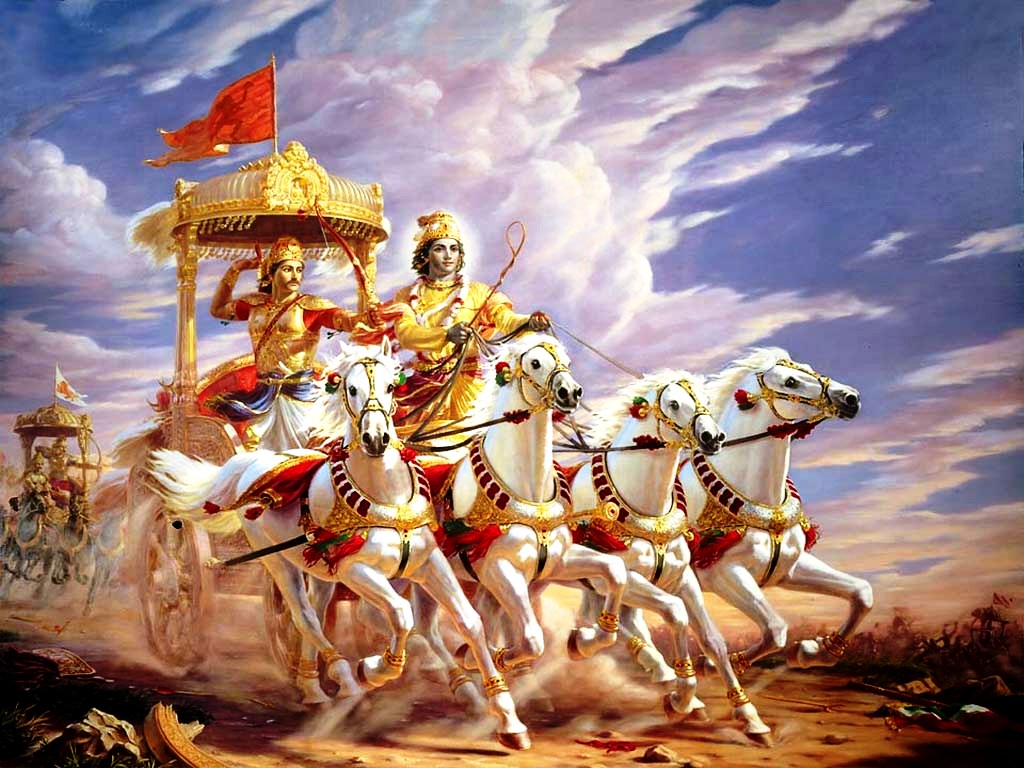
Arjuna [The Zarathustra I] has to fight against his blood-relations. That is his external destiny, it is his own doing, his Karma, which comprises the deeds which he must first of all accomplish in this particular situation. In these deeds he lives at first as external man; but the great Krishna teaches him that a man only becomes wise, only unites himself with the Divine Eternal [Adam Kadmon, the Logos] if he performs his deeds because they themselves in the external course of nature and of the evolution of humanity prove to be necessary; yet the wise man must release himself from them.
He performs the deeds; but in him there is something which at the same time is a looker-on at these deeds, which has no part in them, which says: I do this work, but I might just as well say: I let it happen. One becomes wise by looking on at what one does as though it were being done by another; and by not allowing oneself to be disturbed by the desire which causes the deed or by the sorrow it may produce.
When Krishna Himself caused to sound into the ears of Arjuna that which He then spoke, it sounded thus: “I am Time, which destroys all worlds. I have appeared to carry men away, and even if thou shalt bring death to them in battle, yet all these warriors standing there in line would die even without thee. Rise up, therefore, fearlessly. Thou shalt acquire fame and conquer the foe, Exult over the coming victory and mastery. Thou wilt not have killed them when they fall dead in the battle; by Me they are all killed already, before thou canst bring death to them. Thou art only the instrument, thou fightest only with the hand The Dronas, the Jayadanas, the Bhishmas, the Karnas, and the other warrior heroes whom I have killed, who are already dead — now kill thou them, that my actions may appear externally when they fall dead in Maya; those whom I have already killed, kill thou them. That which I have done will appear to have been done by thee. Tremble not! Thou art not able to do anything which I have not done already. Fight! Those whom I have already killed will fall by thy sword.”
Now having heard that the Krishna teaching is based upon the Sankhya philosophy, it will be quite clear to us that it must be so. In many places one can see it shining through the teaching of Krishna; as when the great Krishna says to his pupil:
The soul that lives in thee is connected in several different ways; it is connected with the coarse physical body, it is connected with the senses, with Manas, Ahamkara, Budhi; but thou art distinct from them all. If thou regardest all these as external, as sheaths surrounding thee, if thou art conscious that as a soul-being thou art independent of them all, then hast thou understood something of what Krishna wishes to teach thee.
If thou art aware that thy connections with the outer world, with the world in general, were given thee through the Gunas, through Tamas, Rajas, and Sattva, then learn that in ordinary life man is connected with wisdom and virtue through Sattva, with the passions and affections, with the thirst for existence through Rajas; and that through Tamas he is connected with idleness, nonchalance and sleepiness.
Why does a man in ordinary life feel enthusiasm for wisdom and virtue? Because he is related to the basic nature characterised by Sattva.
Why does a man in ordinary life feel joy and longing for the external life, feel pleasure in the external phenomena of life? Because he has a relation to life indicated through Rajas.
Why do people go through ordinary life sleepy, lazy and inactive? Why do they feel oppressed by their corporality? Why do they not find it possible continually to rouse themselves and conquer their bodily nature? Because they are connected with the world of external forms which in Sankhya philosophy is expressed through Tamas.
But the soul of the wise man must become free from Tamas, must sever its connection with the external world expressed by sleepiness, laziness and inactivity. When these are expunged from the soul, then it is only connected with the external world through Rajas and Sattva.
When a man has extinguished his passions and affections and the thirst for existence, retaining the enthusiasm for virtue, compassion and knowledge, his connection with the external world henceforth is what Sankhya philosophy calls Sattva.
But when a man has also become liberated from that tendency to goodness and knowledge, when, although a kindly and wise man, he is independent of his outward expression even as regards kindness and knowledge; when kindness is a natural duty and wisdom as something poured out over him, then he has also severed his connection with Sattva.
When, however, he has thus stripped off the three Gunas, then he has freed himself from all connection with every external form, then he triumphs in his soul and understands something of what the great Krishna wants to make of him.
That which one perceives and which springs up before one is what these are not. What can that be which is distinct from everything one acquires along the path of the Gunas.
This is none other than what one finally recognise as one's own being, for all else which may belong to the external world has been stripped away at the preceding stages. In the sense of the foregoing, what is this? It is Krishna himself; for he is himself the expression of what is highest in oneself.
This means that when one has worked oneself up to the highest, one is face to face with Krishna, the pupil with his great Teacher, Arjuna with Krishna himself: who lives in all things that exist and who can truly say of himself: “I am not a solitary mountain, if I am among the mountains I am the largest of them all; if I appear upon the earth I am not a single man, but the greatest human manifestation, one that only appears once [Christ Jesus] in a cosmic age as a leader of mankind, and so on; the unity in all forms, that am I, Krishna.” [Adam Cadmon.]
... The rest of the world disappears and Krishna is there as ONE. As the macrocosm to the microcosm, as mankind, as a whole, compared to the small everyday man, so is Krishna to the individual man.
...
Human power of comprehension is not sufficient to grasp this if the consciousness of it should come to man by an act of grace, for
Krishna, if one looks at the essential in him — which is only possible to the highest clairvoyant power — appears quite different from anything man is accustomed to see. As though the vision of man were uplifted above all else to perceive the vision of
Krishna in his highest nature, we catch sight of him for one moment in the
Gita, as the great Man, compared with whom everything else in the world must appear small; He it is before whom stands
Arjuna. Then the power of comprehension forsakes Arjuna. He can only gaze and haltingly express what he beholds.
...
For one of the greatest artistic and philosophical presentations ever given to humanity is the description of how Arjuna, with words which he speaks for the first time, which he is unaccustomed to speak, which he has never spoken before because he has never come within reach of them, expresses in words drawn from the deepest parts of his being what he feels on seeing the great Krishna:
“All the Gods do I perceive in Thy, body, O God, so also the multitude of all beings. Brahma the Lord, on His Lotus-seat, all the Rishis and the Heavenly Serpent. With many arms, bodies, mouths and eyes, do I see Thee everywhere, in countless forms, neither end, middle nor beginning do I see in Thee, O Lord of everything!
Thou appearest to me in all forms, Thou appearest to me with a diadem, a club, a sword, as a flaming mountain radiating out on all sides, thus do I see Thee. My vision is dazzled, as radiant fire by the brilliance of the sun, and immeasurably great. The Everlasting, the Highest that can be known, the Greatest Good; thus dost Thou appear to me in the wide universe.
The Eternal Guardian of the Eternal Right art Thou. Thou standest before my soul as the Eternal Primeval Spirit.
Thou showest me no beginning, no middle and no end. Thou art eternally everywhere, infinite in force, infinite in the distances of space.
Thine eyes are, as big as the moon, yea, as big as the sun itself, and out of Thy mouth there radiates sacrificial fire. I contemplate Thee in Thy glow and I perceive how Thy glow warms the universe which I can dimly sense between the ground of the earth and the breadth of heaven, all this is filled with Thy power.
I am alone there with Thee, and that world in Heaven wherein the three worlds dwell is also within Thee, when Thy wondrous, awful Figure displays Itself to my sight.
I see whole multitudes of Gods coming to Thee, singing praises to Thee, and I stand there afraid, with folded hands.
All the hosts of seers call Thee blessed, and so do the multitude of saints. They praise Thee in all their hymns of praise. The Adityas, Rudras, Vasus, Sadkyas, Visvas, Aswins, Maruts, Ushmapas, Ghandarvas, Yakshas, Siddhas, Asuras, and all the Saints praise Thee; they look up to Thee full of wonder: Such a gigantic form with so many mouths, arms, legs, feet; so many bodies, so many jaws filled with teeth; the whole world trembles before Thee and I too tremble.
The Heaven-shattering, radiating, many-armed One, with a mouth working as though it were great flaming eyes, thus do I behold Thee. My soul quakes. I cannot find security or rest, O great Krishna, Who to me art Vishnu Himself.
I gaze into Thy menacing innermost Being, I behold It like unto fire, I see how It works, how existence works, what is the end of all times. I gaze at Thee so, that I can know nothing of anything whatever. Oh! be Thou merciful unto me, Lord of Gods, Thou House in which worlds do dwell.”
He turns towards the sons of the race of Kuru and points to them: “These sons of the Kuru all assembled here together, this multitude of kingly heroes, Bhishma and Drona, together with our own best fighters, they all lie praying before Thee, marvelling at Thy wondrous beauty.
I am fain to know Thee, Thou Primal Beginning [The creator, "In the beginning..."] of existence. I cannot comprehend that which appears to me, which reveals itself to me.”
Thus speaks Arjuna, when he is alone with Him Who is his own being, when this Being appears objectively to him. We are here confronted with a great cosmic mystery, mysterious not on account of its theoretical contents, but on account of the overpowering sensations which it should call up within us if we are able to grasp it aright. Mysterious it is, so mysterious that it must speak in a different way to every human perception from how anything in the world ever spoke before.
... Truly we are confronting a great cosmic mystery; for what says Arjuna when he sees his own self before him in bodily form? He addresses this own Being of his as though it appeared to him higher than Brahma Himself.
We are face to face with a mystery. For when a man thus addresses his own being, such words must be so understood that none of the feelings, none of the perceptions, none of the ideas, none of the thoughts used in ordinary life must be brought to bear upon the comprehension. Nothing could bring a man into greater danger than to bring feelings such as he may otherwise have in life to bear upon these words of Arjuna.
Arjuna is not a simple human being, he is the Logoi of humanity, the achetype, just as Krishna is the Logoi of the Angels, and Arjuna is shocked when he sees himself.
If he were to bring any such feelings of everyday life to bear upon what he thus expresses, if this were not something quite unique, if he did not realise this as the greatest cosmic mystery, then would lunacy and madness be small things compared to the illness into which he would fall through bringing ordinary feelings to bear upon Krishna, that is to say, upon his own higher being.
“Thou Lord of Gods, Thou art without end, Thou art the Everlasting, Thou art the Highest, Thou art both Existence and Non-existence, Thou art the greatest of the Gods, Thou art the oldest of the Gods, Thou art the greatest treasure of the whole universe, Thou art He Who knowest and Thou art the Highest Consciousness.
Thou embracest the universe, within Thee are all the forms which can possibly exist, Thou art the Wind, Thou art the Fire, Thou art Death, Thou art the eternally moving Cosmic Sea, Thou art the Moon, Thou art the highest of the Gods, the Name Itself, Thou art the Ancestor of the highest of the Gods. Worship must be Thine, a thousand, thousand times over, and ever more than all this worship is due to Thee.
Worship must come to Thee from all Thy sides, Thou art everything that a man can ever become. Thou art full of strength as the totality of all strength alone can be, Thou perfectest all things and Thou art at the same time Thyself everything.
When I am impatient, and taking Thee to be my friend, I call Thee Krishna: call Thee Yiva, Friend; ignorant of Thy wonderful greatness, unthinking and confiding I so call Thee, and if in my weakness I do not reverence Thee aright, if I do not rightly reverence Thee in Thy wanderings or in Thy stillness, in the highest Divine or in everyday life, whether Thou art alone or united with other Beings, if in all this I do not reverence Thee aright, then do I implore pardon of Thy Immeasurableness.
Thou Father of the world, Thou Who movest the world in which Thou movest, Thou Who art more than all the other teachers, to Whom none resembles, Who art above all, to Whom nothing in the three worlds can be compared; prostrating myself before Thee I seek Thy mercy, Thou Lord, Who revealest Thyself in all worlds. In Thee I gaze at That which never has been seen, I tremble before Thee in reverence. Show Thyself to me as Thou art, O God! Be merciful, Thou Lord of Gods, Thou Primal Source of all worlds!”

Arjuna's view of Krishna - Adam Kadmon
Truly we are confronted with a mystery when human being speaks thus to human being. And Krishna again speaks to his pupil:
“I have revealed Myself to thee in mercy, My highest Being stands before thee, through My almighty power and as though by enchantment it is before thee, illuminating, immeasurable, without beginning.
As thou now beholdest Me no other man has ever beheld Me. As thou beholdest Me now, through the forces which by my grace have been given to thee, have I never been revealed, even through what is written in the Vedas, thus have I never been reached by means of the sacrifices. No libation to the Gods, no study, no ceremonial whatsoever has ever attained unto Me, no terrible expiation can lead to beholding Me in My form as I now am, as thou now beholdest Me in human form, thou great hero.
But fear must not come to thee, or confusion at the sight of My dreadful form. Free from fear, full of high thoughts thou shalt again behold Me, even as I am now known unto thee, in My present shape.”
Then Sandshaya further relates to the blind Dritarashtra: When Krishna had thus spoken to Arjuna, the Immeasurable One — without beginning and without end, sublime beyond all strength — vanished, and Krishna showed Himself again in his human form as though he wished by his friendly form to reassure him who had been so terrified.
And Arjuna said:
“Now I see Thee once more before me in Thy human shape, now knowledge and consciousness return to me and I am again myself, such as I was.”
And Krishna spoke:
“The shape which was so difficult for thee to behold, in which thou hast just seen Me, that is the form for the sight of which even Gods have endlessly longed. The Vedas do not indicate My shape, it will neither be attained by 'repentance, nor by charity, neither by sacrifice, nor by any ritual whatsoever. By none of these can I be seen in the form in which thou hast just seen Me.
Only one who knows how to go along the way in freedom, free from all the Vedas, free from all repentances, free from all charities and sacrifices, free from all ceremonials, keeping his eyes reverently fixed upon Me alone, only such an one can perceive Me in such a shape, he alone can recognise Me thus, and can also become entirely one with Me.
Whosoever behaveth thus, as I put it into his mind to behave, whosoever loveth and honoureth Me, whosoever doth not care for the world and to whom all beings are worthy of love, he comes to Me, O thou, My son of the race of Pandu.”
We are confronted with a cosmic mystery of which the Gita tells us that it was given to mankind at a most significant cosmic hour, that significant cosmic hour when the old clairvoyance which is connected with the blood, ceases: and human souls must seek new paths to the everlasting, to the intransitory. [The so called Death of Krishna, also called Kali Yuga or End of Dreamtime.]
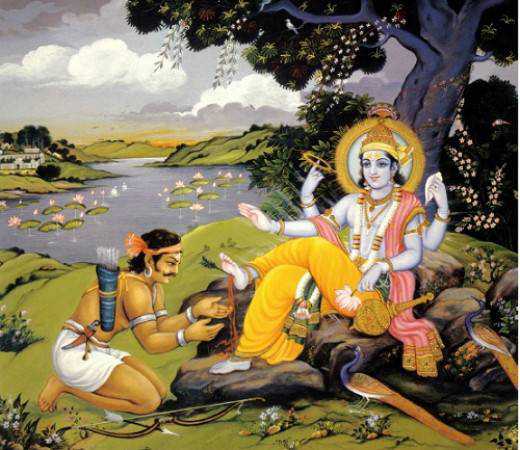
Death of Krishna - Start of Kali Yuga
Thus this mystery is brought to our notice so that we may at the same time realise by means of its presentation all that can become dangerous to man when he is able to see his own being brought to birth out of himself.
It is impossible to see ones own soul, we can only mirror our soul in others soul.
If we grasp this deepest of human and cosmic mysteries — which tells of our own being through true self knowledge — then we have before us the greatest cosmic mystery in the world. But we may only put it before us if we are able to reverence it in all humility.
No powers of comprehension will suffice, none will enable us to approach this cosmic mystery; for that the correct sentiment is necessary.
No one should approach the cosmic mystery that speaks from out the Gita who cannot approach it reverentially. Only when we can feel thus about it do we completely grasp it.
How, starting from this point of view one is able in the Gita to look at a certain stage of human evolution, and how, just by means of what is shown to us in the Gita, light can also be thrown upon what we meet with in a different way in the Epistles of St. Paul — that it is which, is to occupy us in the course of these lectures.

From The Spiritual Hierarchies (Dusseldorf 1909), Lecture 10
Now consider that such Beings as the Mights, belonging to the second threefold Hierarchy, could not have had the power to become evil of their own free will; they had to be ‘adversely-commanded;’ and it was the Beings of the third threefold Hierarchy, and only those who stand nearest to man, the Angels, who first had it in their power to follow, or not to follow, the hindering Powers.
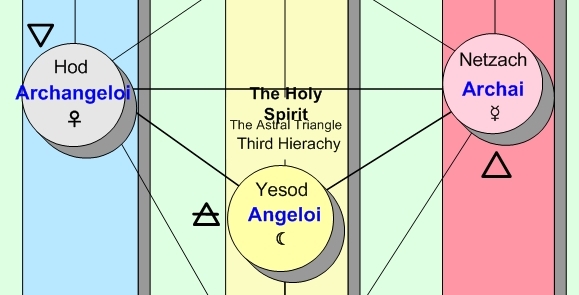
Third Hierarchy
Those who did not follow we always find represented in the pictures which illustrate the victories fought out in heaven. They express what happened during the Moon development, when Man had progressed as far as the organisation of his astral body, that is to the human-animal stage.
Then those Angel beings who, so to speak, remained good, tore themselves away from the course of the Moon development, they escaped from what was going on down there, on the Moon. And this picture is represented to the Soul of man in different ways.
It was originally represented in the fight of Michael with the dragon. You see it also in the symbol of the Bull of Mithra, where it is specially clearly expressed.
It is, of course, not meant that in doing this these Angel Beings avoided their duty, but they were put forth as an ideal for the future. [Krishna is often shown as dancing on the heads of Shivas snakes, they cant touch him, he is immune to the Luciferic.]
‘These beings’ — it was said — ‘preferred to rise into the spiritual worlds [the Angels, symbolized through Abel,] whereas you have descended. Other beings came down with you, those who followed the Powers of Hindrance [the Luciferic beings.] You must now work upon that which you have absorbed in this descent, and carry it up again into the spiritual world; when you rise again you must become a Michael, a conqueror of the Bull [Krishna, conquerer of the Bull of Shiva.]’ For every symbol of this kind is used in a twofold sense.
The first who had the possibility of becoming evil were the Angels, for this could only happen after the development of the Moon. There, from the Sun to the Moon, the Fight in Heaven took place. A part of the Angels avoided this possibility, they would not be seduced by the forces which had to introduce hindrances, they held to the way of the old Nature. Thus, as far down as the Angels, or part of them, we have Beings who are absolutely unable to do otherwise than follow the divine Will. It is essential to remember this. [Krishna.]
We now come to two categories of Beings. First those Angels who fling themselves into that which the Mights produced during the Fight in Heaven; these are Beings who on account of their later deeds we call Luciferic. These Beings became united to the human astral bodies during the Earth-evolution and gave to men the possibility of evil, and also the possibility of developing through their own free power; so that in the whole sequence of Hierarchies we have only men; and some of the Angels, who have the possibility of freedom.
In the midst of the ranks of the Angels the possibility of freedom begins, but it is first fully developed in men. When man entered the earth, he had at the beginning to be assailed by the power of the Luciferic Spirits; they penetrated the human astral body with their force.
The ‘I’ was therefore attracted towards those forces, so that during the Lemurian and Atlantean evolutions, and even later we have the ‘I’ as in a cloud, as sheathed in a cloud, which was produced by the assaults of Lucifer.
Man was saved from being overpowered by these forces which penetrated him [Luciferic spirits,] only because he was overshadowed by earlier Beings, because Angels who had remained above [Krishna,] and also Archangels, came down from the spirit world, incarnated into special individuals and guided men.
And this continued up to the time when something quite particular took place; when a Being, whose existence up to then had always been united to the existence of the Sun, when a Being [Archai, Spirit of Personality] had progressed so far as to be able to penetrate, not only the physical, etheric and astral bodies of men, as former exalted Beings had done, but to penetrate into man even as far as his I.
... the Moon development passed on into that of the Earth, the whole process was repeated, and those Beings who had plunged into the full tide of the Moon's development, remained behind those who would have nothing to do with it, and others remained still further back, and were attracted by the retrograding development.
The result of all this was, that during the earth evolution Angel-men existed, who were advanced, and others who were retrograde.
The advanced Angel-men approached the men of the earth during the time, when, in Lemuria, they were ripe to receive the germ of the human ‘I,’ and gave them the choice, as it were, to rise into the spiritual worlds, then, and not to have anything further to do with that which since the time of the Moon, had mingled with the course of the world's development.
The Beings who had stayed behind, whom we call the Luciferic beings, came into touch with the human astral body — they could not approach the ‘I’ — and grafted into that astral body all the results of the fight in heaven.
While to the Mights was assigned the fight in heaven, for they were created Gods of Hindrance; the consequences of their deeds now slipped into the human astral body, and there signified something else; they signified the possibility of error and the possibility of evil.
Man had now been given the possibility of error and of evil with the object that he should also have the possibility of rising above evil and error, through his own strength.
Let us take a man who has voluntarily received the Christ. Christianity is only at its beginning. But let us take the Ideal; the man's ‘I’ has voluntarily, with complete free will, allowed the Christ's force to flow into him. When the I has progressed so far that it has filled itself with the Christ, then this Christ force irradiates the astral body also. In that same astral body, into which the Luciferic powers had formerly implanted their deeds, the Christ power is now radiating from within outwards. What happens in the future?
Because we have overcome with the help of Christ, and only with His help, all those human qualities which come from Lucifer, we also, as men, gradually release the Luciferic powers; and a time will come, when the Luciferic powers who, during the Moon development, had to sink downwards into a certain lower evolution for the sake of human freedom, and who had not themselves the opportunity of experiencing the Christ force upon earth, these Luciferic powers will experience the Christ force through man, and through Him they will be released.
Man will save Lucifer, when he takes the Christ force into himself in the necessary way. And because of this, man will again grow stronger than he otherwise would have been. For imagine: if man had not received the Luciferic powers, then the Christ force irradiating him, would not have encountered the hindrances of the Luciferic forces, and it would have been impossible for man to progress so far in wisdom, goodness and in truth as he may do, when he has to overcome these opposing forces.
Thus in Man, we have a member of the Hierarchies who, as we see, is very distinct from the other members. We see that man's position is different from that of the Seraphim, Cherubim, Thrones, the Spirits of Wisdom, of Motion and of Form, and different too from the Spirits of Personality, from the Fire Spirits the Archangels and from some of the Angels.
He can say to himself, looking into the future: ‘I am called on to search in my own inmost depths, for that which gives me the impulse for my actions — I do not receive it from gazing on the Godhead like the Seraphim, but from the innermost depth of my own being.’
The Christ is a God whose action is such that one is not absolutely forced to follow His Impulse, one follows it only when one understands it, and in freedom. He is, therefore, the God who never seeks to hinder the free development of the I in this or that direction.
The Christ says in the very highest sense: ‘You will know the Truth and the Truth will make you free.’
And those beings of the next Hierarchy who had the possibility of doing evil, the Luciferic beings, these will again be released, liberated by the power of man.
We therefore see, my dear friends, how in fact the World development does not simply repeat itself, but that new things enter. For a human stage such as is lived by men at present was never met with before, not with the Angels, nor the Archangels, nor the Spirit of Personality.
Man had a completely new mission to fulfil in the world, the mission we have just characterised. For the sake of this mission he has descended into the world of the earth.
And the Christ came into the world as a free Helper for him, not as a God acting from above, but as a first-born among many.
Thus at last, we understand all the dignity and all the importance of Man as a member of our Hierarchies, and when we glance upwards to all the nobility and the glory of the higher Hierarchies we say to ourselves: Be they ever so great, so wise, so good that they never err from the right path, yet the great mission of man is to bring Freedom into the world, and with Freedom firstly that which one calls Love in the true sense of the word.
For Love without Freedom s impossible. A Being who blindly follows an impulse, just follows it; but for a Being who can also act otherwise, there exists but one force which he could follow, and that is Love. Freedom and Love are two poles which belong to each other.
If Love is to enter into our Cosmos, it can happen only through Freedom, that means, only through Lucifer and those who conquer him; and at the same time through the Saviour of men, through the Christ [Krishna, Jahve.]
Therefore, the earth is the Cosmos of Freedom and Love, and therefore, the essential thing is, that we, without tempting man away from humility, must learn to reckon the Hierarchies as they ever have been reckoned in Western esotericism: Seraphim, Cherubim, Thrones; these follow the direct impulse of the Godhead, having the sight of God. The Spirits of Wisdom, of Motion, and of Form, (Dominions, Mights, and Powers), these are as yet so bound to the higher powers that they have to be given ‘adverse-commands’ in order that evolution should have the possibility of proceeding further. The Archangels and the Spirits of Personality also cannot fail, cannot, through their own free will, sink into evil. Therefore, the spirits of the Hierarchies next above man were called Messengers and Arch-Messengers [Face of God] to show that they did not fulfil their own tasks but the tasks of those who stand immediately above them.
But in men a Hierarchy is maturing which will fulfil its own tasks.
After the Archangels and Angels, the Arch-messengers and messengers, we will have to rank the Spirits of Freedom or Spirits of Love; for this, beginning from above, is the tenth of the Hierarchies, which although in process of development, yet belongs to the Hierarchies.

In the universe we have not to do with repetitions, each time that a cycle is passed, something new is added to the world's evolution. And to introduce the new element, is always the mission of that Hierarchy, which is at its human stage of development.
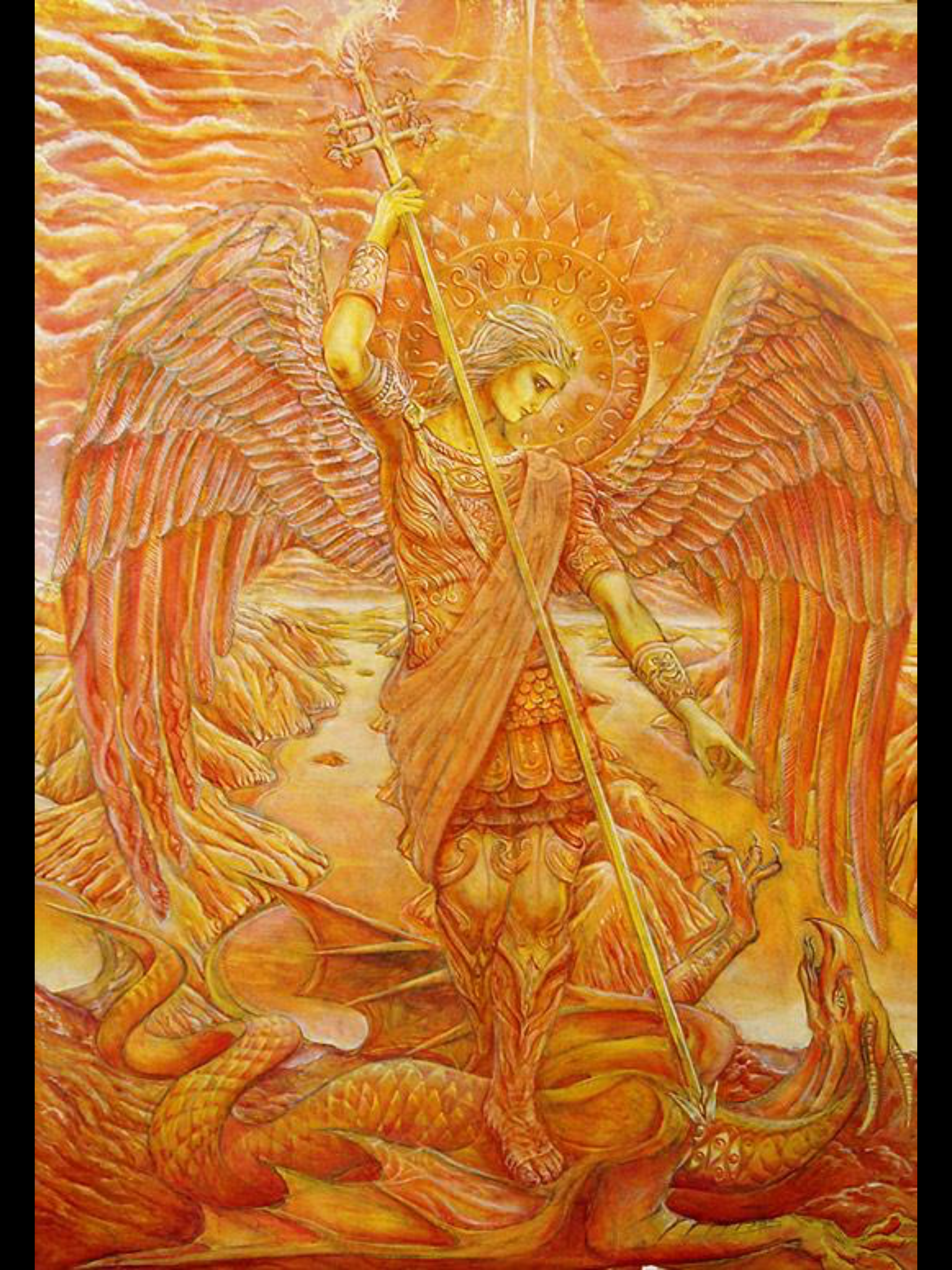
It's interesting that Archangel Michael isn't mentioned in the four gospels. Gabriel is mentioned, for not so obvious reasons, but otherwise the hierarchies are hidden behind the trinity. And Steiner stays in context, he usually doesn't mention Michael in connection with the Gospels either.
From Occult Science and Occult Development, Lecture II
Nevertheless the Being whom we may call Michael, and who belongs to the Hierarchy of the Archangels — whatever name we may give him — this Being does exist. There are many Beings of the same hierarchical rank, but this particular Being who is known esoterically by the name of Michael is as superior to his companions as the Sun is to the planets — Venus, Jupiter, Mercury, Saturn, and so on.
He — Michael — is the most eminent, the most significant Being in the Hierarchy of the Archangels. The ancients called him the ‘Countenance of God’. As a man reveals himself by his gestures and the expression of his countenance, so in ancient mythology Jehovah was understood through Michael.
Jehovah made himself known to the Hebrew Initiates in such a way that they realised something they had never, with their ordinary powers of comprehension, previously been able to grasp, namely, that Michael was verily the countenance of Jehovah. Hence the ancient Hebrews spoke of Jehovah-Michael: Jehovah the unapproachable, unattainable by man, just as a person’s thoughts, his sorrows and cares, lie hidden behind his outward physiognomy. Michael was the outer manifestation of Jahve or Jehovah, just as in a human being the manifestation of his Ego is to be recognised in his brow and countenance.
We can therefore say that Jehovah revealed himself through Michael, one of the Archangels. Knowledge of the Being described above as Jahve was not confined to the ancient Hebrews, but was far more widespread. And if we investigate the last five hundred years before the Christian era, we find that throughout this whole period revelation was given through Michael. This revelation can be discovered in another form in Plato, Socrates, Aristotle, in Greek philosophy, even in the ancient Greek tragedies, during the five centuries before the event of Golgotha.
When with the help of occult knowledge we endeavour to shed light upon what actually took place, we can say that Christ-Jehovah is the Being who has accompanied mankind through the whole course of evolution. But during the successive epochs Christ-Jehovah always reveals Himself through different Beings of the same rank as Michael. He chooses a different countenance, as it were, to turn towards mankind. And according as one or the other Being from the Hierarchy of the Archangels is chosen to be the mediator between Christ-Jehovah and humanity, widely different ideas and conceptions, impulses of feeling, impulses of will, are revealed to men. The whole period which surrounded the Mystery of Golgotha can be described as the Age of Michael, and Michael may be regarded as the messenger of Jehovah.
Michael inspired mankind for several centuries, for almost five hundred years before the Mystery of Golgotha, as was indicated in the old Mysteries, by Plato and so forth. Soon, however, after the Mystery of Golgotha had taken place and Christ had united Himself with the evolution of the earth, the direct impulse of Michael ceased. At the time when the old documents we possess in the form of the Gospels were written — as I have said in my book Christianity as Mystical Fact — Michael himself could no longer inspire mankind; but through his companions among the Archangels men were inspired in such a way that much soul-force was received unconsciously through inspiration.
Reference shall now be made to the event in the higher worlds which has led to this altered state of affairs, to this time of a renewal of the Mystery of Golgotha. When we look back we remember what came to pass at the Baptism by John in the Jordan, when Christ revealed Himself in a human form, visible on the earth among mankind. Further, we will fill our souls with the thought of how, as regards His outer form, Christ then united Himself with the Hierarchy of the Angels and has since that time lived invisibly in the sphere of the earth.
Christ came into the old Hebrew race and was led to His death within it. The angelic Being, who since then has been the outer form assumed by Christ, suffered an extinction of consciousness in the course of the intervening nineteen centuries as a result of the opposing materialistic forces that had been brought into the spiritual worlds by materialistic human souls who had passed through the gate of death. This onset of unconsciousness in the spiritual worlds will lead to the resurrection of the Christ-consciousness in the souls of men on earth between birth and death in the twentieth century. In a certain sense it may therefore be said that from the twentieth century onwards, what has been lost by mankind in the way of consciousness will arise again for clairvoyant vision. At first only a few, and then an ever-increasing number of human beings in the twentieth century will be capable of perceiving the manifestation of the Etheric Christ — that is to say, Christ in the form of an Angel. It was for the sake of humanity that there was what may be called an extinction of consciousness in the worlds immediately above our earthly world, in which Christ has been visible in the period between the Mystery of Golgotha and the present day.
Thus the Christ-consciousness may be united with the earthly consciousness of men from our time on into the future; for the dying of the Christ-consciousness in the sphere of the Angels in the nineteenth century signifies the resurrection of the direct consciousness of Christ — that is to say, Christ’s life will be felt in the souls of men more and more as a direct personal experience from the twentieth century onwards.
The correct pronunciation of Michael’s name is with three syllables. Me - Ka - El - My Light is God. Lucifer is the Lightbearer and Michael the raised Lucifer.
From Cosmic Memory, Chapter xvii - The Life on Earth (1904)
During the second half of this third cycle something else is already in preparation. The minerals harden, the plants gradually lose the animal character of their sensibility, and out of the uniform species of animal man there develop two classes. One of these remains on the level of animality, while the other is subjected to a division of the astral body into two parts.
The astral body splits into a lower part, which continues to be the carrier of the emotions, and a higher part, which attains to a certain independence, so that it can exercise a kind of mastery over the lower members, over the physical body, the ether body, and the lower astral body. [Sentient Soul.]
Now the Spirits of Personality [Archai] seize upon this higher astral body and implant in it just that independence we have mentioned, and therewith also selfishness. Only in the lower human astral body do the Fire Spirits [Arhangelic hierarchy] now accomplish their work, while in the ether body the Spirits of Twilight [Angels] are active,
and in the physical body that power entity begins its work which one can describe as the real ancestor of man.
This being who are the real ancestor of man, whose lowest body is the physical body, just like man, in whose picture we are created, our archetype, have Steiner been somewhat vague. It is of course Adam Kadmon, but a soul component must be there too, the Logos of Mankind, the human archetype who tread the path before the rest of mankind.
It is the same power entity which formed the spirit man (Atma) with the help of the Thrones on Saturn, the life-spirit (Buddhi) with the assistance of the Cherubim on the Sun, and the spirit-self (Manas) together with the Seraphim on the Moon. But now this changes. Thrones, Cherubim, and Seraphim ascend to higher spheres, and the higher man now receives the assistance of the Spirits of Wisdom, of Motion, and of Form. These are now united with spirit-self, life-spirit, and spirit-man (with Manas-Buddhi-Atma).
With the assistance of these entities the human power being characterized above develops its physical body during the second half of the third earth cycle. It is the Spirits of Form which act here in the most significant way. They already form the human physical body so that it becomes a kind of precursor of the later human body of the fourth cycle (the present one, or the fourth round)
From World History in the light of Anthroposophy (Dornach 1923), Lecture V
Those who had been initiated in the Oriental Mysteries, or had received the wisdom that streamed forth from the Oriental Mysteries, were able to say:
I look back in the evolution of the world to an ancient Sun epoch. In that time I bore still within me the plants. Then afterwards I let them stream forth from me into the far circles of Earth existence. But as long as I bore the plants within me, while I was still that Adam Cadmon who embraced the whole Earth and the plant-world with it, so long was this whole plant-world watery-airy in substance.
Then the human being separated off from himself this plant-world. Imagine that you were to become as big as the whole Earth, and then to separate off, to secrete, as it were, inwardly something plant-like in nature, and this plant-like substance were to go through metamorphoses in the watery element — coming to life, fading away, growing up, being changed, taking on different shapes and forms — and you will by this imagination call up again in your soul feelings and experiences that once lived in it. Those who received their education and training in the East at about the time of Gilgamesh were able to say to themselves that these things had once been so.
Christ is the second Adam Cadmon, and that he show through his seven "I am", each one corresponds to a hierarchy of Sun-initiated, beings that are following the development, in contrast to the stragglers.
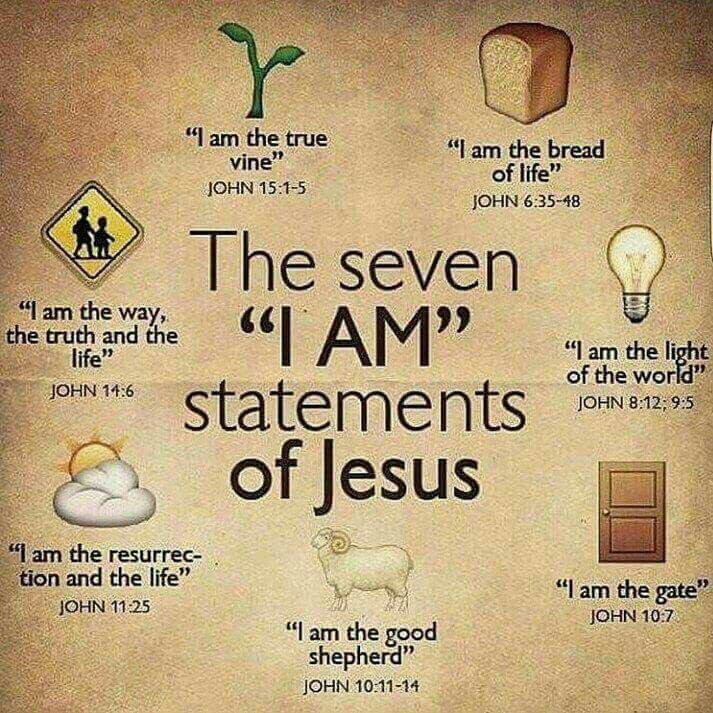
As we are created in the picture of God/Adam Cadmon our bodies are part of these hierarchies.
I am the Door of the Sheep - the Physical Body - Man.
I am the Good Shepherd - the Etheric Body - Angels.
I am the Resurrection and the Life - the Astral Body - Archangels.
I am the Way, the Truth and the Life - the soul: Sentient Soul, Intellectual Soul and Consciousness Soul - Spirits of Personality or Archai.
I am the True Vine - Manas or Spirit Self - Spirits of Form or Exusiai.
I am the Bread of Life - Buddhi or Life Spirit - Spirits of Motion or Dynamis.
I am the Light of the World - Atma or Spirit Body - Spirits of Wisdom or Kyriotetes.
When we transform our karma/demons, ie purify our bodies, we become more and more I AM.
We are now working with our consciousness soul, purifying it. That can also be seen as the Spirits of Personality (Archai) fighting with the stragglers of the Spirits of Form (mentioned in the above Steiner text,) meaning that our consciousness soul becomes more I AM.
This figure shows the relation between the I AM's and our bodies

From The Temple Legend - The Prometheus Saga (Berlin 1904), Lecture 4
One has to imagine the three races of the gods, Uranus, Chronos and Zeus, as three successive great leaders of humanity. Uranus denotes heaven, Gaia the earth.
If we go back in time beyond the middle of the Lemurian epoch, we do not find man in the form we know him today, but one called Adam Cadmon by occult science, who is still asexual, and who had never belonged to the earth previously, who had not developed organs of sight for physical observation, but was still a part of Uranus, of the heavens. Through the union of Uranus with Gaia, man was born, man who descended to the earth and at the same time became involved in time.
Chronos (Time) was the leader of the second divine race from the middle of Lemurian times until the beginning of Atlantis. These leading figures were symbolised by the Greeks, first under the name Uranus, then Chronos, and later Zeus. Zeus, however, is one of those leaders who underwent his training elsewhere than on the earth. He is one of the great immortals, as are all the rest of the Greek gods.
From Greek and Germanic Mythology in the Light of Esotericism (Berlin, 7th October, 1904)
By the three generations of gods — Uranus, Chronos and Zeus — we have to understand three Beings who were leaders of men one after another. Uranus means heaven, Gaia the earth. If we go back beyond the middle of the third race, the Lemurian, we find no men as we now know them, but one man, who is called in the secret doctrine Adam Cadmon — the man who is still without sex, who does not yet belong to the earth, who has not yet evolved the organs for earthly sight, who still belongs to the Uranus-nature, to heaven.
By the marriage of Uranus with Gaia there arose the man who descended into matter, and thereby stepped into Time. Chronos (Time) becomes the ruler of the second generation of gods from the middle of Lemuria right up to the beginning of Atlantis. The Greeks symbolised these leading Beings as, first of all Uranus, later Chronos, and after that they went over to Zeus. But Zeus is still one of the leaders who did not undergo their training on earth, he is still one of the immortals, as in fact were all the Greek gods
This is an extract of Steiner’s lecture on Truth, Beauty and Goodness, and it is interesting in many ways, and especially in relation to the previous.
“Rudolf Steiner stated that the primary function of education is to exercise the students' faculties of thinking, feeling and willing. These basic human qualities manifest in civilization as the “eternal verities” of truth, beauty and goodness, and these in turn in science, art and religion."
THE True, the Beautiful, the Good — through all the ages of man's conscious evolution these words have expressed three great ideals: ideals which have instinctively been recognized as representing the sublime nature and lofty goal of all human endeavour.
In epochs earlier than our own there was a deeper knowledge of man's being and his connection with the universe, when Truth, Beauty and Goodness had more concrete reality than they have in our age of abstraction.
Anthroposophy, or Spiritual Science, is able once again to indicate the concrete reality of such ideals, although in so doing it does not always meet with the approval of the times.
For in our age men love to be vague and nebulous whenever it is a question of getting beyond the facts of everyday life.
Let us try to understand how Truth, Beauty and Goodness are related, as concrete realities, to the being of man...
In his pre-earthly existence man lives in a world of pure Spirit, where, in communion with higher Beings, he is engaged in building up the spiritual prototype, the spirit-form of his physical body. The physical body here on earth is but an after-copy of the spirit-germ that is elaborated, in a certain sense, by man himself in pre-earthly existence.
In earthly life the human being is conscious of his physical body, but does not know what this implies. We speak of Truth, little realizing that a feeling for truth is connected with our consciousness of the physical body.
When man is confronted by a simple fact, he may either form an idea that harmonizes strictly with it and thus is true, or, from inaccuracy, laziness or positive aversion to truth, he may evolve an idea that does not coincide with the fact.
In pre-earthly existence a delicate spiritual wool is spun, and this is concentrated into an after-copy — the physical body. Many threads connect this physical body with pre-earthly existence, and they are severed by untruthfulness.
The purely intellectual consciousness that is a characteristic quality in the early stages of the epoch of the consciousness Soul does not realize that such a severance takes place. And that is why man is subject to so many illusions as to his connection with cosmic existence.
For the most part to-day, man regards his bodily health from a purely physical point of view. But when, through untruthfulness, he severs the threads that bind him with pre-earthly existence, this works right down into his physical body, and especially into the constitution of the nervous system.
The feeling he has of his physical body gives him his “spiritual sense of being” in the universe. And this spiritual sense of being depends upon maintenance of the threads proceeding from the physical body to pre-earthly existence.
If they break, man must create a substitute for his healthy sense of being — and he does so, unconsciously. He is then led, unconsciously, to ascribe to himself a sense of being “out of the common.” But even here he has fallen into an inner uncertainty that makes itself felt even in the physical body....
What is it that can strengthen man in this sense of being? In earthly existence we live in a world that is but a copy of true reality. Indeed, we only understand this physical world aright when we realize it to be this copy of reality.
It behooves us, however, to feel the true reality within us; we must be aware of our connection with the spiritual world. And this is only possible if the bond that links us with pre-earthly existence remains intact.
This bond is strengthened by a love of truth and Integrity. Nothing establishes man's true and original sense of existence so firmly as a feeling for truth and truthfulness.
To feel himself in duty bound first to “prove all things” he utters, to set due restraint on all his words — this helps to consolidate the sense of existence that is worthy of his being.
To be aware of the spirit within the physical body — with this, indeed, the sense of being is connected. There is, in effect, an intimate kinship between the physical body and this ideal of Truth.
We acquire the etheric body (or body of “formative forces”) only a short time before the descent from pre-earthly to earthly existence. We draw the forces of the etheric world together, as it were, to build up our own etheric body.
The sense of the reality of the etheric body is strengthened by the experience of Beauty. When truth and truthfulness enter the realm of real experience, we are, in a sense, living rightly in the physical body. A highly developed sense of beauty gives us a right relation to the etheric body of formative forces. Whereas Truth is connected with the physical body, Beauty is connected with the etheric body.
If we try either through sculpture, painting, or drama — indeed, through any art — to portray a human being, we endeavour to create a figure that is sufficient and complete in itself — one that contains a whole world, just as man contains the whole universe within himself in his etheric body. For he draws together the etheric forces from the whole universe to mould his etheric body within earthly existence.
An intense feeling for beauty — as it was then conceived — existed in earlier ages. Nothing of the same kind is present in modern civilization, Man cannot be truly man if he has no sense of beauty. It is so, indeed; for to possess a sense of beauty is to acknowledge the reality of the etheric body. To have no sense of beauty is to disregard, to disown, the etheric body.
Enthusiasm for truth and truthfulness can kindle in man — in the unconscious depths of his soul at any rate — a feeling for pre-earthly existence. .... But when this sense is highly developed, it binds man strongly to the pre-earthly past, and his more immediate experience of the earthly present must needs cause a certain sadness to arise within him.
It is a sadness that can only find consolation if the sense of beauty is awakened in the soul. Beauty gives us joy once more, even in the presence of a sadness that must always accompany great enthusiasm for truth.
In a delicate, subtle way this enthusiasm tells us: Truth, alas, is only really present in pre-earthly existence. .... Only enthusiasm for truth can help us to maintain intact our relationship with pre-earthly existence.
We ought never to undervalue the significance of beauty in education and in outer culture. A civilization that is filled with ugly machines, with chimneys and smoke, and dispenses with beauty, is a world that makes no efforts to forge a link between man and pre-earthly existence; indeed, it tears him asunder.
The world of spirit in which we live during our pre-earthly existence is always present. We have but to stretch out our arms, as it were, to this pre-earthly world of spirit.
Although it is always there, a link can only be forged in the depths of unconscious life when man glows with enthusiasm for truth and truthfulness.
And when his heart thrills with love for the beautiful, this too forms a bond with pre-earthly existence. .... To glow in response to beauty means that in his soul man must create in a picture, at least, a new link with pre-earthly spirituality.
A good man is one who can bear his own soul over into the soul of another. Upon this all true morality depends, and without morality no true social order among earthly humanity can be maintained.
When this true morality develops into momentous impulses of will which then pass to reality in moral acts, it begins to be a quickening, all-pervading impulse in the soul, inasmuch as a man can then be moved to real sympathy at the sight of care on the face of another — his own astral body feels pain at the sight of suffering in others.
Truth, then, is related to the physical body, Beauty to the etheric body, Goodness to the astral body. Here we have the concrete reality of the three abstractions of Truth, Beauty, Goodness.
These ideals show us how far man is able to fulfill his whole human nature, when, to begin with, as he lives in his physical body, he is filled with a real sense of truth instead of conventional opinions.
Again, full “humanity” is only afforded a worthy existence when a man can quicken his etheric body into life through his feeling for beauty. .... One can merely gaze at beauty or one can experience it. .... To gaze at beauty is not to experience it. The moment we experience beauty, however, the etheric body is quickened.
A man may do good because of some convention, or because punishment is in store for serious wrong-doing — or, again, because other people will respect him less if he does wrong. He can, however, also do good from sheer love of goodness. ... Such an experience of goodness will always lead to a recognition of the reality of the astral body. Indeed, only this recognition will teach man anything about the essence of goodness. There can only be abstract knowledge of and inconsequent chatter about goodness, if loving enthusiasm for goodness in its essence does not lead to actual experience of the astral body.
The sense of truth is a heritage from pre-earthly existence.
The sense of beauty will create an image, at least, of pre-earthly connection with spirit.
Experience of goodness is a link, leading directly to the world he enters after death.
To be true is to be rightly united with our spiritual past. To sense beauty means that in the physical world we do not disown our connection with spirit. To be good is to build a living seed for a spiritual world in the future.
Past, present, future — these three concepts, as they play their part in human life, assume far-reaching significance when we understand the concrete reality of the other three concepts — Truth, Beauty, Goodness.
The man who is untruthful denies his spiritual past; the liar severs the threads between himself and his spiritual past. He who disregards beauty is building himself an abode on earth where the sun of spirit never shines, where he wanders in spiritless shadow. The man who belies the good renounces his spiritual future; and yet he would like this future to be bestowed on him, may be by means of some outer remedy.
It was, indeed, out of a profound instinct that Truth, Beauty and Goodness were held to be the greatest ideals of human striving. Yet they have faded away into shadowy words, and it is only our present age that can bestow concrete reality upon them.”
From The Spiritual Hierarchies (Dusseldorf 1909), Lecture 9
Thus you see that the configuration and the distribution of the stars as we see them in space, is a result of the action of the spiritual Beings or Hierarchies. For when we speak of the contraction of large masses, we must realise that this does not happen of itself, but that it is brought about by the action of those Beings of the higher Hierarchies which we have described.
And when we take a general view of all that has been described, we may say:
When ancient Saturn was in formation, when all that mighty mass of fire out of which all our solar system has arisen organised itself into ancient Saturn, the Spirits of Personality were passing through their human stage of existence;
during the Sun formation the Archangels or Spirits of Fire were passing through their human stage;
during the Moon evolution the Angels,
and on the earth Man, is passing through his human existence.
But it must be realised that this Man had also taken part in all that happened before. What is called the physical body to-day had its first foundations during the very earliest Saturn formation. That physical body was not as yet interpenetrated by an etheric body, or by an astral body; but it was already so organised that after passing through all the transformations it experienced later, it could become the bearer of the spiritual earth-man of to-day.
Very slowly and gradually was this physical body organised during the ancient Saturn evolution, and, whilst ancient Saturn itself was being formed, the different signs of the Zodiac slowly revolved, and the human body member by member, took on its earliest form.
When Saturn stood under the sign of the Lion the beginning of the heart was formed;
the ribs or the thoracic cage were started while Saturn was under the sign of the Crab;
the foundation of the symmetrical shape of man, that is the reason for his being symmetrically built on two sides, arose while Saturn was under the constellation of Gemini.
Thus we follow piece by piece the formation of the human body, and when we look up to that part of the Zodiac, where Aries the Ram is, we can say: The upper part of our head originated when ancient Saturn stood under the sign of Aries;
the foundation of our organ of speech, when Saturn stood under the sign of the Bull. And when you think of man distributed thus, you can see in the Zodiacal circle the creative forces for each of the human organs.
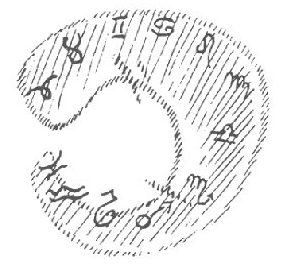 This was represented pictorially in the old Mysteries, and the Zodiac was drawn as you see it here on the ceiling of this hall. By chance —
but there is no such thing as chance — we have met in a hall which is adorned above by the signs of the Zodiac. Formerly the Zodiac was not designed by depicting the animal form corresponding to each sign, but the different human members were drawn in the corresponding region of the heavens: for instance, for Aries a head; further on, for the Bull, the region of the throat; that which most of all expresses symmetry — the arms, for Gemini; the thoracic cage, for the Crab; the heart, for the Lion; and thus they came to the lower parts of the legs, for the Waterman; and to the feet, for Pisces.
This was represented pictorially in the old Mysteries, and the Zodiac was drawn as you see it here on the ceiling of this hall. By chance —
but there is no such thing as chance — we have met in a hall which is adorned above by the signs of the Zodiac. Formerly the Zodiac was not designed by depicting the animal form corresponding to each sign, but the different human members were drawn in the corresponding region of the heavens: for instance, for Aries a head; further on, for the Bull, the region of the throat; that which most of all expresses symmetry — the arms, for Gemini; the thoracic cage, for the Crab; the heart, for the Lion; and thus they came to the lower parts of the legs, for the Waterman; and to the feet, for Pisces.
Think of such a Zodiacal circle as a man designed out there in the Cosmos, then you have that which corresponds to the powers of the Thrones, Cherubim and Seraphim who created the first beginnings of the physical human body. This is the great Cosmic Man, the Man who is found in all the World Myths, and all the national legends or sagas, out of whom single individuals of the earth are composed in the most varied forms.
Think of the giant YMIR who is spread out in the great Cosmos; microcosmic man is formed out of this giant. Up above is the macrocosmic man who is a Creator, who, out there, comprises all that man has within him. Profound truth lies in the depths of such representations, truth which comes to light more or less imperfectly, according to the degrees of the clairvoyant power of the nations. It also shines through that wisdom which finds its outward expression in the old Testament. It shines in that wisdom which, as the old Hebrew mystery-teaching, leads back to that Mystery teaching which was the foundation of the Old Testament — to Adam Cadmon of the Kabbala. The macrocosmic Man is none other than the one we have now designed in the Cosmos; only we must form our conceptions of him in the right way.
What I have now explained to you, and which culminated in the teaching of the macrocosmic man, is a teaching which in fact includes the deepest cosmic mysteries, and which in the future will gradually flow into the general education of humanity at large.
That which man has already transformed goes with him through all eternity; that which he has not yet changed in which his 'I' has had no part, must leave him, as a sort of astral shell, after he has passed through Kama-Loka; that shell dissolves in the astral world, not without its having brought about considerable mischief if as an astral body, it had bad desires and evil passions. [Karma.]
Thus we can say that the development of man consists in. his leaving always less and less behind him in the astral world.
Let us follow the process; the man dies. Soon after death the etheric body is dissolved; and the extract of it remains. The man passes through. Kama-Loka, and the untransformed shell detaches itself; that which has been re-worked goes with man through all eternity, it is brought back into each new incarnation. The more perfect the man is, the less there will be of those remnants left in the astral world; till at last he will have progressed so far that he leaves nothing of his astral body in Kama-Loka, so far — that he can injure no living being on earth through the remnants he leaves in Kama-Loka. Such. a man has then the possibility of seeing into spiritual worlds. For it is not possible to reach this condition without having reached a certain degree of clairvoyance in the Astral. The whole astral body has then been spiritualised, it has become Spirit-Self, and the whole of it is taken with him by the man to the spiritual world.
Formerly that which was bad was left behind, now the whole astral body can be taken with him into all futurity.
And in the moment when the astral body is so far advanced that it is completely transformed, in that moment the whole of this new astral shape is impressed upon the etheric body, so that the etheric body becomes a counterpart of the astral body.
The etheric body does not need to be as yet quite transformed, but that is impressed upon it which has been refashioned in the astral body.
You see, that we have here described a particularly exalted being, one who is eminently far advanced, because he has developed the whole of the Spirit-self. This Being is called Nirmana-Kaya in Eastern Science; for his astral body, his astral Kaya, has reached the stage when it leaves no remnants in the astral world.
Through such transmutations man becomes more and more ruler over his astral and his etheric bodies. Such control enables him also to direct in a certain way his astral and etheric bodies. One who has not yet brought his astral body under the rule of his 'I' must certainly wait until he has come thus far; but the man who already is lord of his astral and etheric bodies, has them at his free disposal.
He can say: ‘Because with my “I,” I have passed through so many incarnations which have taught me to transform my astral and etheric bodies, I am now enabled, when I have to return to earth again, to form for myself out of astral and etheric substances, an astral and an etheric body which will be equally perfect.’ He is also enabled to sacrifice his own astral and etheric bodies, to pass them on to others.
You now see, that there are individualities who, because they have become rulers of their astral and etheric bodies, are able to sacrifice these bodies, because they have learnt how to build them. If they wish to return to earth again, they will themselves form them anew out of the existing material. The perfection to which they have attained, they pass on to other personalities who have to perform certain tasks in the world. Thus personalities of later days have woven into them, organised into them, the astral and etheric bodies of these who lived in times of yore. You see that when this happens the personality of olden times did not only influence the time in which he lived, but that his influence works on also into the future.
Thus, for instance, Zarathustra who was capable of governing his astral body, and who later passed it over to Hermes, could say to himself: ‘I live, but in the future I will not only work as I do now, as a person in the outer world, but, I will penetrate the astral body of the Egyptian Hermes, he in whom the Egyptian epoch of civilisation has its beginning.’
Such a personality has a body, a Kaya, which does not only operate in the place and time when it lives, but which acts into the future, and gives law unto the future. Law for the future is called Dharma. Such a body is called Dharmakaya. These are names, expressions which one often meets with in Eastern science. You have here the true explanation as it is always given in primeval wisdom.
From An Esoteric Cosmology - The Apocalypse (Paris 1906), Lecture XVIII
Thus there are seven great epochs of Aryan civilisation in which the laws of evolution slowly come to expression. At first, man has within him what he later sees around him. All that is actually around us now, passed out from us in a preceding epoch when our being was still mingled with the Earth, Moon and Sun. This cosmic being from whom the man of today and all the kingdoms of nature have issued, is referred to in the Cabala as Adam-Cadmon. Adam-Cadmon embraced all the manifold aspects of man as we know him today in the various races and peoples.
From Foundations of Esotericism (Berlin 1906), Lecture 6
Man is both receptive and creative. On the one hand, for instance with regard to all sense impressions, he is receptive, with regard to thinking however he is creative. Nothing gives rise to thoughts unless he first produces perceptions. Thus he is on the one hand a receptive being and on the other hand a creative being. This is an important difference.
Let us imagine that man were to be in a position to create everything he perceives, sounds, colours and so on, just as today he creates thoughts. Today he is only creative in one sphere, in thinking, and in order to have perceptions he needs creative beings around him. In bringing forth his own being he was at first creative. In the beginning he himself created his own organism. For this he now needs other beings. Now man must incarnate in a bodily form determined from outside. Here he is closer to the elemental beings than to the sphere of perception and thinking.
Let us imagine for once that man were able to bring forth sounds, colours and other sense perceptions and also his own being. Then we should have the human being as he was before the Lemurian race, who is called the “pure” man. Man becomes impure through the fact that he does not produce his own being, but incorporates something other into his nature. This pure man was called Adam Cadmon. When at the beginning of Genesis the Bible speaks of man, it speaks of this pure human being.
This human being had as yet nothing kamic (astral) within him. Desire first appeared after he had incorporated other elements into himself. Thus there arose the second stage of humanity, the kama-rupic man (man with an astral body). The higher animal is to be seen as at a lower stage of this development. Without warm blood no beings can possess an independent Kama-rupa (astral body). All warm-blooded animals are derived from man.
Thus to begin with we have the pure man who up to the Lemurian Age actually led a super-sensible existence and brought forth out of himself everything that lived and was part of him.
Present day cold-blooded animals and the plants have developed in a different way from the warm-blooded animals. Those which exist today are remnants of strange, gigantic beings. Some of these can be verified by science.
They are decadent animals which are descended from those which the pure man made use of in order to incarnate in them, so that he might have a body for what is kamic (astral).
At first the pure man had found no means of incarnating on the earth. He still hovered above what was manifested. From among these huge, powerful beings (animals) man made use of the most developed in order to incarnate in them.
He attached himself to these beings and thereby he was in a position to bring into them his own Kama (astral body). Some of these beings developed further and then became the animals of Atlantis and present day humanity. However it was not possible for all of them to adapt themselves. Those who failed became the lower vertebrate animals; kangaroos for instance are such attempts as proved unsuccessful on the way to becoming man — like pottery vessels which are rejected and left behind.
Now man tried to introduce Kama into the animal forms. Kama is first to be found in the human form, in actual fact in the heart, in the warm blood and in the circulation of the blood.
Attempts were made again and again and in this way there was an ascent from stage to stage. We see unsuccessful attempts for instance in the sloths, the kangaroos, the beasts of prey, the monkeys and apes. All these remained behind on the way. The warm-blooded animals are unsuccessful attempts to become human forms endowed with Kama. Everything in them which is of the nature of Kama, man also could have within himself; but he unloaded it into them, for he was unable to use this kind of Kama.
There is an important occult axiom: Every quality has two opposite poles. So we find, just as positive and negative electricity complement one another, so we have warmth and cold, day and night, light and darkness and so on. In the same way every Kamic quality also has two opposite aspects. For instance man has cast rage out of himself into the lion, and this, on the other hand, when ennobled by him, can lead him upward to his higher self. Passion should not be annihilated, but purified. The negative pole must be led upwards to a higher stage. This purifying of passion, this leading upwards of its negative aspect was called by the Pythagoreans catharsis.
At first man had within him the rage of the lion and the cunning of the fox. Thus the kingdom of the warm-blooded animals is a comprehensive picture of Kama qualities. Today the opinion is commonly held that the ‘Tat twam asi’ (‘That art thou’), is to be understood as something general and undefined, but one must conceive something quite definite underlying it.
Thus in the case of the lion man must say to himself: That art thou. We have therefore in the kingdom of the warm-blooded animals spread out before us the kama-rupic human being. Previously there only existed the pure man: Adam Cadmon.
The philosopher of natural science, Oken, who in the first half of the 19th century was a professor in Jena, was acquainted with all these ideas and expressed them in a grotesque way in order to nudge people to attention. Here we find an example which points to a still earlier stage of human development, before man separated off from himself the kingdom of the cold-blooded animals. Oken connected the cuttlefish with the human tongue. In this analogy of the tongue with the cuttlefish one can find an occult significance. Now we also have beings who for the first time are, as it were, being conjured up as by-products. Man has ejected from himself the cunning of the fox and retained its opposite pole. In the fox's cunning however the germ of something else is beginning to develop, for example something similar to the way in which the black shadow of an object has a secondary shadow when light enters it from outside. We incorporated cunning into the fox out of our inner being. Now spirit is directed towards him from the periphery. The beings which in this way work from the periphery into what is kamic are elemental beings. What the fox has received from us, is in him animal; what coming from outside attaches itself to him from the spirit, is elemental being. On the one hand he originated through the spirit of humanity and on the other hand through an Elemental being.
Thus we differentiate: firstly, elemental beings, secondly, the kama-rupic man, thirdly, the pure man, fourthly, the man who in a certain respect has overcome the pure man, who has taken into himself what is outside and around him and is creatively active. He has contacted and taken into himself everything which is around him in earthly existence. This gives him the plans, the directions, the laws which create life. Once man was perfect and he will become so again. But there is a great difference between what he was and what he will become. What is around him in the outer world will later become his spiritual possession. What he has won for himself on the Earth will later become the faculty of being creatively active. This will then have become his innermost being.
One who has absorbed all earthly experiences, so that he knows how to make use of every single thing and has thus become a creator, is called a Bodhisattva, which means a man who has taken into himself to a sufficient degree the Bodhi, the Buddhi of the earth. Then he is advanced enough to work creatively out of his innermost impulses.
The wise men of the earth are not yet Bodhisattvas. Even for such a one there always remain things to which he is still unable to orient himself. Only when one has absorbed into oneself the entire knowledge of the Earth, in order to be able to create, only then is one a Bodhisattva; Buddha, Zarathustra, for example, were Bodhisattvas.
When man ascends still further in evolution, so that he is not only a creator on the Earth, but possesses forces which reach out above the Earth, only then is he free to choose either to use these higher forces or to work further with them on the Earth. In this case he can bring into the Earth something coming from higher worlds. Such an epoch occurred before man began to incarnate, in the last third of the Lemurian Age.
The human being had developed his physical, etheric and astral bodies. He had brought these members of his being with him from an earlier Earth evolution. The two next impulses, Kama and Manas, he could not have found on the Earth; they do not lie in its evolutionary sequence.
The first new impulse (Kama) was only to be found as a force on Mars. It was added shortly before man incarnated.
The second impulse (Manas) came from Mercury in the fifth sub-race of the Atlanteans, with the original Semites.
The stimulus of these new principles had to be brought to the Earth from other planets through still higher beings, through the Nirmana-kayas. From Mars they added Kama, from Mercury Manas. The Nirmana-kayas are yet another stage higher than the Bodhisattvas. The latter are able to order evolution which has continuity; but they cannot bring into it what comes from other regions, this can only be done by the Nirmana-kayas.
[In] yet another stage higher than the Nirmana-kayas, stand those beings who are called Pitris. Pitris = Fathers. For the Nirmana-kayas can indeed bring something coming from other regions into evolution, but they cannot sacrifice themselves, sacrifice themselves as substance, so that on the following planet they can bring forth a new cycle.
This can be done by the Pitris, beings who had evolved on the Moon and had now come over; they became the activating impulse towards Earth evolution. When man has gone through every possible experience, then he is in a position to become a Pitri. The next and even higher stage, the last that it is possible to mention, is that of the Gods themselves.
Thus we have seven ranks of beings: Firstly the Gods [Archangelic hierarchy?,] secondly Pitris [Angelic hierarchy?,] thirdly Nirmana-kayas [The Luciferic hierarchy?,] fourthly Bodhisattvas, fifthly pure human beings, sixthly human beings, seventhly elemental beings. This is the sequence of which Helena Petrovna Blavatsky speaks.
Now we can add the question: What kind of organ is it which has made man kama-rupic? It is the heart with the veins and the blood that pulsates through the body. The heart has a physical part and an etheric part. Aristotle speaks about this, for in earlier times it was only the etheric man which was held to be important. The heart has also an astral part. The etheric heart is connected with the twelve-petalled lotus flower. Not all the physical organs have an astral part; for example the gall bladder is only physical and etheric, the astral is lacking.
The following description of the Luciferic beings is a description of man, where he is cut of from above, developing his own inner spiritual life. When we initiate we open up to above, we have again access to wisdom, but we retain our inner spiritual life.
From The Spiritual Beings in the Heavenly Bodies and in the Kingdoms of Nature 1912Now if we want to understand all this aright, we must make ourselves acquainted with yet other concepts than those I have just recalled to you — concepts to which we shall most easily attain if we begin with the beings of that hierarchy which stands, so to speak, nearest to humanity in the spiritual world, namely the beings of the Third Hierarchy [Angels, Lunar Piris.]
We have said that characteristic of the beings of the Third Hierarchy is the fact that what is perception in man is in them manifestation, and that what in man is inner life, in them is being filled with spirit. Even in those beings who start immediately above man in the cosmic order, the Angels or Angeloi, we already find this peculiarity, that they are actually conscious of that which they manifest from out of themselves.
When they return to their inner being, they have nothing independent, nothing self-enclosed, like the inner life of man; but they then feel shining and springing forth in their inner being, the forces and beings of the higher hierarchies above them. In short they feel themselves filled and inspired by the spirit and its beings, immediately above them.
Thus what we men call our independent inner life, really does not exist in them. If they wish to develop their own being, if they wish to feel, think and will somewhat as a man does, all that is immediately manifested externally; not as in man, who can shut up within himself his thoughts and feelings, and allow the impulses of his will to remain unfulfilled. What lives as thought in these beings, in so far as they themselves bring forth these thoughts, is at the same time also externally revealed. If they do not wish to manifest externally they have no other means of returning into their inner being, but by once again filling themselves with the world above them.
Thus, in the inner life of these beings dwells the world above them, and when they live a life of their own, they project themselves externally, objectively.
Thus, as we have seen, these beings could hide nothing within them as the product of their own thought and feeling, for whatever they bring about in their inner being must show itself externally.
As we mentioned in one of the former lectures, they cannot lie, they cannot be untrue to their nature so that their thoughts and feelings did not harmonize with the external world; they cannot have an idea within them which does not agree with the external world; for any ideas which they have in their inner being, are perceived by them in their manifestation.
But now let us just suppose that these beings had a desire to be untrue to their own nature, what would be the result? Well, in the beings we have designated as Angels, Archangels, and Spirits of the Age or Archai, we find throughout that everything which reveals itself to them, everything which they can perceive is, so to speak, their own being. If they were to wish to be untrue, they would be obliged to develop something in their inner being which would not be consistent with their own nature. Every untruth would be a denial of their nature. That would mean nothing less than a deadening, a damping-down of their own being. Now suppose that nevertheless these beings had the desire to experience something in their inner nature which they did not manifest externally; to do so they would have to take on another nature.
What I have just described as the denial of their own nature by beings of the Third Hierarchy, the taking on of another nature, did actually take place; it did occur in the course of the ages. We shall see, as these lectures go on, why this had to happen; but to begin with we will confine our attention to the fact that it did happen; that, as a matter of fact, among the beings of the Third Hierarchy there were some possessed with this desire to have experiences in their inner nature which they need not manifest externally.
That is, they had the wish to deny their own nature. What did this bring about in these beings? Something entered, which the other beings, those of the Third Hierarchy which retained their own nature, cannot have. The beings of the Third Hierarchy can have no inner independence such as man has. If they wish to live in their inner being, they must immediately be filled with the spirit-world above them.
A certain number of the beings of the Third Hierarchy had the desire to develop something within their inner being which they would not immediately encounter in the external world as perception, or revelation of their own being. Hence the necessity arose of denying their own nature and taking on another nature. To develop an inner life of their own, to attain inner independence, a number of beings of the Third Hierarchy had to give up their own nature, to deny it. They had, so to speak, to bring about in themselves the power not to manifest certain inner experiences externally.
Now let us ask: — What then were the reasons which moved these beings of the Third Hierarchy to develop such a desire within them? If we fix our attention upon the nature of the beings of the Third Hierarchy, with their manifestation and enfilling with spirit, we see that these beings are in reality wholly at the service of the beings of the higher hierarchies. Angels have no life of their own; their own life is manifestation, which is for the whole world; as soon as they do not manifest themselves there radiates into their inner being the life of the higher hierarchies.
That which induced a number of them to deny their nature was a feeling of power, of independence and freedom. At a certain time a number of beings of the Third Hierarchy had an impulse, an urge, not merely to be dependent upon the beings of the higher hierarchies, but to develop within themselves an inner life of their own.
The result of this was very far-reaching for the whole evolution of the planetary system to which we belong; for these beings whom we may call the rebels of the Third Hierarchy, brought about nothing less than the actual independence of man — making it possible for him to develop an independent life of his own, which does not immediately manifest externally, but can be independent of external manifestation.
I am intentionally using many words to describe this circumstance, because it is extremely important to grasp accurately what is here in question, namely, that an impulse arose in a number of the Third Hierarchy to develop an inner life of their own. Everything else was simply the result, the consequence of this impulse. What then was this result? It was in fact a terrible one, namely, the betrayal of their own nature; untruth, falsehood.
You see, it is important that you should understand that the spirits of the Third Hierarchy which had this impulse, did not do what they did for the sake of lying, but in order to develop an independent life of their own; but in so doing they had to take the consequence, they had to become Spirits of Untruth — spirits which betrayed their own being — in other words, Spirits of Lies. It is as though someone were to take a journey on foot — and he meets with a wet day; he must of necessity make the best of it and put up with getting wet, which he did not at all intend: — in the same way the spirits of which we are speaking, had no intention of doing something in order to sink into untruth. Their action arose from their wish to develop an inner life, an inner activity; but the result, the consequence was, that they at the same time became Spirits of Untruth.
Now all the spiritual beings which in this way, through betraying their own nature, arose as a second category beside the spirits of the Third Hierarchy, are called in occultism, Luciferic Spirits.
The concept of the Luciferic Spirits consists essentially in the fact that these beings wish to develop an inner life. Now the question is — What have these spirits to do, to attain their goal? We have already seen what they had to develop as a result; and we shall now inquire further what they had to do in order to attain this goal of an inner independent life. What did these spirits wish to surmount?
They wished to prevent themselves from being filled wholly with the substance of the higher hierarchies; they wished to be filled, not only with the beings of the higher hierarchies, but with their own being. They could only accomplish this in the following way: Instead of filling themselves with the spirit of the higher hierarchies, and, as it were, leaving themselves open to the free outlook towards the higher hierarchies, they cut themselves off, detached themselves from them, in order in this way to create substance of their own from the substance of the higher hierarchies.
We can gain a correct idea of what is here in question if we think of the beings of the Third Hierarchy in the following way. We think of them represented symbolically, graphically, in such a way that they manifest their own being outwardly, as it were, as though it were their skin; so that each time they developed inner thought or feeling, a manifestation arises, like a shining-forth of their own being. The moment they do not manifest themselves, they take up the light of the higher hierarchies which flows into them; they fill themselves with the spirit of the higher hierarchies and, as it were, open their whole being to them.
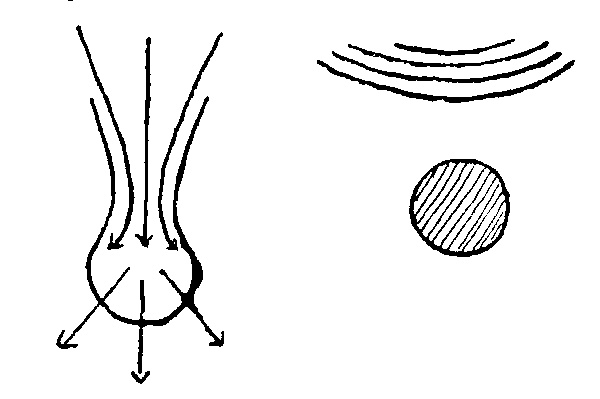
Those spiritual beings of the Third Hierarchy of which we have just spoken did not wish to be filled with the spirit nor to be connected with the spiritual substance of the hierarchies. They wanted an independent spiritual life, they therefore cut themselves off, they detached themselves, so that the being of the higher hierarchies was above them; they cut the connection and detached themselves as independent beings, retaining the actual light in their inner being.
Thus they, as it were, stole what should only have filled them, and then returned to the higher hierarchies. They stole it for themselves, filled their own inner being with it, and by that means developed an independent side to their nature. This concept can provide an explanation of events in the cosmos, without which we should be quite unable to grasp a stellar system, the constitution of the stars in general as we know them with our human physical consciousness. Without these concepts one cannot possibly grasp the life of the stars, the life of the heavenly bodies.
From The Spiritual Beings in the Heavenly Bodies and in the Kingdoms of Nature, Lecture 10 - 1912Just as in the mineral kingdom something is active in the moon which keeps the balance with regard to the Luciferic forces streaming down from the sun, so does a spiritual moon-principle work from the moon against the temptation of Lucifer which man has encountered in the course of the earth evolution. As we have seen, all the planets, all the heavenly bodies stand in connection with beings of the higher hierarchies, and so, too, is it with the moon.
The Spirits of Wisdom founded a colony upon the moon in order to preserve the equilibrium; and so from the direction of the moon there also Work in upon humanity compensating spirits against Lucifer, who approached man as a tempter; and just as he disseminated light, so, too, did his spiritual principle sink down into the human soul. So we can also point to the moon as the bearer of the opponent of Lucifer; as the dwelling-place of dark spirits, who yet must be there that the balance may be maintained with regard to the Light-bearers pressing forward, who, at the same time, are the tempting spirits to humanity.
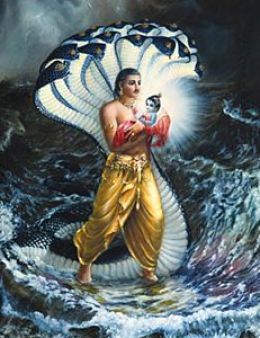
Krishnas
escape, protected by the powers of the stars, the seven planetary powers.
In fact, the secret of the moon and its spiritual principle was first revealed to humanity in the old Hebrew Records, and what we have found physically in the moon is, in its spiritual aspect, what Hebrew antiquity designated as the Jehovah principle.
According to this the moon, so to speak, is designated as the starting-point of the forces working upon humanity as the opponents of Lucifer. Jahveh, or Jehovah, is the opponent of Lucifer.
The secret doctrine of the ancient Hebrews looked up to the Sun, saying: In the Sun work the invisible Spirits of Wisdom who are only visible to spiritual, not to physical sight. The latter sees the principle of Lucifer raying down. What is to be seen externally as the sun principle is Lucifer; but therein works secretly, invisible to physical vision, everything attainable through the Spirits of Wisdom, who form the gateway to it.
One of these Spirits of Wisdom separated and sacrificed himself, and has taken up his abode upon the moon in order through his activity there to curb the light and also to counteract the spiritual work of Lucifer.
Hebrew antiquity saw in Jehovah an Ambassador of those true exalted spirits to whom vision is opened through the Spirits of Wisdom, if the sun is looked upon with spiritual sight. Hebrew antiquity justly concluded that Jehovah must continue to work from the moon until humanity has become inwardly mature enough to perceive and feel at least a little of that which gradually in the course of evolution will be both seen and understood — that from the same sun proceeds not only the physical part of Lucifer, but also the dissemination of that of which the Spirits of Wisdom are the portal.
Thus to the ancient Hebrew there appeared in Jehovah that which is similar to the Spirits of Wisdom in the sun, and we can say: just as the sunlight is reflected from the moon in space, so to the ancient Hebrew who really knew,
Jehovah was the reflection of that Spiritual Being Who, when man shall have become sufficiently mature, will ray down from the sun, and Whose appearance was foretold by the
Holy Rishis, Zarathustra, and the worshippers of Osiris.
Just as in space sunlight is reflected from the moon, so
Jehovah is revealed as a reflection of the principle of the great Sun-Spirit Whom you may designate by whatever name you will —
Vishvakarma, as the ancient Indians called him;
Ahura Mazdao, as He was called by
Zarathustra, Osiris by the ancient Egyptians, or as the
Christ, as He is known to the fourth post-Atlantean period of civilisation — that is, the esoteric comprehension of
Jehovah.
He is Christ reflected by the moon-principle and because reflected in time, Christ announced prophetically. Hence in St. John's Gospel we come across a passage which otherwise can never be understood, in which it is said that
Moses spoke of Christ. Actually, he spoke of Jehovah, but it is
Christ, prophetically announced. This passage, in which Jehovah is mentioned is referred to because the bearer of the
Christ wishes to point out that in antiquity Jehovah is but
Christ foretold.
Thus we see that these things are in accord, and that what we have heard to-day is connected with what was said in the last lecture; and that in what we call the external light and its bearer we must recognize something which is in opposition to the spiritual principle which is at the normal point of its evolution, and which appears to us as the spiritual center of our planetary system.
It is not a question of names, but of recognizing the whole significance of this Principle. We must recognize that in the realm of the spiritual, we speak of Christ just as in that of the physical we speak of the Sun; that in the realm of the spiritual we speak of the planetary spirits and of the planets just as in the development of earthly civilisation we speak, perhaps, of the principle of Buddha.
Here again is a point concerning which you find one of the important revelations you come across in H. P. Blavatsky. What great revelations there are in The Secret Doctrine you can see by the way H. P. Blavatsky treats the conception of Jehovah. We need not recoil at this, or think things are not correct because she shows a certain antipathy towards Christ and Jehovah; the truth nevertheless presses through, and the description of Jehovah as a Moon divinity, and the presentation of Lucifer as his opponent as given by H. P. Blavatsky is — one might say — the broken expression of a truth. The presentation given from inspiration by Blavatsky is only given a subjective coloring by her, because she had a feeling that Lucifer was really a good Divinity — she felt him as such. She preferred him, in a certain sense to the Moon-god, because to her Lucifer was a Sun-god. That is correct; he is that; but we had to represent the true connection in order that the expression used in former times. “Christ is the true Lucifer,” “Christus verus Luciferus,” may be understood. It does not sound quite right to us today; but at that time when people knew from the old Secret Doctrine that the Light-Bearer manifests in the external physical light, and that, if we penetrate through the physical light to the Spirits of Wisdom, to the spiritual light, then we reach the Light-Bearer of that Light.
From The Deed of Christ and the Opposing Spiritual Powers (Berlin 22nd March, 1909)
This “Holy Spirit” is none other than the Lucifer-Spirit, resurrected now in higher, purer glory — the Spirit of independent understanding, wisdom-inwoven. Christ Himself foretold that this Spirit would come to men after Him, and in the light of this Spirit their labors must proceed. What is it that works onward in the light of this Spirit? The world-stream of spiritual science, if rightly conceived! What is this spiritual science? It is the wisdom of the Spirit, the wisdom that lifts into the full light of consciousness that in Christianity which would otherwise remain in the unconscious.
The torch of the resurrected Lucifer, of the Lucifer now transformed into the good, blazons the way for Christ. Lucifer is the bearer of the Light — Christ is the Light! As the word itself denotes, Lucifer is the “Bearer of the Light”. That is what the spiritual scientific movement should be, that is implicit in it. Those who know that the progress of mankind depends upon living apprehension of the mighty Event of Golgotha are they who as the “Masters of Wisdom and of the Harmony of Feelings” are united in the great Guiding Lodge of mankind.
And as once the “tongues of fire” hovered down as a living symbol upon the company of the apostles, so does the “Holy Spirit” announced by Christ Himself reign as the Light over the Lodge of the Twelve. The Thirteenth is the Leader of the Lodge of the Twelve. The “Holy Spirit” is the mighty Teacher of those we name the “Masters of Wisdom and of the Harmony of Feelings”. It is through them that his voice and his wisdom flow down to mankind in this or that stream upon the earth.
The treasures of wisdom gathered together by the spiritual scientific movement in order to understand the universe and the Spirits therein, how through the “Holy Spirit” into the Lodge of the Twelve; and that is what will ultimately lead mankind step by step to free, self-conscious understanding of Christ and of the Event of Golgotha Thus to ‘cultivate’ spiritual science means to understand that the Spirit has been sent into the world by Christ; the pursuit of spiritual science is implicit in true Christianity.
The bodhisattva incarnating as Buddha was the lightbearer, and the light was Krishna, also known as Wotan, Zeus and many more.
These Luciferic Beings who have brought man freedom, also make it possible for him, if he so wills, to turn it to account in order to understand Christ. Then the Luciferic Spirits are cleansed and purified in the fire of Christianity and the wrong done to the earth by them is changed into blessing. Freedom has been attained; but it will also be carried into the spiritual sphere as a blessing. That man is capable of this, that he is capable of understanding Christ, that Lucifer, resurrected in a new form, can unite with Christ as the good Spirit - this, as prophecy still, was told by Christ Himself to those around Him, when He said: "Ye shall be illumined by the new Spirit, by the Holy Spirit!" This "Holy Spirit" is none other than the Spirit through whom man can apprehend what Christ has wrought. Christ desired not merely to work, but also to be apprehended, to be understood. Therefore the sending of the Spirit by whom men are inspired, the sending of the "Holy spirit", is implicit in Christianity.
From Man in the Light of Occultism, Theosophy and Philosophy (Christiania, 12th June, 1912.), LECTURE X
When we go back to the time of the old Sun, we do not find there any story of the Temptation! We find the Sun still as a planet among the seven planets, we find Venus with Lucifer as her ruler; and these two, the Sun Spirit and the Venus Spirit — in other words, Christ and Lucifer — appear at first sight like brothers. Only by straining to the utmost our powers of perception are we able to remark the difference between them. For the difference between Lucifer and Christ, in the time of old Sun is not apparent to an observation of their external being, it requires a more inward observation and study. It is indeed extraordinarily difficult to find outward means of demonstrating wherein the difference lies. Please, therefore, take what I am now going to say as no more than an attempt to characterise, as well as may be, the difference that clairvoyant consciousness can perceive between Christ and Lucifer in the time of the ancient Sun.
When we direct our gaze now to Christ, now again to Lucifer, a new perception begins to dawn upon us. Lucifer, the ruler of Venus, appears in a form that is extraordinarily full of light, — I mean, of course, spiritual light. We have the feeling that all the glow and brilliance we can ever experience on Earth in looking upon a manifestation of light is weak and dim in comparison with the majesty of Lucifer in the old Sun time. But then we notice, when we begin to perceive his intentions — and we are able to see through these—, that Lucifer is a Spirit endowed in his very nature with infinite pride, so great a pride that it can prove a temptation to man. For, as is well-known, there are things which up to a point are not temptations for man but become so when they grow majestic in their proportions, and pride is one of them. When pride is majestically great it tempts man. Lucifer's proud greatness, Lucifer's pride in his majestic figure of light — these contain a seductive element. “Unmanifest light,” light that does not shine outwardly but has immense, strong power in itself — that Lucifer has in full measure. And how does the Christ figure look beside Lucifer? The Christ figure in the time of old Sun — the Lord and Ruler of the Sun planet — is a picture of utmost devotion, entire devotion to all that is around Him in the world. Whereas Lucifer looks like one who thinks only of himself — we are obliged to clothe it all in human words, notwithstanding the fact that these are quite inadequate — Christ appears as wholly given up, in devotion, to all that is around Him in the great wide world.
The great wide world was not then as it is now. If we were to transport ourselves in these days to the present Sun, then, looking outwards in all directions as from the centre of a circle, we should perceive in the first place the twelve Signs of the Zodiac. These were not then externally visible; but instead, twelve great Forms, twelve Beings were present who let their words ring forth from the depths of the darkness, — outer space being of course not then filled with light. What kind of words were these? They were words — the word “word” is again only a makeshift, to indicate what is here meant — they were words that told of primeval times, of times that even then were in a remote and ancient past. The twelve were twelve World-Initiators. Today we behold standing in the directions of these twelve World-Initiators the twelve Signs of the Zodiac, but from them resounds, for the soul that is open to the whole world, the original being of the Unspoken Word of Worlds, that could take form in the twelve Voices. And whilst Lucifer alone — I must now begin to speak more in pictures; human words do not in the least suffice — whilst Lucifer had the impulse to let stream out upon all things the light that was present in him and therewith come to a knowledge of all things, the Christ on the other hand, gave Himself up to the Impression of this Word of the Worlds, received It in its fulness and entirety into Himself, so that this Christ Soul was now the Being that united in Himself all the great Secrets of the World that sounded into Him through the inexpressible Word. Such is the contrast that presents itself, — the Christ Who receives the Word of the Worlds, and the proud Lucifer, the Spirit of Venus, who rejects the Word of the Worlds and wants to found and establish everything with his own light.
All subsequent evolution is a direct outcome of what Lucifer and Christ were at that time. The Christ Being, as we saw, received into Himself the great and all-embracing secrets of the Worlds. The Lucifer Being, having what I can only describe as a “proud figure of Light,” lost thereby his kingdom, lost his Venus kingdom. On other grounds, to enter into which would take us too far afield, the other Spirits of the Planets lost also their kingdoms, or rather changed their natures. But they need not concern us here. What is important for us here is the contrast between Christ and Lucifer. It came about that Lucifer lost more and more of his rulership; the kingdom of Venus gradually fell away from him. Lucifer with his light became a dethroned ruler, and the planet Venus had thenceforward to do without a proper ruler and was consequently obliged to undergo a backward evolution. The Christ, however, had during the old Sun time received the Word of the Worlds, and this Word of the Worlds has the quality of kindling itself to new light in the soul by which It is received; so that from that time forward the Word of the Worlds became in the Christ Light, and the planet of which the Christ was ruler, the Sun, became the centre of the whole planetary system, the other planets being brought into subjection to It. The same is true also of their spiritual Rulers.
We must let these scenes live before us, we must learn to see the divergence that came about during the old Sun time between the path of Lucifer and the path of Christ. Lucifer went downward, he had to remain behind in his evolution, and he remained behind also during the Moon time. Christ went forward. The Christ Spirit, the Sun Spirit, became a Spirit evolving ever forward until at length He was able to appear on Earth in the Form we have often described. Through His devotion to the World All, through His having received and identified Himself with the Divinely Creative, Inexpressible Word, through His having rejected every sort of pride and put always in its place devotion to the Word of the Worlds, — Christ, from being Ruler of a single planet, as He was in the the ancient Sun time, became Ruler from the Sun over all the planets, the other planets being reckoned as part of the realm of the Sun. When you know this — I am speaking here more particularly to those who heard my lectures in Helsingfors — knowing this, you will not feel it as a contradiction that Christ is spoken of in those lectures as a Sun Spirit of a higher kind than the Spirits of the planets. For there of course we were speaking of the present day. Christ is far above the other planetary Spirits. He is the Spirit of the Sun. Here, however, where we are not merely describing how the individual planetary bodies are quickened to life by their Spirits, but where our task is above all to describe the several states of consciousness, we have to show how Christ through His own special character and nature has, during the course of the evolution that has taken place between old Sun and the present time, passed through an upward evolution, and from having been a Spirit who was of like nature with the planetary Spirits has become the Ruler or Regent of the whole solar system.
From Foundations of Esotericism (Berlin1905), Lecture 7
Helena Petrovna Blavatsky, in the Secret Doctrine, called Jehovah [Krishna] a Moon God. (26) There is a deep reason underlying this. In order to understand it we must be clear about the further development of man. In man as he is today, his higher forces are intermingled. His further development depends on the emergence of his higher self from the sheath of the lower forces and organs.
The brain is divided into three actual parts: into thinking, feeling and willing sections. Later these three parts, like the three divisions of an ant-heap, will be directed by man from outside. The parts, however, from which the higher has been withdrawn do not remain as they are today, but they then descend a further stage lower. This is the reason why many people practicing a one-sided spiritual development suffer a moral decline. In the case of western cultural life there is less danger of this, for western science does not yet compel the higher things of the mind to rise up out of the lower body. Through Theosophy, on the other hand, man actually absorbs a wisdom through which the 'I' is partially torn out of the usual environment of the organs. It can happen that when a person who, through his conventional milieu had observed ordinary moral standards, takes up theosophical teachings, his worser qualities, which up to that time had remained hidden, actually make their appearance. Frequently the lower comes to the surface because one occupies oneself with spiritual things without at the same time strengthening one's morality. This fact brings with it a certain tragedy. Certain men of academic standing, who in the sphere of western knowledge had been quite admirable people, suffered through having come into the Theosophical Society; in their case the lower nature made its appearance without being mastered by the higher.
The same law is also to be found on a larger scale. The beings whom we meet with on the Old Moon had not as yet incorporated their power of thinking in a physical brain. The power of thinking in the case of the Moon-Nirmana-kayas, Bodhisattvas, Pitris and pure human beings did not yet work in a physical brain but in the ether masses surrounding them. [This goes for man through first half of the Earth-development, the period named Mars.]
On the Old Moon the environment consisted not only of air, but also of ether filled with wisdom. On the Old Moon thoughts were not in the individual beings but they flew hither and thither in the ether. In occultism therefore the Old Moon is also called the Cosmos of Wisdom.
The Old Moon was surrounded by Warmth Ether and other forms of ether. In these ethers lived intelligence and reason, as they now live in the human brain. Underlying this however there was development. At the beginning of the Moon evolution wisdom still impressed itself into beautiful forms. The beings who only possessed the lower human members, physical body, etheric body and astral body, were directed by these streams of wisdom. In the course of further development the three lower bodies descended more deeply.
When the Old Moon evolution came to an end the beings who were wise, but did not possess wisdom in a brain, had progressed so far that they could completely relinquish these lower bodies. These beings who had now become Pitris and who no longer needed to enter into such physical, etheric and astral bodies, were the hosts of the Elohim in different stages. [They have become Angels, raised from human level.]
The lowest rank of these Elohim is the Jehovah stage [Angels]. Jehovah therefore is an actual Moon divinity, who on the Old Moon passed through physical development. Nevertheless on the Moon he was never able to work on the physical surroundings, using a brain as the vehicle of thought. Only his physical, etheric and astral bodies had worked on the physical environment. This however he did through pictures. Thinking hovered above.
The name Jehovah does not designate a single being, but a rank in the order of the hierarchies. [This goes for many such spiritual beings, they are both a personality, a Logoi, and a hierarchy.]
Many beings can take on the Jehovah rank, or assume it for a purpose. Eliphas Levi repeatedly emphasised that with the designations Jehovah, Archangeloi, Angeloi, we have to do with ordered ranks of beings.
The first human beings to receive teaching on the Earth received it from Jehovah in pictures. That is why Genesis is a sum of great pictures, pictures which Jehovah had experienced on the Old Moon. [Dream symbols, the language before Kali Yuga, before the Tower of Babel.]
While on the Old Moon, on the one hand, only the lower being of man was developed in physical, etheric and astral bodies — on the other hand the higher trinity was being cherished and fostered. These principles had reached a certain degree of maturity, after having been implanted; Atma on Old Saturn, Buddhi on Old Sun, Manas on Old Moon. They could then develop further on the Earth.
What came over on to the Earth from the Old Moon as physical, etheric and astral bodies, are the grotesque animals in which Atma, Buddhi and Manas gradually incorporated themselves.
The Moon Pitris had left aside the lower parts, but to make up for this they had cherished and fostered Atma, Buddhi and Manas in an objective way. Through their fostering care they brought it about that a thinker could develop on the Earth. If one looks at the external creatures on the Old Moon, these are the sheaths which surrounded man, not man himself. The sheaths could be made use of because what had to leave them had departed. [Gap in the text ...] Now the remaining material could be condensed to form the brain. In a germinal condition the matter for the brain was there, but could only condense after the Pitris had left.
What took place in the pre-Lemurian Age is a preparation. The human body is so worked upon that Atma, Buddhi and Manas can sink into it. These principles enveloped themselves with Kama-substance.
Let us now imagine a jelly-like being which had freed itself from what had come over from the Old Moon. This provides a physical foundation. In addition to this there are Atma, Buddhi and Manas, and an astral body which these principles organise around themselves.
They work on the jelly-like masses from outside until they are able to take possession of them from within. Finally the spiritual penetrates the physical.
Now two kinds of beings have amalgamated. The moment the brain is formed they interpenetrate one another. Through this, birth and death entered into Earth-evolution. Previously human beings had themselves built up the physical body; in the future this will be so again.
But because two beings are united who are only partially suited to one another we have birth and death, and every period of time between birth and death is a continual attempt to make these two beings fit together better — a swinging to and fro of the pendulum until eventually a rhythmical condition is brought about.
Up to the middle of the Sixth Root-Race (epoch) this will continue, until this rhythmical condition is attained and the one being has become completely adapted to the other.
And Karma is nothing else than the measure of balance which the human being has already brought about. In each single incarnation one attains a certain degree of adaptation. After each incarnation man must ascend again to Devachan in order to survey what has still to be done. Only when the balance is achieved is Karma overcome and the human being can take up something new, the true Wisdom, Buddhi, which until that time must be fostered and cherished.
Future evolution must be prepared for. What man already produces from himself, as preparation for the future human being, is the word, speech. What man speaks remains in the Akashic Record. It is the germinal beginning for the future human being. Speech is one half of the former means of reproduction. Through speech man propagates himself spiritually. The breaking of the male voice is connected with this. One half of what is sexual has been carried over into speech. The voice is the future organ of reproduction. In ancient Hebrew the same word was used for sex and speech. Today man thinks and the thought passes outwards through the larynx. The next stage will be that feeling, warmth, passes outwards. Then the word will be the expression of the inner warmth of the body. This can happen when the pituitary gland (hypophysis) develops in the brain. The stage following this appears when the pineal gland (epiphysis) is developed. Then not only the warmth-imbued word will go forth, but the word will remain, will be given form through the will, which then lives within it. Then when one utters the word it becomes an actual being.
Related to this is: ‘I think, I feel, I am’ (will). The word in this sense is ‘the word’ which undergoes a transformation from thinking, into feeling and then into willing. This is a threefold process. First the word is ‘consciousness’ (in thinking) then ‘life’ (the warmth-permeated word), and lastly ‘form’, the word shaped through the will. This latter is the word become objective. So here too, following one another, we have: consciousness, life, form. Everything, which today is form stems from earlier times and has arisen through such a process. The physical body, the form, is the most perfected body; less developed are the etheric body, life, and the astral body, consciousness.
From Egyptian Myths and Mysteries (September 12, 1908), Lecture 10 (pdf)
When we are familiar with this phenomenon, we shall not regard incarnation as such a simple matter. There can perfectly well be a person who is the reincarnation of an earlier man, who has developed himself so far and purified his three bodies to such an extent that he is now a vessel for a higher being. Buddha became such a vessel for Wotan. The same being who was called Wotan in the Germanic myths, appeared again as Buddha. Buddha and Wotan are even related linguistically.
Then there were beings who still embodied themselves at that time, when the air was permeated by water-vapors. When man still lived in the water-fog atmosphere, these incarnations were possible for them. Such a figure was the later Wotan, for example. He said to himself, “If man incarnates in this fluid matter, then I can also.” Such a being assumed a human form and moved about in the physical world. But as the earth condensed and man took on ever denser forms, Wotan said, “No, I shall not go into this dense matter.” Then he remained in invisible worlds, in worlds removed from the earth.
Until End of Dreamtime (Kali Yuga), the gods walked the Earth in etheric body, while men slowly became more and more enmeshed in the physical stuff. End of Dreamtime are symbolized through the death of Krishna, God disappeared from the vision of men. From now on they couldn't talk through dreams, they had to invent words, as symbolized through the Tower of Bable.
From Egyptian Myths and Mysteries (September 13, 1908), Lecture 11 (pdf)
It has recently been said that certain beings pursued a different path in evolution. The individuality of Wotan, for example, takes such a different course. Up to a certain stage it travels together with man, but then it does not descend so deeply. Man descends further into matter and only later will he again join these beings, who are completing their evolution in the earth-time. We have seen that a time came when Wotan no longer walked on our earth. Such beings, however, were not like Osiris and Isis. These latter were beings who had branched off still earlier, who completed their evolution on a higher level in full invisibility. These forms went through their special experiences.
From Universe, Earth and Man (Stuttgart 16th August, 1908), Lecture XI
We must keep in mind the fact that no negation has passed the lips of Western esotericists, and that much that was puzzling at the beginning of the Anthroposophical movement has been explained by them. The followers of Western esotericism never find in it anything out of harmony with the mighty truths given to the world by H. P. Blavatsky. When we are told, for example, that we have to distinguish in the Buddha the Dhyani-Buddha, the Adi-Buddha, and the human Buddha, this is first fully explained by the Western esotericist. For we know that what is regarded as the Dhyani-Buddha is nothing but the etheric body of the historic Buddha that had been taken possession of by a God; that this etheric body had been laid hold of by the being whom we call Wotan. This was already contained in Eastern esotericism, but was only first understood in the right way through Western esotericism.
Wotan was an initiate of the northern peoples. He is none other than the bearer of the elements of Atlantean culture into these parts. Everywhere in these northern regions the Druid initiation was still practised. I have already said that one of its founders, one can say its chief founder, was named Sieg. And in these northern parts something happened rather like what happened later in Palestine at the Foundation of Christianity. Sieg renounced his body and placed it at the disposal of a higher individuality. Hence later the transformed Sieg was named Odin. Odin is the highest initiate of the northern Mysteries. He is the bearer of the spiritual culture of that time. Sieg therefore was the Chela of the north who placed his body at the disposal of the higher, more spiritual Odin. He himself lived later as an initiate Master.
I have always been mystified by
From The Mission of Christian Rosenkreutz, Neuchatel 18th December, 1912
A Conference of the greatest and most advanced Individualities was called together by Christian Rosenkreutz. His most intimate pupil and friend, the great teacher Buddha, participated in these counsels and in the decisions reached.
But it's actually not so mysterious. Christian Rosenkreutz is the Second Logos, the Word. Buddha is the First Logos.
From The Christ Impulse and the Development of the Ego-Consciousness (Berlin, 25th October, 1909), Lecture 1
Thus in this incarnation of Apollo as Orpheus, we have again a sort of descent of a Bodhisattva - if we may use this Eastern term - to Buddha-hood. We might quote a number of such Beings who stand out from age to age as the great Teachers of humanity and who always had a very special experience at the time of their deepest descent. The Buddha experiences the bliss of inspiring the whole of humanity. That Bodhisattva, whose memory is preserved externally under the name of 'Apollo,' had an individual experience: he was to prepare the individuality, the quality of the 'I'. He experiences the tragedy of the 'I'; he experiences the fact that this 'I' is, in the present state of man as regards this attribute of his, not entirely with him. Man is struggling up to the higher 'I'. That was foreshadowed for the Greeks by the Buddha or Bodhisattva in Orpheus.
From The Manicheans (Berlin, November 11, 1904)
Manes, lived on the Earth three hundred years after Jesus the Christ. The tradition is as follows: In Western Asia there lived a merchant who was exceedingly learned. He was the Author of four works: (1) The Mysteries, (2) The Letters, (3) The Gospel, and (4) The Thesaurus. Tradition holds that his death he left the writings to his widow, who was a Persian. She had once redeemed a slave named Manes and he was called ‘the Son of the Widow.’ His followers called themselves ‘Sons of the Widow.’ Manes designated himself ‘Paraclete’ or ‘Holy Spirit’ promised by Christ to humanity — that is as an incarnation of the Holy Spirit, merely a reincarnation of the same.
In ancient epochs, in Atlantis and Lemuria, all knowledge was in part influenced by that which stands above man. Not until our own epoch have men matured to the stage where they have, as brothers, human beings who have passed through all stages since the middle of the Lemurian Race. In the Fifth Root Race, the guidance of the soul from above withdraws, leaving it to take its own paths. In esotericism, the soul was called the Mother or Isis. The Father was the Instructor or Osiris, who represented the inpouring Divine. He is the Revealer. The soul conceives or receives. The soul is the Mother. During the Fifth Root Race the Father withdraws. Then the soul is widowed, becomes the Widow. The soul, which will later on become completely independent, is designated by Manes, the Divine Fructifier, as the Widow.
Then Manes designates himself as the Son, He it is who prepares the soul to become independent. Everything that comes from him is a call to the Divine-Spiritual Light of the soul, a rebellion of the soul against everything which has not come from out of the soul itself. ‘You must strip off everything that is external revelation, everything that external authority has transmitted to you. Then you must become ripe to behold your own soul.’
 :
:
| Physical | Consciousness Soul | Truth | Life | I Am / I Will | The Life | Spirits of Wisdom |
| Etheric | Intellectual Soul | Beauty | Consciousness | I Feel | The Truth | Spirits of Motion |
| Astral | Sentient Soul | Love | Form | I Think | The Way | Spirits of Form |
These words follow the Deed of the Washing of the Feet. You know this most significant scene, Peter at first protests but then begs that the Lord shall wash his whole body. Then the Lord indicates that one among the disciples is not clean, namely, he who will betray Him. The whole secret of present-day mankind is contained in this chapter. Fundamentally, the object of the education of the last 2000 years was to be a washing of the feet. Judas stands there with the knowledge that Christ washes the feet of the others. ..... (sentence missing in original) .....
And now think of our astral and physical bodies. The physical body stands within the physical world; the same physical and chemical forces which work outside in Nature, work also in our physical body. The character of the astral body is determined by the natural urges and passions.
What did Christ accomplish by the washing of the feet? I have often said that the physical body of man is the most perfect and the most important and that the other bodies have yet to develop to this stage of perfection. As an instance, think of the upper part of the thigh-bone. No technician could put together anything as perfect. The physical body is built “wisely and perfectly;” it is an imprint of the highest wisdom. And if the physical body only were on the Earth, then the physical world would be much more perfect.
There are no inferior functions in the physical body itself; they are something which the
astral body brings about. Nothing that the physical body accomplishes is sinful; the astral body alone is
sinful.
The astral body works as the enemy of the physical body and sinfulness, wrong-doing, are thereby evoked in the physical body.
[Karma.]
It was necessary for the astral body to descend and adapt itself to the physical body during the course of the last 2000 years. The Christ, too, had to descend and to be betrayed. He had to use the means whereby He could best render service to the physical body. The passions had to pour over physical life. Judas with the money-bag had to fulfil his function in order that harmony with the physical world might eventually be established.
But the astral body has not united itself with the material world without being punished; it has sunk in the physical world.
Just as human beings with their astral bodies live in the physical body, so do higher beings live with their higher spirit-bodies, in an astral body, and they can put this astral body to perverted use, just as man is able to do in the physical body.
Diabolus — the Demons — took possession of Judas. This is a real fact. Judas fulfilled the function whereby the astral body was led downwards, but now we must liberate ourselves from Judas.
Perfection and wisdom are imprinted in the physical body. Therefore the occultist says:
The Gods have created the physical body in perfection, and the astral body has yet to grow to this perfection. It must itself become divine, must be purified, just as the physical has been purified, by coming down to the physical Earth.
When we descend to the Earth, we must purify our feet, and when the etheric body descends to the Earth, then the feet must be especially pure; the etheric body must be able to come right down into the material world, must be able to experience everything,
but still remain pure.
If those who seek to ennoble their astral body are to fulfill their task, then they must take this principle as their model. In our age, the astral body is the servant of the physical body.
For the God, the Divine Godhead indwells the physical body and it would be evil for man if he were to put his physical body under the domination of his astral body. The Lord is the Principle which works in the physical body, and the servant is the astral body. The Lord himself has made the physical body perfect; He has sent out the astral body and has placed it forever under the influence of spiritual forces whereby it should be made ever more perfect.
We are servants, and it would be presumption to place ourselves above the higher forces working in Nature. We must let ourselves be strengthened and uplifted by the Divine and not place ourselves above it — otherwise we sin against this precept.


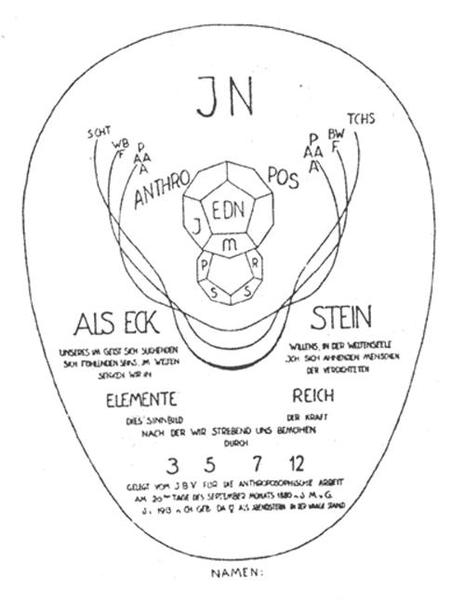
The Foundation Stone Meditation
... was given by Rudolf Steiner on Christmas Day 1923 as a meditation enfolding a supersensible reality which has been called by various names: the Holy Grail and the Philosophers' Stone being two of the more traditional designations for what Rudolf Steiner called the Foundation Stone of Love. He indicated that through living deeply and intensively with this meditation one is able to receive the Foundation Stone of Love into one's heart. ~Robert Powell
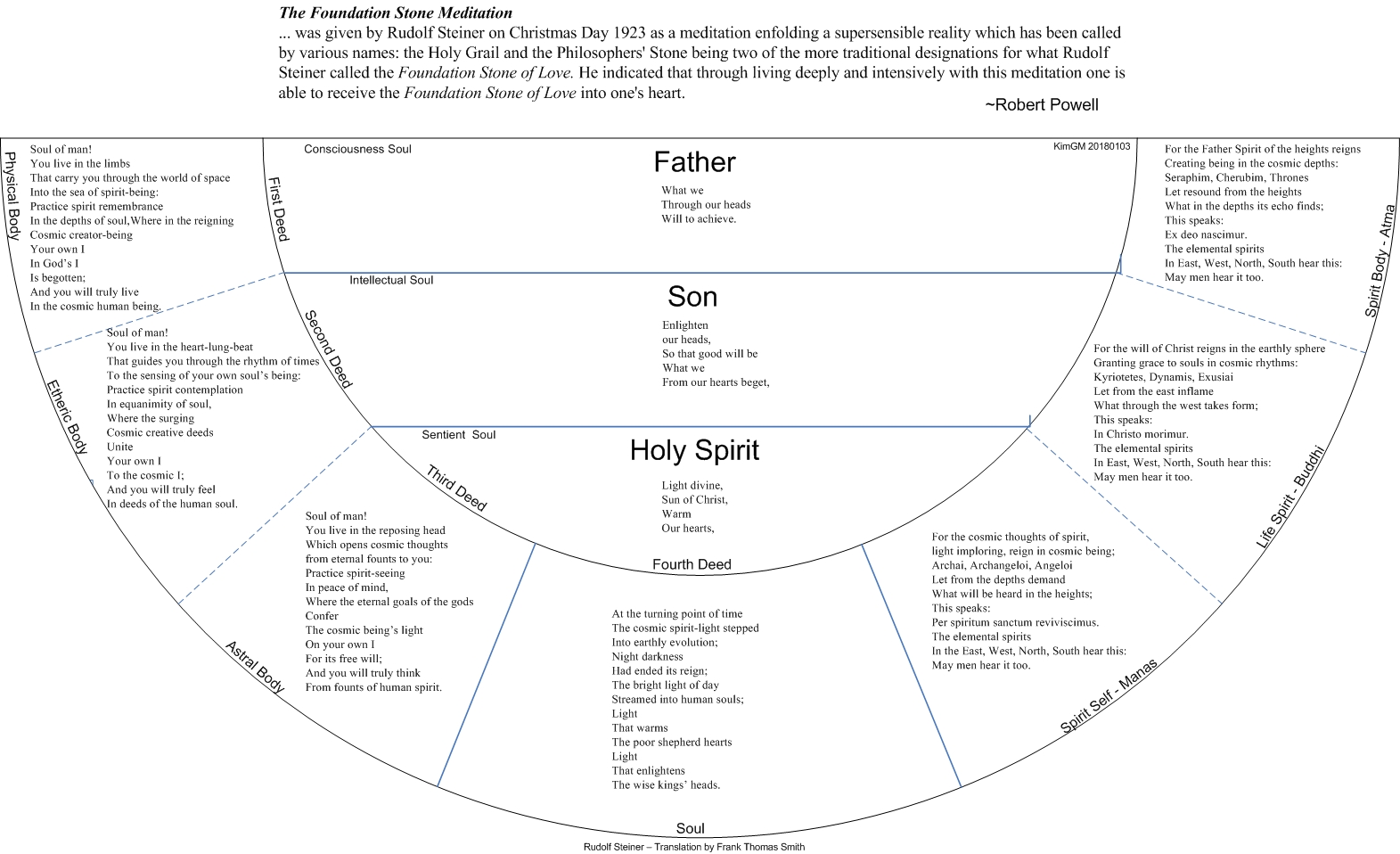 Select picture to see in large.
Evolution of the Word in Paul and the Four Gospels John Shelby Spong
Evolution of the Word in Paul and the Four Gospels
A foundational teaching of the New Testament is that God has declared that Jesus is the Son of God, thus affirming, on the highest authority, his divine nature. At what point in time, or during which event in the life of Jesus, is the declaration made? It turns out that there are four answers to this question: four different answers.
The earliest writings are the letters of Paul and in Romans, written circa 58 C.E., Paul says that God designated Jesus the “Son of God in power according to the spirit of holiness by his resurrection from the dead” (Romans 1:4). Paul, therefore, places the time of the divine declaration at the resurrection of Jesus.
Paul, a servant of Jesus Christ, called to be an apostle, set apart for the gospel of God which he promised beforehand through his prophets in the holy scriptures, the gospel concerning his Son, who was descended from David according to the flesh and designated Son of God in power according to the Spirit of holiness by his resurrection from the dead, Jesus Christ our Lord . . . Romans 1:1-4
Mark, the earliest gospel, written around 70 C.E., moves the declaration back in time to an earlier event: the baptism of Jesus. And, whereas Paul merely states that God has designated Jesus as Son of God, Mark presents it as a story, or episode, with dramatic details:
In those days Jesus came from Nazareth of Galilee and was baptized by John in the Jordan. And just as he was coming up out of the water, he saw the heavens torn apart and the Spirit descending like a dove on him. And a voice came from heaven, “You are my Son, the Beloved; with you I am well pleased.” Mark 1:9-11:
Continuing that backward trend, Matthew, writing in the late 80s C.E., places the divine declaration at the time of the conception of Jesus. And it is in this gospel that we first hear of the nativity story and the virgin birth, an addition that is made some six decades after the crucifixion of Jesus.
Now the birth of Jesus the Messiah took place in this way. When his mother Mary had been engaged to Joseph, but before they lived together, she was found to be with child from the Holy Spirit. Her husband Joseph, being a righteous man and unwilling to expose her to public disgrace, planned to dismiss her quietly. But just when he had resolved to do this, an angel of the Lord appeared to him in a dream and said, “Joseph, son of David, do not be afraid to take Mary as your wife, for the child conceived in her is from the Holy Spirit. She will bear a son, and you are to name him Jesus . . .” Matthew 1:18-21
Luke (early 90s C.E.) follows Matthew’s nativity story but offers an upgrade in terms of more concrete details: the angel now has a name, Gabriel, and he appears not in a dream, but in person, and not to Joseph, but to Mary.
In the sixth month the angel Gabriel was sent by God to a town in Galilee called Nazareth, to a virgin engaged to a man whose name was Joseph . . . The virgin’s name was Mary. And he came to her and said, “Greetings, favored one! The Lord is with you.” But she was much perplexed by his words and pondered what sort of greeting this might be. The angel said to her, “Do not be afraid, Mary, for you have found favor with God. And now, you will conceive in your womb and bear a son, and you will name him Jesus. . . .” Mary said to the angel, “How can this be, since I am a virgin?” The angel said to her, “The Holy Spirit will come upon you . . . ; therefore the child to be born will be holy; he will be called Son of God.” Luke 1:26-35 [Virgin means really free of sin, that all chakras are open.]
And so, thus far, the declaration has been moved back in time from resurrection, to baptism, and to conception.
“One would think that no point earlier in life than conception could be imagined. But thinking thus would not appreciate fully the ingenuity of the early Christian theological mind.” So writes John Shelby Spong, the Episcopal Bishop whose analysis I follow in this presentation.
And indeed, when we come to the gospel of John, written around the turn of the century, or 100 C.E., the divine designation has been moved back to its ultimate temporal limit, the dawn of creation. Jesus was with God in the beginning . . . With this expansion of the backward theme, by the incarnation of the eternal logos, there is no time when Jesus is not with God. Moreover, with God as God.
In the beginning was the Word, and the Word was with God, and the Word was God. He was in the beginning with God. John 1:1-2
In light of this, it is interesting to note that there is not so much as a whisper in John’s Gospel about the nativity or virgin birth. For John, the important birth was the mystical birth, the incarnation of the Word.
And the Word became flesh
and lived among us . . .
full of grace and truth.
John 1:14
Children Prayer by Steiner:
FROM head to foot
I am made in the image of God.
From my heart right into my hands
I feel the breath of God.
When I speak with my mouth
I follow the will of God.
When I behold God
In father and mother,
In all dear people,
In animal and flower,
In tree and stone,
Nothing can fill me with fear,
But only with love for all that is about me.