By Kim Graae Munch.
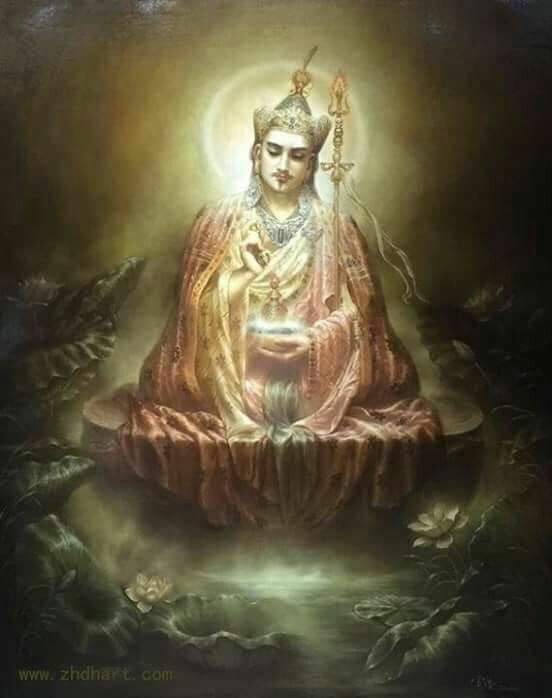
Padmasahmbhava
A dear friend of mine told me about Padmasahmbhava, the founder of Tibetan Buddhism. She wrote:
• He was born on a lotus. [ He is an Avatar, he is not born of a woman but descended down into the body of a compatible person, a lotus flower. ]
• He loved the elementals and freed them through his compassion. [ He is a Manas Bearer, the Manu. ]
• As soon as he was born the elemental beings recognized him. [ He shines in the astral world. ]
• And he could see them. [ He is conscious in the elemental world, the astral world. ]
• He was their redeemer just like Christ was the redeemer of mankind. [ He is conscious in the elemental worlds. ]
• He used love to tame the most evil and ugly elementals and made them live more harmoniously with mankind. [ He has compassion with the elemental world. ]
• So the elementals actually came to love him as much as it was in their capacity to love.

The Rainbow body of Padmasambhava
In his Jesus incarnation we are also shown his power over the demonic elemental world, he could see them and they recognized him and he cared. Jesus also didn’t hold the restrictions of religion and customs, he showed that we should live fully, have joy in life.
In his etheric incarnation as Krishna we also see his powers over the demonic. One of Krishna’s tasks is to teach humanity love and to love, and this is also a strong theme for Padmasambhava.
Radha: What is your real purpose of being born?
Krishna: To establish `dharma’ so that right can triumph over wrong.
Radha: What was the purpose of your time spent in Vrindavan? Especially with me.
Krishna: To teach people the weapon with which they can triumph good over evil.
Radha: Which is?
Krishna: Love. Only Love can conquer everything. When you fight with Love, no one gets hurt; not even the ones you’re fighting with.
Radha: So will all your wars be fought with Love?
Krishna: I will try my best to do that. If it doesn’t work, then I may have to use other means so good can triumph over evil, but personally, I won’t lift any other weapon apart from Love and counseling; but I may encourage others to do so if all else fails.
See Krishna and the Holy Spirit
Padmasambhava gave knowledge to be given up through time in hidden ways, Terma.
 It’s interesting that Padmasambhava’s icons are the same as Indra’s and looking at the powers of Indra, it’s a good guess that Indra is the Second Logos of today. Both Krishna and Padmasambhava are also shown as a child in depictions, as a young god.
Indra is the same as the Thunder God Thor, and Shiva is the same as Loki.
It’s interesting that Padmasambhava’s icons are the same as Indra’s and looking at the powers of Indra, it’s a good guess that Indra is the Second Logos of today. Both Krishna and Padmasambhava are also shown as a child in depictions, as a young god.
Indra is the same as the Thunder God Thor, and Shiva is the same as Loki.
I think he is the central force behind establishing the Tibetan Buddhism. The teaching of Manes continued in new clothes in Tibet. It also explains the more physical characteristics of the Tibetan Buddhism, of the role elementals and demons play in the daily life of the Tibetans.
He practiced and educated in tantric practices together with Mandarava, they mastered the physical fully, and they achieved or build the rainbow body, the resurrection body, the purified physical body. Both are believed to be alive in the rainbow Body today by their followers. Both Mandarava and Padmasambhava's other main consort, Yeshe Tsogyal, are said to have reached Buddhahood, which is quite possible with a rainbow body, resurrection body.
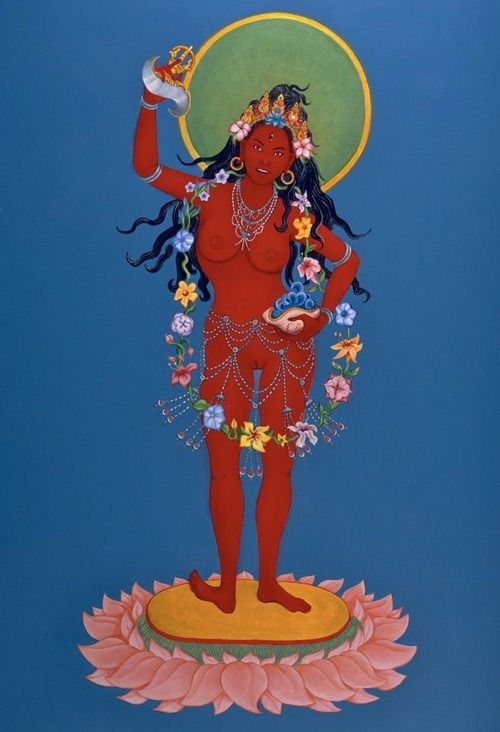
Dakini Yeshe Tsogyal
My friend also mentioned a children book by a Waldorf teacher, Surabhi Katherine Splain about Padmasambhava, The Lotus Born for the Young at Heart. Her introduction, where she writes about how she came to writing the book, is also worth reading.
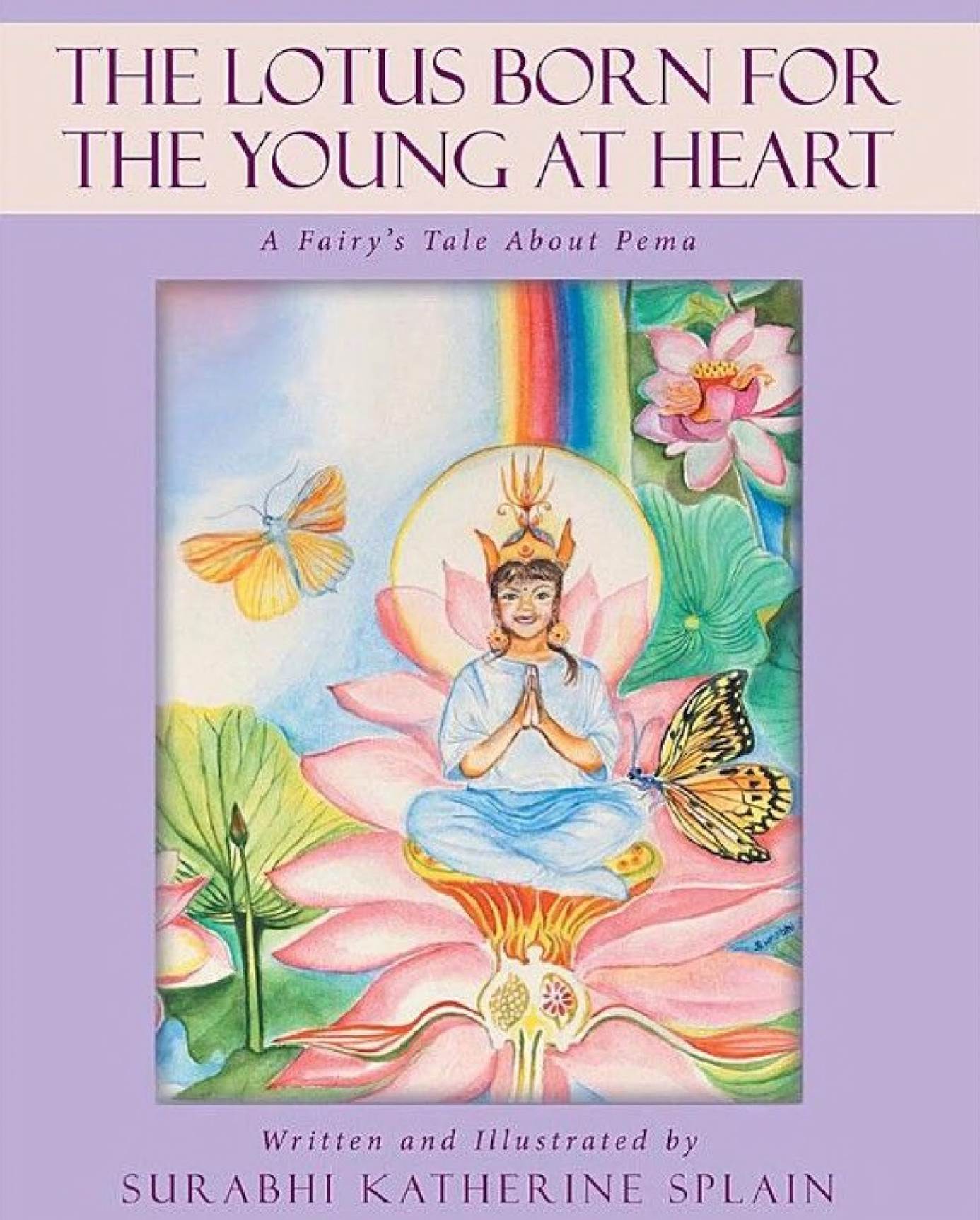
The Lotus Born for the Young at Heart
It is said that Padmasambhava is the same being as Amitābha, whose name means the Infinite Light, what also matches Manes of the Kingdom of Light.
Amitābha is mostly depicted sitting and holding in his hands a vessel containing the nectar of immortality, the Grail.
Amitāyus is an emanation of Amitābha. Amitābha is the head of the Lotus family. Amitābha means "Infinite Light” where Amitāyus means "Infinite Life" so Amitābha is also called "The Buddha of Immeasurable Light and Life".
Amitābha is often portrayed with two assistants: Avalokiteśvara(Kuan Yin, Guanyin) on the right and Mahāsthāmaprāpta on the left. Mahasthamaprapta is symbolised by the moon while Avalokiteśvara is represented by the sun. Both are often shown as women.
It’s natural to surmise that Padmasambhava's two consorts Mandarava and his main consort, Yeshe Tsogyal, are the same as Mahāsthāmaprāpta and Avalokiteśvara (Kuan Yin).
I have come to have a high degree of trust in the buddhistic and hinduistic stories and their information, so my guess is that Padmasambhava's main consort, Yeshe Tsogyal, is Quan Yin, and that she is the feminine part of the Second Logos.
She is Sophia who stand behind the Second Logos.
In Vajrayana, Amitābha is the most ancient of among the Dhyani Buddhas. He is of red color originating from the red seed syllable hrīḥ. He represents the cosmic element of "Sanjana" (name). His vehicle is the peacock! When standing, Amitābha is often shown with left arm bare and extended downward with thumb and forefinger touching, with the right hand facing outward also with thumb and forefinger touching. The meaning of this mudra is that wisdom (symbolized by the raised hand) is accessible to even the lowest beings, while the outstretched hand shows that Amitabha's compassion is directed at the lowest beings, who cannot save themselves. The lotus is his sign. When represented on the stupa, he always faces toward west.
Padmasambhava (lit. "Lotus-Born"), also known as Guru Rinpoche, is a literary character of terma, an emanation of Amitābha that is said to appear to tertöns in visionary encounters and a focus of Tibetan Buddhist practice, particulary in the Nyingma school. A statue of Padmasambhava in the form of Guru Nangsi Zilnoen is being built in Takela, Lhuntse in the eastern part of the Kingdom of Bhutan to bring peace and harmony to the world as prophesied by Lord Buddha and the Great Dzogchen masters. The statue will stand 148 feet tall including 30 foot high lion throne and 17 foot high lotus seat.
A number of legends have grown around Padmasambhava's life and deeds, and he is widely venerated as a 'second Buddha' across Tibet, Nepal, Bhutan, and the Himalayan states of India, and whomever believes in Tibetan Buddhism.
In Tibetan Buddhism, he is a character of a genre of literature called terma, an emanation of Amitābha that is said to appear to tertöns in visionary encounters and a focus of guru yoga practice, particularly in the Rimé schools. The Nyingma school considers Padmasambhava to be a founder of their tradition.
In the eleventh and twelfth centuries there were several competing terma traditions surrounding Padmasambhava, Vimalamitra, Songtsän Gampo, and Vairotsana. At the end of the 12th century, there was the "victory of the Padmasambhava cult," in which a much greater role is assigned to the role of Padmasambhava in the introduction of Buddhism to Tibet.
Padmasambhava left with Mandarava, and took to Maratika Cave in Nepal to practice secret tantric consort rituals. They had a vision of buddha Amitāyus and achieved what is called the "phowa rainbow body," a very rare type of spiritual realization. Both Padmasambhava and one of his consorts, Mandarava, are still believed to be alive and active in this rainbow body form by their followers. She and Padmasambhava's other main consort, Yeshe Tsogyal, who reputedly hid his numerous termas in Tibet for later discovery, reached Buddhahood. Many thangkas and paintings show Padmasambhava in between them, with Mandarava on his right and Yeshe Tsogyal on his left.
According to Sam van Schaik, from the 12th century on a greater role was assigned to Padmasambhava in the introduction of tantric Buddhism into Tibet:
According to earlier histories, Padmasambhava had given some tantric teachings to Tibetans before being forced to leave due to the suspicions of the Tibetan court.
But from the twelfth century an alternative story, itself a terma discovery, gave Padmasambhava a much greater role in the introduction of Buddhism to Tibet, and in particular credited him with travelling all over the country to convert the local spirits to Buddhism.
According to this enlarged story, King Trisong Detsen, the 38th king of the Yarlung dynasty and the first Emperor of Tibet (742–797), invited the Nalanda University abbot Śāntarakṣita (Tibetan Shiwatso) to Tibet.
Śāntarakṣita started the building of Samye. Demonical forces hindered the introduction of the Buddhist dharma, and Padmasambhava was invited to Tibet to subdue the demonic forces. The demons were not annihilated, but were obliged to submit to the dharma.
This was in accordance with the tantric principle of not eliminating negative forces but redirecting them to fuel the journey toward spiritual awakening.
According to tradition, Padmasambhava received the Emperor's wife, identified with the dakini Yeshe Tsogyal, as a consort.
Padmasambhava introduced the people of Tibet to the practice of Tantric Buddhism.
He is regarded as the founder of the Nyingma tradition. The Nyingma tradition is the oldest of the four major schools of Tibetan Buddhism. The Nyingma tradition actually comprises several distinct lineages that all trace their origins to Padmasambhava.
Traditional Nyingma texts see themselves as a lineage which was established by Samantabhadra (Güntu Sangpo), the “primordial buddha” (Adi Buddha) and who is also the embodiment of the Dharmakāya, the "truth body" of all buddhas.[2] Nyingma also sees Vajradhara (an emanation of Samantabhadra) and other buddhas as teachers of their many doctrines. Samantabhadra's wisdom and compassion spontaneously radiates myriads of teachings, all appropriate to the capacities of different beings and entrusts them to "knowledge holders" (vidyadharas), the chief of which is Dorjé Chörap, who gives them to Vajrasattva and the dakini Légi Wangmoché, who in turn disseminate them among human siddhas. https://en.wikipedia.org/wiki/Nyingma
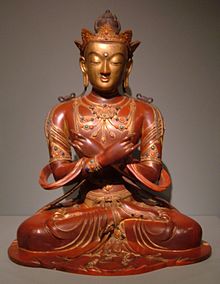
18th-century Chinese statue of Vajradhāra Vajradhara (Also, the name of Indra, because 'Vajra' means diamond, as well as the thunderbolt, anything hard more generally) Tibetan: རྡོ་རྗེ་འཆང། rdo rje 'chang (Dorje Chang); Chinese: 金剛總持; Javanese: Kabajradharan; Japanese: 執金剛; English: Diamond-holder; Vietnamese: Kim Cang Tổng Trì) is the ultimate primordial Buddha, or Adi Buddha, according to the Gelug and Kagyu schools of Tibetan Buddhism. In the evolution of Indian Buddhism, Buddha Vajradhara gradually displaced Samantabhadra, who is the 'Primordial Buddha' in the Nyingma, or 'Ancient School.' However, the two are metaphysically equivalent. Achieving the 'state of Vajradhara' is synonymous with complete realisation. https://en.wikipedia.org/wiki/Vajradhara