
By Kim Graae Munch.
From Karmic Relationships: The School of Chartres by Rudolf Steiner:
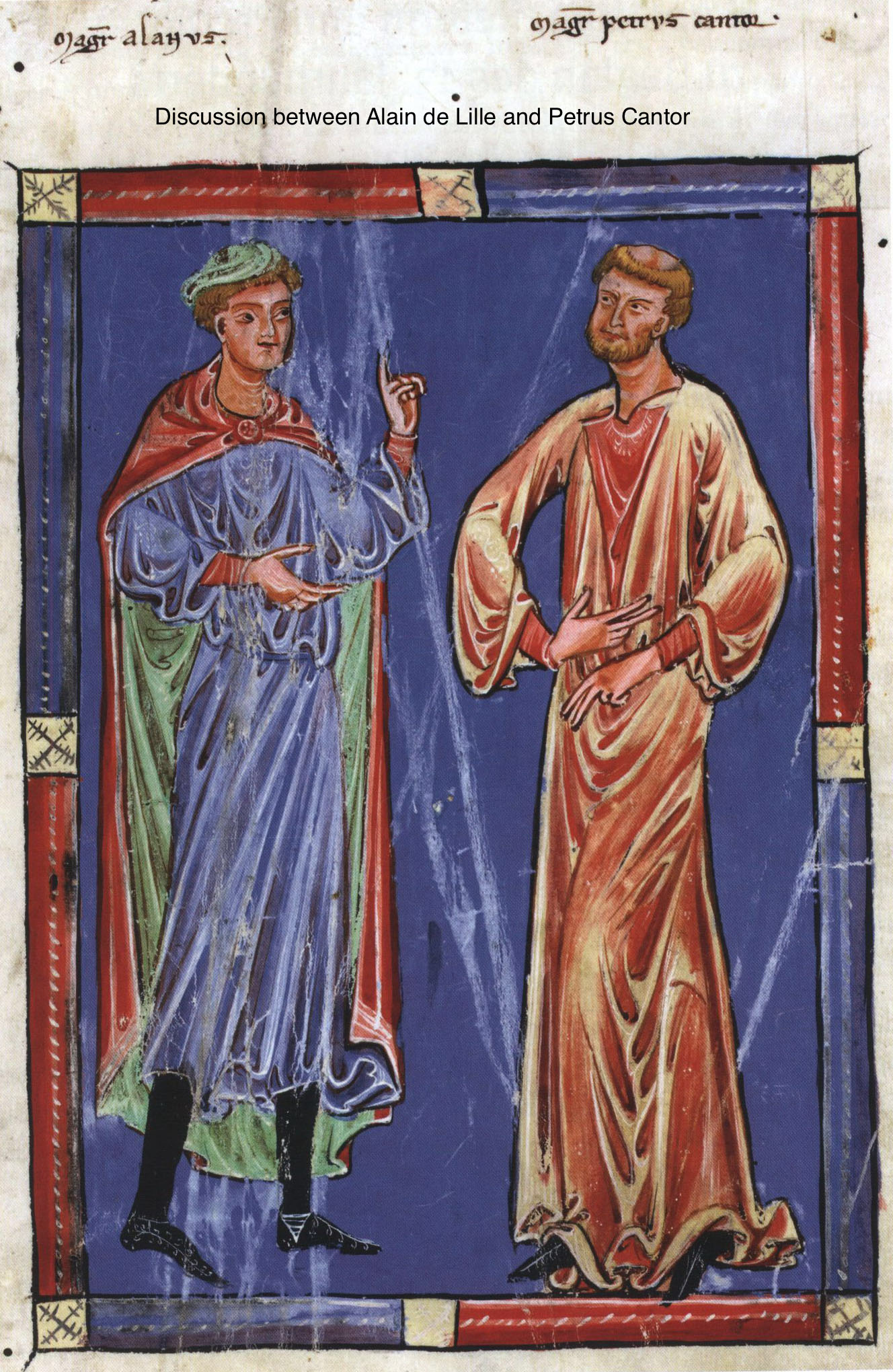 Meanwhile in the School of Chartres itself these teachings continued to be given with remarkable purity. The whole of the 12th century was radiant with them. And there was one who was in reality
greater than all the others, — who taught in Chartres, with what I would call a true inspiration of ideas, the Mysteries of the seven Liberal Arts in their connection with Christianity. I mean
Alain de Lille, Alanus ab Insulis.
Meanwhile in the School of Chartres itself these teachings continued to be given with remarkable purity. The whole of the 12th century was radiant with them. And there was one who was in reality
greater than all the others, — who taught in Chartres, with what I would call a true inspiration of ideas, the Mysteries of the seven Liberal Arts in their connection with Christianity. I mean
Alain de Lille, Alanus ab Insulis.
Alain de Lille at Chartres in the 12th century fired his pupils with a true enthusiasm. His great insight showed him that in the coming centuries it would no longer be possible to endow the earth with spiritual teachings such as these. For these teachings were not only Platonism; they contained the teachings from the old seership of the pre-Platonic Mysteries, with the difference that it had since received Christianity into itself.
To those in whom he presumed an understanding for such things, Alain de Lille taught already in his life-time that an Aristotelian form of knowledge would now have to work for awhile on earth, — Aristotelianism with its sharply defined conceptions and ideas. For in this way alone would it be possible to prepare for what must come again as a Spirituality in later time.
...
But there was still another outcome for all those who had worked in Chartres, when they passed again through the gate of death, and, having passed through the gate of death, entered the spiritual world. Deeply significant was the spiritual life which they had led: Peter of Compostella, Bernard of Chartres, Bernardus Silvestris, John of Chartres (John of Salisbury), Henri d'Andeli, author of the poem “Bataille des Sept Arts,” and above all, Alain de Lille. Alain de Lille, in his own style of course, had written the book Contra Hereticos, where on behalf of Christianity he turned against the heretics, writing directly out of the old vision which was in fact the vision of the spiritual world. And now, all these souls, these individualities who had been the very last to work within the echoes of seership, the wisdom seen in fulness of spiritual light, — they all of them entered into the spiritual world. And in that spiritual world they came together with other souls, of great significance, who were preparing for a new earthly life just at that time. For they were preparing to descend in the very near future into an earthly life where they would work in the sense that was necessary, to bring about the subsequent turning-point: the turning-point of the 14th and 15th century. We have a great spiritual life before us, my dear friends. The last great ones of the School of Chartres had just arrived in the spiritual world. Those individualities who afterwards brought forth the full flower of Scholasticism were still there in the spiritual world, and at the beginning of the 13th century there took place one of the most important exchanges of ideas behind the scenes of human evolution, — an exchange of ideas between those who had carried up the old Platonism, inspired by spiritual vision, from the School of Chartres into the super-sensible world, and those on the other hand who were preparing to carry Aristotelianism down to earth, as the great transition to bring about a new Spirituality that was to flow into the evolution of mankind in the future.
They came to an agreement with one another. The individualities from the School of Chartres spoke, as it were, to those who were preparing to descend into the physical world of sense, who were preparing to cultivate Aristotelianism in the Scholastic system which was right for that age.
...
I don't fully agree with this, both Goethe and Platon reincarnated in what I see as a platonic wave, although not as spiritual as the Chartres wave:
Thus the great spirits of Chartres remained in the super-sensible world, nor have they returned hitherto in any earthly incarnations of significance.
But they were working mightily, helping in the formation of that mighty Imagination in the spiritual world that was formed in the first half of the 19th century and of which I have already told you. They worked in full harmony with those who descended with their Aristotelianism to the earth.
The Dominican Order, above all, contained individualities who lived in this kind of “super-sensible contract,” if I may so describe it, with the great spirits of Chartres, for they had agreed with them:
“We will descend in order to continue the cultivation of knowledge in the Aristotelian form. You will remain up here. On earth too we shall remain in union with you. Platonism for the present cannot prosper on the earth. We shall find you again when we return, and then together we will prepare for that time when the period of Scholastic Aristotelianism will have been completed in earthly evolution, and it will be possible to unfold Spirituality once more in communion with you, with the spirits of Chartres.”
It was, for example, an event of deep significance when Alain de Lille, as he had been called in earthly life, sent down to earth a pupil [Thomas Aquinas] well instructed by him in the spiritual world. For in this pupil he sent down on to the earth all the discrepancies, it is true, which could arise between Platonism and Aristotelianism, but he sent them down so that they might be harmonised through the Scholastic principle of that time. Such was the spiritual working, especially in the 13th century, to the end that there might flow together the workings of those who were on the earth, — who were on the earth for instance in the garment of Dominicans, — and those who had remained in yonder world. For the time being, these latter could find no earthly bodies in which to stamp their spirituality. For theirs was a spirituality which could not come down to the Aristotelian element.
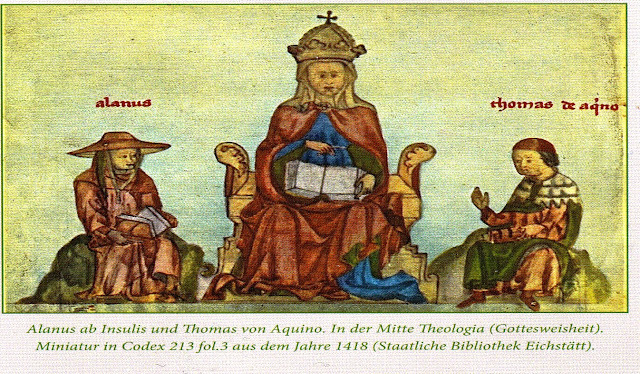
So there arose in the 13th century a wonderful co-operation of that which was being done on earth with that which was flowing down from above. Often those who were on earth were not conscious of this working from the other side, but those who were working on the other side were all the more conscious. It was a truly living co-operation. One would say, the principle of the Mysteries had ascended to the heavens and sent down its Sun-rays thence upon all that was working on the earth.
This went into all the details and can be traced above all in the detailed things that happened. Alain de Lille, in his own earthly life as a teacher at Chartres, had only been able to go so far that at a certain age of life he put on the garment of the Cistercians. He became a priest of the Cistercian Order. In the Cistercian Order at that time, in the exercises of that Order, the last relics of a striving to awaken Platonism — the Platonic world-conception, in unison with Christianity — had found a refuge.
The way in which he sent a pupil down to the earth expressed itself in this: he sent his pupil down to continue through the Dominican Order the task that was now to pass over to Aristotelianism.
The transition expressed itself outwardly in a remarkable symptom. For the
pupil of Alanus ab Insulis of whom I am speaking, — his pupil, that is to say, in the worlds above the earth, — having descended to the earth, first wore the garment of a
Cistercian, which he only afterwards exchanged for that of a Dominican.
Such were the individualities who worked together: those who afterwards became the leading Schoolmen and their pupils, — human souls long connected with one another, — and these in turn united with the great spirits of the School of Chartres, united in the sensible and super-sensible worlds during the 13th and on into the early 14th century.
Such was the mighty world-historic plan. Those who could not descend to Aristotelianism upon the earth remained in the spiritual world above, waiting until the purposes in which they were all so intimately united should have been carried forward by the others upon the earth, under the influence of the sharply outlined concepts and ideas proceeding from Aristotelianism.
It was really like a conversation upward and downward from the spiritual to the earthly world, from the earthly to the spiritual world, in that 13th century.
Indeed it was only into this spiritual atmosphere that true Rosicrucianism was able to pour its influence.
From Karmic Relationships: The New Age of Michael by Rudolf Steiner
 Several centuries had passed since Michael, in the
9th century A.D., had seen arriving on the earth what had hitherto been the
Cosmic Intelligence. He now witnessed its further course on earth. He saw it flowing onward now on earth, especially in
Scholasticism. This was below.
Several centuries had passed since Michael, in the
9th century A.D., had seen arriving on the earth what had hitherto been the
Cosmic Intelligence. He now witnessed its further course on earth. He saw it flowing onward now on earth, especially in
Scholasticism. This was below.
He on the other hand gathered around him those who belonged to his realm in the domain of the Sun. He gathered them all — human souls who happened to be in the life between death and a new birth, and those, also belonging to his realm, who in their own evolution never enter into human bodies yet have a certain connection with mankind. You may imagine, those human souls especially were there, whom I have mentioned as the great teachers of Chartres. Among the greatest who at that time, at the beginning of the 15th century, were in the hosts of Michael and had their deeds to do in the spiritual world, — among the greatest of them was Alanus ab Insulis. But all the others too were there, those whom I have named as belonging to the School of Chartres. United with them were the others who by now had returned to the life between death and a new birth, who had come back again from the Order of the Dominicans. Souls, therefore, belonging to the Platonic stream were intimately united with souls who belonged to the Aristotelian times. All these had experienced and undergone the several impulses of Michael. Many of them lived in such a way as to have witnessed the Mystery of Golgotha, not from the earthly aspect, but from the aspect of the Sun. And at that time, at the beginning of the 15th century, their situations in the spiritual world were fraught with peculiar significance.
Then there arose under the leadership of Michael something which we may call, as we must use earthly expressions, a super-sensible School. What had once been the Michael Mystery — what had been told to the Initiates in the ancient Mysteries of Michael, and must now become different, since the Intelligence had found its way from the cosmos to the earth — all this Michael himself now gathered up, expressing it again with untold significance to those whom he had gathered around him in this School of Michael. For it was a super-sensible School of Michael at the beginning of the 15th century. All that once lived as the Michael Mystery in the Sun Mysteries now became alive again in super-sensible worlds. It was a wonderful summing-up of the Platonism that had been continued in the Aristotelian manner, and of all that Alexander the Great had carried into Asia and down into Egypt. It was expounded how the ancient spirituality still lived in this. In this super-sensible School all the souls took part who had ever been connected with the stream of which I have now been speaking to you in many lectures. I mean the souls who are now predestined to belong to the Anthroposophical Movement, — whose karma, as it takes shape, leads them to the Anthroposophical Movement. For all that was taught in that School was taught from this point of view, that in the evolution of humanity below, the Michael principle must thenceforth be developed in a different way, namely through the Intelligence of the human soul itself.
It was pointed out how at the end of the 19th century (in the last third of this century) Michael himself would once again assume dominion upon the earth. Throughout the intervening time since the age of Alexander, the six other Archangels would have fulfilled their several dominions. Now a new Michael Age would begin. But this new Michael Age must be different from the others. For the other Ages of Michael were such that the Cosmic Intelligence had always expressed itself in the common sphere of humanity. But now, — thus said Michael in super-sensible worlds to his pupils, — now in the new Michael Age something quite different would be required.
For what Michael had administered for men through many aeons, pouring it into earthly existence in living inspirations, this had now fallen away from him. But he was to find it again when at the end of the seventies of the 19th century he would begin his new earthly rule. He would find it again at a time when, to begin with, an Intelligence bereft of spirituality had taken root among men. And he would find it in a peculiar condition, — most intensely exposed to the Ahrimanic forces. For in the very time when the Intelligence was descending from the cosmos to the earth, the aspirations of the Ahrimanic powers grew ever greater, striving to wrest the Cosmic Intelligence from Michael as soon as it became earthly Intelligence, striving to make it dominant on earth alone, free of Michael.
Such was the crisis from the beginning of the 15th century until our day — the crisis in the midst of which we are, which expresses itself as the battle of Ahriman and Michael. For Ahriman is using all his power to challenge Michael's dominion over the Intelligence that has now become earthly. And Michael, with all the impulses that are his, though his dominion over the Intelligence has fallen from him, is striving to take hold of it again on earth at the beginning of his new earthly rule, from the year 1879 onwards. Human evolution stood at this decisive point in the last third of the 19th century. The Intelligence, formerly cosmic, had become earthly, and there was Ahriman, wanting to make it altogether earthly. He wants to make it continue in the way that began during the age of Gabriel, making it earthly, making it an affair only of the human communities of blood — an affair of the generations, the forces of reproduction and inheritance. All this Ahriman desires.
Michael came down towards the earth. He could alone desire to find again, on earth, what had had to take its own course in the intervening time in order that man might attain Intelligence and Freedom. He could alone desire to find it again in such a way that he might take hold of it on earth and become, within the earth once more, Lord of the Intelligence that is now working within mankind. Ahriman versus Michael: Michael finding himself obliged to defend against Ahriman what he had ruled through the aeons of time for the benefit of humankind. Mankind stands in the midst of this battle; and among other things, to be an anthroposophist is to understand this battle to a certain extent at least. It shows itself everywhere; in its true form it is there behind the scenes of the historical events, but it shows itself even in the facts that lie manifest before us.
...
As we look down on to the earth, great and mighty, divine-spiritual workings reveal themselves to us. Now at the time (at the beginning of the 15th century) when that School began, of which I said that many souls within the realm of Michael took part in it, at that very time one could witness something that is repeated in cosmic evolution after only long, long centuries. As one looked down to the earth, one witnessed, as it were how Seraphim, Cherubim and Thrones — the members of the highest Hierarchies — were accomplishing a mighty deed. It was in the first third of the 15th century, in the time when behind the scenes of modern history the Rosicrucian School was founded. Ordinarily when one looks down to the earthly realm from the life between death and a new birth, one sees the deeds of the Seraphim, Cherubim and Thrones taking place in a uniform and steady way. One sees the Seraphim, Cherubim and Thrones carrying the Spiritual from the realm of the Exusiai, Dynamis and Kyriotetes down into the Physical, and by their power implanting the Spiritual into the Physical. But, ever and again after long epochs of time, one witnesses an awe-inspiring departure from what is thus seen in the ordinary course of being. It was in the Atlantean time that such a thing had last shown itself, as seen from the aspect of the Supersensible. What is taking place at such a moment in humanity shows itself thus: — As one looks down from the spiritual world, one sees the earth in all its realms flashed through by lightning flashes; one hears a mighty, rolling thunder. It was one of the cosmic thunderstorms that take their course while human beings upon earth are as though wrapt in sleep. But it revealed itself mightily to the spirits around Michael.
...
In the age when men were conscious of the earthly historic convulsions only, — when the Rosicrucians were going forth, when all manner of remarkable events were happening of which you can read in external history, — in that age the earth appeared, to the spirits in the super-sensible worlds, surrounded by mighty lightnings and thunderclaps. The Seraphim, Cherubim and Thrones were carrying over the Cosmic Intelligence into that member of man's organisation which we call the system of nerves and senses, the head-organization.
Once again a great event had taken place, It does not show itself distinctly as yet, it will only do so in the course of hundreds or thousands of years; but it means, my dear friends, that man is being utterly transformed. Formerly he was a heart-man; then he became a head-man. The Intelligence becomes his own. Seen from the super-sensible, all this is of immense significance. All the power and strength that lies in the domain of the first Hierarchy, in the domain of the Seraphim and Cherubim who reveal their strength and power through the fact that they not only administer the Spiritual within the Spiritual, like the Dynamis, Exusiai and Kyriotetes, but carry the Spiritual into the Physical, making it a creator of the Physical, — all this their power the Seraphim, Cherubim and Thrones now had to apply in accomplishing a deed such as takes place, as I said, only after many aeons. And one might say: What Michael taught to his own during that time was heralded in the earthly worlds beneath with thunder and lightning.
This should be understood, my dear friends, for these thunders and lightnings must become enthusiasm in the hearts and minds of anthroposophists. And whoever really has the impulse towards Anthroposophy — (though it be unconsciously as yet, for men do not know it yet, but they will learn it in good time) — whoever has this impulse within him, still bears in his soul the echoes, the after-echoes of the fact that in the circle of Michael he received yonder heavenly Anthroposophy. For the heavenly Anthroposophy went before the earthly. The teachings given at that time were to prepare for what is now to become Anthroposophy on the earth.
Thus we have a double super-sensible preparation for what is to become Anthroposophy on the earth. We have the preparation in the great super-sensible School from the 15th century onward, and then we have what I have described as an Imaginative cult or ritual (Cultus) that took shape in the super-sensible at the end of the 18th and beginning of the 19th century, when all that the Michael pupils had learned in the super-sensible School before, was cast into mighty pictures and Imaginations. Thus were the souls prepared, who afterwards descended into the physical world, being destined through all these preparations to feel the inner impulse to seek for what would work as Anthroposophy on earth.
Think of them all! The great teachers of Chartres took part. They, as you know from my last descriptions, have not yet come down again, but they sent out before them those who worked above all in the Dominican Order, having held a kind of conference with them at the turn of the 12th and 13th centuries. All these souls afterwards came together again — those who with fiery lips had declared ancient and sacred teachings in the School of Chartres, and those again who had wrestled in the cold and clear, but heart-devoted works of Scholasticism, to master the true meaning of Intelligence. All these were among the hosts of Michael, learning the lessons of the School which I have indicated.
We have this School of Michael, and we have the great Imaginative ritual at the beginning of the 19th century, of the effects of which I have also spoken. Then we have the significant fact that at the end of the eighteen-seventies the dominion of Michael began again. Michael prepares once more to receive, down here on earth, the Intelligence that fell away from him in the intervening time. Intelligence must become Michael-like again. We must understand the sense of the new Age of Michael. Those who come today with the inner urge to a spirituality that already shows such Intelligence within it, as in the Anthroposophical Movement, are souls who are already here at this day according to their karma, to pay heed to what is taking place on earth in the beginning of the Age of Michael. But they are connected with all those who have not yet come down again. They are connected above all with those of the Platonic stream who still remain above, in super-sensible existence, under the leadership of Bernardus Silvestris, Alanus ab Insulis and the others.
Those who are able to receive Anthroposophy today with true and deep devotion in their hearts — those who are able to unite themselves with Anthroposophy — have within them the impulse, as a result of all they experienced in the super-sensible at the beginning of the 15th century and at the beginning of the 19th century, to appear again on earth at the end of the 20th century together with the others who have not yet returned. By that time anthroposophical spirituality will have prepared for what must then be realised, through the community of them all, namely, for the fuller revelation of all that has been supersensibly prepared through the different streams that I have named.
My dear friends, the anthroposophist should receive these things into his consciousness. He should understand that he is called to prepare already now that spirituality which must expand ever more and more, till the culmination is reached at the end of the 20th century, when true anthroposophists will be able to be here again, united with the others. Conscious the true anthroposophist must be that the need today is to look with active participation and to co-operate in the battle between Ahriman and Michael. Only when a spirituality, such as is seeking to flow through the Anthroposophical Movement on earth, unites with other spiritual streams, will Michael find the impulses which will unite him once more with the Intelligence that has grown earthly but that in truth belongs to him.
From Wikipedia:
 Alain de Lille (or Alanus ab Insulis) (c. 1128 – 1202/03) was
a French theologian and poet. He was born in Lille, some time before 1128. His
exact date of death remains unclear as well, with most research pointing toward
it being between April 14, 1202, and April 5, 1203.
Alain de Lille (or Alanus ab Insulis) (c. 1128 – 1202/03) was
a French theologian and poet. He was born in Lille, some time before 1128. His
exact date of death remains unclear as well, with most research pointing toward
it being between April 14, 1202, and April 5, 1203.
Little is known of his life, however it is clear that Alan entered the schools no earlier than the late 1140s; first attending the school at Paris, and then at Chartres. He probably studied under masters such as Peter Abelard, Gilbert of Poitiers, and Thierry of Chartres. This is known through the writings of John of Salisbury, who is thought to have been a near exact contemporary student of Alan of Lille.
...
Alan’s philosophy was a sort of mixture of Aristotelian logic and Neoplatonic philosophy. The Platonist seemed to outweigh the Aristotelian in Alan, but he felt strongly that the divine is all intelligibility and argued this notion through much Aristotelian logic combined with Pythagorean mathematics.
From Alan of Lille Critical Essays:
During his lifetime Alan was known as doctoris universalis, celebrated for the breadth of his learning, the power of his preaching, and the flexibility of a poetic imagination which, according to J. R. O'Donnell—because of Alan's confidence in his Christian faith—was able to admit elements from pagan culture into his poetry.
John of Garland wrote of him in 1252 as an “inspired bard,” who “enhanced the wealth of learning at Paris,” “tamed” heretics and was “greater than Virgil, more reliable than Homer.” His pupil Ralph of Longchamps, writing of his own commentary on Alan's Anticlaudianus notes that “the memory of [his] love and friendship often forces me to tears.”
In the centuries following his death, Alan's works were reproduced and circulated in a number of manuscripts. In fact, his reputation was so great that many more works were attributed to him. Scholars now believe that many of these works were not actually written by him.
Curtius regards Alan as “a poet with a prodigious power of expression; a speculative theologian who tapped fresh springs;” all in all “one of the most significant figures of the twelfth century.” C. S. Lewis, in his well-known study of medieval literature, The Allegory of Love, agrees that the Anticlaudianus is important from a “historical point of view” noting that “no one who has plodded doggedly through him will wholly regret the time he has spent.”
From AnthroWiki:
Alanus ab Insulis (Alanus von der Insel; auch Alain de Lille, Alanis ab Insulis oder Alanus de Insulis genannt) (* um 1120 in Lille, Frankreich; † 1202 in Cîteaux, Frankreich) war ein französischer Scholastiker, Dichter und Zisterziensermönch und gilt als Heiliger. Sein Festtag ist der 30. Januar.
Über das Leben des Alanus ist ein geheimnisvolles Dunkel gebreitet. Geboren wurde er, wie man annimmt, etwa um 1120 - 1128 in Flandern in der Stadt Lille (= L'Île = Insel), deren Name daher kommt, dass die Stadt ursprünglich auf einer Insel inmitten des Flusses Deûle gelegen war. Rudolf Steiner weist aber darauf hin, dass mit der «Insel» eigentlich Irland gemeint ist, das alte Hybernia, weil Alanus eine enge Beziehung zu den hybernischen Mysterien hatte (Lit.: GA 180, S. 105).
Alanus studierte vermutlich in Paris, Chartres, Tours und Orléans und lehrte dann in Paris und Montpellier die Sieben Frein Künste und dann auch Theologie. Seine enzyklopädische Gelehrsamkeit trug ihm den Beinamen Doctor universalis ein.
Keine äußeren Dokumente belegen, dass Alanus eine unmittelbare Beziehung zur Schule von Chartres hatte, und doch ist sein Schaffen so sehr in deren Geist gehalten, dass man mit Fug und Recht behaupten darf, dass mit ihm die Schule von ihren Höhepunkt erreichte – und sie fand mit ihm, wie Alanus selbst sehr deutlich empfand, auch ihren Abschluss.
I love this, it's actually not simple to explain the trinity, however we try there is always something that are unexplainable, but it's possible to learn many aspects of the trinity.
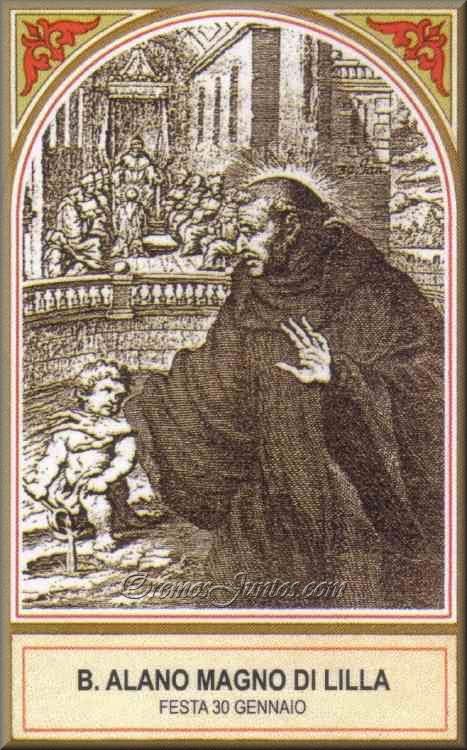
Zwei vielsagende Legenden sind uns von Alanus überliefert. Die erste führt uns in die Zeit, als er noch in Paris lehrte. Hier wollte er eines Tages öffentlich das Mysterium der Trinität darlegen. Als er am Vorabend in tiefer Meditation versunken am Ufer der Seine entlangwandelte, sah er ein Kind, das mit einem kleinen Löffel Wasser aus der Seine in ein kleines Loch schöpfte. Danach gefragt, was es da mache, antwortete das Kind: "Ich will in dieses Loch das ganze Wasser des Flusses schöpfen!" Als Alanus dem Kind vorhielt, dass das völlig unmöglich sei, erwiderte ihm das Kind, dass diese Aufgabe leichter zu bemeistern sei als jene, die sich Alanus für den nächsten Tag vorgenommen habe, nämlich das Geheimnis der Trinität zu erklären! Am nächsten Tag bestieg Alanus den Lehtstuhl, sagte aber nichts weiter als: "Lasset es Euch genügen, den Alanus gesehen zu haben." Dann stieg er herab, zerriss seine Gewänder und ging in das Kloster von Cîteaux.
Alanus are part of the Platonic stream, but he is more, he is creating the synthesis of the Platonic and Aristotelic stream.
Letztere Schrift ist sehr stark von der logisch-argumentativen aristotelischen Denkweise geprägt, wie sie für die späteren Schriften des Alanus typisch ist. Ganz anders seine frühen Schriften, die eine deutliche Abneigung gegen die aristotelische Gedankenart zeigen und ganz aus dem allegorisierenden platonischen Stil geschaffen sind, wie er für die Schule von Chartres typisch war.
Alanus hat also im Laufe seines Lebens eine bedeutsame Wandlung durchgemacht. Ihm war klar, dass sich die ganze Weltanschauung der Menschen ändern und sich zunächst ganz auf den abstrakten Intellekt stützen müsse, ehe man wieder zu einer unmittelbaren spirituellen Erkenntnis zurückkehren könne. Rudolf Steiner spricht darüber in seinen Arnheimer Vorträgen über das Karma der Anthroposophischen Gesellschaft:
"Da sagte Alanus ab Insulis zu einem engen Kreise seiner eingeweihten Schüler: Wir schauen heute die Welt so an, daß wir noch die Mittelpunktstellung der Erde erkennen, daß wir von der Erde aus alles beurteilen. Wenn man mit dieser irdischen Anschauung, die uns zu unseren Bildern, zu unseren Imaginationen befähigt, die folgenden Jahrhunderte allein befruchten würde, dann würde die Menschheit nicht fortschreiten können. Wir müssen ein Bündnis eingehen mit den Aristotelikern, die in die Menschheit den Intellekt hereinbringen, der dann spiritualisiert werden soll und im 20. Jahrhundert in einer neuen spirituellen Weise unter den Menschen aufleuchten soll. Wenn wir jetzt die Erde als den Mittelpunkt des Kosmos anschauen, wenn wir die Planeten als um die Erde kreisend, wenn wir den ganzen Sternenhimmel, wie er sich zunächst auch für das physische Auge darbietet, so beschreiben, als wenn er sich drehen würde um die Erde, so wird aber doch einer kommen und wird sagen: Stellen wir einmal die Sonne räumlich in den Mittelpunkt des Weltensystems! Dann aber, wenn dieser kommt, der die Sonne räumlich in den Mittelpunkt des Weltalls stellt, dann wird die Weltanschauung veröden. Die Menschen werden dann nur noch die Bahnen der Planeten ausrechnen, werden nur noch die Orte der Himmelskörper an-geben. Die Menschen werden von den Himmelskörpern nur sprechen wie von Gasen oder physischen Körpern, die da brennen und brennend leuchten; sie werden nur ganz mathematischmechanisch etwas von dem Sternenhimmel wissen. Aber das, was da als öde Weltanschauung sich ausbreiten wird, das hat doch eines - ein Armseliges , aber eines hat es: Wir schauen von der Erde aus die Welt an; der, der da kommen wird, wird von der Sonne aus die Welt anschauen. Er wird sein wie einer, der nur die "Richtung" angibt, die Richtung auf einen großartig bedeutsamen, mit den wunderbarsten Ereignissen und wunderbarsten Wesenheiten ausgestalteten Weg. Aber er gibt nur die abstrakte Richtung an; damit war auf die kopernikanische Weltanschauung hingedeutet, in ihrer Öde, in ihrer Abstraktheit, aber als Richtung, denn alles das muß zuerst fort, was wir mit unseren Imaginationen vertreten, so sagte Alanus ab Insulis; das muß fort, und gewissermaßen ganz abstrakt muß das Weltbild werden, fast nur wie ein Meilenzeiger auf einem Wege mit wunderbaren Denkmälern. Denn da wird in der geistigen Welt einer sein, der diesen Meilenzeiger, der für die Erneuerung der Welt nichts anderes haben wird als Richtung, nehmen wird, damit er dann, mit dem Intellek-tualismus zusammen, die neue Spiritualität begründen kann, einer, der nichts wird brauchen können als diesen Meilenzeiger. Das aber wird sein, wie Alanus ab Insulis sagte, Sankt Michael! Für ihn muß das Feld frei werden; er muß den Weg mit neuen Saaten besäen. Dazu muß nichts anderes da sein als Linie, mathematische Linie." (Lit.: GA 240, S. 151f)
