By Kim Graae Munch.
June 23, 2008 hrodrigues
In Hindu mythology, the god Indra “is viewed as the king of all the gods to whom most of the Vedic hymns are dedicated” (Jansen 66),
👉and is regarded as the god of the Aryan people.
Indra’s name is unlike most of the other Vedic gods, and does not have any particular connection with a natural phenomenon.
👉For this reason, it is possible that Indra could have been an actual historic figure, a leader of the Aryan people who after the defeat of the indigenous people of India was deified (Embree 17).
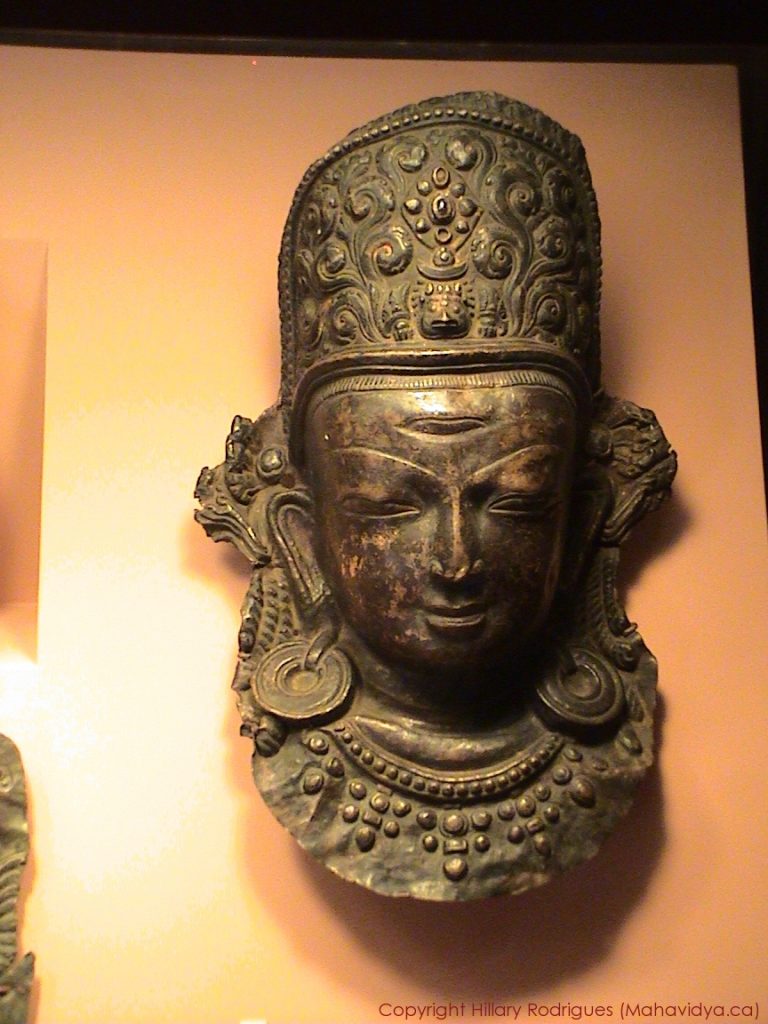
Indra: The Vedic God of Thunder and Lightning with his distinctive horizontal third eye (Bronze masterpiece, Patan Museum, Nepal).
…
👉Indra is viewed as the “personification of the thunderstorm” (Embree 17), with his weapon being a bolt of lightning.
👉He is regarded secondly as the god of battles (the warrior-god), the protector of human beings, whose power and rule are directly connected to the life of mankind (Perry 125).
👉Furthermore, he has come to represent the god cried out to for protection by men rushing into deadly combat (Embree 17). [Sounds very much as the thunder god Thor of the nordic mythology. ]
👉In the Rg Veda, the most important deeds of Indra are celebrated. Among these deeds the most prominent is Indra’s fight against the evil spirits of the air, the demoniac rain stealers who are thought to have stopped the rain from reaching the earth.
👉In the Vedas, Indra is viewed as the unconquerable hero and warrior, who is the defender of Aryan worshippers against their non-Aryan enemies.
👉In India thunderstorms holds high significance, especially in Northern India among the gigantic mountains where rain is eagerly prayed for because of its beneficial effects. Rain/water in the Vedic thought was believed to be the highest heaven, thus signifying the importance of Indra among the Aryan people (Perry 133 – 134). [Water was also connected to the etheric world.]
👉In the Vedas, Indra is closely associated to soma, an intoxicating plant that causes hallucinations. Soma was the primary ingredient used in Vedic rituals, and offerings of soma are often associated with Indra’s character, which is often depicted as a drunken brawler.
👉One of the most important is the story of him slaying Vrtra, a demon, the great enemy, who is often thought of as a dragon (Embree 17 -18, 21).
Vrtra is viewed as the arch-demon among the rain-stealers (Perry 134).
It is said when the earth dried up, Indra was offered the intoxicating soma plant. Under the influence of the plant, Indra fought against the demon drought, Vrtra (Jansen 66).
Vrtra shut off the waters and the sun, imprisoning them in caves in the cloud-mountains. However, “commissioned by the gods to set the waters free” Indra appears on the scene (Perry 134).
After a fierce battle, Indra was able to expel Vrtra with his weapons of thunder (vajra) and lightning. Thus releasing the life-giving forces, and saving the earth and all its inhabitants.
👉From this myth it can also be gathered that Indra has come to represent the force against spirits of darkness. When Indra conquered the rain-hiding demons he also expelled the spirits who concealed the light. The black storm clouds that had once concealed the light of heaven where driven away by Indra, thus the heavenly radiance once again shone on earth (Perry 139). …
👉In epic literature, Indra is not only a god of battles but can also be viewed as a god of fertility, who can bestow children on women (Hopkins 242- 243).
…
The Apala-hymn (RV 8.91.4) suggests another connection between Indra and women. The verse states “(I ask) whether he will be able (to do it), whether he will (really) do it, whether he will make us more happy and prosperous; whether we who are disliked by our husbands will, through Indra, come together with them” (Sohnen 68). This particular verse demonstrates women’s wishes directed to Indra to help them become desirable and attractive to their husbands, to help create bliss between them and their husbands, along with helping them to bear sons by their husband (Sohnen 70).
👉Iconographically, Indra has been represented in various ways. “He is not a giant of the mountains, as represented by some scholars, but rather a cosmic giant” (Hopkins 256).
👉His greatness surpasses that of Varuna (Sky God) and encompasses the earth, the sky and beyond. He is the conception of an all-god, whose rule and will the other gods follow (Hopkins 256).
👉Indra is sometimes viewed riding the “royal elephant, which is often depicted with three trunks and/or four tusks” (Jansen 66).
👉Indra’s attributes include four arms, and he is often presented alongside a bolt of lightning, however, he can also be depicted with a lance, sword, bow and arrow, spear, and a net and conch shell.
👉However, this is not always how Indra is depicted; he can also be represented with two arms, with eyes covering his entire body (Jansen 66).
👉Over time Indra’s position weakened, and he became the “king of only the lesser gods and the lord of heaven (svarga) where the gods dwell” (Jansen 66).
Bibliography
- Embree, Ainslie T (1966) The Hindu Tradition: Readings in Oriental Thought. New York: Random House, Inc.
- Hopkins, E Washburn (1916) “Indra as God of Fertility”. Journal of the American Oriental Society, Vol. 36. Pp. 242 – 268.
- Jansen, Eva Rudy (2004) The Book of Hindu Imagery: The Gods and their Symbols. Holland: Binkey Kok Publications BV.
- Perry, Edward Delavan (1882 – 1885) “Indra in the Rig-Veda”. Journal of the American Oriental Society, Vol. 11. pp. 117-208.
- Rodrigues, Hillary ( 2006) Introducing Hinduism. New York & London: Routledge Taylor & Francis Group.
- Sohnen, Renate (1991) “Indra and Women”. Bulletin of the School of Oriental and African Studies, University of London, Vol. 54, No. 1. pp. 68 – 74.
Related Readings
- Brown, Norman W (1942) “The Creation Myth of the Rig Veda”. Journal of the American Oriental Society, Vol. 62, No. 2. pp. 85 – 98.
- Buck, Harry M (Sep., 1968) “Lord Rama and the Faces of God in India”. Journal of the American Academy of Religion, Vol. 36, No. 3. pp. 229 – 241.
- Chakraborty, Uma (1997) Indra and Other Vedic Deities: A Euhemeristic Study. New Delhi: D.K. Printworld.
- Edgerton, Franklin (1920) “Counter-Rejoinder to Professor Fay”. Journal of the American Oriental Society, Vol. 40. pp. 100 – 102.
- Gonda, J (1967) “The Indra Festival According to the Atharvavedins”. Journal of the American Oriental Society, Vol.87, No. 4. pp. 413 – 429.
- O’Flaherty, Wendy (Jul. – Sep., 1985) “The Case of the Stallion’s Wife: Indra and Vrsanasva in the Rg Veda and the Brahmanas”. Journal of the American Oriental Society, Vol.105, No.3. pp. 485 – 498.
Related Topics for Further Investigation:
- Agni
- Dyaus-pitr
- Rama
- Rg Veda,
- Soma
- Surya
- Varuna
- Vayu
- Vedic rituals
- Vritra
Noteworthy Websites Related to the Topic:
http://hinduwebsite.com/hinduism/vedicgods.asp
http://www.sanatansociety.org/hindu_gods_and_goddesses/indra.htm
http://en.wikipedia.org/wiki/Indra
http://www.marvunapp.com/Appendix4/indrathor.htm
http://www.webonautics.com/mythology/indra.html
http://www.religionfacts.com/hinduism/deities/vedic_gods.htm
http://www.craftsinindia.com/indian-art-culture/indra.html
http://temples.newkerala.com/Temples-of-India/More-Hindu-Gods.html
Article written by Sara Smith (March 2008) who is solely responsible for its content