Kim Graae Munch
Kim Graae Munch
Rudolf Steiner on the Gospel of Mark
I have collected a number of texts from Steiner on the Gospel of Mark that I think are especially interesting and seldom understood and therefore overlooked.
Steiners
text is indented. I have added a few comments in [] in the text or starting in
the left margin with this font [Trebuchet MS,] and I have put frames around
some outstanding sentences. I have
added some illustrations for clarifying or for creating a more visually
appealing layout.
In most english translations they have
translated "Ich" to ego, and it gives problems with other literature, New Age
and Jung, where they use ego as the sentience in the astral body, so I
have substituted "ego" with "I" that have the same meaning as "Ich".
From Gospel of Mark: Lecture 1, 15th September, 1912, Basel
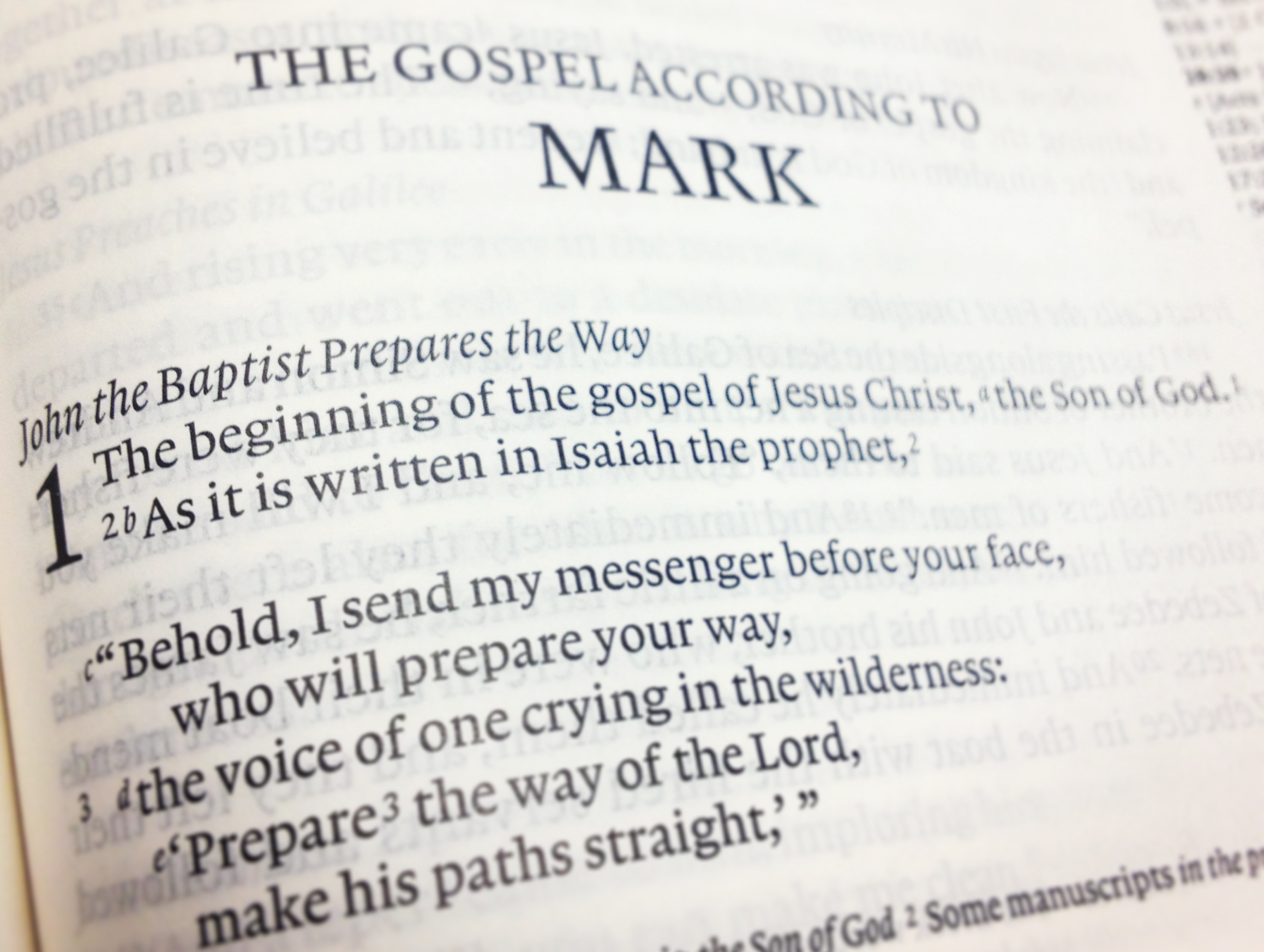
It is well known that the Gospel of St. Mark begins with the words: “This is the beginning of the Gospel of Jesus Christ.”

Let us begin with the question to which the beginning of this Gospel of Saint Mark gives rise, this Gospel which begins with the words, “the beginning of the Gospel of Jesus Christ.” Let us remember that these introductory words are immediately followed not only by a characterization of a passage of the old prophets but by the announcement of Christ by John the Baptist. This proclamation was stated by him in such a way that it may be comprised in these words:
“The time is fulfilled; the kingdom of the divine is extending over the whole earth-existence.”
What does all this mean?
From being outside the bodies of man they enter the inner of man, the soul enters our body. With the death of Jesus dies the gods in the outer and they resurrects in our inner, they enter the inner of the physical world.
I have mentioned two characteristic figures, in both of whom we can perceive that when great men of earlier times reappear in a modern post-Christian age, they are shaken to the very depths of their souls and can only with difficulty adjust themselves to life. Everything that was within them in the past is still within them.
Previously the soul was outside the body, hovered above it, controlled the body like man a dog. After Golgotha the soul entered the body, now the soul was like a rider trying to tame a wild horse, it was a chocking experience. They had become one!
 For example, when we allow Hamlet to work upon us, we feel that the whole force of Hector is in him. But we feel that this force cannot come forth in the post-Christian era, that it then meets with obstacles, that something now works upon the soul that is the beginning of something new, whereas in the figures of antiquity something was coming to an end.
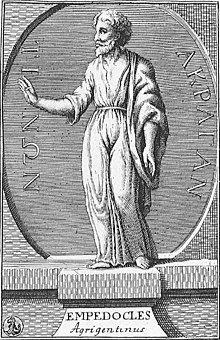
So do these figures stand plastically delineated before us; both Hector and Empedocles represent a conclusion.
But what is working on further in mankind must find new paths into new incarnations. This is revealed with Hector in Hamlet and also with Empedocles in Faust, who had within him all the abysmal urges toward the depths of nature.
Because he had within him the whole nature of Empedocles, he could say, “I will lay aside the Bible for a time and study nature and medicine. I will no longer be a theologian.”
He felt the need to have dealings with demonic beings who made him roam through the world leaving him marveling but uncomprehending. Here the Empedocles element had an after-effect but was not able to adjust itself to what a man must be after the new age had begun.
I wanted to show you through these explanations how in well-known souls, about whom anyone can find information, a powerful transformation shows itself, and how the more deeply we study them the more perceptible this becomes.
If we inquire what happened between the two incarnations of such individualities, the answer always is the Mystery of Golgotha, which was announced by the Baptist when he said, “The time is fulfilled, the kingdoms of the spirit, or the kingdoms of heaven, are passing over into the kingdom of man.”
Yes, the kingdoms of heaven did indeed powerfully seize the human kingdom, but those who take this in an external sense are unable to understand it. They seized it so powerfully that the great men of antiquity, who had been in themselves so solid and compact, had to make a new beginning in human evolution on earth.
This new beginning showed itself precisely with them, and lasted until the end of the old epoch, with the Mystery of Golgotha. At that time something that had been fulfilled ebbed away, something which had presented men in such a way that they appeared as rounded personalities in themselves.
Then came something that made it necessary for these souls to make a new beginning. Everything had to be transformed and altered so that great souls appeared small.
They had to be transformed into the stage of childhood, for something quite new was beginning.
We must inscribe this in our souls if we wish to understand what is meant at the beginning of the Gospel of St. Mark by the words “a beginning.”
Yes, truly a beginning, a beginning that shakes the inmost soul to its foundations and brings a totally new impulse into human evolution, a “beginning of the Gospel.”
 What then is the Gospel? It is something that comes down to us from the kingdoms we have often described, where dwell the higher hierarchical beings, among whom are the angels and archangels.
It descends through the world that rises above the human world. So do we gain an inkling of the deeper meaning of the word Gospel. It is an impulse that descends through the realms of the archangels and angels; it comes down from these kingdoms and enters into mankind.
None of the abstract translations really covers the matter adequately. In reality the word Gospel should indicate that at a certain time something begins to flow in upon the earth which formerly flowed only where there dwell the angels and archangels.
Something descended to earth that shook the souls of men and shook the strongest souls most. It is here noted that this was the beginning, and the beginning has a continuation.
The beginning was made at that time, and we shall see that fundamentally the whole development of humanity since then is a continuation of that beginning when the impulse began to flow down from the kingdom of the angeloi, or what we call the “ev-angel” or Gospel.

From Gospel of Mark: Lecture 2, 16th September, 1912, Basel
It is not perhaps quite accurate, though not far wrong, to say that if we go very far back in evolution, human souls were not yet truly individualized; they were still entangled in the group-soul nature. This was particularly the case with the more prominent among them, so we may say that such natures as Hector or Empedocles were typical group-soul representatives of their entire human community.
These people are the pioneers of humanity. When their souls enter an individual body they can only influence their community through their own example. They are those who was called Giants, just like Gilgamesh and Enkido.
Hector grew out of the soul of Troy. He stands as an image of the group soul of the Trojan people in a particular form, specialized but nevertheless just as rooted in the group soul as Empedocles.
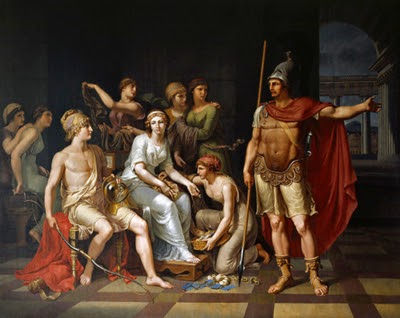 When they were reincarnated in the post-Christian era, they had to face the necessity of experiencing the
I-consciousness. This passing over from the group-soul nature to the experience of the individual soul causes a mighty leap forward.
When they were reincarnated in the post-Christian era, they had to face the necessity of experiencing the
I-consciousness. This passing over from the group-soul nature to the experience of the individual soul causes a mighty leap forward.
It causes souls so firmly embedded in the group-soul nature as Hector to appear like Hamlet, i.e. wavering and uncertain, as though incapable of dealing with life. On the other hand it causes a soul like that of Empedocles, when it reappears in post-Christian times as the soul of the Faust of the sixteenth century, to become a kind of adventurer who is brought into various situations from which he was only with difficulty able to extricate himself, and who is misunderstood by his contemporaries and even by posterity.
See also The Cleavage cannot be healed by todays civilization.
From Gospel of Mark: Lecture 2, 16th September, 1912, Basel
We shall see how from the first day of creation the continuity of progress is under the control of this unitary spirit from the time of the patriarchs through the time of the judges, and through that of the great Jewish prophets and kings until the whole soars to a wonderful dramatic culmination in the book of the Maccabees, in the sons of Mattathias, the brothers of Judas who fought against the king of Antioch.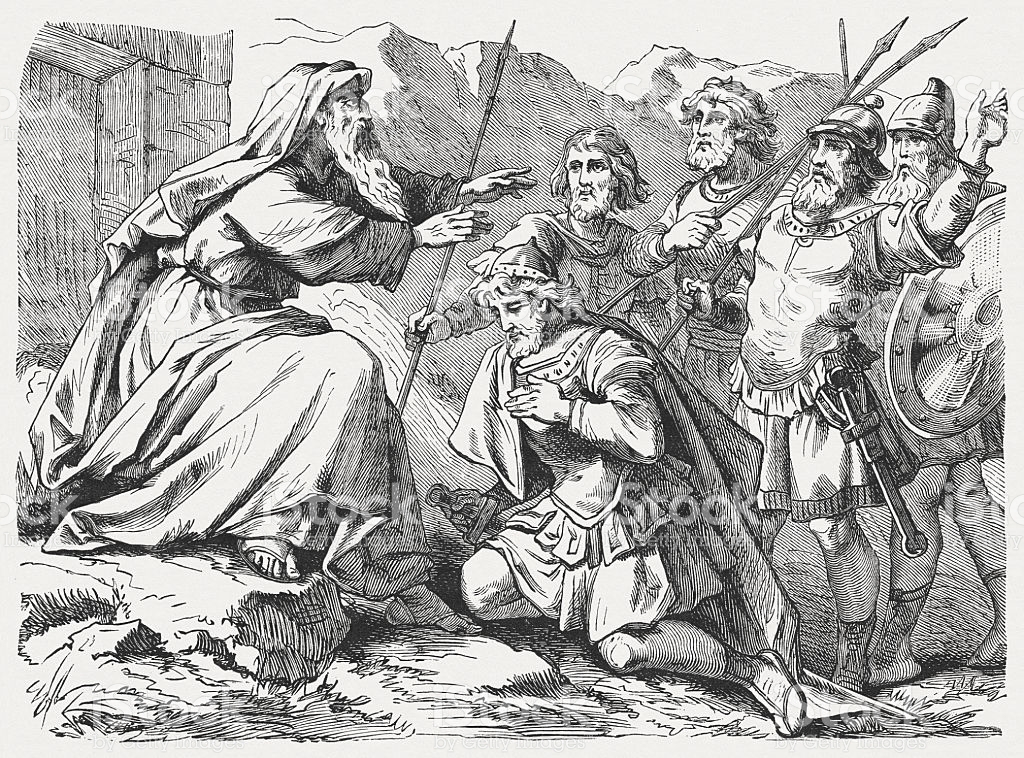
In the whole there lives an inner dramatic force that reaches a certain culminating point at the end. We shall then feel that it is not a mere phrase when we say that a man who is equipped with the occult method of observation is seized by a peculiar feeling when he comes to the end of the Old Testament and has in front of him the seven sons of the Maccabean mother and the five sons of Mattathias.
Five sons of Mattathias, with the seven sons of the Maccabean mother making the remarkable number twelve, a number we notice everywhere when we are led into the secrets of evolution.
Most of you may perhaps remember, for it happened in this very place, that when I gave here the course on St. Luke's Gospel the whole magnificent figure of Christ Jesus sprang forth from the fusion of the two souls, the souls of the two Jesus children.
The soul of the one was none other than the soul of Zarathustra, the founder of Zoroastrianism. You may still have before your spiritual eyes the fact that in the Jesus boy described in the Gospel of St. Matthew is the reincarnated Zarathustra.
What kind of fact do we have here? We have the founder of Zoroastrianism, the great initiate of antiquity, of the primeval Persian civilization, who passed through human evolution up to a certain point and appeared again among the ancient Hebrew people.
Through the soul of Zarathustra, we have a transition from the ancient Persian to the element of the ancient Hebrew people.
Yes indeed, the external, that which takes place in the history of the world and in human life, is really only the manifestation, the externalization of inner spiritual processes and of inner spiritual forces.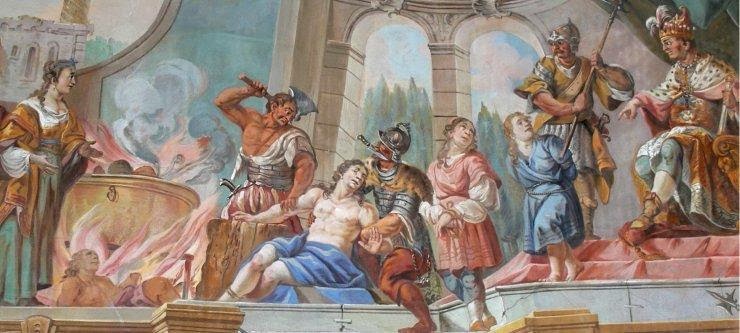
What external history relates can therefore be studied by considering it as an expression of the inward and spiritual, of the facts which move in the spiritual realm.
Let us place before our souls the fact that Zarathustra passed over from Persia into the old Hebrew element. Now let us consider the Old Testament — we really only need to study the headings of the chapters.
That the matter stands with Zarathustra as I then related is the result of clairvoyant research: it results if we follow his soul backward in time. Now let us contrast this result not only with the way the Bible represents it, but also with the results of external investigation.
The ancient Hebrew people founded their kingdom in Palestine. That original kingdom was divided. First it passed into Assyrian captivity, then into the Babylonian. The ancient Hebrew people were subjugated by the Persians.
What does all this mean? World historical facts do indeed have a meaning; they correspond with inner processes, spiritual soul-processes [cosciousness-soul processes?].
Why did all this take place? Why were the ancient Hebrew people guided in such a way that they passed over into the Chaldean, into the Assyrian-Babylonian element, and were set free again by Alexander the Great?
To put it briefly, it is because this was merely the external transition of Zarathustra from the Persian to the Jewish element. The Jews brought him to themselves. They were guided to him, even being subjugated by the Persian element, because Zarathustra wanted to come to them.
External history is a wonderful counterpart of these processes, and anyone who observes these things from the point of view of spiritual science knows that external history was only the body for the transition of the Zarathustra element from the old Persian element, which at first actually included the old Hebrew element.
Then, when the latter had been sufficiently permeated by the Persian element, it was lifted out of it again by Alexander the Great.
What then remained was the milieu necessary for Zarathustra; it had passed over from one people to another.
We find that the souls of the Hebrew prophets are reincarnations of initiates who had lived in other nations, and who had attained certain stages of initiation. When we trace backward one of these prophets, we arrive at some other people and find an initiated soul who remained a long time with this people.
This soul then went through the portal of death and was reincarnated in the Jewish people. If we wish to find the earlier incarnations of the souls of Jeremiah, Isaiah, Daniel, and so on, we must seek them among other peoples.
Trivially speaking, it is as though there were a gradual assembling of the initiates of other peoples among the Jewish people, where these initiates appear in the form of prophets.
This is why these prophets appear in such a way that their gift of prophecy appears to proceed elementally from out of their own inner being.
Thus we see that the Jewish prophets gave their people many spiritual impulses, which are often disarrayed, but nonetheless grandiose recollections of former incarnations. That is the peculiarity to be observed in the Jewish prophets.
Why is this? It is because in fact the whole evolution of humanity had to go through this passageway, so that what was achieved in its parts over the whole world should be brought together in one focal point, to be born again from out of the blood of the people of the Old Testament.
So we find in the history of the old Hebrew people, as in that of no other, something that may be found also in tribes but not in peoples that had already become nations — a state of homogenity, the emphasizing of the descent of the blood through the generations.
All that belongs to the world-historical mission of the Old Testament people depends upon the continuity of the stream of blood through the generations. Hence anyone who had a full right to belong to the Jewish people was always called a “son of Abraham, Isaac, and Jacob,” meaning a son of that element that first appeared in the blood of Abraham, Isaac and Jacob.
It was in the blood that flowed through this people that the elements of initiation of other peoples were to reincarnate. Like rays of light coming from different sides, streaming in and uniting in the center, the incarnating rays of the various peoples were collected together as in one central point in the blood of the old Hebrew people.
The psychical element of human evolution had once to pass through that experience. It is extremely important to keep these occult facts in mind, for only thus can we understand how such a Gospel as that of St. Mark is from its beginning based upon the element of the Old Testament.
But if we now take the whole dramatic progress of the Old Testament into consideration, we shall see how the thought of immortality is gradually developed in the Old Testament through the taking up of the initiation elements of the different peoples and how it appears at its very summit precisely in the sons of the Maccabees.
But we must now allow this to influence our souls in its full original significance, enabling us to envision the consciousness man then had of his connection with the spiritual world.
I wish to draw your attention to one thing. Try to follow up the passages in the Old Testament where reference is made to the divine element shining into human life. How often it is related, for example in the Book of Tobit (Tobit, Chapter 5), when something or other is about to happen — as when Tobit sends his son to carry out some business or other — the archangel Raphael appears to him in an apparently human form. In another passage other beings of the higher hierarchies appear. [Like the blue beings of India.]
But as we proceed, we observe a great dramatic progression, finally reaching the culminating point of that progression in the martyrdom of the seven sons of the Maccabees who speak out of their souls of a uniting, a reawakening of their souls in the divine element.
The inner certainty of soul about their own inner immortality meets us in the sons of the Maccabees and also in Judas and his brothers who were to defend their people against the king of Antioch.
There is an increased inner understanding of the divine spiritual element, and the dramatic progress becomes ever greater as we follow the Old Testament from the appearance of God to Moses in the burning bush, in which we see God approaching man externally, to the inner certitude springing up in the souls of the sons of the Maccabees, who are convinced that if they die here they will be reawakened in the kingdom of their God through what lives within them.
From a state of passivity toward the God Yahweh or Jehovah, there gradually comes into being an active inner consciousness of the soul about its own nature. This increases page by page all through the Old Testament, though it was only by slow degrees that during its progress the thought of immortality was born.
Strange to say, the same progress may also be observed in the succession of the prophets. Just observe how the stories and predictions of each successive prophet become more and more spiritual; here again we find the dramatic element of a wonderful intensification.
The further we go back into the past, the more do the stories told relate to the external. The more we advance in time, the more we discover the inner force, the inner certainty and feeling of unity with the divine spiritual, referred to also by the prophets.
Thus there is a continual enhancement until the Old Testament leads on to the beginning of the story of the New Testament, and the Gospel of St. Mark is directly linked with all this.
For at the very beginning, the Gospel tells us that it intends to interpret the event of Christ Jesus entirely in the sense of the old prophets, so that it is possible to understand the appearance of Christ Jesus by keeping before us the words of Malachi and Isaiah respectively,
“Behold I send my messenger before you who is to prepare the way. Hear how there is a cry in the wilderness, ‘Prepare the way of the Lord and make his paths level.’ ”
Thus there is a prevailing tone running through the history of the Old Testament pointing to the appearance of Christ Jesus. It is further related in St. Mark's Gospel — indeed we may distinctly hear it in the words if we so desire. In the same way that the ancient prophets spoke, so essentially does the Baptist speak.
How comprehensive and grandiose is this figure of the Baptist if we interpret him in the way the ancient prophets spoke of a divine messenger, of one who in the solitude would show the path that Christ Jesus had to pursue in cosmic evolution.
Mark's Gospel then goes on to say, “Thus does John the Baptist appear in the solitude and proclaim baptism for the recognition of human sinfulness.” For in this way should the words rightly be translated.
So it is said, “Direct your gaze to the old prophetic nature, which has now entered into a new relation with the Divinity and experienced a new belief in immortality. And then behold the figure of the Baptist, how he appeared and spoke of the kind of development through which we may recognize the sinfulness of man.”
Thus is the Baptist directly referred to as a great figure.
But how about the wonderful figure of Christ Jesus Himself? Nowhere else in the world is He presented in so simple and at the same time so grand and dramatic an ascending gradation as in Mark's Gospel. Direct your spiritual gaze at this in the right way.
What are we told at the beginning of the Gospel? We are particularly told to turn our attention to the figure of the Baptist. You can understand him only when you take into account the Jewish prophets, whose voice has become alive in him. The whole Jewish nation went up to be baptized by him.
This means that there were many among them who recognized that the old prophets spoke through John the Baptist. That is stated at the beginning of the Gospel. We see John standing before us, we hear the voice of the old prophets coming to life in him, and we see the people going out to him and recognizing him as a prophet come to life again.
Let us confine ourselves for the moment to the Mark Gospel. Now the figure of Christ Jesus Himself appears. Let us now also leave out of account the so-called baptism in the Jordan, and what happens after that, including the temptation, and fix our attention on the dramatic intensification we meet with in the Mark Gospel.
A man must first become accustomed to being a specific individuality. This he cannot easily do when he is transferred from the element of the nation in which his soul had taken root into a condition of being dependent upon himself alone. The Twelve were deeply rooted in a nationality which had constituted itself in the grandest form.
They stood there as if they were naked souls, simple souls, when Christ found them again. There had been a quite abnormal interval between their incarnations.
The gaze of Christ Jesus could rest upon the Twelve, the reincarnated souls of those who had been the seven sons of the Maccabean and the five sons of Mattathias, Judas and his brothers; it was of these that the apostolate was formed. They were thrown into the element of fishermen and simple folk.
But at a time when the Jewish element had reached its culminating point they had been permeated by the consciousness that this element was then at the peak of its strength, but strength only — whereas, when the group formed itself around Christ, this element appeared in individualized form.
We might conceive that someone who was a complete unbeliever might look upon the appearance of the seven and the five at the end of the Old Testament, and their reappearance at the beginning of the New Testament, as nothing but an artistic progression. If we take it as a purely artistic composition, we may be moved by its simplicity and the artistic greatness of the Bible, quite apart from the fact that the Twelve are the five sons of Mattathias and the seven sons of the Maccabean mother.
And we must learn to take the Bible also as a work of art. Then only shall we develop a feeling for the artistic element in it, and acquire a feeling for the realities from which it springs.
Now perhaps your attention may be called to something else. Among the five sons of Mattathias is one who is already called Judas [Judah in Hebrew] in the Old Testament. He was the one who at that time fought more bravely than all the others for his own people. In his whole soul he was dedicated to his people, and it was he who was successful in forming an alliance with the Romans against King Antiochus of Syria (I Maccabees, Chap. 8).
This Judas is the same who later had to undergo the test of the betrayal, because he who was most intimately bound up with the old specifically Hebrew element, could not at once find the transition into the Christian element, needing the severe testing of the betrayal.
Again, if we look at the purely artistic aspect, how wonderfully do the two figures stand out: the grand figure of the Judas in the last chapters of the Old Testament and the Judas of the New Testament. It is remarkable that in this symptomatic process, the Judas of the Old Testament concluded an alliance with the Romans, prefiguring all that happened later, namely the path that Christianity took through the Roman Empire, so that it could enter into the world.
If I could add to this something that can also be known but that cannot be given in a lecture to an audience as large as this, you would see that it was precisely through a later reincarnation of Judas that the fusion of the Roman with the Christian element occurred.
The reincarnated Judas was the first who, as we might say, had the great success of spreading Romanized Christianity in the world. The treaty concluded by the Judas of the Old Testament with the Romans was the prophetic foreshadowing of what was later accomplished by another man, who is recognized by occultists as the reincarnation of that Judas who had to go through the severe soul-testing of the betrayal.
What through his later influence appears as Christianity within Romanism and Romanism within Christianity is like a renewal of the alliance concluded between the Old Testament Judas and the Romans, but transferred into the spiritual.
From Gospel of Mark: Lecture 3, 17th September, 1912, Basel
We read in the Bible that Elijah challenged all the followers and peoples of King Ahab among whom he lived, and how he pitted himself against his opponents, the priests of Baal, setting up two altars and causing them to lay their sacrifice on one of them while he laid his own sacrifice on the other.
He then showed the triviality of what his opponents had said about the priests of Baal because no spiritual greatness was manifested by the god Baal, whereas the greatness and significance of Yahweh or Jehovah appears at once in the case of the sacrifice of Elijah.
This was a victory won by Elijah over the followers of Ahab. Then in a remarkable way we are told that Ahab had a neighbor called Naboth who was the owner of a vineyard.
Ahab coveted this vineyard, but Naboth would not sell it to him because he regarded it as sacred since it was an inheritance from his father.
The Bible then tells us of two facts. On the one side Jezebel, the Queen, was an enemy of Elijah and proclaims that she will have him put to death in the same way as his opponents, the priests of Baal, were put to death because of his victory at the altar. But according to the biblical account, Elijah's death was not brought about through Jezebel. Something else took place. Naboth, the king's neighbor, was summoned to a kind of penitential feast, to which other important persons of the state were also called, and on the occasion of this feast of penitence, he was murdered at the instigation of Jezebel (I Kings 21).
Now we might say that the Bible seems to relate that Naboth was murdered at the urging of Jezebel. Yet Jezebel does not announce that she intends to murder Naboth but rather Elijah.
There is an evident discrepancy in the story. Now occult research begins and shows us the real facts in the case, that Elijah was a great spirit who roamed invisibly through the land of Ahab. But at times he entered into and penetrated the soul of Naboth [a Bodhisattva.]
So Naboth is the physical personality of Elijah; when we speak of the personage of Naboth, we are speaking of the physical personage of Elijah. In the biblical sense, Elijah is the invisible figure, and Naboth his visible image in the physical world. All this I have shown in detail in my lecture entitled, “The Prophet Elijah in the Light of Spiritual Science.”
But if we wish to consider the whole spirit of Elijah's work, and the whole spirit of Elijah as it is presented in the Bible, and allow it to influence our souls, we may say that in Elijah we are confronted by the spirit of the whole ancient Hebrew people.
All that lives and is interwoven in this people is encompassed within the spirit of Elijah. We may refer to him as the folk spirit of the ancient Hebrew folk. Spiritual science shows him to have been too great to dwell altogether in the soul of his earthly form, in the soul of Naboth.
He hovered over him like a cloud; and he not only lived in Naboth but went around the whole country like an element of nature, active in rain and sunshine. This is revealed ever more clearly the more we go into the whole narrative, which begins by saying that drought and barrenness prevailed, but that through Elijah's relationship to the divine spiritual worlds the drought was ended and the needs of the land at that time were fulfilled. He worked as an element of nature, a law of nature itself.
We could say that the best way to learn to recognize what worked in the soul of Elijah is to let the 104th Psalm influence us, with its description of how Yahweh or Jehovah works in all things as a nature-divinity.
Of course Elijah is not to be identified with this divinity itself; he is the earthly image of that divinity, an earthly image which is at the same time the folk soul of the Hebrew people. [Adam, the sister soul to Krishna.]
Elijah was a kind of differentiation of Jehovah, an earthly Jehovah, or, as he is described in the Old Testament, the “countenance” of Jehovah.
If we look at it in this way, the fact becomes especially clear that the same spirit that lived in Elijah-Naboth now reappears as John the Baptist. How does he work in John?
According to the Bible, and especially as is shown in the Gospel of St. Mark, he works through what is called baptism. What in reality is baptism? Why was it administered by John the Baptist to those who allowed themselves to be baptized?
Here we must examine what was the actual effect of baptism on those who were baptized. The candidates were immersed in water. Then there always followed what has often been described as happening when a man receives the shock of being threatened by death, for example by falling into the water and nearly drowning, or by nearly falling over a precipice.
A loosening of the etheric body takes place; it partly leaves the physical body. As a consequence, something happens that always happens immediately after death, i.e., a kind of retrospect of the past life. That is a well known fact and has often been described even by the materialistic thinkers of the present time.
Something similar took place during the baptism by John in the Jordan. The people were plunged into the water. This baptism was not like the usual baptism of today. The baptism of John caused the etheric bodies of the candidates to be loosened and they saw more than they could comprehend with their ordinary powers of understanding.
They saw their life in the spirit and the influence of the spirit on this life. They saw also what the Baptist taught, that the old age was fulfilled and that a new age must begin. In the clairvoyant observation that was possible for them for a few seconds during the baptismal immersion they saw that mankind had come to a turning point in evolution, and that what humanity had possessed in former times when it was in a group-soul condition was now in the process of completely dying out; quite new conditions had to come in, and they saw this while in their liberated etheric body.
A new impulse, new capacities, must come to humanity. The baptism of John was therefore a question of knowledge. “Transform your minds, but don't merely turn your gaze backwards as would still be possible. Turn your gaze now to something else, to the God who manifests in the human `I.' The kingdoms of the divine have approached you.”
The Baptist did not only preach that; he made it manifest to them by bestowing the baptism on them in the Jordan. Those who had been baptized knew then as a result of their own clairvoyant observation, even though it lasted but a short time, that the words of the Baptist expressed a world-historical fact.
Only when we consider this connection does the spirit of Elijah, which also worked in John the Baptist, appear to us in the right light. Then we see that Elijah was the spirit of the old Jewish people. What kind of spirit was this?
In a certain respect it was already the spirit of the “I.” However, it does not appear as the spirit of the individual human being but as the collective folk spirit of the whole people. That which later was to live in each individual man was, so to speak, still in Elijah the group soul of the ancient Hebrew people.
That which was to descend as the individual soul into every individual human breast was at the beginning of the Johannine age still in the super-sensible world. It was not yet in every human breast, and it could not yet live in this way in Elijah. So it entered into the individual personality of Naboth but only by hovering over it.
Yet in Elijah-Naboth it manifested itself more distinctly than it did in the individual members of the ancient Hebrew people. This spirit, hovering, as it were, over man and man's history, was now about to enter more and more into every bosom.
This was the great fact now proclaimed by Elijah-John himself when he said, as he baptized the people, something like the following, “What until now was in the super-sensible worlds and worked from these worlds you must now take into your souls as impulses that have come from the kingdom of heaven right into the hearts of men.”
The spirit of Elijah itself shows how in multiplied form it must enter human hearts, so that in the further course of world history they may gradually take up ever more and more of the Christ Impulse.
The meaning of the baptism by John was that Elijah was ready to prepare the way for the Christ. This was contained in the deed of the baptism by John in the Jordan, “I will make a place for Him; I will prepare the way for Him into the hearts of men. I will no longer merely hover over men, but will enter into human hearts, so that He also can enter in.”
If this is so, what may we then expect? If it is so, there is nothing more natural than to expect something to come to light in John the Baptist that we have already observed in Elijah.
It becomes clear how in this grand figure of the Baptist there is not only his individual personality at work, but something more than a personality, which hovers over the individuality like an aura but has an efficacy that transcends it, something alive like an atmosphere among those within whom the Baptist is working.
Just as Elijah was active like an atmosphere, so we may expect that as John the Baptist he would again be active like an atmosphere.
Indeed, we may expect something further, that this spiritual being of Elijah, now united with John the Baptist, would continue to work on spiritually even if the Baptist were no longer there, if he were away.
What does this spiritual being desire? It wishes to prepare the way for the Christ! We can also say that the physical personality of the Baptist may perhaps have left, but his spiritual being like a spiritual atmosphere may remain in the region where he was formerly active, and this spiritual atmosphere actually prepares the very ground on which the Christ could now perform His deed.
This is what indeed we might expect. It could perhaps be best expressed if we were to say, “John the Baptist has gone away but what he is as the Elijah-spirit remains, and in this Christ can work best. Here He can best pour forth His words, and in that atmosphere that has remained behind, the Elijah-atmosphere, He can best perform His deeds.” That we can expect. And what does Mark's Gospel tell us?
It is very characteristic that twice allusion is made in the Mark Gospel to what I have just indicated. The first time it is said that “immediately after the arrest of John, Jesus came to Galilee and there proclaimed the teaching of the kingdoms of the heavens.” (Mark 1:14.)
John therefore was arrested, that is to say, his physical personality was then prevented from working actively. But the figure of Christ Jesus entered into the atmosphere created by him. And it is significant that the same thing occurs a second time in the Mark Gospel, and it is a grandiose fact that it should occur a second time.
We must only read the Gospel in the right way. If we pass on to the sixth chapter we hear fully described how King Herod had John the Baptist beheaded. But it is strange how many assumptions were made, not only after the physical personality of John had been arrested, but when he had been removed through death. To some it seemed that the miraculous forces through which Christ Jesus Himself worked were due to the fact that Christ Jesus Himself was Elijah, or one of the prophets.
But the tortured conscience of Herod arouses a strange foreboding in him. When he hears all that has occurred through Christ Jesus he says, “John, whom I beheaded, has been restored to life!” Herod feels that, though the physical personality of John had gone away, he is now all the more present! He feels that his atmosphere, his spirituality — which was none other than the spirituality of Elijah, is still there. His tormented conscience causes him to be aware that John the Baptist, that is, Elijah, is still there.
But then something strange happens. We are shown how, after John the Baptist had met his physical death, Christ Jesus came to the very neighborhood where John had worked. I want you to take particular notice of a remarkable passage and not to skim over it lightly, for the words of the Gospels are not written for rhetorical effect, nor journalistically. Something very significant is said here.
Jesus Christ appears among the throng of followers and disciples of John the Baptist, and this fact is expressed in a sentence to which we must give careful attention: “And as Jesus came out He saw a great crowd,” by which could be meant only the disciples of John, “and He had compassion on them ...” (Mark 6:34.)
Why compassion? Because they had lost their master, they were there without John, whose headless corpse we are told had been carried to his grave. But even more precisely is it said, “for they were like sheep who had lost their shepherd. And He began to teach them many things.” It cannot be indicated any more clearly how He teaches John's disciples.
He teaches them because the spirit of Elijah, which is at the same time the spirit of John the Baptist, is still active among them. Thus it is again indicated with dramatic power in these significant passages of the Mark Gospel how the spirit of Christ Jesus entered into what had been prepared by the spirit of Elijah-John. Even so this is only one of the main points, around which many other significant things are grouped.
Now it is very remarkable how the Baptist himself is again introduced into the work of Christ Jesus. On two occasions it is indicated to us that Christ Jesus really entered the aura of the Baptist just when the physical personage was withdrawing more and more into the background, finally leaving the physical plane altogether.
But it is shown in very clear words precisely through the very simplicity of the Mark Gospel how through the entry of Christ Jesus into the element of Elijah-John a wholly new impulse enters the world. In order to understand this we must envisage the whole description given in the Gospel from the moment when Christ Jesus appears after the arrest of John the Baptist and speaks of the divine kingdom, to the passage where the murder of John by Herod is related, and continue on with the subsequent chapters. If we take all these stories down to the story of Herod and consider them in their true character we find that the intention of all of them is to reveal in a correct manner the qualities that are characteristic of Christ Jesus. Yesterday we spoke of His characteristic way of acting so that He is recognized also by the spirits which live in those possessed by demons. In other words, He is recognized by super-sensible beings and this is presented to us in a sharply accentuated manner.
And then we are faced with the fact that that which lives in Christ Jesus is something in reality quite different from what dwelt in ElijahNaboth for the reason that the spirit of Elijah could not wholly enter into Naboth. The purpose of the Gospel of St. Mark is to show us that the being of Christ entered fully into Jesus of Nazareth and entirely filled his earthly personality.
What we recognize as the universal human 'I' was working in Him. What then is so terrible to the demons who were in possession of human beings when they were confronted by Christ Jesus? The devils are compelled to say to Him, “You are He who bears the God within You.” They recognize Him as a divine power in the human personality, thus compelling the demons to allow themselves to be recognized and to come forth from the human beings who were possessed through the power of what lives in the individual personality of man (Mark 1:24; 3:11; 5:7).
This is why in the early chapters of the Mark Gospel the figure of Christ is worked out so carefully, making Him in a certain way a contrast to ElijahNaboth, and also to Elijah-John. For whereas that which was active in them could not wholly live in them, this activating quality was wholly contained within Christ Jesus. For this reason, although a cosmic principle lives in Him, Christ Jesus as an individual personality confronts other human beings quite individually, including those whom He heals.
From Gospel of Mark: Lecture 4, 18th September, 1912, Basel
In the fifth century B.C. ... We see Socrates in ancient Greece gathering pupils around himself, and indeed we need to mention Socrates in this connection even if we only consider the picture drawn of Socrates by the great philosopher Plato, a picture which in its essentials seems to be confirmed by the great philosopher Aristotle.
If we consider the striking picture of Socrates as presented by Plato, then we can also say that a movement began with Socrates that then spread into the West.
Anyone who visualizes the whole character of Western cultural development is bound to conclude that the Socratic element was a determining factor for everything in the West.
Although the Socratic element in the West spreads through the waves of world history more subtly than the Buddhistic element in the East, we are still entitled to draw a parallel between Socrates and the Buddha.
If we visualize these two figures, the Buddha and Socrates, they will seem to us like two different, polar opposite configurations of the evolutionary streams of mankind. And when we now link these two within a higher unity as we have done, we may add to them a third in whom we also have to do with a great individuality around whom gather pupils and disciples — Christ Jesus.
And what was the clearest, the most striking and concise expression of this relationship? It is when the Christ — and this is indicated on several occasions — faced the crowd that wished to hear Him. He speaks to this crowd in parables and imagery.
Then it is said that when He was alone with his disciples He interpreted this imagery to them.
If we wish to understand the reason for this we must recognize clearly in our souls that the whole turning point of evolution had been reached at the time of the Mystery of Golgotha. The end of the period during which clairvoyance was the common possession of humanity was approaching.
The further we go back in human evolution the more was the ancient clairvoyance that enabled men to see into the spiritual worlds the common possession of all mankind. How did they see into these worlds? Their vision took the form of perceiving the secrets of the cosmos in pictures, which were either conscious or unconscious imaginations. It was a dreamlike clairvoyance in the form of dreamlike imaginations, not in the rational concepts that people today make use of in the pursuit of knowledge.
Our dreams today is like these pictures.
Both science and popular thinking which today make use of prosaic reasoning power and judgment were absent in those ancient times. In confronting the external world men did indeed see it, but they did not analyze it conceptually. They possessed no logic, nor did they make deductions in their thinking.
Who, then, were His intimate disciples? We have heard how the Twelve consisted of the seven sons of the Maccabean mother and the five sons of Mattathias. We have heard how throughout the whole history of the Hebrew people they had advanced to the point where they could vigorously assert their immortal 'I'. They were indeed the first whom Christ Jesus could choose Himself, appealing to that which lives in every human soul, living in it in such a way that it can become the new starting point for human development.
When Christ spoke to His intimate pupils about spiritual matters He did so in a Socratic manner.
When the Buddha spoke to his disciples and expounded spiritual matters he showed how this was possible through illumination and through the sojourn of the human soul in the spiritual world.
When Christ spoke to the crowd He spoke of the higher worlds in the way in which they formerly were experienced by ordinary human souls. He spoke to the crowd, as one might say, like a popular Buddha; to His intimate disciples He spoke like a higher Socrates, a spiritualized Socrates.
Socrates drew forth from the souls of his pupils the individual earthly reason, whereas Christ drew forth heavenly reason from the souls of His disciples. The Buddha gave heavenly enlightenment to his pupils; Christ in His parables gave earthly enlightenment to the crowd.
I would ask you to give thought to these three pictures: Over there in the land of the Ganges there is the Buddha with his pupils — the antithesis of Socrates; over there in Greece is Socrates with his pupils — the antithesis of the Buddha. And then four or five centuries later there is this remarkable synthesis, this remarkable combination.
In what cultural epoch do Socrates and the Buddha live? They live in the epoch of the intellectual soul; both have their task and their mission in that epoch.
The Buddha has the task of preserving the culture of the sentient soul from the previous, the third epoch, into the fourth.
What the Buddha announces and his pupils take up into their hearts, is something destined to shine over from the third post-Atlantean period — the period of the sentient soul — into the era of the intellectual soul. In this way the era of the intellectual soul, the fourth post-Atlantean cultural period, could be warmed through by the glow and the light of the teachings of Buddha, by what was brought forth by the sentient soul, permeated as it was by clairvoyance.
Socrates in the same way stands in the midst of the era of the intellectual soul. His appeal is made to the single human individuality, to something that can truly emerge only in our fifth cultural age.
It was his [Socrates] task to foreshadow, though in a still abstract form, the era of the consciousness soul in the era of the intellectual soul.
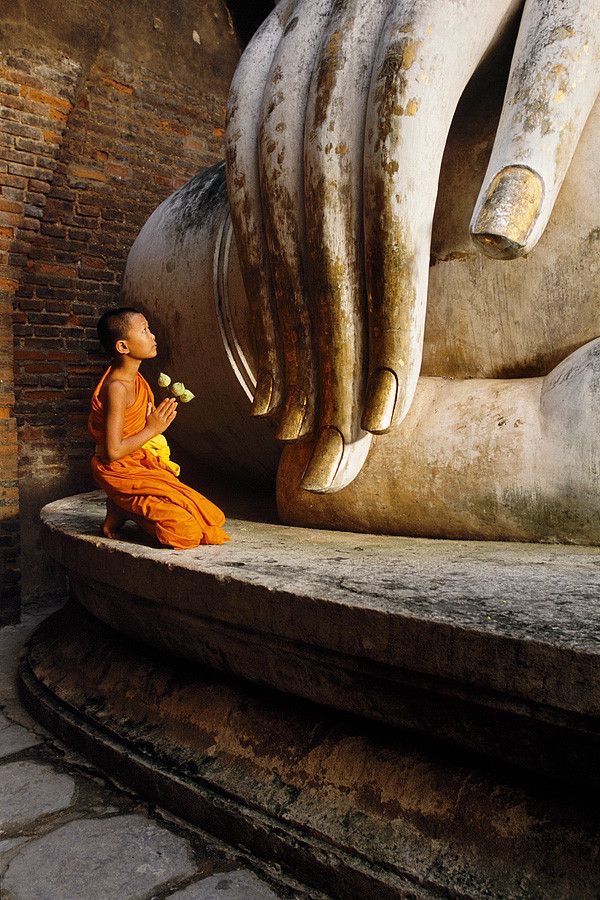 The Buddha preserves what came from the past, so that his message appears like a warming, shining light. Socrates anticipates what in his own time lies in the future, the characteristics of the consciousness soul era.
So in his age it seemed to be somewhat prosaic, merely rational, even arid. Thus the third, fourth and fifth cultural epochs are telescoped in the fourth. The third is preserved by the Buddha, the fifth is anticipated by Socrates. West and East have the task of pointing up these two different missions — the East preserving the greatness of the past, while the West in an earlier era is anticipating what is to appear in a later one.
From the very ancient times in human evolution when the Buddha appeared time and again as the Boddhisattva, there is a straight path until the time when the Bodhisattva ascended to Buddhahood. There is a great and continuous development that comes to an end with the Buddha, and this really is an end because the Buddha undergoes his last incarnation on earth and never again descends to it. It was a great age that came to an end then, since it brought over from very ancient epochs what constituted the culture of the sentient soul of the third post-Atlantean cultural era and let it shine out again.
If now we consider Socrates as he was, without all the wealth of material provided by the discoveries of natural science and the humanities since his day, and observe how he approaches the things of everyday life, we shall see how a man of the present time, when fortified by all the material of natural science, will find everywhere the Socratic method active in it. We expect it and need it. So we have a clear line beginning with Socrates and continuing into our own era, and this will grow ever more perfect in the future.
Thus there is one stream of human development that goes as far as the Buddha and ends with him; and there is another stream that begins with Socrates and goes on into the distant future.
Socrates and the Buddha stand next to one another like the nuclei of two comets, if I may be allowed such an image. In the case of the Buddha, the light-filled comet's tail encircles the nucleus and points far back into the indeterminate perspectives of the past; in the case of Socrates the comet's tail of light encircles the nucleus in the same way but points far, far into the indeterminate distances of the future.
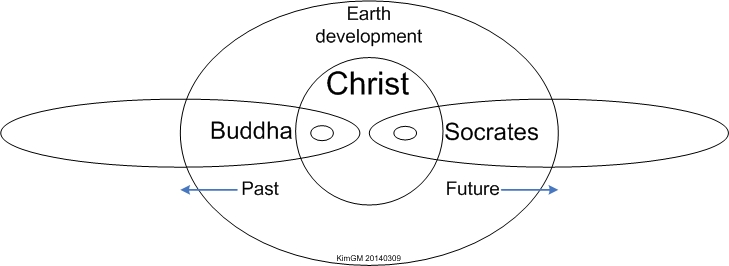
Two diverging comets going in succession in opposite directions whose nuclei shine at the same time, this is the image I should like to use to illustrate how Socrates and the Buddha stand side by side.
Half a millennium passes, and something like a uniting of these two streams comes into being through Christ Jesus.
Steiner have written extensively on Krishna in connection with hist commentaries on the Gospel of Saint John. I have a short text with central quotes of Steiner here The Humble Man of Nazareth and a larger with longer texts from Steiner and a few others on Saint John's Gospel: The Word was a God.
From Gospel of Mark: Lecture 5, 19th September, 1912, Basel
We can see even more clearly how far the Buddha represented the great conclusion of one cosmic stream when we place before our minds his great predecessor who recedes far back into the twilight of human evolution: Krishna, who in quite a different sense appears to us as the final moment of a revelation thousands of years old.
Krishna can be placed several centuries before the Buddha, but that is not the issue here. The main point is that the more we allow the being of Krishna and the being of the Buddha to affect us, the more clearly do we recognize that in Krishna what was later to be proclaimed by the Buddha appears in an even brighter light, whereas with Buddha, as we wish to demonstrate in a moment, in a certain way it comes to an end.
We may say of the revelation of Krishna that it is in a certain sense an occult teaching. Why occult? It is occult for the simple reason that few people can achieve the inner capacity to ascend to those spiritual heights where understanding can be gained.
There is no need to keep secret what Krishna revealed in an external way, to lock it up in a safe, so that it stays “occult”; it remains occult for no other reason than that too few people rise to the heights to which they must rise if they are to understand it.
Earlier I said that there is just one thing that can be compared with the teaching of Krishna, and indeed what we associate with the name “Krishna” can be compared with what may remind us of three later names which are in a certain sense closely connected with us — though in the case of these three the method, conceptual and philosophical, is quite different. I am referring to everything that in recent years has been linked to the names of Fichte, Schelling and Hegel, and the teachings of these men have a slight resemblance to other ”occult teachings” of mankind.
What shines out towards us from the East from Krishna appears again in Fichte, Schelling and Hegel in an abstract conceptual way, and it is not easy to notice the similarity; indeed, it requires a special constitution of soul to be able to do so.
And of what nature are the conceptual heights to which this very ancient, this ether-like, light-like wisdom aspires?
Today people believe they are able to think with great subtlety. But when we see how people jumble up everything in a higgledy-piggledy way as soon as they try to explain something, then we lose all respect for the thinking of today, especially for its logical thinking.
If we look back to the ancient Indian civilization, the first post-Atlantean cultural period, we may say that no records are extant from this epoch, for at that time men still could see into the spiritual world. Only through the Akasha Chronicle can there be rediscovered what was then revealed to mankind. It was a lofty revelation.
But then mankind sank down lower and lower. In the old Persian epoch, the second post-Atlantean cultural period, though the revelations still continued they had lost their original purity.
They were still less pure in the third cultural period, that of ancient Egypt. If we wish to visualize what were the real conditions of the time we must bear in mind that as far as the first cultural epochs are concerned no records exist, and this is true for all the peoples of that age, whether or not a cultural epoch has been called after them.
?
If we speak of the ancient Indian culture we are referring to a culture from which nothing has come down to us in writing. It is just the same with the primeval Persian culture. Written records exist only from the Egyptian-Babylonian-Chaldean culture, which belongs to the third cultural period.
But during the period of the unfolding of the primeval Persian culture within Indian culture there was a second Indian period, running parallel to the old Persian. And yet a third period began in India contemporary with the Egyptian-BabylonianChaldean culture, and it was during this period that the first written records began to be kept.
These first records date from the latter part of this third culture. Such records are, for example, those contained in the Vedas, which then penetrated into external life. It is these records which also speak of Krishna.
These are the records assembled around the person of Krishna. Thus ancient India tells us something that can be externally investigated. If we examine things fundamentally, everything agrees with what can be discovered in the external documents. As the third world age came to an end and men lost what they had originally possessed, Krishna appeared on the scene to preserve what otherwise would have been lost.
When the old clairvoyance and all its treasures were on the point of being lost, then Krishna appeared and revealed them so that they could be preserved into later times.
And the more you go into what has been given out over the years, the more you will see that it is in complete agreement with all the documents of the Orient.
So Krishna stands there as a conclusion. Then, a few centuries later, comes the Buddha. In what sense is the Buddha, if we may so express it, the other pole of this conclusion? In what relation does the Buddha stand to Krishna?
This wisdom is expressed in great powerful words in Krishna's revelations. If we immerse ourselves in the Vedas, in all that we can sum up in conclusion as the revelation of Krishna, then we may say that this is the world in which man is at home, the world which lies behind what our eyes can see, our ears hear, our hands grasp, and so on. Yes, the human soul belongs to the world revealed by Krishna.
How could the human soul itself feel in the course of subsequent centuries? It could perceive how these marvelous revelations of an older time spoke about the true, spiritual, celestial home of mankind. It could then look into all that surrounded it. It saw with eyes, heard with ears, grasped things with the sense of touch; it could think with the intellect about things, the intellect that never penetrates into the spiritual element proclaimed in the revelation of Krishna.
And the soul could say to itself, “There is an ancient holy teaching from times past which tells of a world, our spiritual home which lies all around us, around that world which is all that we now recognize. We no longer live in that spiritual home; we have been expelled from that world of which Krishna spoke so magnificently.”
Then comes the Buddha. How does he speak of the marvels of the world spoken of by Krishna to human souls which could perceive only what eyes can see and ears hear? He says, “Certainly you live in the world of the senses. The yearning that drives you from incarnation to incarnation has led you into this world. But I am telling you of that path which can lead you out of this world and into that world of which Krishna spoke. I am telling you about the path through which you will be redeemed from the world that is not the world of Krishna.” Buddha's teaching in these later centuries resounds like a kind of nostalgia for the world of Krishna.
In this respect the Buddha seems to us like the last successor of Krishna, as Krishna's successor who had to come. And if the Buddha himself had spoken of Krishna, how would he have been able to speak about him? He would have said something like this:
“I have come to proclaim to you again the greater one who was my predecessor. Turn your mind backward to the Krishna who was greater than I, and you will see what you can attain if you leave this world which is not your true spiritual home. I will show you the path by which you can redeem yourselves from the world of sense. I lead you back to Krishna.”
The Buddha could have spoken in this way, but he did not use these exact words. Nevertheless he did say them in a somewhat different form when he said, “In the world in which you live there is suffering, there is suffering, there is suffering. Birth is suffering. Age is suffering. Illness is suffering. Death is suffering. To be apart from that which one loves is suffering. To be bound to that which one does not love is suffering. The longing for that which one loves but may not attain is suffering.”
And so he gave his Eightfold Path. It was a teaching that did not go beyond that of Krishna because in fact it was the same teaching as the one given by Krishna.
“I have come after him who is greater than I, and I will show you the way back to him who is greater than I.”
These are the world-historical tones that ring forth to us from the land of the Ganges.
Now let us go a little further toward the West, and place once more before our souls the figure of the Baptist, and remember the words that the Buddha could have spoken: “I have come after Krishna who is greater than I; and I will show you the way back to him, away from the world bereft of the divine of which Krishna spoke. Turn your minds backward!”
Now consider the figure of the Baptist. How did he speak, how did he express his views? How did he express the facts he had received from the spiritual world? He too pointed to another, but he did not say, as the Buddha could have said, “I have come after him.” On the contrary he said, “After me there will come one greater than I.” (Mark 1:7.) This is what the Baptist said. Nor did he say, “Here in the world is suffering, and I wish to lead you to something that is not of this world.” No, he said, “Change your way of thinking. Do not continue to look backward, but look forward. When He comes who is greater than I the time will be fulfilled. Then the divine world will enter into the world of suffering. And what was lost of the revelations of past times will enter in a new way into human souls.
So the successor of Krishna is the Buddha, and John the
Baptist is the forerunner of Christ Jesus. Thus everything is reversed.
[Buddha
was the countenance of Krishna, Elijah was the countenance of Jahve, the Baptist
the countenance of Christ, the sistersoul.]
We are faced with the six hundred years that elapsed between these two events, and we have before us the two comets, with their nuclei: the one comet pointing backward with Krishna as nucleus together with the one who leads men backward, the Buddha. Then we have the other comet pointing forward, with Christ as its nucleus together with him who stands before us as the forerunner.
If, in the best sense, you recognize the Buddha as the successor of Krishna, and John the Baptist as the forerunner of Christ Jesus, then this formula expresses in the simplest way what took place in human evolution around the time of the Mystery of Golgotha. It is in this way that we should look at things, and then we can understand them.
Steiner have used the comet metaphor before, with Buddha as the past and Socrates as the future:

With Christ as Krishna raised in the inner.
Another context, but same story:
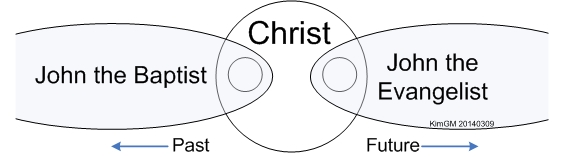
Gospel of John 1
29 The next day John saw Jesus coming toward him and said, “Look, the Lamb of God, who takes away the sin of the world.
30 This is He of whom I said, ‘A man who comes after me has surpassed me because He was before me.’
This saying is in many ways curious, why is the Baptist come after the Christ being? The Baptist is the astral principle while the Christ or the Evangelist is the Soul principle, and it's an æon older.
From German GA 146, p. 115ff (Google translation):
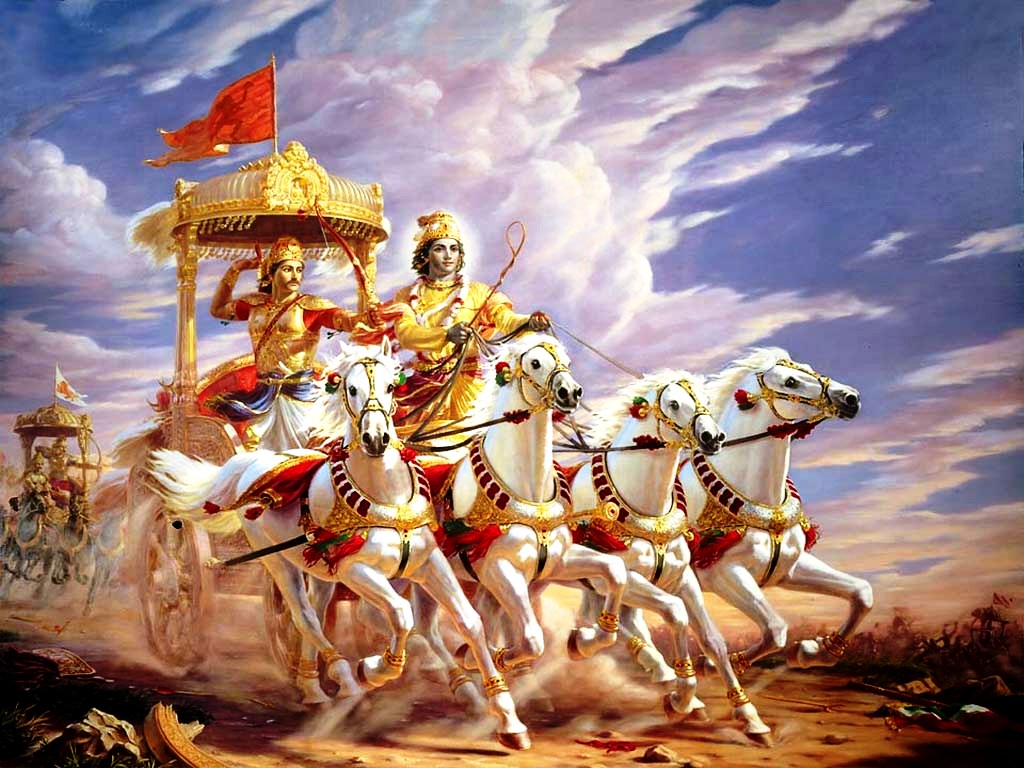 By those special circumstances in which the Arjuna soul perceived all that was around them, and exercised their feelings by feeling what was happening in Kurukshetra on the battlefield, where the Kurus and Pandus stood, That this particular peculiar soul spoke through the soul of the chariot of Arjuna. And the appearance of this soul, speaking through a human soul, is the Krishna.
What soul, then, was capable of sinking into the human soul, the impulse to self-consciousness? It was the soul which remained behind in the old Lemurian period when mankind entered the real earth evolution.
Earlier this soul was often seen in appearances, but in a much more spiritual way. In the time, however, of which the sublime singing, the divine Gita proclaims, is to be thought a sort of incarnation - but much Maya is there - a kind of incarnation of this soul of Krishna.
But then there is a definite incarnation in the history of mankind: this same soul is later embodied in a boy. Those of the revered friends, to whom I have often spoken, know that, at the time when Christianity was established, two boys were born in families in which the blood of the house of David flowed. The one boy is portrayed in the Gospel of Matthew, the other in Luke's Gospel. This is the true reason why the Gospel of Matthew, with the Gospel of Luke, is not correct for external observation.
The same Jesus, whom the Gospel of
Luke relates, Is the incarnation of this same soul which has never before lived
in a human body but is nevertheless a human soul because it was a human soul
during the ancient Lemurian period in which our actual evolution began.
It is the same soul that has revealed itself as Krishna. Thus we have what is the
Krishna impulse, the impulse to human self-consciousness, embodied in the body of
Luke-Jesus-Boy.
That which was embodied is related to the powers that are sleeping in the childhood in so innocent anger before they awaken as sexual forces. In the Luke-Jesus-boy, they can manifest themselves up to this age where man enters the sexual maturity.
It would have been the body of Jesus, who has been taken from the universal humanity which had descended into the incarnations, no longer fit the forces which are indeed related to the innocent, innocent generations of the child.
Therefore, the soul who is in the other Jesus-boy, and who, as most of our dear friends know, is the Zarathustra, is a soul that has passed from incarnation to incarnation, and which is reached by special work within many incarnations. Therefore, this Zarathustra is going into the body of the Luke-Jesus-boy, and from this point onwards-as you find it represented in my book, The Spiritual Leadership of Man and Humanity is connected with this body of Luke Jesus.
We touch a wonderful secret. Here we see, As in a human body, into the body of the Luke-Jesus-boy, the human soul is as it has been before man has descended into the earthly incarnation series. Then we understand that this soul in the human body could only rule until the twelfth year of this body, that then another soul, which has undergone all human transformations, like the Zarathustra, must take possession of this particular body. The miraculous is realized that what is the innermost of man is to see his own self, which we regard as Krishna, as impulses, flashing in the Krishna impulse, the Jesus, which is portrayed in Luke's Gospel.
From Gospel of Mark: Lecture 6, 20th September, 1912, Basel
This Elijah-soul is at the same time the soul of the Old Testament people, as it enters the Baptist and lives in him. When he was imprisoned and then beheaded by Herod, what happened then to his soul?
This we have already indicated. His soul left the body and worked on as an aura; and into the domain of this aura Christ Jesus entered. [Jahve/Krishna.]
Where then is the soul of Elijah, the soul of John the Baptist? The Mark Gospel indicates this clearly enough. The soul of John the Baptist, of Elijah, becomes the group soul of the Twelve; it lives, and continues to live in the Twelve.
We can say that it is artistically and pictorially shown in a remarkable manner how the teaching of Christ Jesus, his way of teaching, differed when he taught the crowd and when he taught his own individual disciples — and this, even before the Mark Gospel has told us of the death of John the Baptist.
We have already spoken of this. However, a change takes place when the soul of Elijah is freed from John the Baptist and works on further in the Twelve as a group soul. And this is indicated, for from this time onward — this is quite clear if we read the passage and reread it — Christ makes greater demands on His disciples than before.
He calls upon them to understand higher things. And it is very remarkable what He expects them to understand, and what later on He reproaches them for not understanding.
He reproaches them severely because they cannot understand the meaning of these revelations. Why does He do this?
Because the thought was in His mind, “Now that the spirit of Elijah has been freed, he lives in you, and you must gradually prove yourselves worthy of his penetration into your souls, so that you may understand things that are higher than what you have hitherto been able to understand.”
When Christ Jesus spoke to the crowd, He spoke in parables, in pictures, because there was still in their souls an echo of what had formerly been perceived in the super-sensible world in imaginations, in imaginative knowledge. For this reason He had to speak to the crowd in the way used by the old clairvoyants. [Dream Language.]
To those who came out of the Old Testament people and became His disciples He could interpret the parables in a Socratic manner, in accordance with ordinary human reasoning capacities. He could speak to the new sense that had been given to mankind after the old clairvoyance had died out.
But because Elijah's spirit as a group soul came near to the Twelve and permeated them like a common aura, they could, or at least it was possible for them to become in a higher sense clairvoyant.
Enlightened as they were through the spirit of Elijah-John they could, when the Twelve were united together, perceive what they could not attain as individual men. It was for this that Christ wished to educate them.
Now Peter says, “You are the Christ,” that is, “You are a leader who has not gone through the mysteries in this way but has come down from the cosmos and become a leader of mankind.” Something which in all other cases had happened in a different way, through initiation, was now to take place on the earth plane once and for all as a historical fact.
In order to picture to ourselves this viewpoint let us now consider again what we called yesterday the “greatest monologue in world history,” the soliloquy of the God. We must recognize that the whole episode was especially concerned with the relationship between Christ Jesus and His closest disciples.
And we must include in such a study most particularly what was said yesterday, that the spirit of Elijah, after it had been freed from the physical body of John the Baptist, was actually active as a kind of group soul of the disciples.
What happened then cannot just be related in a simple external way since it took place in a much more complicated manner.
To a certain extent there was a deep and inner connection between the soul of the Christ and the souls of the Twelve. Everything that took place within the soul of Christ was made up of processes of significance for that time, rich and manifold processes.
But all that took place in the soul of Christ took place again in a kind of reflected image, a reflection in the souls of the disciples, but divided into twelve parts. In this way each of the Twelve experienced, as in a reflected image, a part of what happened in the soul of Christ Jesus; but each of the Twelve experienced it somewhat differently. What took place within the soul of Christ Jesus was like a harmony, a great symphony, reflected in the souls of each of the Twelve, in much the same way as twelve instruments can give forth a harmony.
[The twelve starsigns of the Zodiac.]
So any event that concerns one or more of the disciples in particular may be described from two sides. It is possible to describe how the event in question appeared within the soul of Christ, as, for example, in the case of the great world-historical monologue of Christ Jesus. It is possible to describe how it was experienced within His soul, and then it appears as it was described yesterday.
But it also takes place in a certain reflected image in the soul of Peter. Peter has the same soul experience. But, whereas in the case of Christ Jesus it encompasses the whole of mankind, Peter's identical experience encompasses only a twelfth part of all mankind, a twelfth, a single zodiacal sign of the entire Christ spirit. For this reason it must be pictured differently when it concerns Christ Jesus Himself.
It must be spoken of in this way if we are to describe it in the sense of the Mark Gospel, for most remarkable things are described in it, and especially what is presented as having taken place within the soul of Christ Jesus Himself.
By contrast the Matthew Gospel pictures more what has reference to the soul of Peter, and what Christ Jesus added to explain what took place within Peter's soul. If you read the Gospel carefully, you will notice how in the Matthew Gospel certain words have been added which give us the picture as perceived from the side of Peter.
Otherwise, why should the words have been added, “Blessed are you, Simon, son of Jonah, for flesh and blood have not revealed it to you but my Father in the heavens.” (Matt. 16:17)?
In other words the soul of Peter felt something of what the soul of Christ had been feeling.
But while Peter's soul felt that his master was Christ, this should be understood as meaning that Peter was for a time raised upward to an experience in his higher “I,” and that he was overwhelmed by this experience and then fell back, as it were, afterward.
Nevertheless it was possible for him to penetrate through to a knowledge which, with a different aim and purpose, came about within the soul of Christ. Because Peter was able to do this, there followed the handing over of the power of the keys mentioned in the Matthew Gospel (Matt. 16:19), about which we spoke in our interpretation of that Gospel.
By contrast, in speaking of the Mark Gospel we have emphasized, forcefully and simply, those words that indicate that the event, quite apart from what happened within Peter, took place at the same time and in a parallel manner as the monologue of God.
Let us now consider together what the essential elements of the Oriental world view actually are. We are always told of recurring world ages, of what happens at the beginning of the first and at the end of the first cosmic age. Then we are told of the beginning of the second world age, and its end, then the beginning of the third and its end.
And the secret of world development is correctly presented when it is said that when the ancient culture of the third world age had become dry and arid and the culture had entered the phase of autumn and winter, then there appeared Krishna.
The son of Vasudeva and Devaki, his task was to sum up for later ages, namely for the fourth period, what could be carried from the third into the fourth period as the germ, the new seed for that period.
The individual world ages appear to us like successive years in the life of a plant. In the Oriental world view the cycles of time, which constantly recur, are the essential element.
From Gospel of Mark: Lecture 8, 22nd September, 1912, Basel
Thus Christ Jesus appears to His disciples by the lake in imagination only since He Himself is involved in the entire episode because of His capacity to exteriorize Himself. Although they do not have Him there in the physical body, the disciples see Him. In such an experience separation in space has no importance. He was together “with them” by the lake. For the same reason when reference is made to the soul forces of the apostles, the “mountain” is spoken of, as it was when the Twelve were appointed and their souls were enjoined to take into themselves the group soul of Elijah. And when the Christ wished to appear in the whole grandeur of His world-historical and cosmic manifestation, again the mountain is spoken of. The Transfiguration therefore takes place on the mountain.
It is indeed from this point of view that we must picture the scene of the Transfiguration. The three disciples Peter, James, and John prove themselves to be capable of being initiated into the deeper secrets of the Mystery of Golgotha. To the clairvoyant eyes of these three which were now opened there appeared, transfigured, that is in their spiritual nature, Elijah on the one side and Moses on the other, with Christ Jesus Himself in the middle.
And it is imaginatively indicated in the Gospel that Christ was now in the form in which in His spiritual nature He could be recognized. This is shown with sufficient clarity in the Mark Gospel:
And He was transfigured before them.
And His garments became gleaming bright, brighter than any fuller on earth could bleach them.
And there appeared to them Elijah with Moses, and they conversed with Jesus. (Mark 9:2-4.)
After the great monologue of God comes a conversation among these three. What a wonderful dramatic crescendo! Everywhere the Gospels are full of such artistic sequences. Indeed they are wonderfully composed. After hearing the monologue of God we now have a conversation among these three, and what a conversation! First we see Elijah and Moses, one on each side of Christ Jesus. What is the significance of Elijah and Moses?
The figure of Moses has long been familiar to you; even from the occult standpoint it has often been illuminated. We know that world-historical wisdom chose to bridge the span between primeval ages and the Mystery of Golgotha indirectly through Moses. We know from our studies on the Luke Gospel that in the Jesus boy of whom Matthew especially speaks the reincarnated Zarathustra is to be seen. We know also that this Zarathustra through all that belonged to him and was in him made preparations for his later appearance on earth.
I have often mentioned how through special occult processes Zarathustra gave away his etheric body, which then passed over into Moses so that Zarathustra's etheric body was active in him. Thus when Elijah and Moses are pictured next to Christ Jesus we have, so to speak, in Moses those forces destined to lead over from primitive forms of culture to what mankind was later to be given in Christ Jesus and the Mystery of Golgotha.
But from another point of view we also have a transitional figure in Moses. We know that he not only had within him the etheric body of Zarathustra, which enabled him to bear within himself the wisdom of Zarathustra which could then become active in him, but we know also that Moses was in a certain way initiated into the secrets of other peoples. In the meeting with the Midianite priest Jethro we have to see a special scene of initiation, as we have discussed before. This is to be found in the Old Testament (Exodus 2:16-21).
Here it is clearly pointed out how Moses visits this lonely priest and not only learns from him the secrets of the initiation of Judaism but also those of other peoples. He bears all these within his inner being which has already experienced the special strengthening that came from the etheric body of Zarathustra. So there entered into the Jewish people through Moses the secrets of initiation of the whole surrounding world, thus enabling him to prepare, on a lower stage, as it were, what was to come about through Christ Jesus. This then was one of the streams that was to lead to the Mystery of Golgotha.
The other stream, as I have also indicated before, derived from what by this time was living in a natural way in the Jewish people, as a people.
Moses was the individuality who as far as was possible in his time allowed the other stream that was in the world to pour into that stream that flowed through the generations from Abraham, Isaac and Jacob.
But at the same time we should always keep in mind what was especially connected with the nature of the Hebrew people. Why had this people been chosen? Their task was to prepare for that era that we tried to call before our souls when, for example, we referred to Hellenism, and then when yesterday we spoke of Empedocles.
We were referring in this way to that time when the ancient clairvoyant capacities were disappearing from men, when they lost their ability to see into the spiritual world, when the power of judgment took its place; and judgment is the special characteristic of the 'I', when the 'I' emerges as an independent entity.
And the Lord spoke with Moses and said: “Phinehas, the son of Eleazar, the son of Aaron the priest, has turned away my anger from the children of Israel through his zeal concerning me. So in my zeal I have not destroyed the children of Israel. Therefore say: See, I give him my covenant of peace.”
Yahweh said this to Moses. And in this particular passage we must also see something that according to ancient Hebrew esoteric teaching is exceptionally significant. This is confirmed by occult research. We know that those representing the high priesthood of ancient Israel are direct descendants of Aaron, and that in them the essence of what was given to mankind by the Jewish people lives on.
At that moment of world history, according to Hebrew esoteric teaching and confirmed by more recent occult research, the significant truth was indicated that Yahweh imparts the knowledge to Moses that in Phinehas, the son of Eleazar, the grandson of Aaron, he was bestowing on the Hebrew people a very special priest who represents him and is closely connected with him. And the esoteric teaching and occult research reveal that the same soul lives in the body of Phinehas that was later present in Elijah. Thus we have a continuous line of descent which in several points we have already described.
In Aaron's grandson we have one soul that is of concern to us, the soul that lives in Phinehas. The same soul appears again in Elijah-Naboth and then in John the Baptist, and we know how it continues throughout the evolution of mankind.
So there is pictured for us this soul on the one side of the Christ, and on the other the soul of Moses himself.
So in the Transfiguration, in the Transformation on the mountain, we have before us a streaming together of the entire spirituality of earth evolution, the essence of which flowed through the Jewish blood into the Levitical line. [The wisdom of Krishna and his sister-soul the transformed Shiva.]
Thus the soul of Phinehas, the son of Eleazar, the son of Aaron stands before us; Moses stands before us; and there stands before us also He who fulfilled the Mystery of Golgotha. And the three disciples who were to be initiated, Peter, James and John, were to perceive in imaginative knowledge how these forces, these spiritual streams, flowed together.
When yesterday I tried to picture for you how something like a call sounds over from Greece to Palestine and the call that answered it, this was something more than a mere pictorial description of the facts. It was indeed a preparation for that great world-historical discourse that now actually took place.
The disciples Peter, James, and John were to be initiated into what these three souls had to discuss together; one soul who belonged to the people of the Old Testament, one who carried within himself much of what we know about the Moses soul, while the third, as cosmic deity, is uniting Himself with the earth. This the disciples were to see.
There is another remarkable passage where it is again possible to perceive the methodically artistic manner in which the Gospel veils the occult facts concerned with the evolution of mankind. This passage is again a difficult puzzle for the commentators.
And the next day, as they were leaving Bethany he was hungry.
And from afar he saw a fig tree, which had leaves. So he went to see if he might find something on it. And when he came to it he found nothing but leaves, for it was not the season for figs.
And he began to speak to it, “Never to all eternity shall anyone eat fruit from you!” And his disciples heard it. (Mark 11:12-14.)
Now we should all ask ourselves honestly, “Is it not truly extraordinary that, according to the Gospel, a God should go straight up to a fig tree, look for figs and find none, and then the reason is explicitly given why He did not find any — it was not the time for figs — so at a time when there are no figs He goes up to the fig tree, looks for figs and finding none, says, “Never to all eternity shall anyone eat fruit from you?”
What, then is the fig tree, and why is the entire story told here? Anyone who can read occult works first of all will recognize in the fig tree (its connection with the Gospel will be shown later) the same picture as was spoken of in relation to the Buddha, who sat under the Bodhi tree and received enlightenment for his sermon at Benares.
“Under the Bodhi tree” means the same as “under the fig tree.” From a world-historical point of view it was still the “time of figs” in respect to human clairvoyance, that is to say it was possible to receive enlightenment as the Buddha did, under the Bodhi tree, under the fig tree.
But this was no longer true, and that is what the disciples had to learn. From the point of view of world history it was a fact that there was no longer any fruit on the tree under which the Buddha had received his enlightenment.
Christ led them to the fig tree and told them the secret of the Bodhi tree, omitting to tell them, because it had no significance for them, that the Buddha was still able to find fruit on it.
Now it was no longer the “time of figs,” figs that the Buddha had received from the Bodhi tree when he gave his sermon at Benares. Now Christ had to tell them that for all eternity the fruit of knowledge would never again ripen on the tree from which the light of Benares had shown down, but that hereafter the light would shine from the Mystery of Golgotha.
What is the truth that is presented to us here? The truth that Christ Jesus went with His disciples from Bethany to Jerusalem, and that a specially strong feeling, a specially strong force was called forth in the disciples, awakening clairvoyant forces in their souls, so that they were predisposed toward imagination.
Clairvoyant imaginative powers were awakened in the disciples. In clairvoyance they see the Bodhi tree, the fig tree, and Christ Jesus inspires in them the knowledge that the fruit of knowledge can no longer come from the Bodhi tree, for it is no longer the “time of figs,” that is of the ancient knowledge.
For all eternity the tree will be withered, but a new tree must grow forth, a tree consisting of the dead wood of the cross; a tree on which the fruit of ancient knowledge will not ripen, but the fruit that can ripen for mankind from the Mystery of Golgotha, which is linked as by a new symbol to the cross on Golgotha.
In the place of that scene of world history when the Buddha sat under the Bodhi tree stands the picture of Golgotha where another tree, the tree of the cross, is raised, on which hung the living fruit of the God-man revealing himself, so that from Him may radiate the new knowledge of the fruit of the ever growing tree that will bear fruit to all eternity.
From Gospel of Mark: Lecture 9, 23rd September, 1912, Basel
The first question must be: Are the apostles, the chosen disciples equal to the task of comprehension imposed on them? Did they recognize Christ as a cosmic spirit? Did they recognize that there in their midst was one who was not only what He signified to them as man, but who was enveloped in an aura through which cosmic forces and cosmic laws were transmitted to the earth? Did they understand this?
That Christ Jesus demanded such an understanding from them is clearly indicated in the Gospel. For when the two disciples, the sons of Zebedee, came to Him and asked that one of them might sit on His right hand and the other on His left, He said to them, “You do not know what you ask. Can you drink from the cup that I drink, or be baptized with the baptism with which I am baptized?” (Mark 10:38.)
It is clearly indicated here that Christ Jesus required this of them, and at first they solemnly pledge themselves to it. What might then have happened? There were two possibilities. One would have been that the chosen disciples would really have passed in company with Christ through all that is known as the Mystery of Golgotha, and that the bond between Christ and the disciples would have been preserved until the Mystery of Golgotha.
That was one of the two things that could have happened. But it is made very clear, especially in the Mark Gospel, that exactly the opposite occurred. When Christ Jesus was taken prisoner, everyone fled, and Peter who had promised solemnly that he would take offense at nothing, denied him three times before the cock crowed twice.
That is the picture presented from the point of view of the apostles. But how is it shown that, from the point of view of the Christ, it was not at all like this?
Let us place ourselves with all humility — as we must — within the soul of Christ Jesus, who to the end tries to maintain the woven bond linking Him with the souls of the disciples. Let us place ourselves as far as we may within the soul of Christ Jesus during the events that followed.
This soul might well put to itself the world-historical question, “Is it possible for me to cause the souls of at least the most select of the disciples to rise to the height of experiencing with me everything that is to happen until the Mystery of Golgotha?”
The soul of Christ itself is faced with this question at the crucial moment when Peter, James and John are led out to the Mount of Olives, and Christ Jesus wants to find out from within Himself whether He will be able to keep those whom He had chosen.
On the way He becomes anguished. Yes, my friends, does anyone believe, can anyone believe that Christ became anguished in face of death, of the Mystery of Golgotha, and that He sweated blood because of the approaching event of Golgotha?
Anyone who could believe that would show he had little understanding for the Mystery of Golgotha; it may be in accord with theology, but it shows no insight. Why does the Christ become distressed? He does not tremble before the cross. That goes without saying.
He is distressed above all in face of this question, “Will those whom I have with me here stand the test of this moment when it will be decided whether they want to accompany me in their souls, whether they want to experience everything with me until the cross?”
It had to be decided if their consciousness could remain sufficiently awake so that they could experience everything with Him until the cross. This was the “cup” that was coming near to Him.
So He leaves them alone to see if they can stay “awake,” that is in a state of consciousness in which they can experience with Him what He is to experience. Then He goes aside and prays, “Father, let this cup pass from me, but let it be done according to your will, not mine.” In other words, “Let it not be my experience to stand quite alone as the Son of Man, but may the others be permitted to go with me.”
Jesus, the Son of Man, is an astral being, the disciples is his soul, are they strong enough to follow him into the death-world?
He comes back, and they are asleep; they could not maintain their state of wakeful consciousness. Again He makes the attempt, and again they could not maintain it.
So it becomes clear to Him that He is to stand alone, and that they will not participate in the path to the cross. The cup had not passed away from Him. He was destined to accomplish the deed in loneliness, a loneliness that was also of the soul.
Certainly the world had the Mystery of Golgotha, but at the time it happened it had as yet no understanding of this event; and the most select and chosen disciples could not stay awake to that point. This therefore is the first kind of understanding; and it comes to expression with the most consummate artistry if we can only understand how to feel the actual occult background that lies concealed behind the words of the Gospels.
Let us now enquire into the second kind of understanding, and ask how the Jewish leaders understood the one who was to come forth from the lineage of David as the flower of the old Hebrew development.
We find in the tenth chapter of the Mark Gospel one of the first passages in which it is pointed out to us what understanding the ancient Hebrew people showed toward the one who arose from the lineage of David. This is the decisive passage when Christ Jesus is approaching Jerusalem, and should have been recognized by the old Hebrew people as the successor of David.
And they came to Jericho. And as he was leaving Jericho with his disciples and a considerable crowd, a blind man, Bartimaeus, the son of Timaeus, was sitting by the road, begging. And when he heard that it was Jesus of Nazareth, he began to call, “Jesus, thou Son of David, have mercy on me.” And many scolded him, telling him to be silent. But he called all the more loudly, “Thou Son of David, have mercy on me.” (Mark 10:46-48.)
It is explicitly stated that the call of the blind man was expressed in the words “Thou Son of David,” showing that he could reach the understanding only of “the Son of David.”
And Jesus stood still and said, “Call him here.” And they called the blind man and said to him, “Be of good cheer, arise, he is calling you.”
So he threw off his mantle, jumped up and came to Jesus. And Jesus said to him, “What do you want me to do for you?”
The blind man said to him, “Rabboni, that I may receive my sight.”
And Jesus said to him. “Cheer up! Your faith has rescued you.” And immediately he received his sight and followed him on his way.
It was therefore only faith that was required of him. Is it not worthwhile giving consideration to why, among the other stories, the healing of a blind man is referred to? Why does the story stand there all by itself?
We should learn something from the way the Gospel is composed. It is not the cure itself that is at issue, but that only one man among them all, and he a blind man, should call with all his strength, “Jesus, thou Son of David!” Those who had sight did not recognize Him, but the blind man, who does not see Him physically at all, does recognize Him.
So what has to be shown here is how blind the others are, and that this man had to be blind in order to see Him. In this passage what is important is the blindness, not the healing; and it shows at the same time how little Christ was understood.
As we proceed further we find how He speaks everywhere of how the cosmic lives in the individual human being [Krishna.]
Indeed, He speaks of the cosmic when He speaks of immortality, and it is noteworthy how He speaks of this just in connection with His appearance as the Son of David.
He proclaims that God is a God of the living and not of the dead, the God of Abraham, Isaac and Jacob (Mark 12:26-27), because Abraham, Isaac and Jacob live on in their successors in different forms, in that God lives in their individualities.
This is pointed out still more strongly when Christ refers to what slumbers within man and must be awakened. Here it is said that it was not a question of a merely physical son of David, for David himself speaks of the “Lord” and not of a physical son (Mark 12:35-37).
As the influence of the cosmic Christ is waning, everywhere reference is made to the “Lord” that lives within the individuality of man, and how this is to spring from the lineage of David.
We wish to draw attention to one particular passage that you will find near the end of the Mark Gospel. It is a passage that can easily be overlooked if it is not understood, though it is indeed a soul-shattering passage. It occurs where it is reported that Christ has now been delivered over to the worldly powers, that He is to be condemned, and excuses are sought for condeming Him.
Just before this passage what He did in the Temple was described, how He drove out the money-changers and overturned their tables, and how He preached most remarkable words which were heard in the souls of those present. Yet nothing happened to Him because of this.
Christ explicitly draws attention to this when He says, “You have heard all this. Yet now, when I am standing before you, you are looking for false charges against me. You have taken me prisoner by the customary method of employing a traitor, as if you were arresting someone who has committed a serious crime whereas you did nothing while I stood among you in the Temple.”
This is indeed a shattering passage, for we are given to understand that essentially, wherever Christ is active, nothing can be done against Him. [As Krishna tells Arjuna that he will make him invincible when he does his will.]
Is it not permissible to ask why? Indeed, He is working so actively that He points with the utmost clarity to the fact that a turning point in cosmic evolution has been reached, as He indicates with the words, “The first shall be last and the last shall be first.” (Mark 9:35.) Such teachings that He hurls at them must have seemed terrifying by comparison with the teachings of the Old Testament and the way they understood them. Yet nothing happens.
Afterwards He is captured under cover of darkness and night by the agency of a traitor; and we even have the impression that there was something like a struggle when He was captured. The passage is truly shattering:
But the traitor had given them a sign and said, “The one whom I will kiss, it is he; seize and secure him.”
And when he came he went directly to Him and said “Rabbi, Rabbi!” and kissed him. And they laid hands on Him and seized Him.
But one of those who were standing by drew his sword and struck at a servant of the high priest and cut off his ear.
And Jesus spoke to them, “You have come out with swords and sticks to take me prisoner as you would a murderer. I was daily in the Temple teaching, and you did not seize me; but the Scriptures must be fulfilled.” (Mark 14:44-49.)
What was it that really happened that they did not at first capture Him, and then sought reasons to capture Him like a murderer? It is only possible to understand what happened if we look at it in the light of occult truths.
I have already pointed out how the Mark Gospel clearly describes occult and spiritual facts intermingled at random with purely physical facts. And we shall show how Christ clearly does not limit His activity to the deeds of the single personality, Jesus of Nazareth. He worked upon His disciples when He came to them by the lake in an external form but outside His physical body. So while His physical body might be in one place or another, He could while outside it inspire into the souls of His disciples all that He did, and all that radiated from Him as spiritual impulse. And we shall point out that the Mark Gospel makes it abundantly clear how human beings hear what He preaches and teaches while He appears to them in an external form outside His physical body.
What He says lives in their souls; though they do not understand it, it comes to life within their souls. In the individuality of Christ and in the crowd it is both earthly and supra-earthly at the same time. [This points forward to the Holy Spirit.]
The Christ is everywhere connected with a widely extended, actively working aura. This aura was present and active because He was linked with the souls of those whom He had chosen, and it remained present as long as He was linked to them.
The cup had not passed away from Him; the chosen human beings had shown no comprehension.
So this aura gradually withdrew from the man Jesus of Nazareth; Christ became ever more estranged from the Son of Man, Jesus of Nazareth. Toward the end of His life Jesus of Nazareth was more and more alone, and the Christ became ever more loosely connected with Him. [Jesus is the Son of Man. ]
Although the cosmic element was there until the moment pictured as that of the sweating of blood in Gethsemane, and Christ up to this moment was fully united with Jesus of Nazareth, now through the failure of human beings to understand this connection the link was loosened.
And whereas earlier the cosmic Christ was active in the temple and drove out the money-changers, expounding mighty teachings, and nothing happened to Him, now, when Jesus of Nazareth was only loosely connected with the Christ the posse could come near Him.
However, we can still see the cosmic element present, but less and less connected with the Son of Man. This is what makes the whole episode so soul-shattering!
Because the threefold understanding could not be forthcoming, what did the men finally have in their hands? What could they seize, what could they condemn, what could they nail to the cross? The Son of Man!
And the more they did all this, the more did the cosmic element withdraw that had entered the life of earth as a youthful impulse [Krishna.] It escaped them.
For those who sentenced Him and carried out the judgment there remained only the Son of Man, around whom only hovered what was to come down to earth as a youthful cosmic element.
No Gospel other than that of St. Mark tells how only the Son of Man remained, and that the cosmic element only hovered around Him.
Thus in no other Gospel do we perceive the cosmic fact in relation to the Christ event expressed with such clarity, the fact that at the very moment when men who failed to understand laid their violent human hands upon the Son of Man, the cosmic element escaped them.
The youthful cosmic element which from that turning point of time entered earth evolution as an impulse, escaped. All that was left was the Son of Man; and this is clearly emphasized in the Mark Gospel.
Let us read the passage and find out if the Mark Gospel does indeed emphasize how, just at this moment in the unfolding of events, the cosmic acts in relation to the human.
And Jesus spoke to them, “You have set out with swords and sticks to take me prisoner, as if I were a murderer. I was daily with you in the temple teaching, and you did not seize me. But the Scriptures must be fulfilled.”
And they all forsook him and fled. (Mark 14:48-50.)
He stands alone. But what has become of the youthful, cosmic element? Think of the loneliness of this man, permeated as He was by the cosmic Christ, who now confronts the posse like a murderer. And those who should have understood Him flee! “And they all forsook Him and fled,” it says in the 50th verse. Then in verses 51 and 52:
And there was a youth among his followers, who wore a fine linen garment over his bare body, and they seized him. But he let go of the linen garment and fled naked.
Who is this youth? Who was it who escaped here? Who is it who appears here, next to Christ Jesus, nearly unclothed, and then slips away unclothed?
This is the youthful cosmic impulse, it is the Christ who slips away, who now has only a loose connection with the Son of Man. [Krishna is also depicted as youthful.]
Much is contained in these 51st and 52nd verses. The new impulse retains nothing of what former times were able to wrap around man. It is the entirely naked, new cosmic impulse of earth evolution. It remains with Jesus of Nazareth, and we find it again at the beginning of the sixteenth chapter.
And when the Sabbath was over Mary Magdalene and Mary the mother of James and Salome bought spices and went there to anoint him. And early in the morning on the first day of the week they came to the tomb as the sun was rising.
And they said among themselves, “Who will roll away the stone from the door of the tomb for us?” And when they looked up they saw that the stone was rolled away, for it was really very large.
And as they entered the tomb they saw a youth sitting on the right side, clothed in a long white robe; and they were startled.
But he said to them, “Do not be frightened. You seek Jesus of Nazareth, the crucified one. He has risen!” (Mark 16:1-6.)
This is the same youth. In the whole artistic composition of the Gospels nowhere else does this youth confront us, the youth who slips away from the people at the moment when they condemn the Son of Man, who is there again when the three days are over, and who from now onward is active as the cosmic principle of the earth.
Nowhere else in the Gospels — you should compare the others — except in these two passages does this youth confront us, and in such a grandiose manner.
Here we have all we need in order to understand the profound meaning of just this Gospel of St. Mark, which is telling us that we have to do with a cosmic event, with a cosmic Christ. Only now do we understand why the remainder of the Mark Gospel had to be artistically composed as it was.
It is indeed remarkable that, after this significant appearance of the youth has come twice before us, the Gospel quickly comes to an end, and all that remains are a few striking sentences. For it is scarcely possible to imagine that anything that came later could have still yielded any further enhancement. Perhaps the sublime and marvelous element could have been enhanced, but not what is soul-shattering and of significance for earth evolution.
Consider again this composition of the Mark Gospel: the monologue of God; the cosmic conversation on the mountain above the earth to which the three disciples were called but did not understand; then Gethsemane, the scene on the Mount of Olives when Christ had to acknowledge that those who had been chosen could not attain to an understanding of what was about to happen; how He had to tread this path alone, how the Son of Man would suffer and be crucified.
Then the world-historical loneliness of the Son of Man who is abandoned, abandoned by those He had chosen and then abandoned gradually by the cosmic principle.
Thus, after we have understood the mission and significance of the youth who slips away from the eyes and hands of men, we come to understand in an especially profound manner the words, “My God, my God, why hast Thou forsaken me?” (Mark 15:34.)
Then the reappearance of the youth, whereupon it is briefly shown how the youth is a spiritual, super-sensible being, who becomes sense-perceptible only through special circumstances, when He first shows himself to Mary Magdalene.
Then afterward, “He revealed Himself in another form to two of them as they went for a walk into the countryside.” (Mark 16:12.) The physical could not have showed itself “in another form.”
How may we face up to the Mystery of Golgotha? Among the few striking sentences contained in the Mark Gospel after it has spoken to us in such a soul-shattering way is to be found also the very last sentence, in which it is related how the disciples, who had earlier shown so little comprehension, after they had received a new impulse through the youth, the cosmic Christ,
“went forth and preached everywhere, and the Lord worked with them, confirming the word through the signs that accompanied it.” (Mark 16:20.) [The Comforter, the Holy Spirit.]
Precisely in what is contained only in this Mark Gospel, in this remarkable story of the youth who at a decisive moment broke away, so to speak, from Christ Jesus, do we discover the indication as to how this Gospel must be understood.
Because the chosen ones fled and they did not truly participate in everything that happened afterward. This is also told in the Gospel. In truly artistic fashion a passage is inserted in the midst of the composition.
A passage of the utmost clarity is here inserted; yet none of the disciples were present, not one of them was an eye-witness! And yet the whole story is told! So the question is still presented to us, and we shall try, in answering this question, to penetrate still further into the matter, and at the same time to throw light upon the remainder.
The Son of Man is the purified body, the Son of God is the purified Soul, and the Father is the purified Spirit.
From Reading the Pictures of the Apocalypse, Lecture One.
The writer of the Apocalypse describes the same thing to us when he speaks of the “Son of Man.” He calls the seven communities the “seven stars,” and he saw the “Son of Man” as the spiritualized, purified form of the physical body, not only the etheric body, but the spiritual-physical form of “Man,” the human being, now purified and sanctified.
From Gospel of Mark: Lecture 10, 24th September, 1912, Basel
The Gospel itself clearly points to what has appeared in our time in the manner just described. Those people who wish to remain materialists and to believe in nothing whatever beyond what can be attained by materialistic consciousness based on sense perception can find no path leading to Christ Jesus. For this path has been closed because those who stood closest to Christ left Him just at the time the Mystery of Golgotha was taking place.
It was only later that they met Him again, thus failing to participate in what happened in Palestine on the physical plane. And everyone knows for certain that no credible documents have been furnished by the other side of the threshold. Yet in the Mark Gospel and in the other Gospels descriptions of this very Mystery of Golgotha have been given.
How then did these descriptions come into being? It is of the utmost importance for us to picture this to ourselves. Let us consider the descriptions given in one instance, in the Gospel of St. Mark. Even though the description is short and concise, it is in fact indicated to us quite adequately how after the scene of the Resurrection the youth in the white garment, that is to say, the cosmic Christ, again showed Himself to the disciples after the Mystery had been accomplished, and gave certain impulses to them.
As a consequence the apostles, among whom we should include Peter, could be enkindled to clairvoyant vision, so that afterward they could see clairvoyantly what they had been unable to see with their physical eyes because they fled. The eyes of Peter, and of others who were permitted to be their pupils after the Resurrection of Christ Jesus, were opened clairvoyantly so that they could through clairvoyance behold the Mystery of Golgotha. [The Holy Spirit, the Comforter, the Elijah spirit whose aura enclosed first the disciples, later humankind.]
Although the Mystery of Golgotha took place on the physical plane, the only path to it is that of clairvoyance; and we must keep this firmly in our minds. The Gospel points this out quite clearly when it tells us how those who had been summoned fled at the decisive moment, so that it was only after it had received the impulse of the Risen One that in such a soul as that of Peter the memory flashed up of what had happened after the flight.
In ordinary life man remembers only what he has experienced in sense existence. The kind of clairvoyance that now appeared in the disciples differs from ordinary memory in that they were able to remember physical material events, just as if these events had been in their memories, although they were not present.
Just imagine how memory shone forth in the soul of a man like Peter, when he remembered events at which he had not been directly present. And so Peter, for example, taught those who wished to hear him about the Mystery of Golgotha, from memory, taught them what he remembered, even though he had not been present.
This is the important point we must take into consideration when we turn again to the forsaken Son of Man, to the form of the man who stands before us at the moment when, according to the Mark Gospel, the cosmic Christ was only loosely connected with the Son of Man.
There, before all humanity, stood the man, the man in the form originally given to man by divine spiritual powers. There He stood, but ennobled and spiritualized by the three-year sojourn of the Christ within the body of Jesus of Nazareth. Here He stood before His fellow-men.
But man's understanding had reached only as far as was possible through the thousands of years during which Lucifer and Ahriman had penetrated his understanding and knowing.
Yet here stood the man who in those three years had driven out of Himself the influences of Lucifer and Ahriman. Here in front of other men stood restored what man had been before the coming of Lucifer and Ahriman. [The Son of Man, Abel.]
Only through the impulse of the cosmic Christ was man once again what he had been when he left the spiritual world and was brought down into the physical world. [Abel, the Son of Man.]
Here stood the spirit of mankind, the Son of Man, in the presence of men who at that time were the judges and executioners in Jerusalem.
He stood there in the form that man can become if all that has debased him were to be driven out from his nature. Here stood the man at the moment when the Mystery of Golgotha was being accomplished, in the image of His fellowmen.
Before such a man His fellowmen should have stood and worshipped, saying, “Here am I in my true nature, here is my highest ideal. Here am I, in the form to which I can attain only through my most ardent striving, a striving that can come only from the depths of my soul. Here I stand before that in myself which is alone worthy of reverence and worship, the divine in me.”
And the apostles, if they had been able to practice self-knowledge, would have been compelled to say,
“In the whole expanse of space there is nothing in existence that can be compared in greatness with what is before us in the Son of Man!”
Compare with vision of Krishna.
The soul must really dedicate itself, at least in some small measure, to the kind of reflection filled with feeling and emotion that can arise from a reading of the Mark Gospel and that may be characterized somewhat as follows,
“How greatly deluded were my fellowmen who stood around the Son of Man, when in truth they should have perceived there the highest ideal of themselves!”
At this point I should like to remind you of something I have often pointed out with regard to the difference between male and female, pointing out the fact that to some extent the female element — not the single individual woman but rather “womanhood” — has not entirely descended to the physical plane, whereas the man — again not a single individuality, not man in a particular incarnation but “manhood” — has crossed the line and descended lower.
As a result true humanity lies between man and woman; and it is for this reason that a human being also changes sex in different incarnations.
All creation happens through the one becoming two, and all creations ends
through the two becoming one.
The one is the two genders combined creative
force, by splitting them they become weak, but the contrast between them creates
a strong field of development.
This field exist not only between man and
woman, also when we change sex between our incarnations, or the differences
between physical and etheric body.
It’s also permeates all of nature.
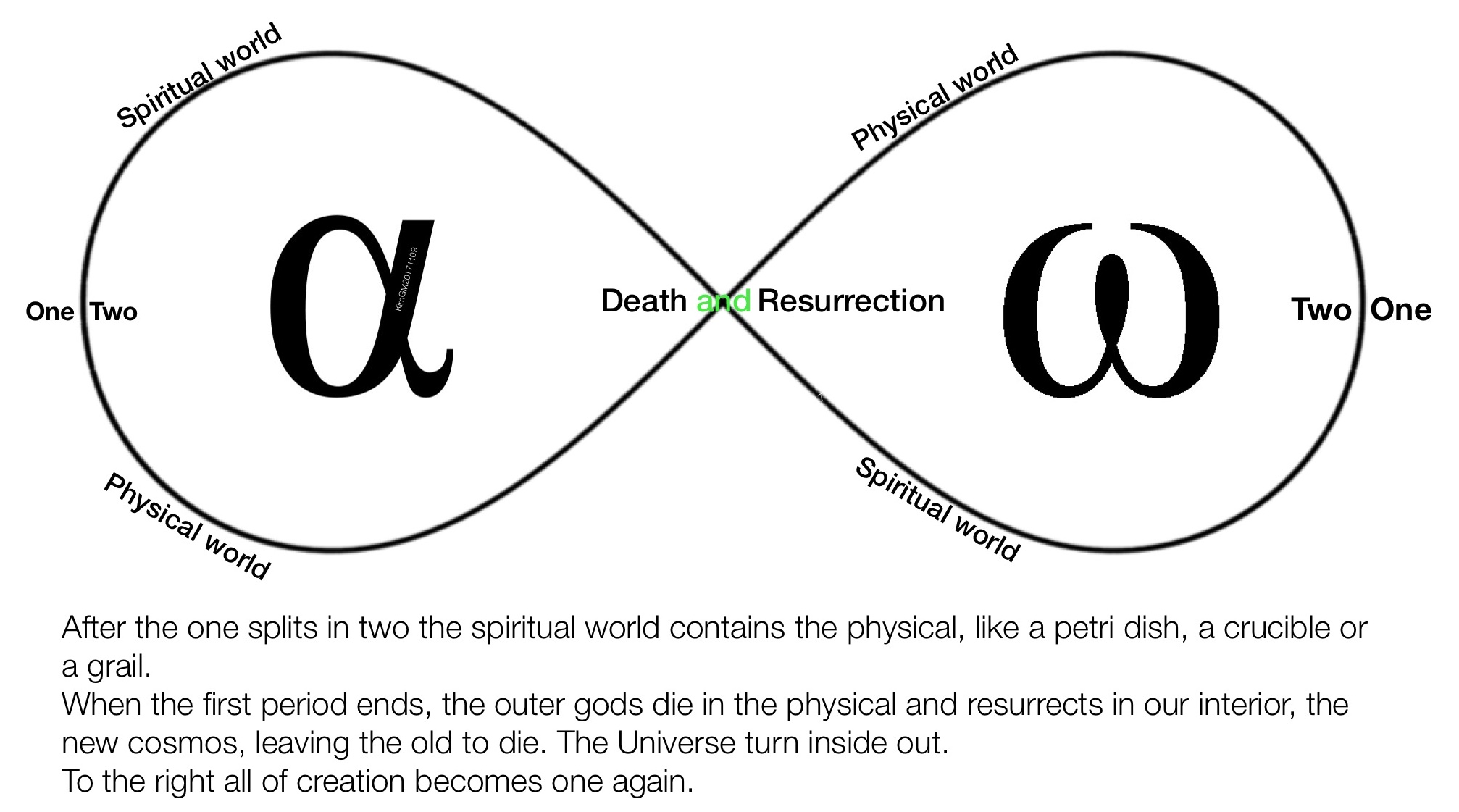
Sexual reproduction increases the development speed enormously. It’s speed is
described through the Fibonacci series, and phi the golden mean, the key of the
universe.
Nearly everything in nature follows the Fibonacci series or spiral,
plants or galaxas. It reflects the three creative powers, the three Logoi :
Father, Mother and Son.
It was necessary for us to enter deeply into
the physical, as creators we should understand the created fully, master it
fully, for that the masculine was needed.
To come up again the female part is
needed, to direct the powers of the masculine upward again, only together can
humanity get up from materialism.
But it is already the case that the woman, as such, because of the different formation of her brain and the different way in which she can use it, is able to grasp spiritual ideas with greater facility.
By contrast the man because of his external physical corporeality is much better adapted to think himself into materialism, because, if we wish to express the matter crudely, his brain is harder.
The female brain is softer, not so stubborn, that is to say in general — I am not referring to individual personalities. In the case of individual personalities there is no need to flatter oneself, for many truly obstinate heads sit on many a female body — to say nothing of the reverse!
But on the whole it is true that it is easier to make use of a female brain if one is to understand something exceptional, as long as the will to do so is also present. It is for this reason that the evangelist after the Mystery of Golgotha allows women to appear first.
And now, as the Sabbath was over, Mary Magdalene and Mary the mother of James, and Salome, brought spices, so that they could go and anoint him. (Mark 16:1.)
And it was to them that the youth, that is, the cosmic Christ, first appeared; and only afterward to the male disciples. True occultism, true spiritual science is interwoven into the composition and details of the contents of the Gospels, and especially of the concise Mark Gospel.
For only then will men truly grasp the reality that the earth is linked with the spiritual worlds, when they understand how the spiritual reality, the Christ, lived as a cosmic being in the body of Jesus of Nazareth; and when they understand that all the leaders of humanity that the world has ever known were sent out by the Christ as His forerunners with the task of preparing the way for Him so that He could be recognized and understood.
All this preparation turned out to be virtually useless when the Mystery of Golgotha took place, for at the decisive moment everything failed. But ever more and more in the future the time will come when people will understand not only the Mystery of Golgotha itself but all the other events that accompanied it, by means of which the Mystery will be ever more fully understood.
For the time being the peoples of Europe can easily perhaps be misjudged because they do not act like many other peoples who recognize as the true religion only those religious creeds that have sprung from their own nation and race, as for example, in India in particular, where only that is considered valuable that has sprung from their own blood.
How often in theosophical circles one talks about how the equality of all religions ought to be recognized, whereas in reality one wishes only to promote one's own religion and looks upon that as the only real wisdom-religion.
The Europeans are totally unable to do this because not a single people of Europe has retained any national deity, any deity growing out of its own soil of the kind that the peoples of Asia possess.
Christ Jesus belongs to Asia, and the peoples of Europe have adopted Him, and allowed Him to influence them.
In the acceptance of Christ Jesus there is no egoism; and it would be a complete distortion if someone were to wish to compare the way a European speaks about Christ Jesus with the way other peoples speak about their national deities, for example the way a Chinese speaks about Confucious or the way an Indian speaks about Krishna or the Buddha.
On other occasions in the past I have already shown how, if we follow the life of the Buddha we shall reach the point described in the Mark Gospel as the scene of the Transfiguration of Christ.
At this point the Buddha's life has come to its final end, and he dissolves into light, as it is described, and this description in truth corresponds to the occult fact. In the case of Christ, as you will find it stated in Christianity as Mystical Fact, [The chapter entitled “Egyptian Mystery Wisdom” contains the statement about the Transfiguration to which he refers here. ]
He does indeed reach the scene of the Transfiguration. But He was not transfigured alone, by Himself; He converses with Moses and Elijah on the mountain, where cosmic events occur. Only after the scene of the Transfiguration does the Mystery of Golgotha begin.
This emerges so clearly from the documents themselves that it is fundamentally impossible to deny the fact, once one has recognized it from a comparison between the lives of Christ and the Buddha. And in essence all that I was able to tell you today about the feelings that arise in us when we think of the great misunderstanding of the Son of Man by human beings is only a consequence of what you will find already pointed out in Christianity as Mystical Fact.

Zur Menge sprach Christus, man möchte sagen, wie ein populärer Buddha; zu seinen intimen Schülern sprach er wie ein höherer Sokrates, wie ein spiritualisierter Sokrates. GA139.84f
Auferstehungsidee. Plato knüpft an den toten Sokrates an in seinen Schriften. Das ist nicht nur eine belletristische Einkleidung, sondern das ist mehr. Das ist, ich möchte sagen, die Fortsetzung, der Nachklang dessen, was in den Mysterien gelebt hat, wo die Mysterienschüler hingeführt wurden zum Verkehr mit den Verstorbenen, die von der geistigen Welt weiterregierten die äußere sinnliche Welt. Wir müssen zu der Möglichkeit kommen, mit den Toten zu leben, die Gedanken der Toten in uns wieder auferstehen zu lassen. Das ist der Weg, auf dem sich der Christus der Menschheit erschließt im inneren Erleben. Aber es gehört zu diesem Wege die Entwickelung dessen, was man nennen kann: den Willen im Denken. Wenn Sie sich die Gedanken nur so bilden können, wie sie sich bilden, wenn Sie die äußere Sinneswelt anschauen, dann kommen Sie nicht zu solchen Gedanken, die mit Toten in eine reale Verbindung kommen. Wir müssen die Fähigkeit gewinnen, Gedankeni elementar aus dem eigenen Wesen heraufzuholen. Der Wille muß den Mut haben, mit der Wirklichkeit sich zu verbinden. Dann wird der Wille, der sich also vergeistigt, er wird, genau ebenso wie Ihre Hand an einen äußeren sinnlichen Gegenstand anstößt, anstoßen an Geistwesen. Und die ersten Geistwesen werden in der Regel sogar diejenigen sein, welche in irgendeiner Weise karmisch mit uns verbundene Tote sind. GA175.386
Der jüngere Dionysos, der im wesentlichen seine Seele ausfließen ließ in die äußere Kultur, sie aber doch in einer bestimmten Zeit wieder zusammenfassen konnte als Seele in einem einzelnen menschlichen physischen Leibe, wurde wiedergeboren, inkarniert unter den Menschen, aber so, daß er nicht seine alte Gestalt behielt, sondern hinzufügte zu seiner äußeren physischen Gestalt etwas von dem, was seine Geistgestalt ausmachte in den Dionysischen Mysterien. Der alte weise Lehrer des Dionysos, Silen, wurde wiedergeboren als Sokrates. Und der wiederverkörperte Dionysos selber, jene Wesenheit, in welcher in Wahrheit die Seele des alten Dionysos lebte, das war Plato. Gerade in derjenigen Zeit, in welcher in den Mysterien selber der Verfall eintrat, in welcher keine Mysten mehr da waren, die in den heiligen Mysterien hellseherisch noch schauen konnten den jüngeren Dionysos, trat dieser selbe jüngere Dionysos als der Schüler des weisen Silen, des Sokrates, in der Gestalt des Plato als der zweite große Lehrer Griechenlands, als der wahre Nachfolger des Dionysos auf. GA129.156f
Silen. Der Lehrer des Dionysos selber war ein recht häßlicher Mensch und diesen Menschen, der der Lehrer des Dionysos selber war, lernten auch die Mysten der Dionysischen Mysterien kennen: Silen. Silen wird uns aber als eine weise Individualität geschildert. 129.154 Sokrates ist der wiederverkörperte alte Silen. Und der wiederverkörperte Dionysos, das war Plato. Und daß diese Gestalten wiedergeboren worden sind, davon hatte die Mystik des alten Griechenlands ihr deutliches Bewußtsein. Davon hatten auch die Künstler des alten Griechenlands, die angeregt und inspiriert wurden von den Mysten, ihr deutliches Bewußtsein. 129.157
Griechentum und Illusionen. Die heren Gestalten des Sokrates und Plato hatten alle Mühe, den Griechen auszutreiben ihren unwiderstehlichen Hang zur Illusion. Der Grieche war so geartet, daß er fortwährend den Hang empfand, über den Ernst des Lebens hinaus sich zur wesenlosen Illusion zu erheben und in ihr seine Wohlbefriedigung zu suchen. Und selbst so lange nur haben es die Griechen dem Sokrates verziehen, von dem Lebensernst zu sprechen, als ihnen der «Bummler» Sokrates ungefährlich erschien. Als sie aber vernahmen, was eigentlich in den Worten des bummelnden Sokrates für Lebensernst enthalten ist, da haben sie ihn vergiftet. Wir haben, soweit wir Menschen unseres Zeitalters sind (durch unser Erziehungssystem vermittelt), nicht in uns den Geist des sokratischen Ernstes. Wir nehmen lieber jenen Geist des Griechentums auf, der Sokrates vergiftet hat, und schwelgen in diesem Geist des Griechentums. GA192.147f
Jupiter-Atome, künftige. So wie wir einen Träumer in uns haben, der die Mondennatur in uns hineingetragen hat, so tragen wir auch in uns den Sonnenmenschen aus der Sonnenentwickelung. Der ist aufgebaut in seinem Bewußtsein nach Art der Pflanzen. Einen schlafenden Pflanzen- oder Sonnenmenschen tragen wir in uns. Und dann auch tragen wir in uns einen vollständig toten, den wie Stein toten Saturnmenschen, der noch tiefer in seinem Bewußtsein, der unter dem Schlafbewußtsein steht. Dieser Saturnmensch liegt (nun), ich möchte sagen, als unsere älteste Ursache, als der innerste Kern in uns. Aber dieser Saturnmensch hat eine tiefe Bedeutung in unserem Leben. Alle die Erkenntnisse, die der Mensch heute gewinnt, sei es im äußeren Leben, sei es in der Wissenschaft, entstehen dadurch, daß die Außenwelt wirkt auf den Menschen als auf den Saturnmenschen. Diese Wirkung kommt dem Menschen nicht zum Bewußtsein, aber sie ist da. Dasjenige, was wir denken, fühlen, wollen, das geht bis zu dem Saturnmenschen hinein. Und dieser Saturnmensch ist dasjenige, was unserer Erde zuletzt bleibt von uns, gleichgültig, ob wir verbrannt werden in bezug auf den physischen Leib, gleichgültig, ob wir verwesen. Dasjenige, was der Träumer ist, das bleibt nicht; dasjenige, was der Sonnenmensch ist, das bleibt nicht. Der Saturnmensch geht in feinen, feinen «Staubkörnchen» in die elementarische Welt der Erde über, das bleibt, und sie trägt immer die Spuren dessen, was in uns war. Sie können heute finden, wenn Sie die elementarische Welt prüfen, dasjenige, wenn auch in feinen Körnchen, was die Überreste Abrahams, Platos, Sokrates’, Aristoteles’ gewesen sind. Sie können finden, was ihr Saturnmensch war. Das wird der Erde gegeben, das verbleibt der Erde, bleibt mit unserem ständigen Charakter in der Erde. Das war in früheren Zeiten noch nicht so. Das ist gerade in der jetzigen Zeit, seit dem 15. und 16. Jahrhundert so. Früher löste sich der ganze Mensch auf; nur diejenigen, die wie Abraham, Plato, Sokrates ihrer Zeit vorausgeeilt waren, gaben ihre Reste der Erde. Jetzt natürlich ist es bei allmählich allen Menschen so. Das ist nämlich das Eigentümliche: alles das, was gegenwärtig auf dem Wege der äußeren Wissenschaft errungen wird, drückt sich in diesem Saturnmenschen ab und geht mit diesem Saturnmenschen hinein in die Erde. Alles, was der Mensch sonst hat, geht verloren, löst sich im Weltenall auf, wenn die Erde einmal an ihrem Ziel angelangt ist. Was Sie als Mineralien, Pflanzen, Tiere um sich herum haben, vergeht, nur was Sie als Saturnmensch waren, bleibt als feine «Staubteilchen» vorhanden, geht hinüber von der Erde zum Jupiterdasein und bildet dann das feste Gerüste des Jupiter. Das sind die wirklichen Atome für den Jupiter. GA157.283f
Justinus der Märtyrer. Man könnte sehr leicht glauben, was ja später immer mehr und mehr zu einer Art von orthodoxer, sehr einseitiger Anschauung geworden ist, daß die Menschen der vorchristlichen Zeit radikal verschieden waren von denen der nachchristlichen Zeit. Daß diese Anschauung eine sehr einseitige ist, können Sie schon aus den Worten des Augustinus entnehmen: «Was man gegenwärtig die christliche Religion nennt, bestand schon bei den Alten und fehlte nicht in den Anfängen des Menschengeschlechtes; und als Christus im Fleische erschien, erhielt die wahre Religion, die schon vorher vorhanden war, den Namen der christlichen.» Man war sich also zur Zeit des Augustinus wohl dessen bewußt, daß nicht ein solcher radikaler Unterschied zwischen den vorchristlichen und den nachchristlichen Zeiten besteht, wie Orthodoxie und Zelotismus es annehmen. Auch Justinus der Märtyrer hat eine ganz merkwürdige Ausführung in seinen Schriften. Justinus, der ja auch von der Kirche anerkannt ist als Märtyrer und Kirchenvater, er ergeht sich über das Verhältnis des Sokrates und des Heraklit zu dem Christus. Er sagt im Sinne seiner Zeit, was wir ja auch heute noch mit denselben Worten wiederholen können: Der Christus oder der Logos war in dem Menschen Jesus von Nazareth verkörpert. Nun fragt er sich: Ja, war der Logos in den ausgezeichneten Persönlichkeiten der vorchristlichen Zeit nicht vorhanden, war der Mensch in der vorchristlichen Zeit dem Logos ganz fremd? Diese Frage beantwortet er mit «Nein». Das ist keineswegs so, meint er; Sokrates und Heraklit waren auch Menschen, in denen der Logos gelebt hat. Nur haben sie ihn nicht ganz besessen; und durch das Christus-Ereignis ist es möglich geworden, daß der Mensch den Logos ganz in sich erlebt, in seiner ursprünglichen vollendeten Gestalt. Das ist sozusagen ein Zeugnis aus der früheren Zeit dafür, wie man empfunden hat, daß wirklich, zwischen den vorchristlichen und den nachchristlichen Jahrhunderten etwas liegt, wodurch sich die vorchristlichen Menschen von den nachchristlichen unterscheiden. Die menschliche Natur hat sich eben verändert. Was also Johannes der Täufer sagt: Ändert eure Anschauung von der Welt, eure Auffassung von der Welt, denn die Zeiten sind andere geworden!, und was die Geheimwissenschaft bestätigt, das ist auch in den ersten nachchristlichen Jahrhunderten stark und intensiv vorhanden gewesen. GA131.100f
Wir müssen uns vorstellen, daß damals (im alten Indien) die Wirkung des Lehrers auf den Schüler eine ganz andere war als heute. Heute ist nur dann, wenn der Schüler auf eine gewisse Einweihungsstufe schon gebracht ist, einigermaßen eine solche Wirkung möglich. Damals waren die Kräfte des Lehrers, die auf den Schüler übergingen, viel stärker. Von diesen Kräften machen wir uns eine Vorstellung, wenn wir uns sagen: Nicht nur das, was der Lehrer durch das Wort oder durch die Schrift übermitteln konnte, wirkte. Das alles wirkte eigentlich nur auf die Verstandesseele, aber außerdem wirkten magische, geheimnisvolle Kräfte vom Lehrer auf den Schüler, und es waren im wesentlichen die Kräfte des Lehrers, die da imstande waren, die Bilder, die der Lehrer vor die Seele des Schülers rückte, zu erfüllen mit Helligkeit und lebendiger Kraft. Diese eigenartige Wirkung hat sich in der griechischlateinischen Kultur erst verloren. Sokrates hatte tatsächlich telepathische Kräfte, die er auf seine Schüler übergehen ließ, während er sie belehrte. Heute würde es selbstverständlich eine verwerfliche Untugend sein, was damals durchaus berechtigt war. Es gehen eben Veränderungen vor sich; niemand hat das Recht, das heute zu kopieren. Heutige Erscheinungen wollen sich darauf berufen, aber dasselbe würde heute verwerflich sein. GA106.59
Aber man kann durchaus sagen: Wenn so in den Mysterien die Menschen den Vergessenheitstrunk bekommen hatten, und die andere Wirkung der physischen Erstarrung ihnen das Wahrnehmen des Geistig-Seelischen in sich ermöglichte, dann waren sie «Christen». In den Mysterien wurden sie Christen. Es ist das durchaus im Bewußtsein der ersten Kirchenväter vorhanden gewesen. Daher finden wir Stellen bei den Kirchenvätern (zum Beispiel bei Justin), daß Heraklit und Sokrates, trotzdem sie vor dem Mysterium von Golgatha lebten, Christen waren, wenn sie auch zu ihrer Zeit Atheisten genannt worden sind. GA210.86ff
Persönlichkeiten historische mit dahinterstehenden höheren Wesenheiten. Plato, Sokrates, vielleicht auch Thales und Perikles, das sind Menschen, die man allenfalls noch als uns ähnlich verstehen kann. Geht man aber weiter zurück, dann hört die Möglichkeit auf, Menschen zu verstehen, wenn man sie nur aus der Analogie mit den Menschen der Gegenwart verstehen will. So läßt sich etwa der ägyptische Hermes, der große Lehrer der ägyptischen Kultur, nicht mehr verstehen, auch nicht Zarathustra, und nicht einmal Moses. Wenn wir zurückgehen jenseits des Jahrtausends, das der christlichen Zeitrechnung vorangeht, dann müssen wir schon damit rechnen, daß überall, wo wir es mit historischen Persönlichkeiten zu tun haben, höhere Individualitäten, höhere Hierarchien hinter ihnen stehen, diese Persönlichkeiten gleichsam von sich besessen machen, im besten Sinne des Wortes allerdings, so daß wir also förmlich sehen können einen Menschen, der auf dem physischen Plan steht, und hinter ihm wirksam eine Wesenheit der höheren Hierarchien, die diesen Menschen gleichsam von hinten hält und ihn hinstellt auf den Platz, auf dem er zu stehen hat innerhalb der Menschheitsentwickelung. GA126.15
Sokrates. Sokrates ist der wiederverkörperte alte Silen, der wiederverkörperte Lehrer des Dionysos. 129.157 Das Frühere (in der Entwickelung) muß immer in das Spätere hinübergenommen werden, und ebenso muß in dem Früheren das Spätere vorausgenommen werden. Buddha hatte die Aufgabe, die Kultur der Empfindungsseele aus der vorhergehenden Epoche, aus der dritten, in die vierte hinein zu bewahren. Sokrates steht ebenso in der Verstandes- oder Gemütsseelenzeit darinnen. Er appelliert an die einzelne Individualität des Menschen, an das, was erst in unserem 5. Kulturzeitalter recht herauskommen kann. Er hat hereinzunehmen in einer noch abstrakten Form die Bewußtseinsseelenzeit in die Zeit der Verstandesseele. Sokrates nimmt herein, was für ihn Zukunft ist, was das Charakteristikon der Bewußtseinsseelenzeit ausmacht. Daher erscheint es in seiner Zeit wie ein Nüchternes, wie ein bloß Verstandesmäßiges, wie ein Trockenes. 139.88 Sokrates tritt an den Menschen heran mit der Voraussetzung: in ihm ist das Gedankenleben; es braucht nur geweckt zu werden. Deshalb richtet er seine Fragen so ein, daß der Gefragte zum Erwecken seines Gedankenlebens veranlaßt wird. Darinnen liegt das Wesentliche der sokratischen Methode. 18.70 Sokrates hatte telepathische Kräfte, die er auf seine Schüler übergehen ließ, während er sie belehrte. Solche Dinge werden angedeutet in Platos Schriften. Solches kann in unserer Zeit nicht mehr wirken. Heute würde es selbstverständlich eine verwerfliche Untugend sein, was damals durchaus berechtigt war. GA106.60
Es wirken hinein in die Gefühle, in die Willensimpulse, durch die das Schicksalsmäßige zieht, die Impulse der Toten. Sokrates, der weise Grieche, hat davon gesprochen, daß alles, was er tut, unter der Einwirkung eines Dämons steht. Es ist Sokrates nur zum Bewußtsein gekommen, was bei allen Menschen gewirkt hat. Bis zum Mysterium von Golgatha waren es gewisse Wesenheiten, die richtunggebend waren für dasjenige, was die Toten ins Menschenleben hereinwirkten. Diese Wesenheiten haben ihre Kraft verloren in der Zeit des Mysteriums von Golgatha, und an ihre Stelle ist der Christus-Impuls getreten. Und jetzt haben Sie den Christus-Impuls mit dem Schicksalsmäßigen des Menschen geisteswissenschaftlich verbunden. In unsere Willens- und in unsere Gefühlssphäre wirken so, wie ich es geschildert habe, die Kräfte, die Impulse der Toten herein. Christus ist die dirigierende Macht in diesem Reiche. Man wird also nicht nur eine Wissenschaft von dem Mysterium von Golgatha begründen, sondern man wird in der Zukunft wissen müssen: unsere Welt durchdringt, ebenso, wie die Welt der natürlichen Tatsachen, ein Reich des Schicksalsmäßigen als der andere Pol. Dieses Reich des Schicksalsmäßigen wird heute noch wenig beachtet. Man wird es ebenso beachten müssen wie das Reich des Natürlichen. Aber man wird dann zu gleicher Zeit wissen, daß man in diesem Reich des Schicksalsgemäßen mit den Toten in Verbindung ist, man wird wissen, daß in diesem Reiche, was wir mit den Toten gemeinsam haben, zugleich das Reich Christi enthal- Band 13 Tote – Zusammenhang mit ihnen 413 414 ten ist, daß Christus durch das Mysterium von Golgatha auf die Erde heruntergestiegen ist zu seiner Wirksamkeit, um mit uns Menschen auf Erden das wiederum gemeinsam zu haben, daß wir mit den Toten, insofern die Toten im Erdenbereich wirken, gemeinsam haben. GA182.29f
